乐高建筑师 - 续章3
本书内容
本页包含《乐高建筑师》续篇内容,涵盖:
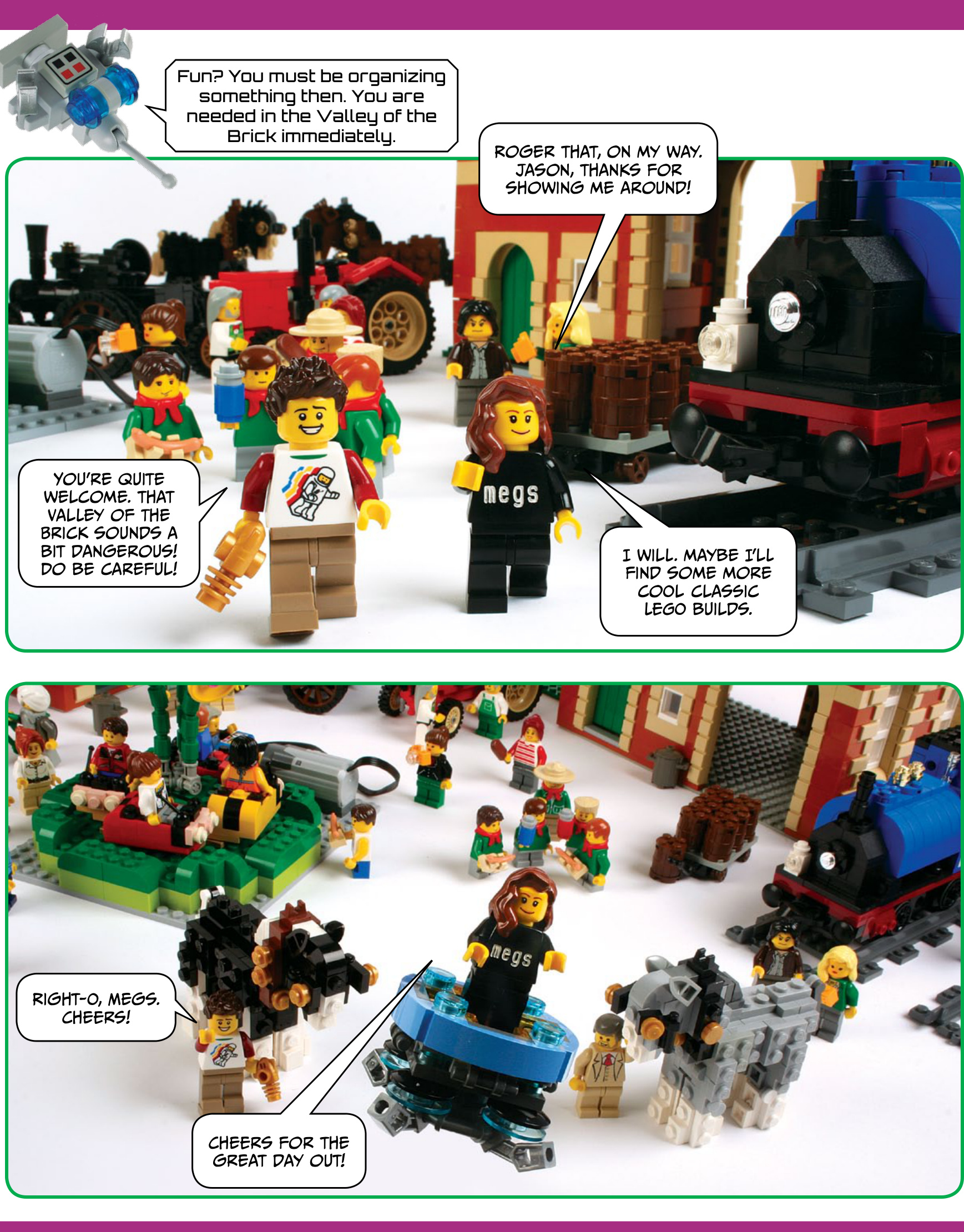
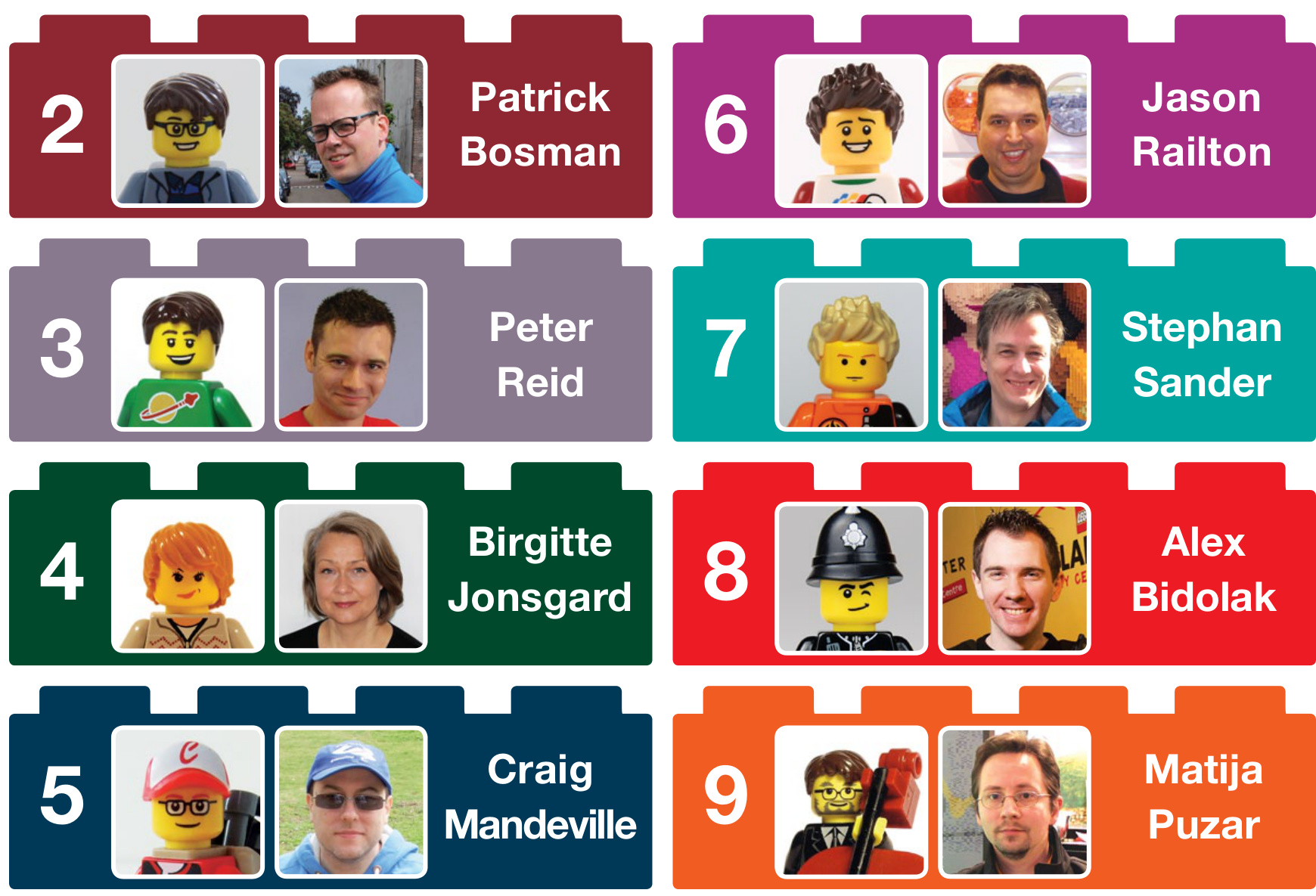
- Jason Railton (Joefish) — Steam Fair Fun(蒸汽游乐场)
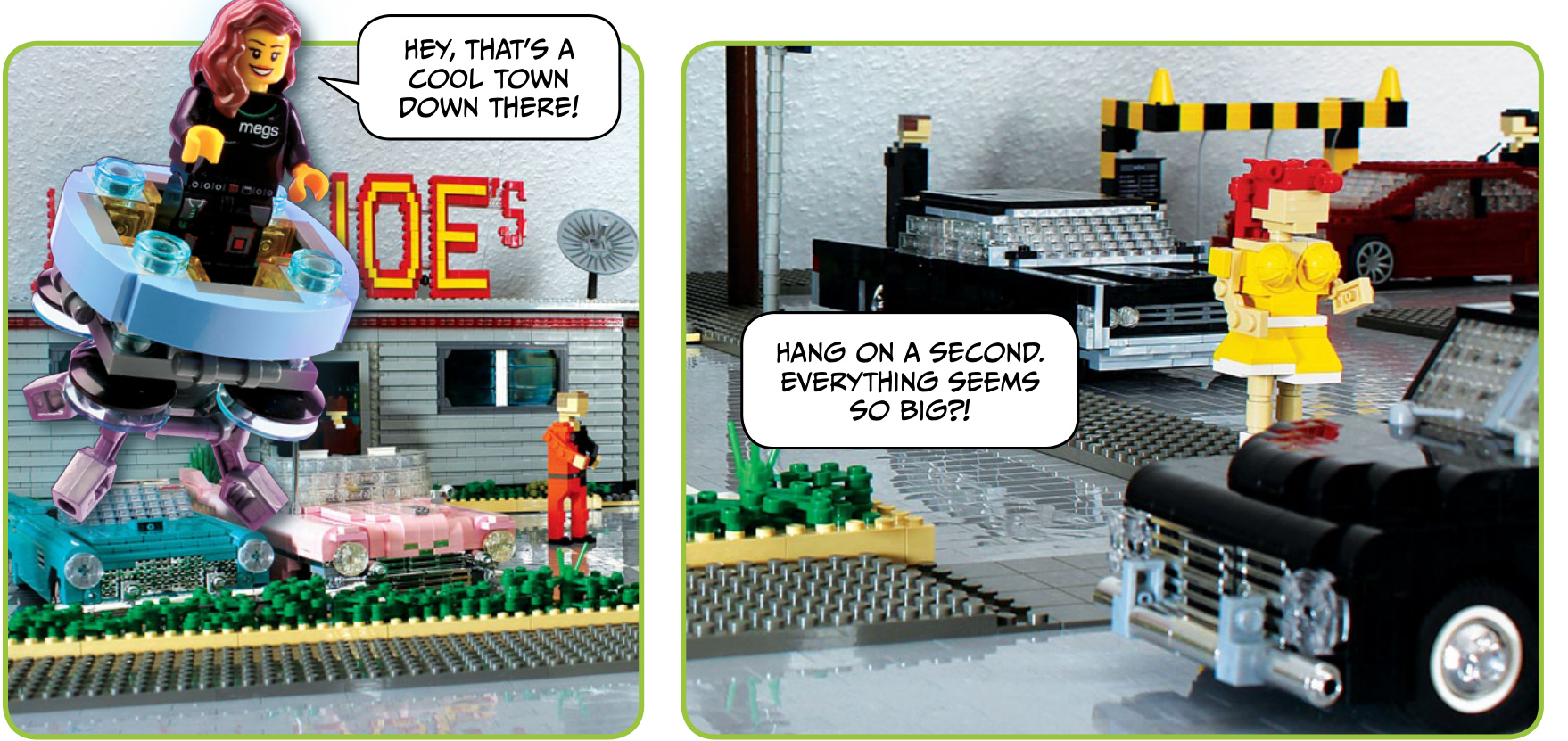
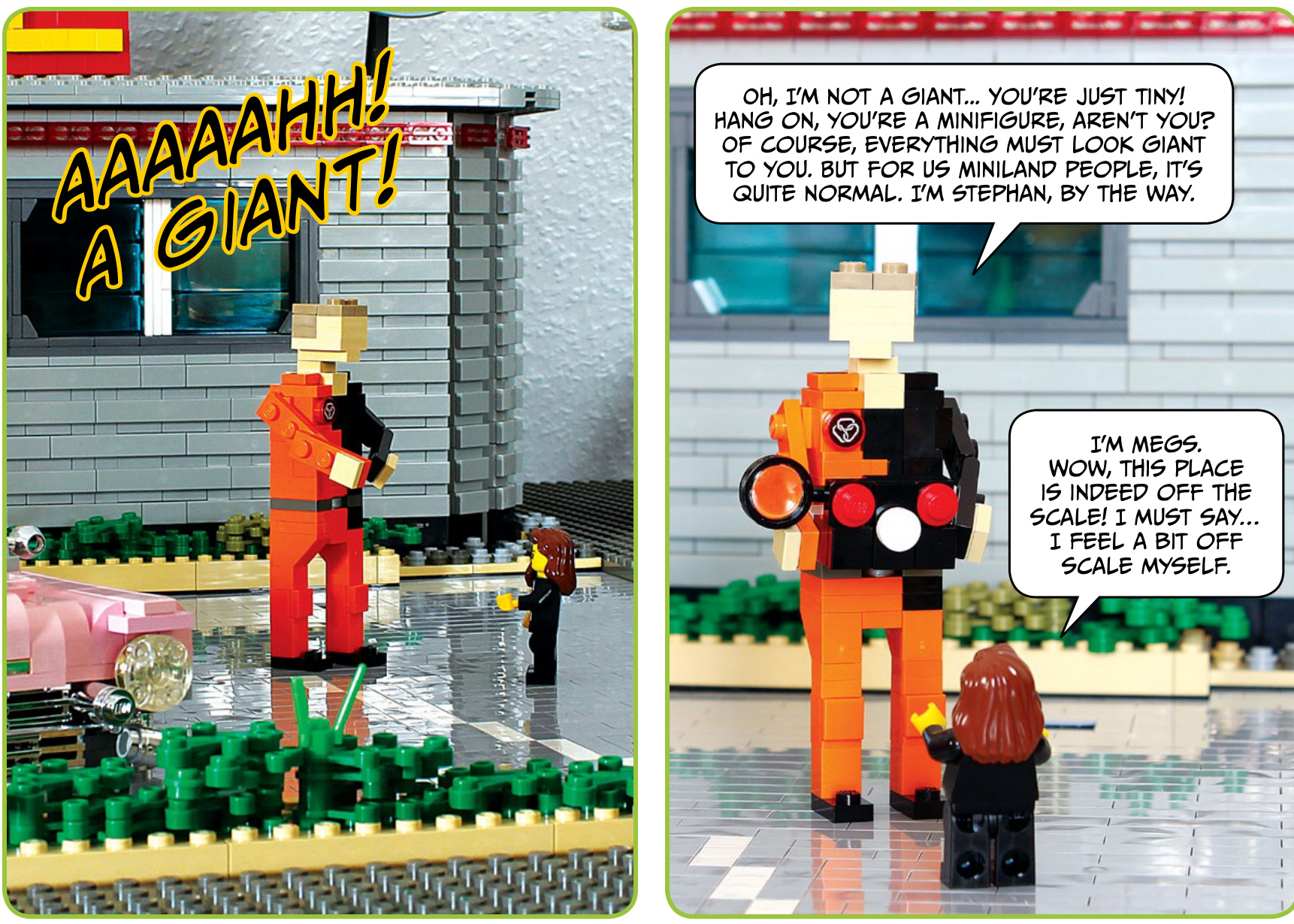
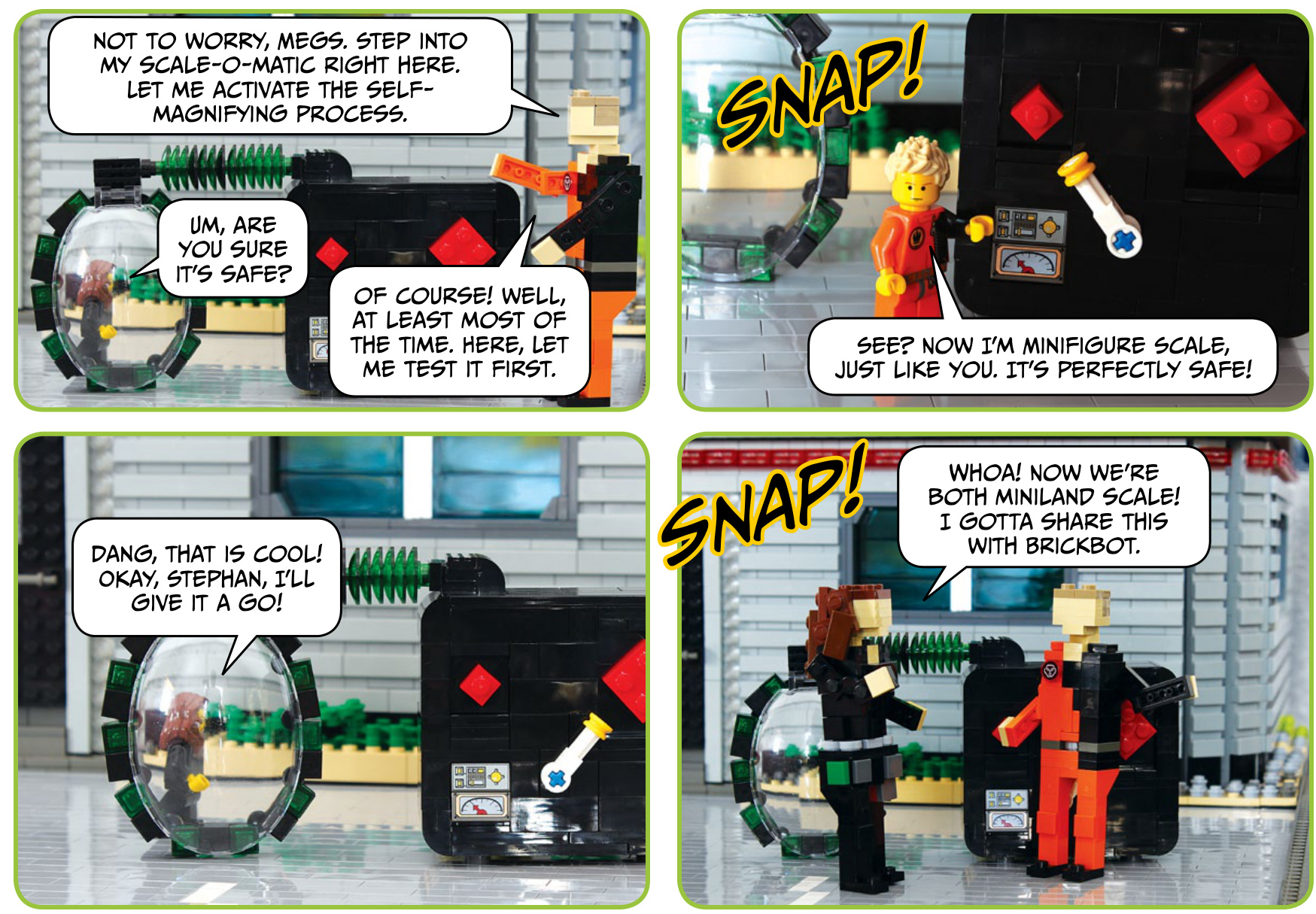
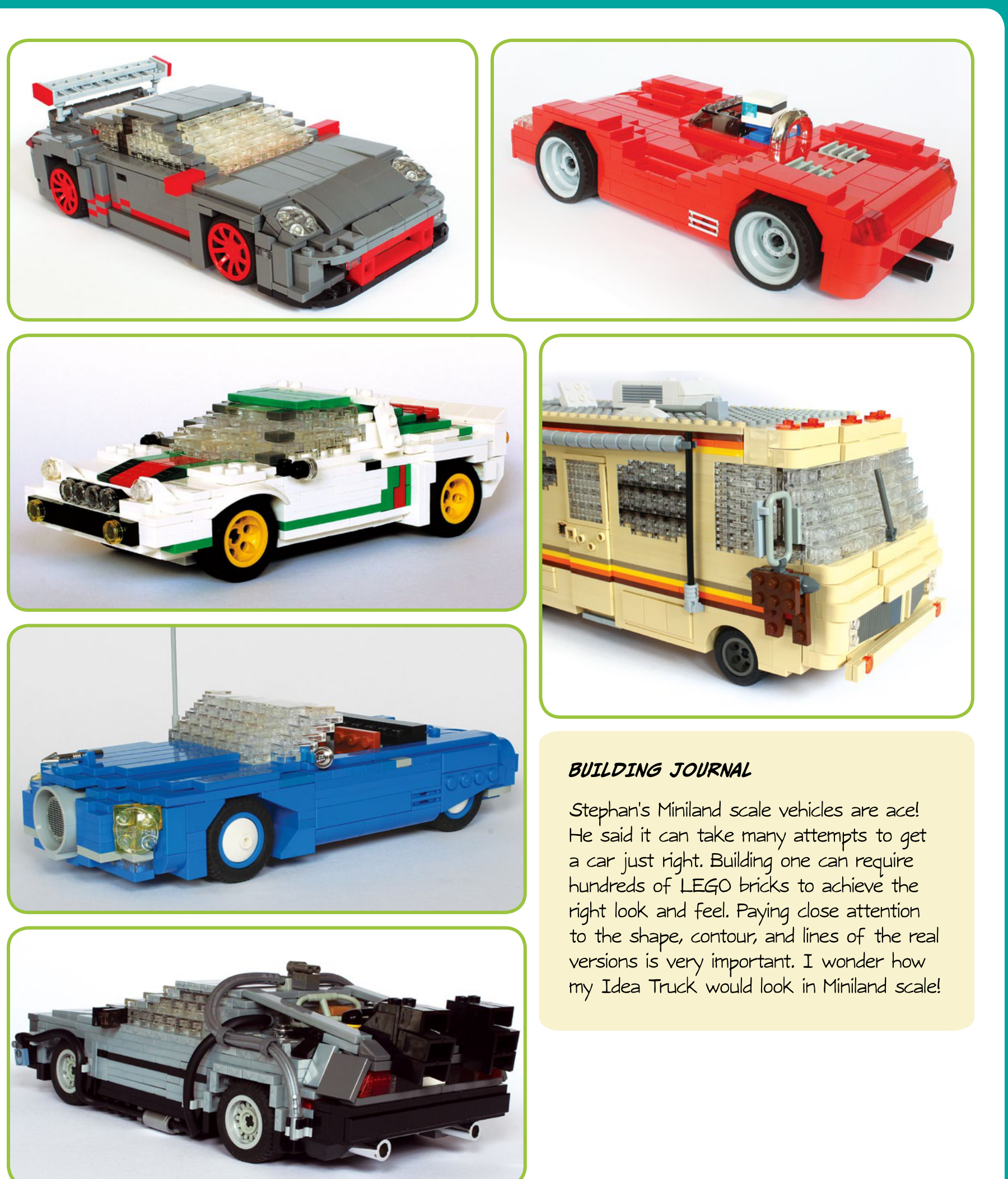
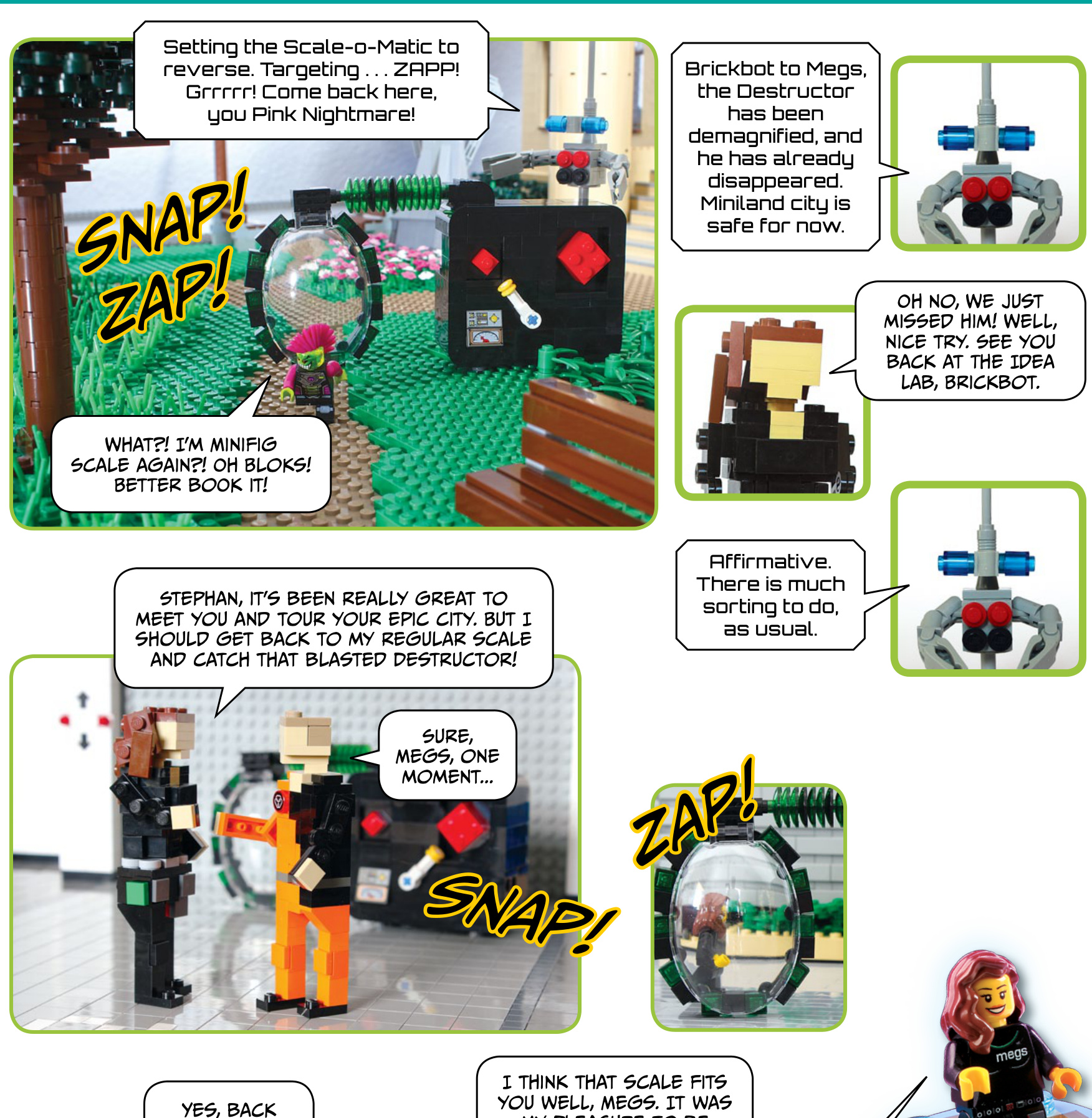
- Stephan Sander (x_Speed!) — Out of Scale(超尺度汽车模型)
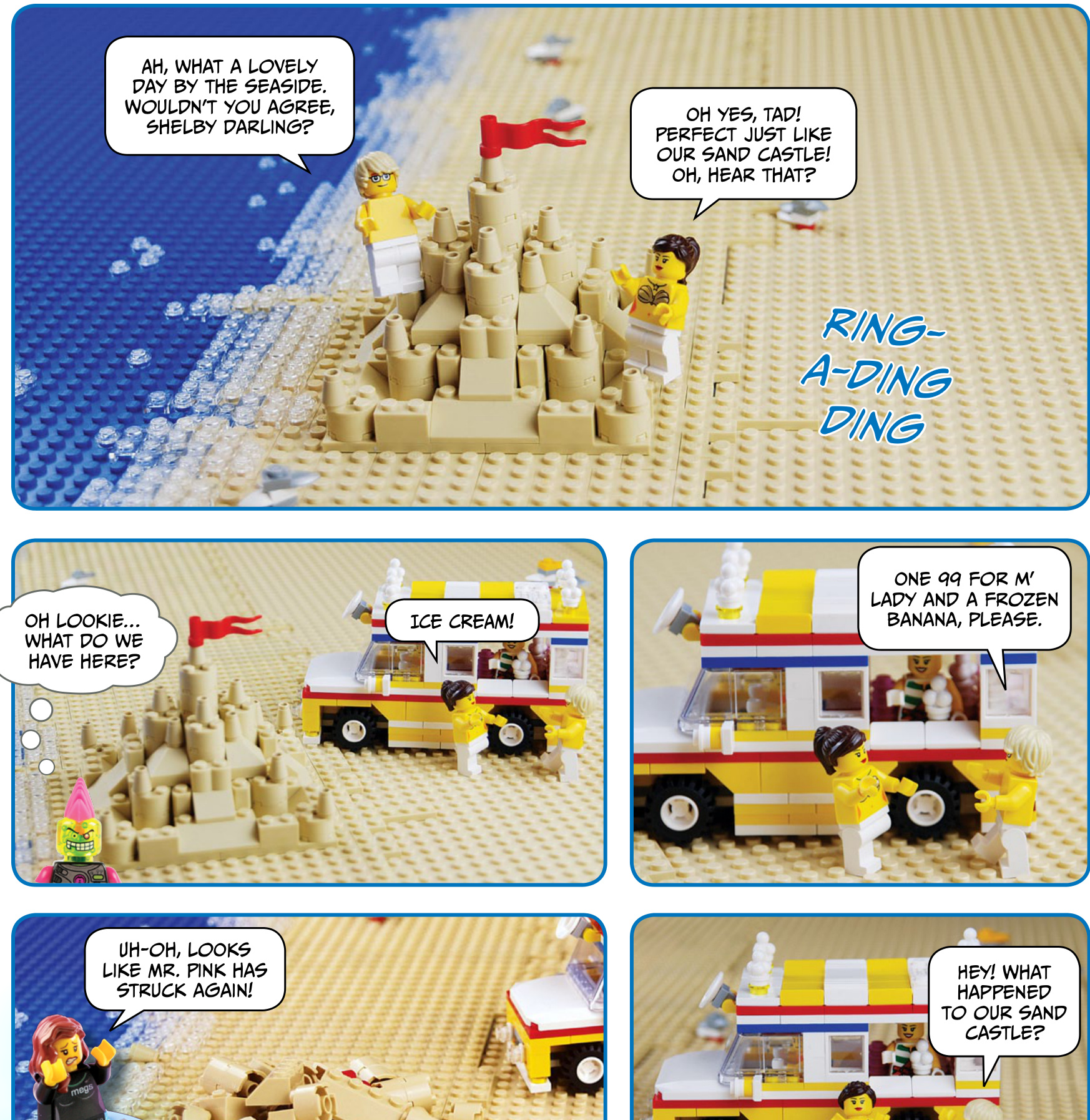
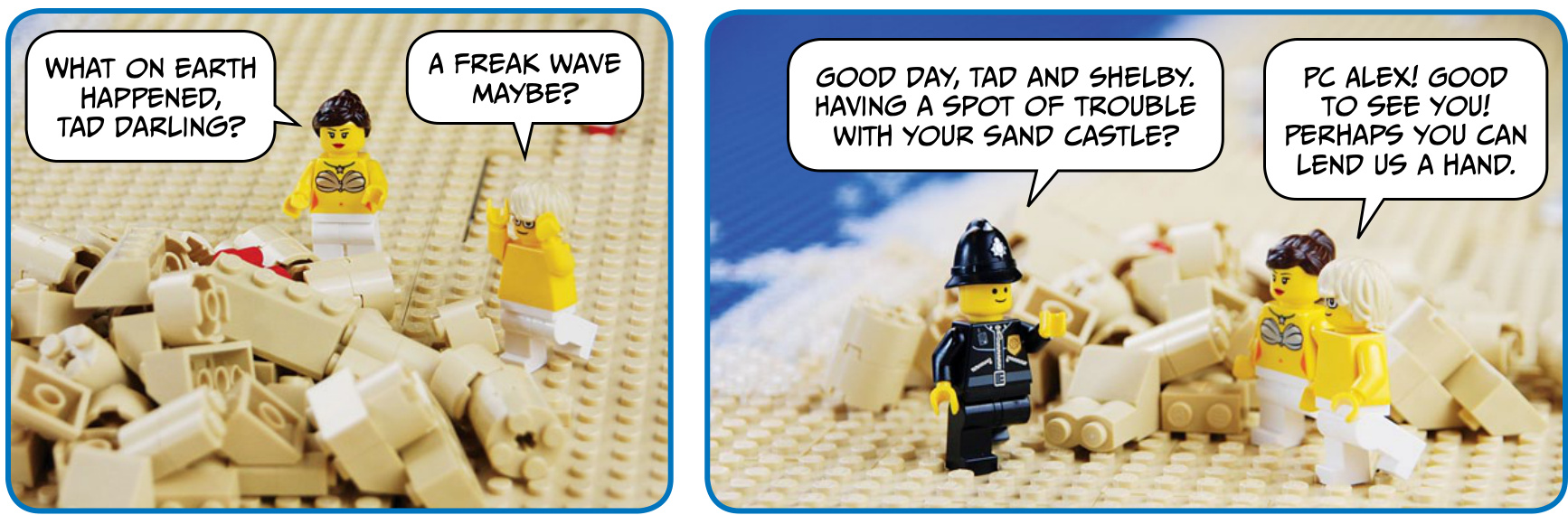
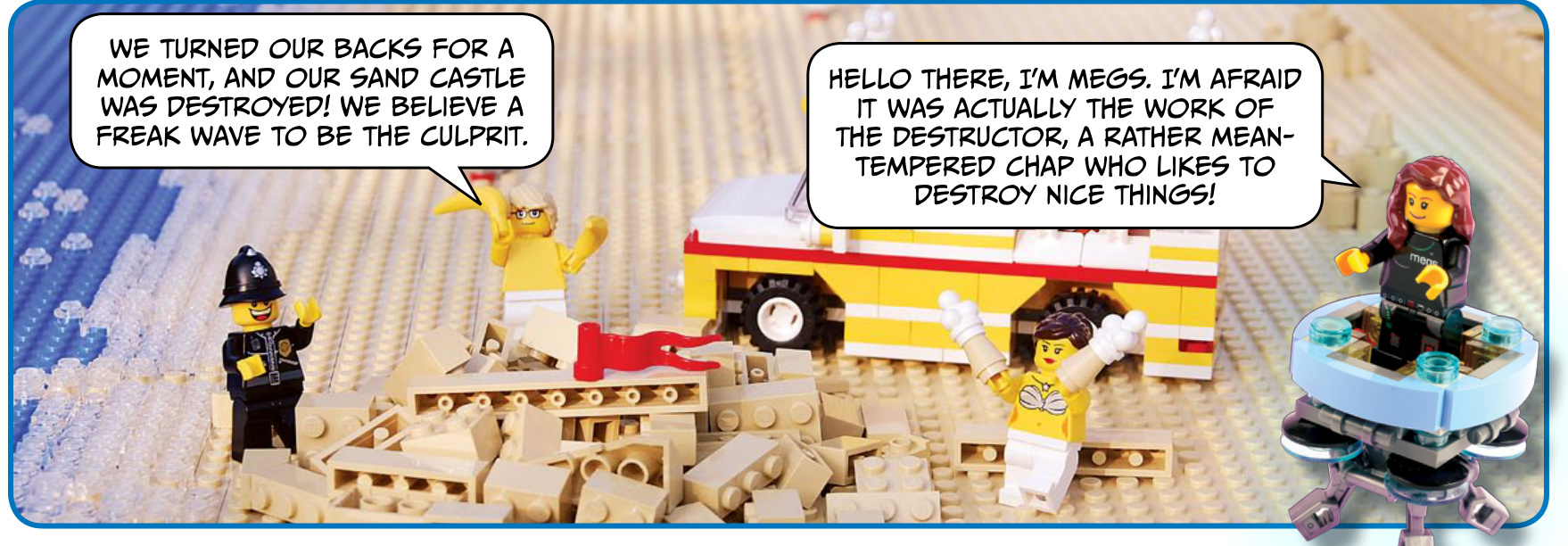
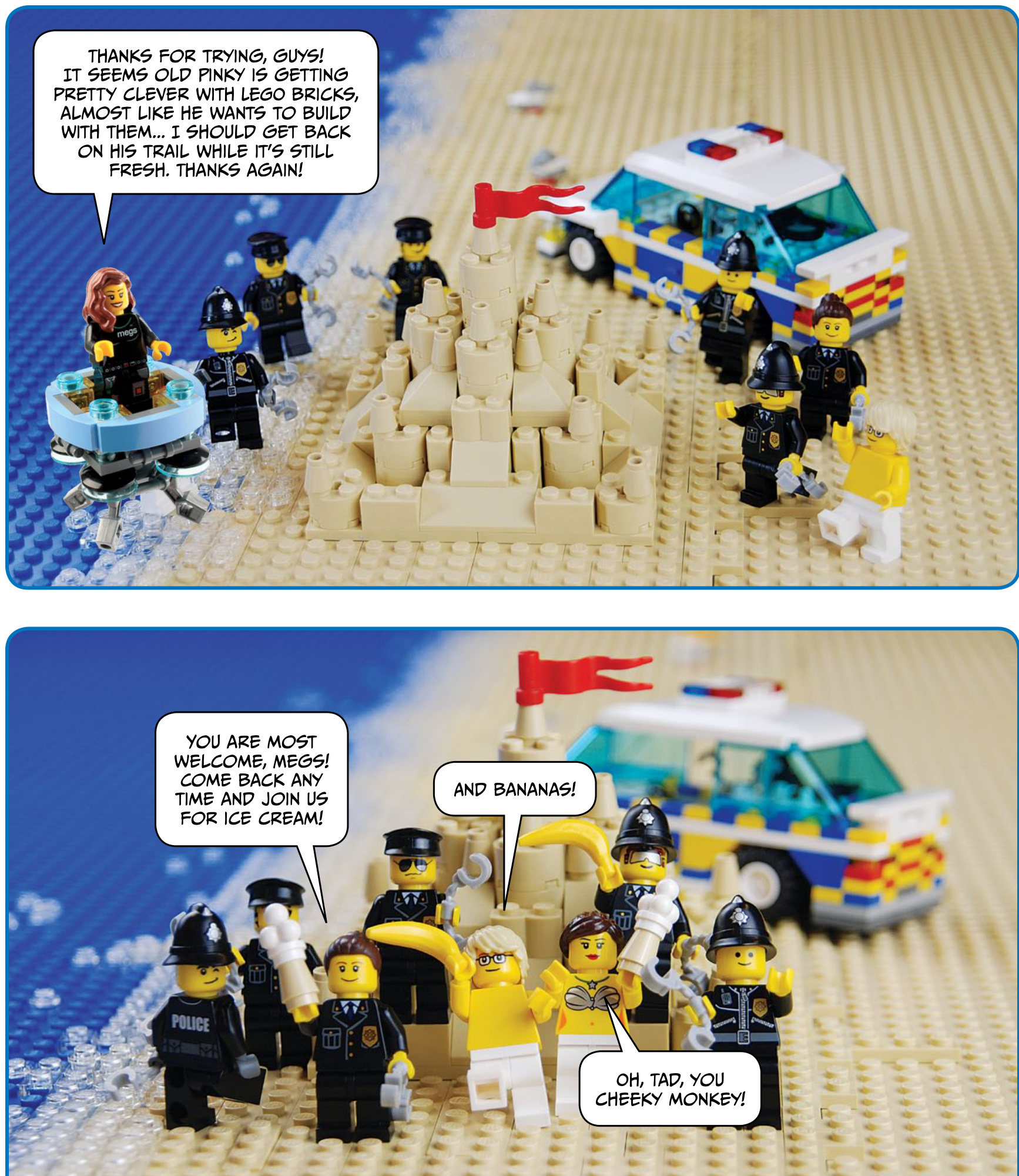
- Alex Bidolak (Brick-A-Lak) — A Seaside Situation(海滨场景)
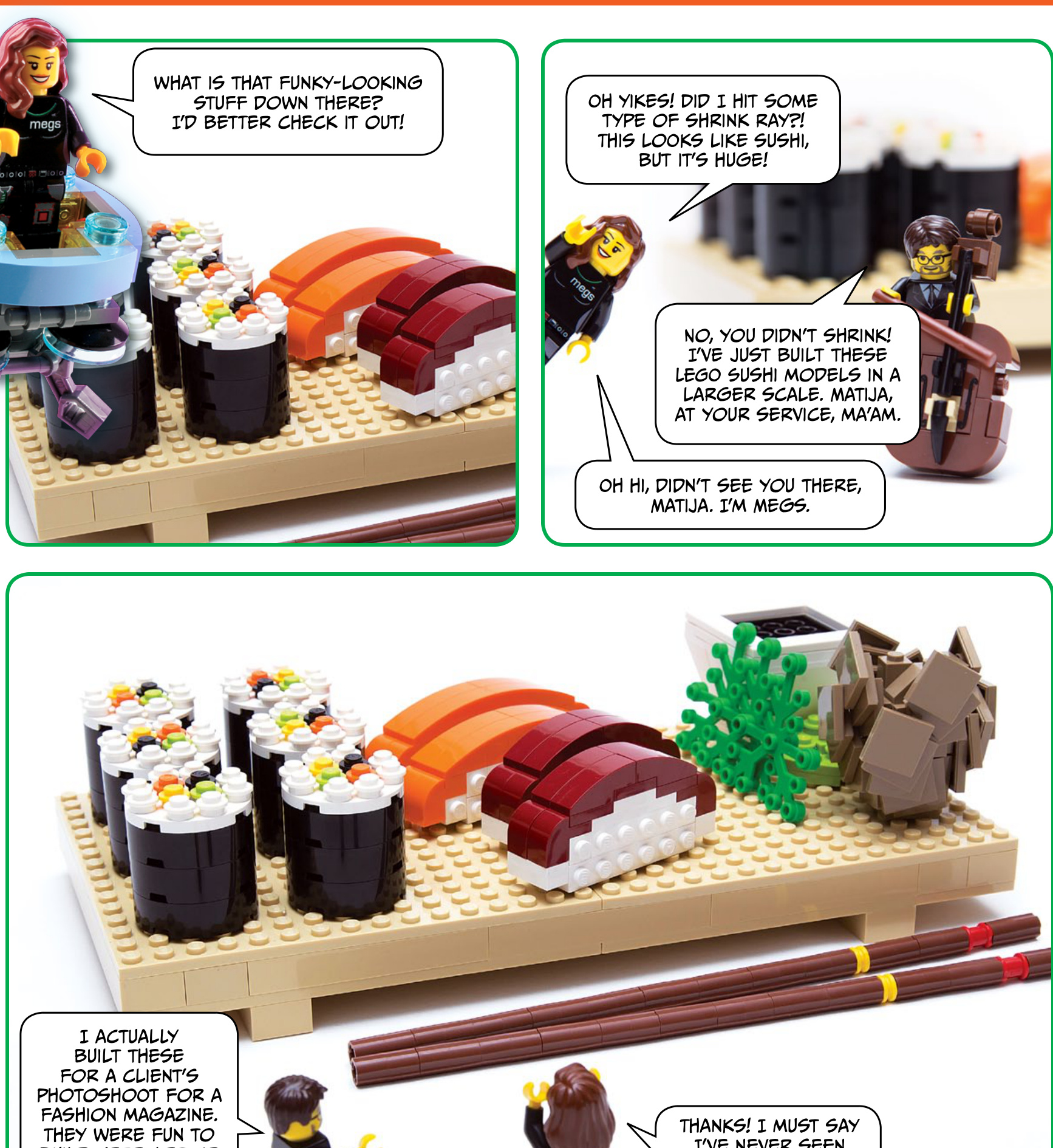
- Matija Pužar — Dinner and a Show

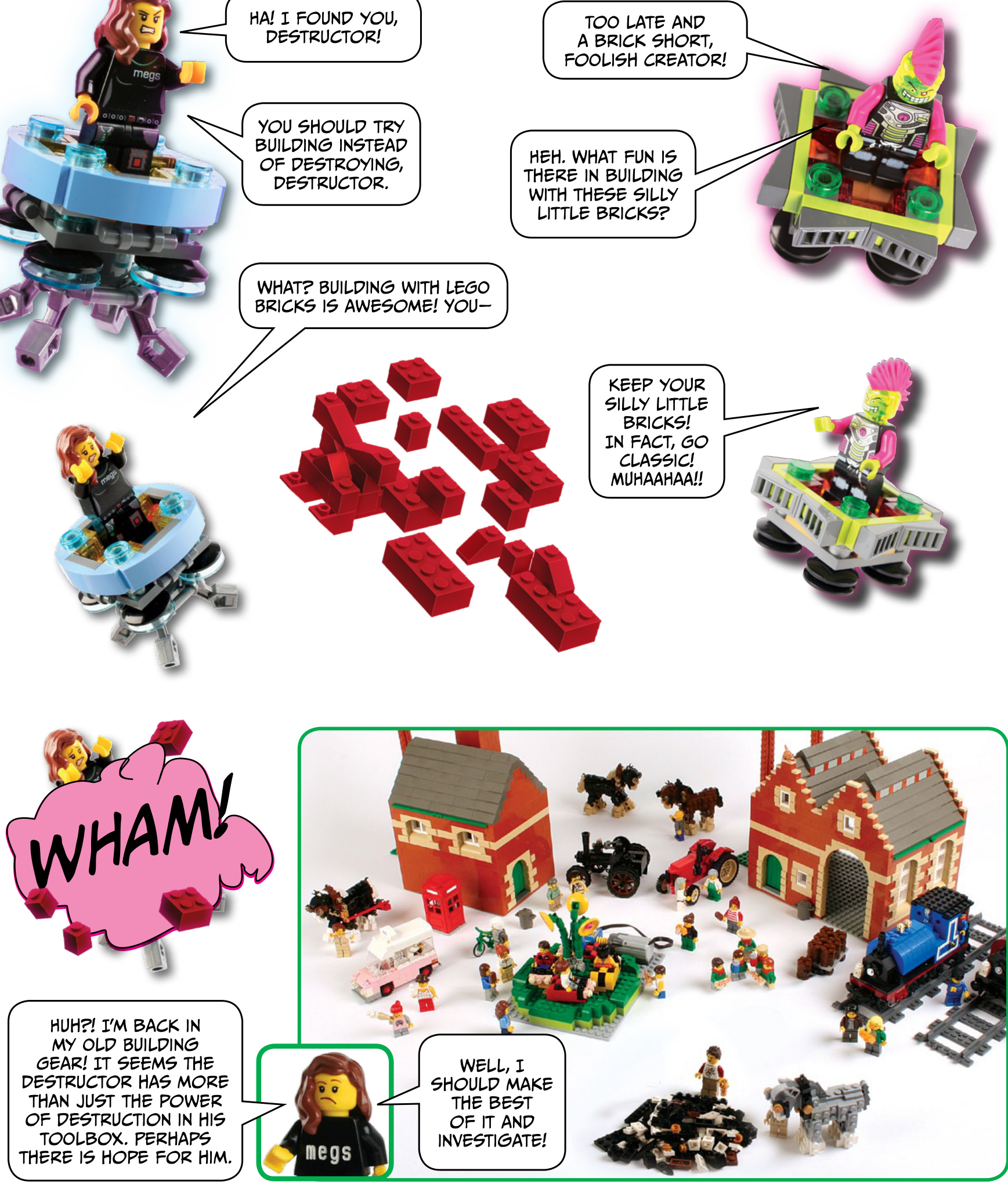
Steam Fair Fun!
Jason Railton

Nickname: Joefish
Profession: IT Developer
Nationality: British
Website: www.flickr.com/photos/jjrailton/
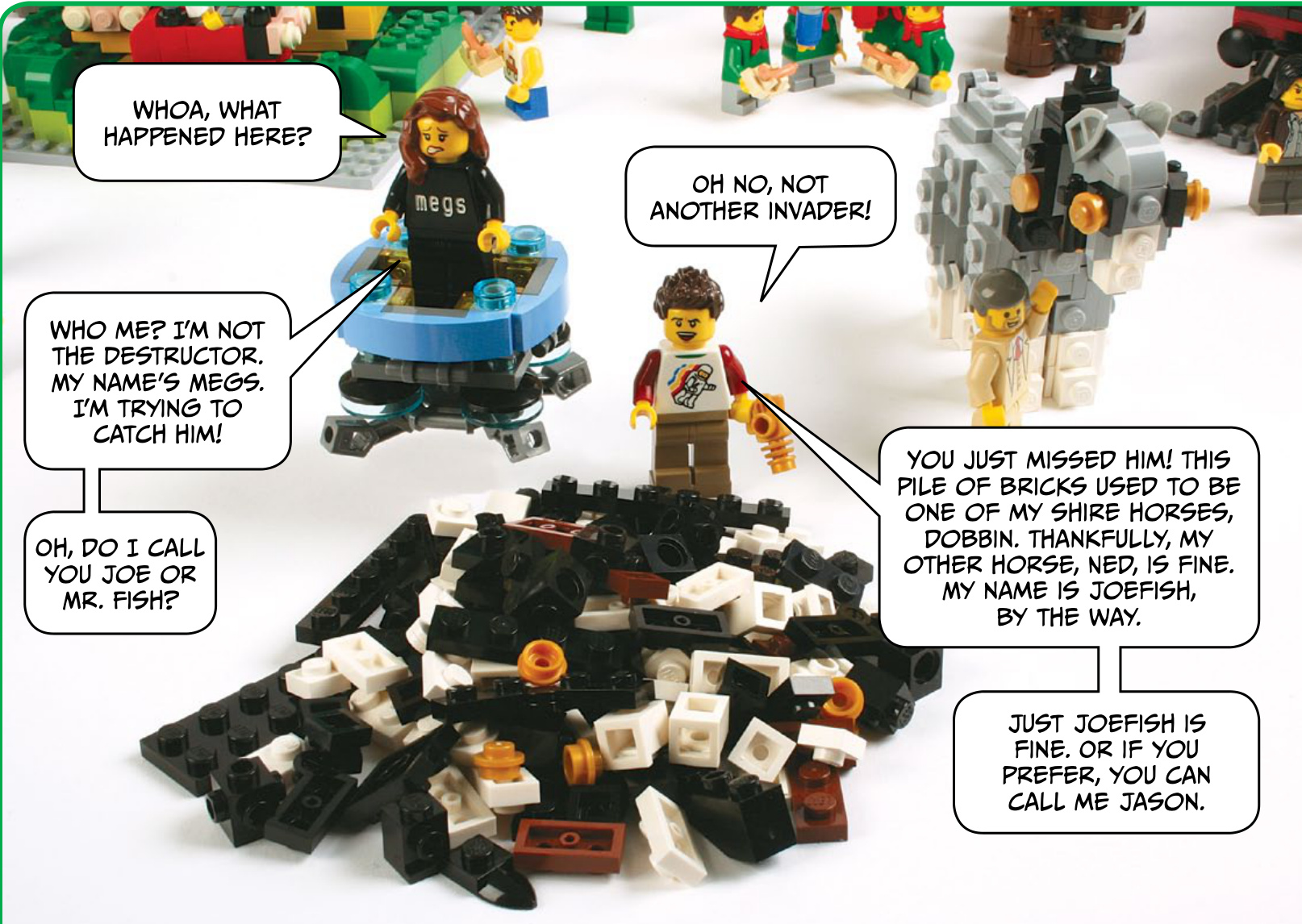
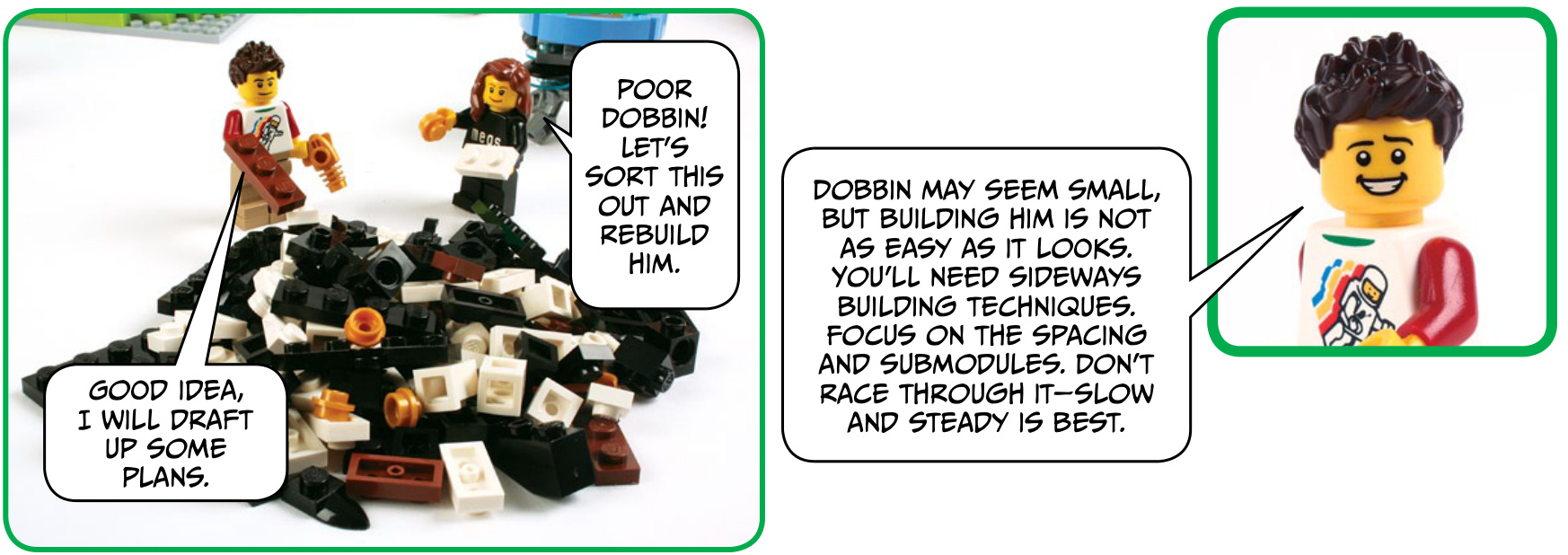
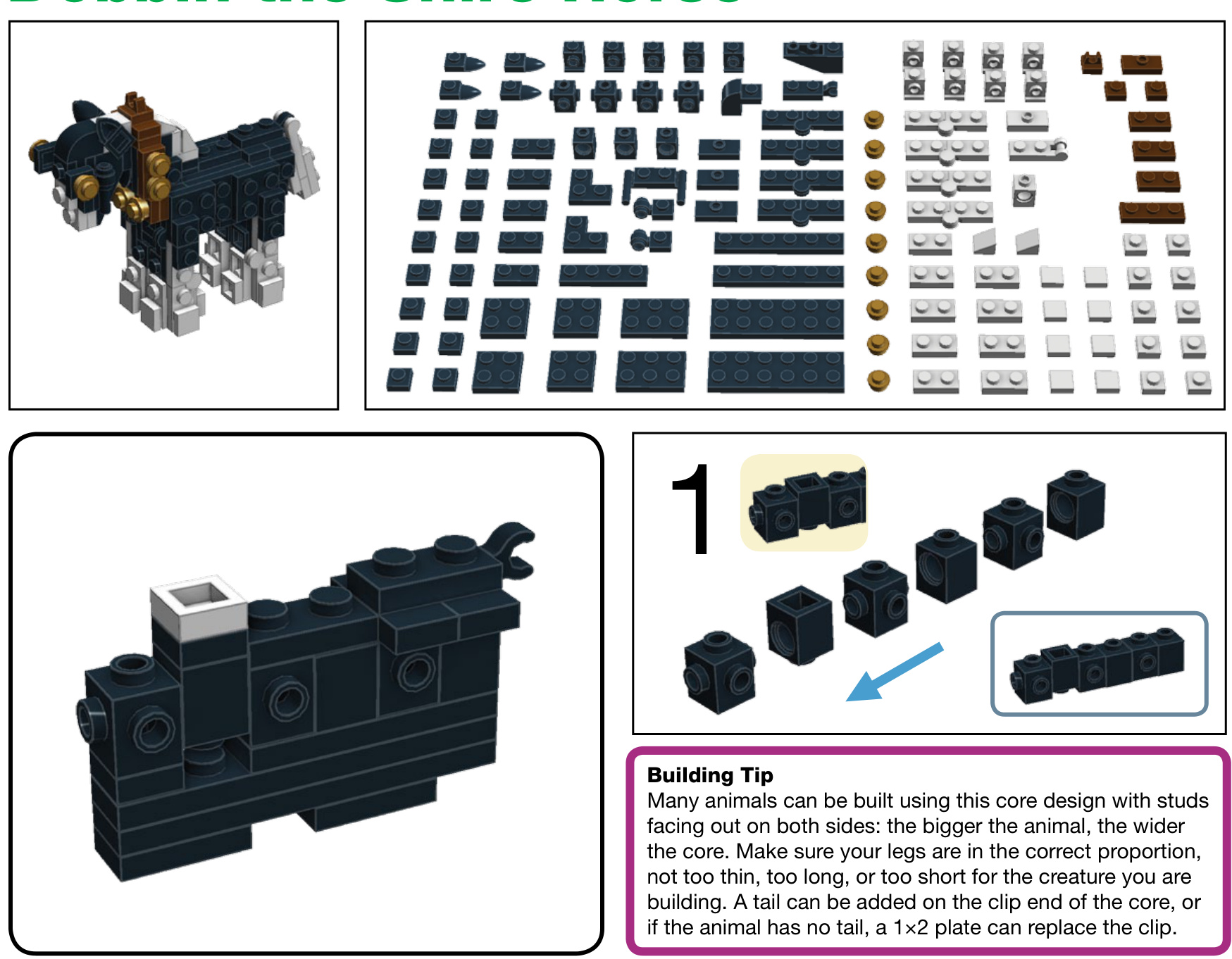
Dobbin the Shire Horse
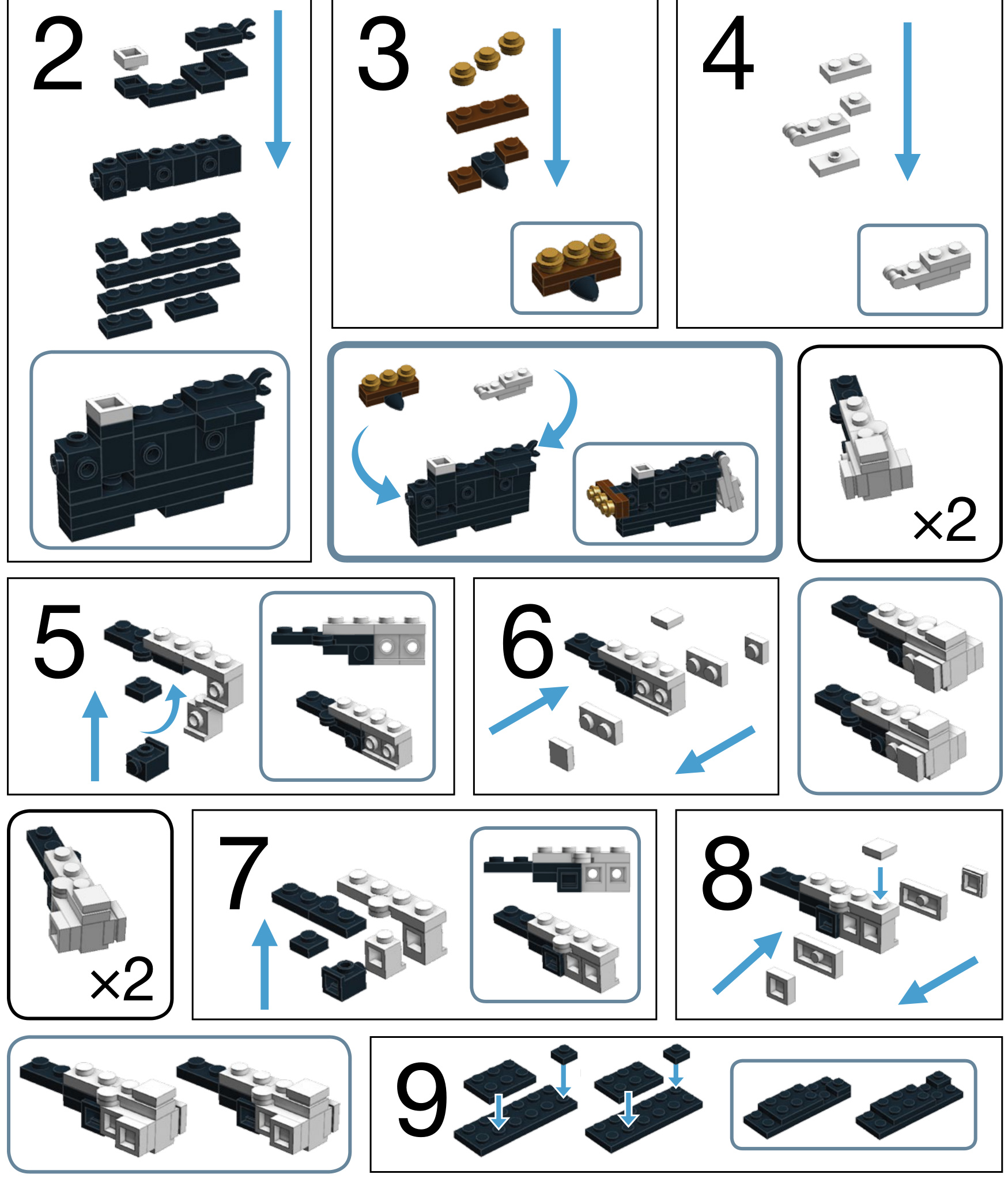
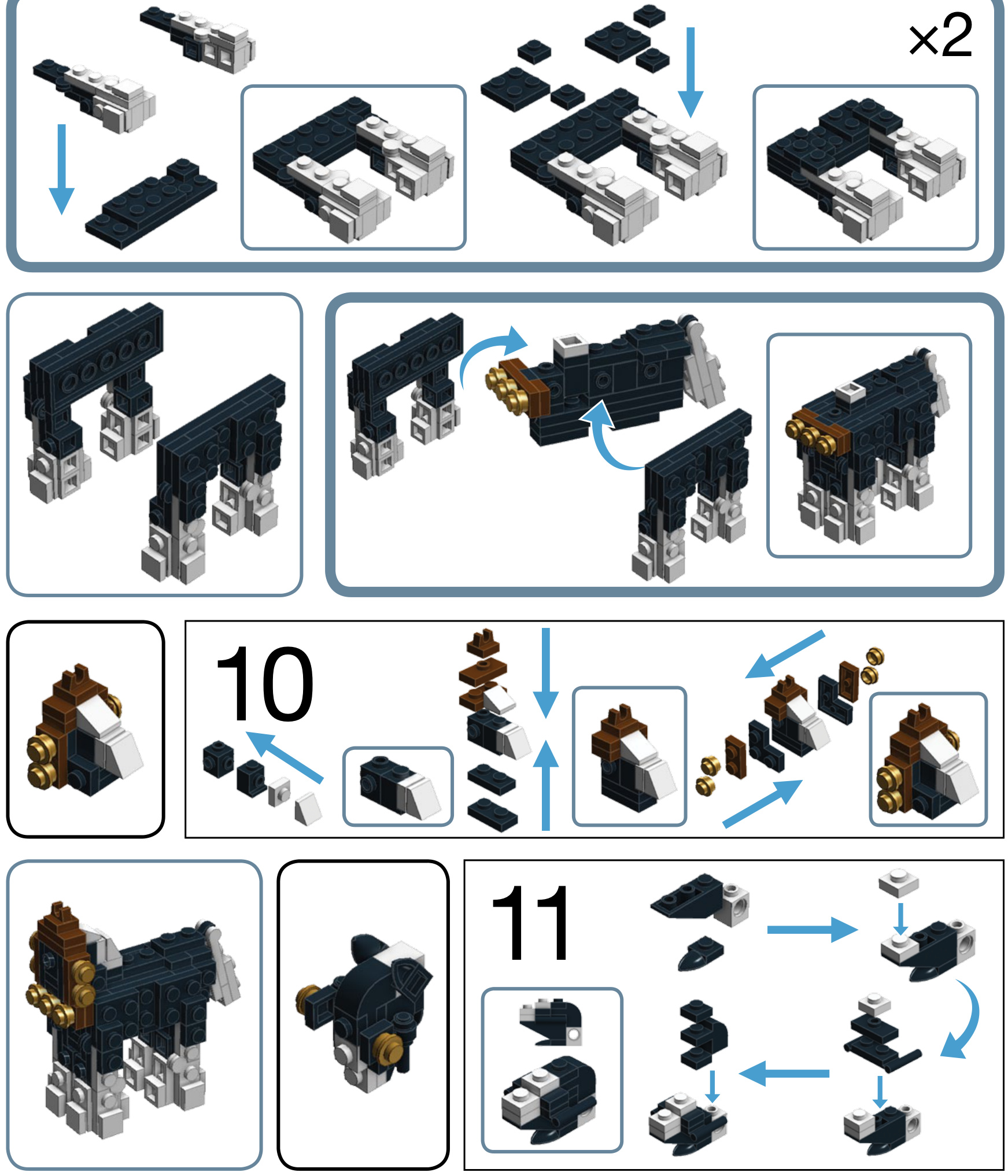
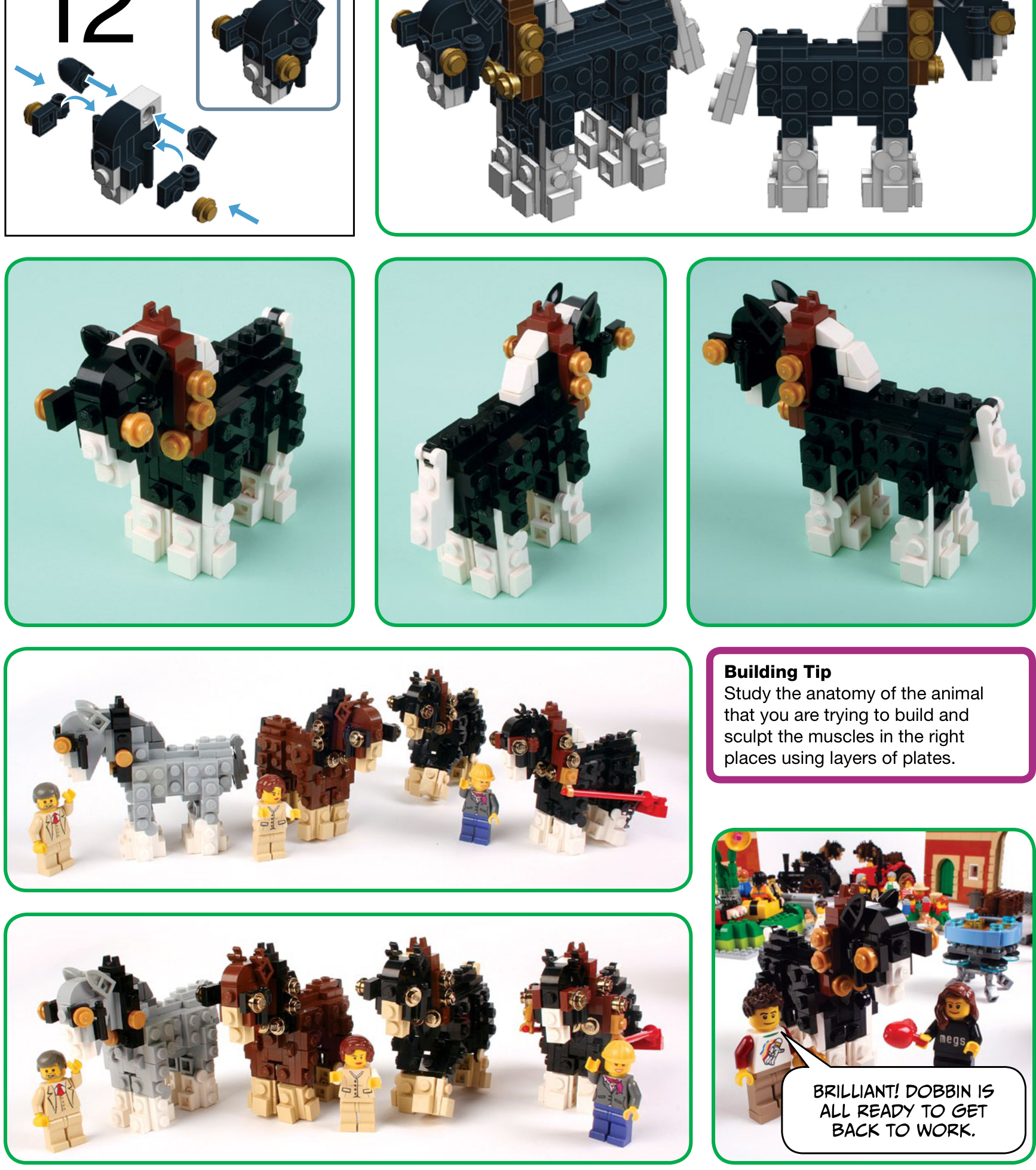
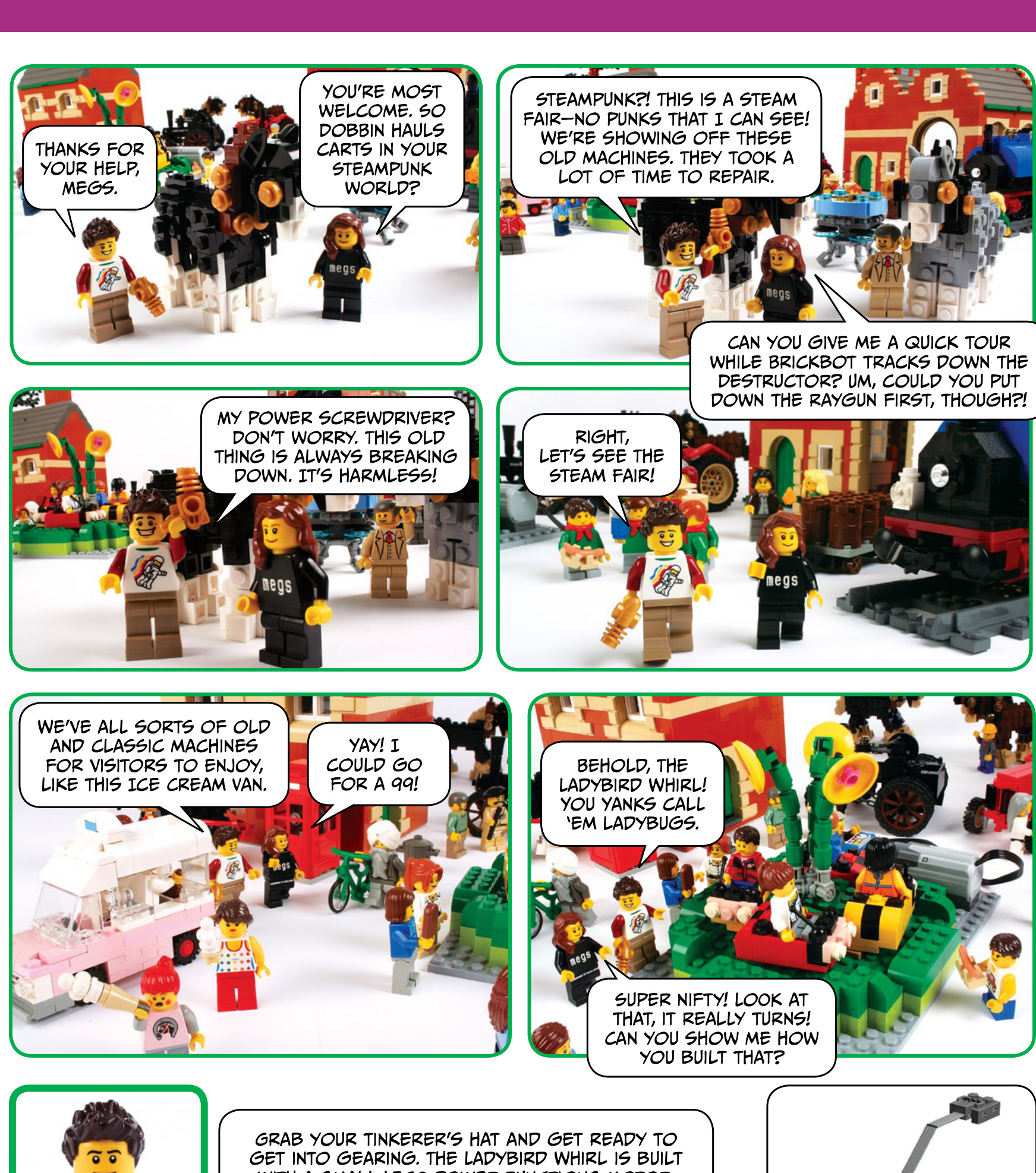

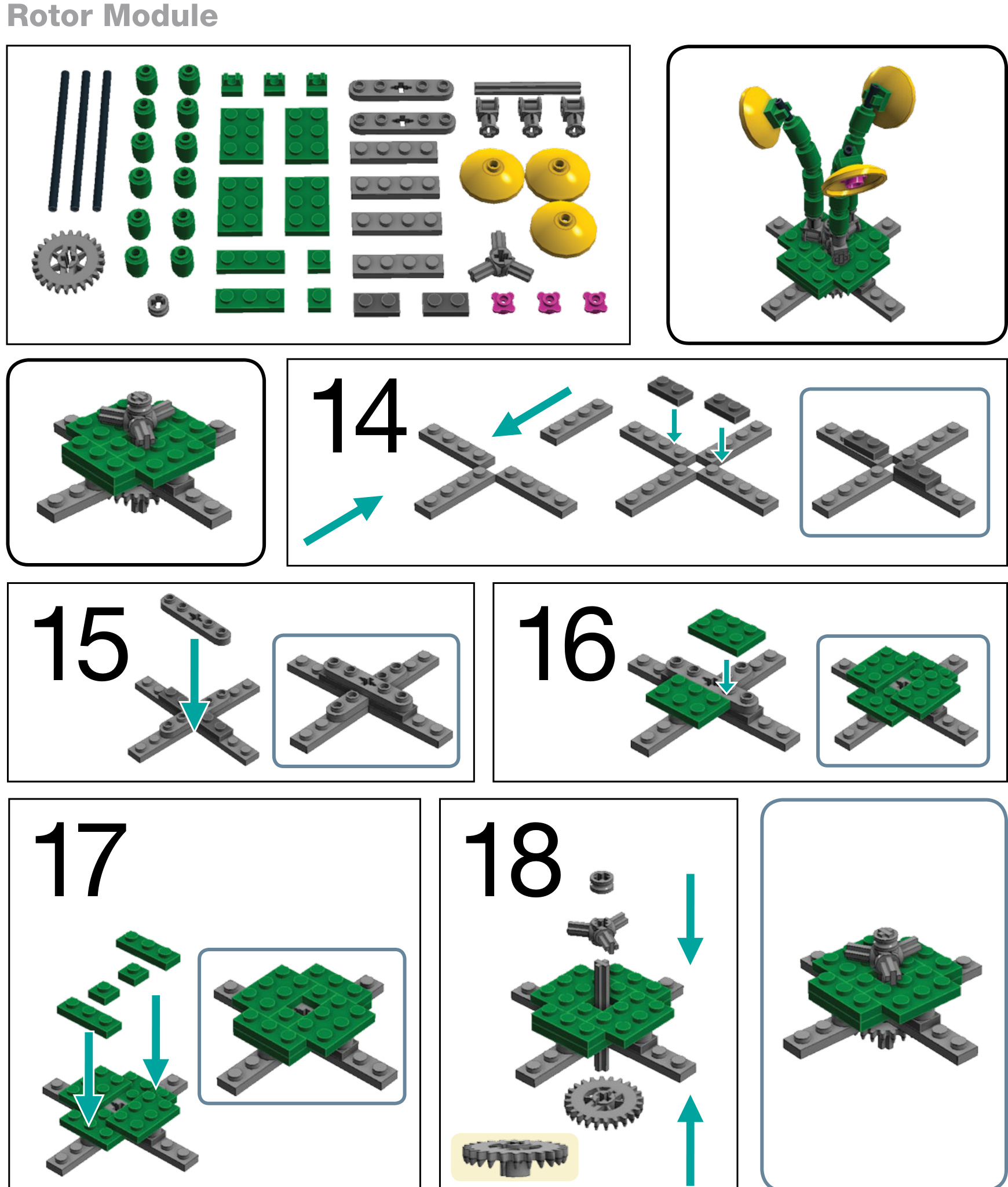
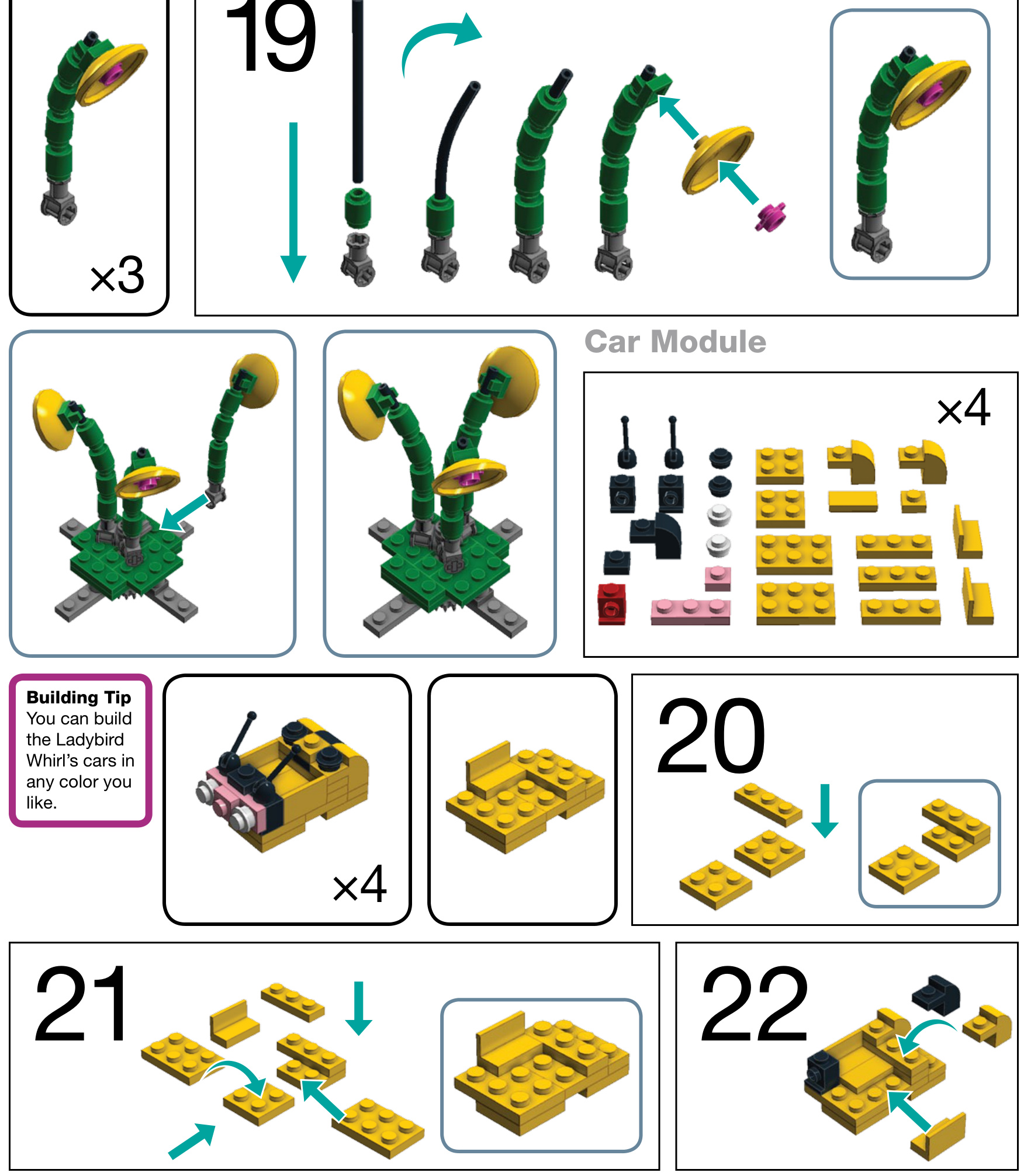
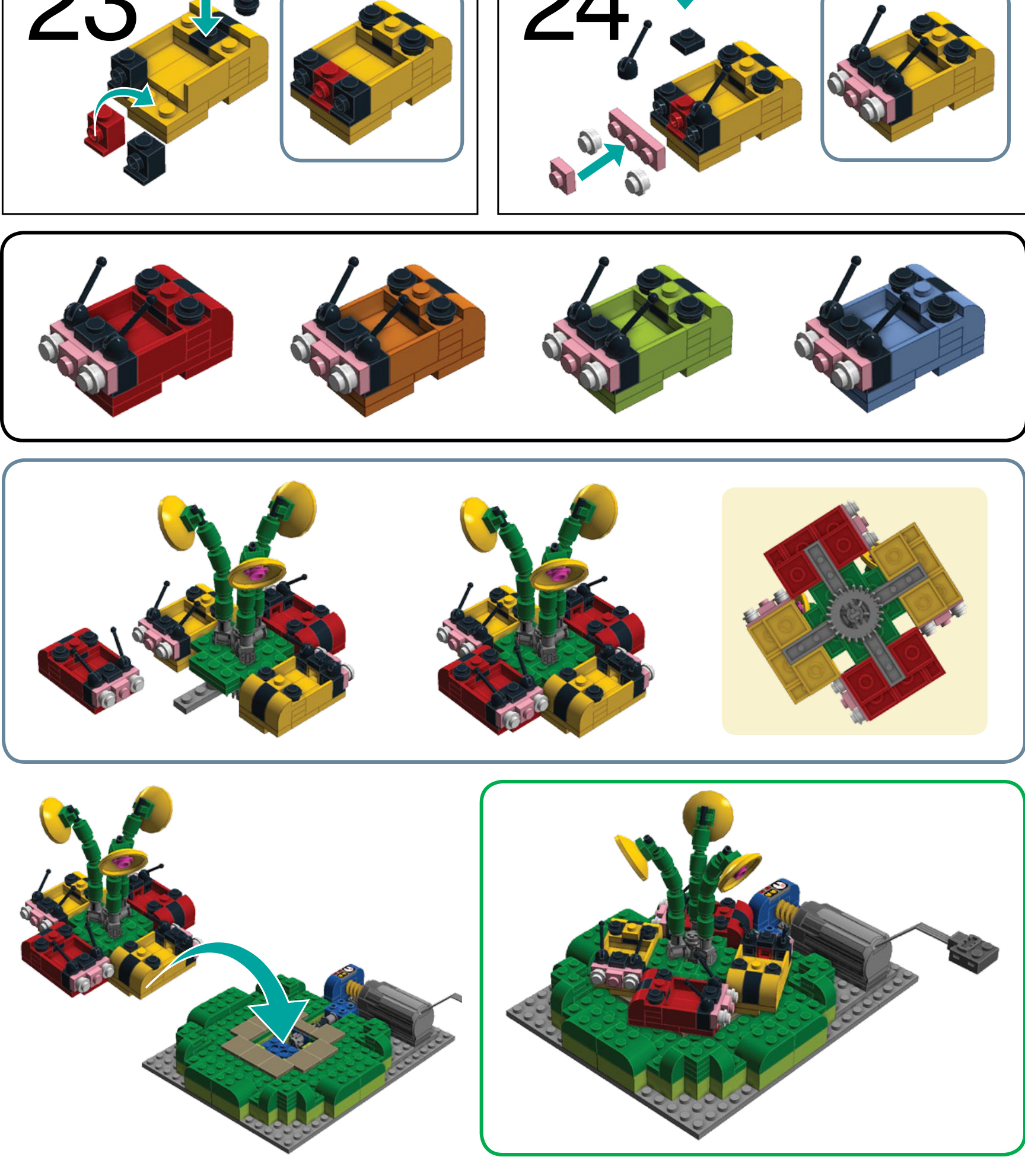
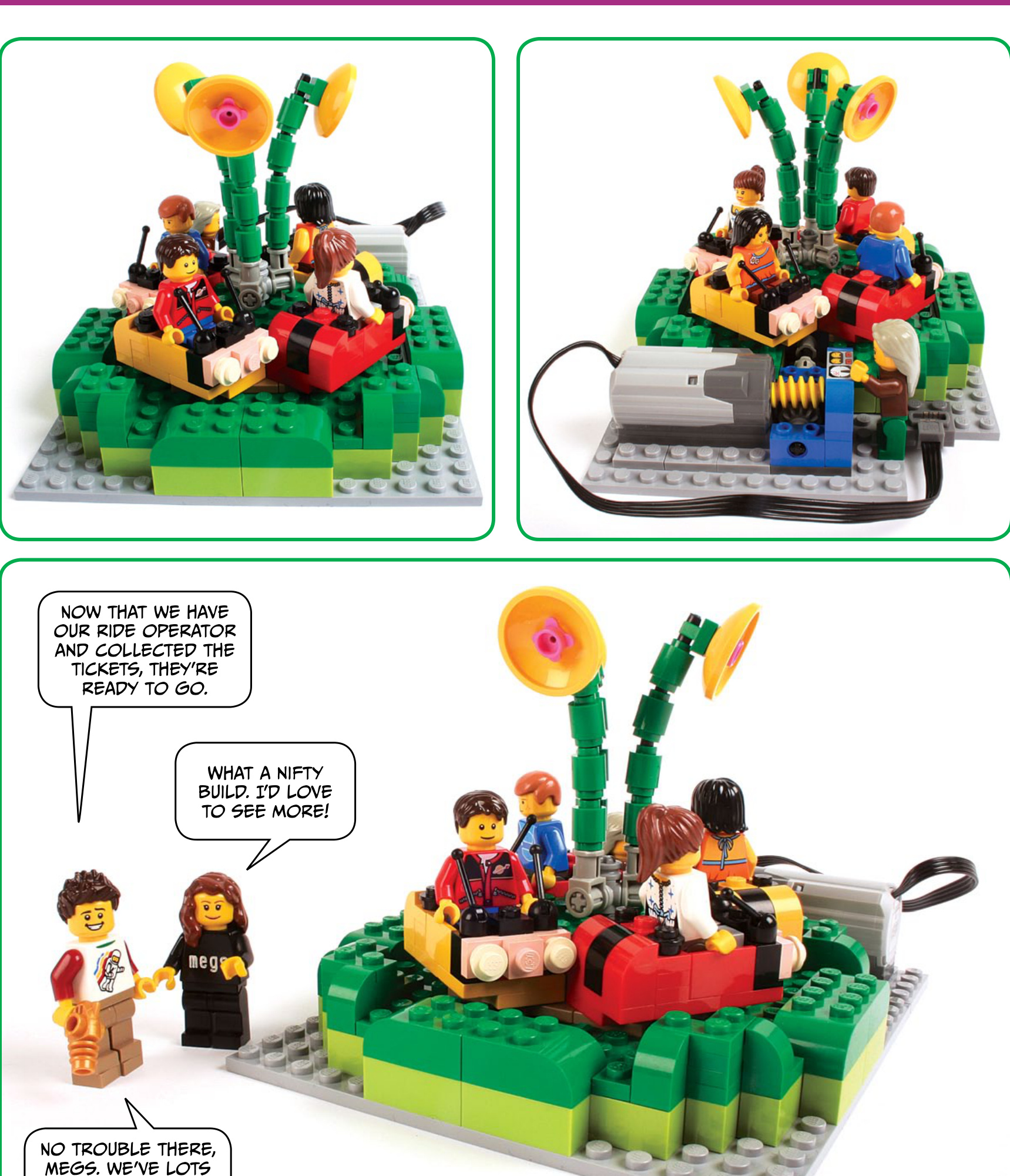
Ladybird Whirl
Red Tractor

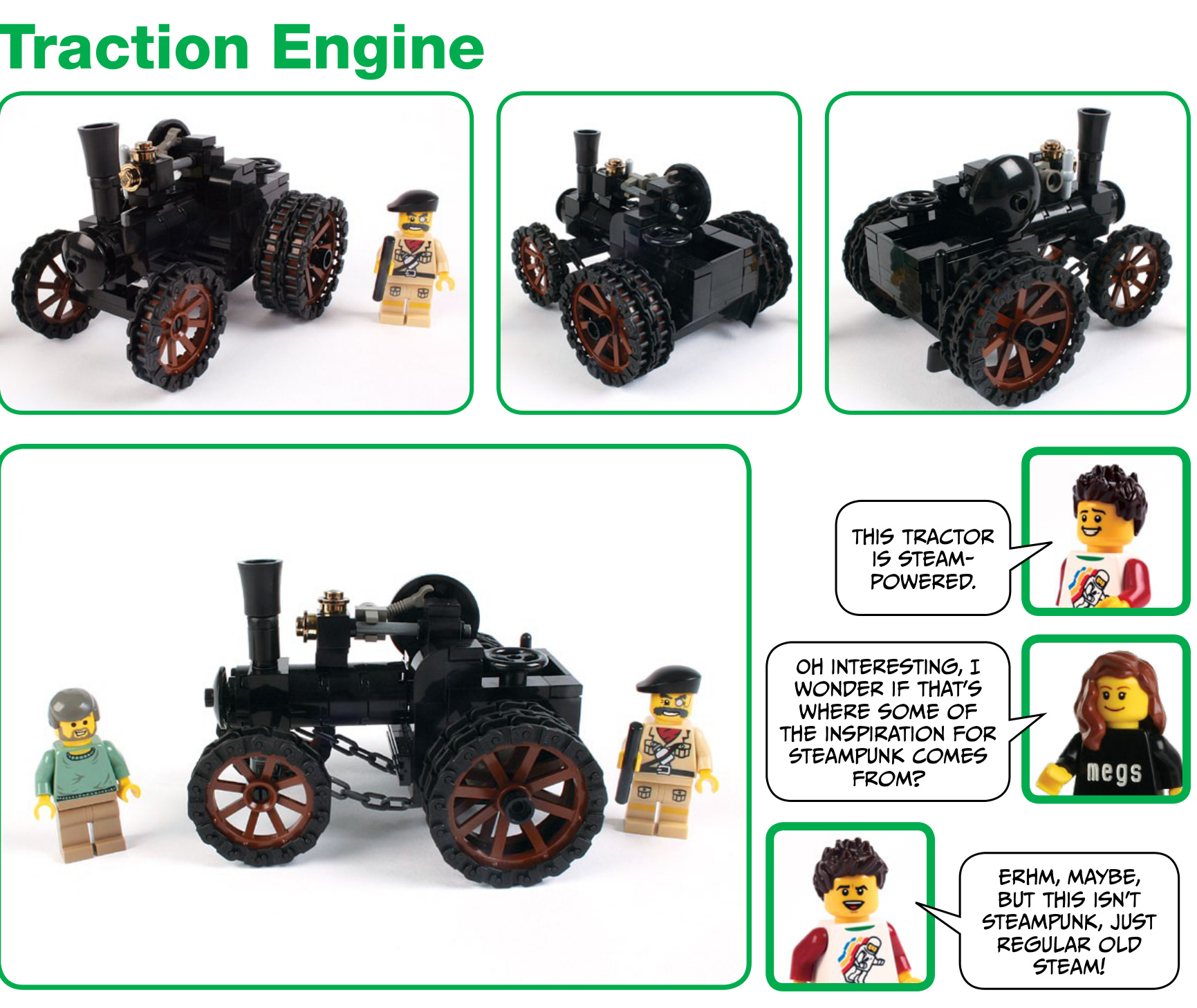
Engine Shed
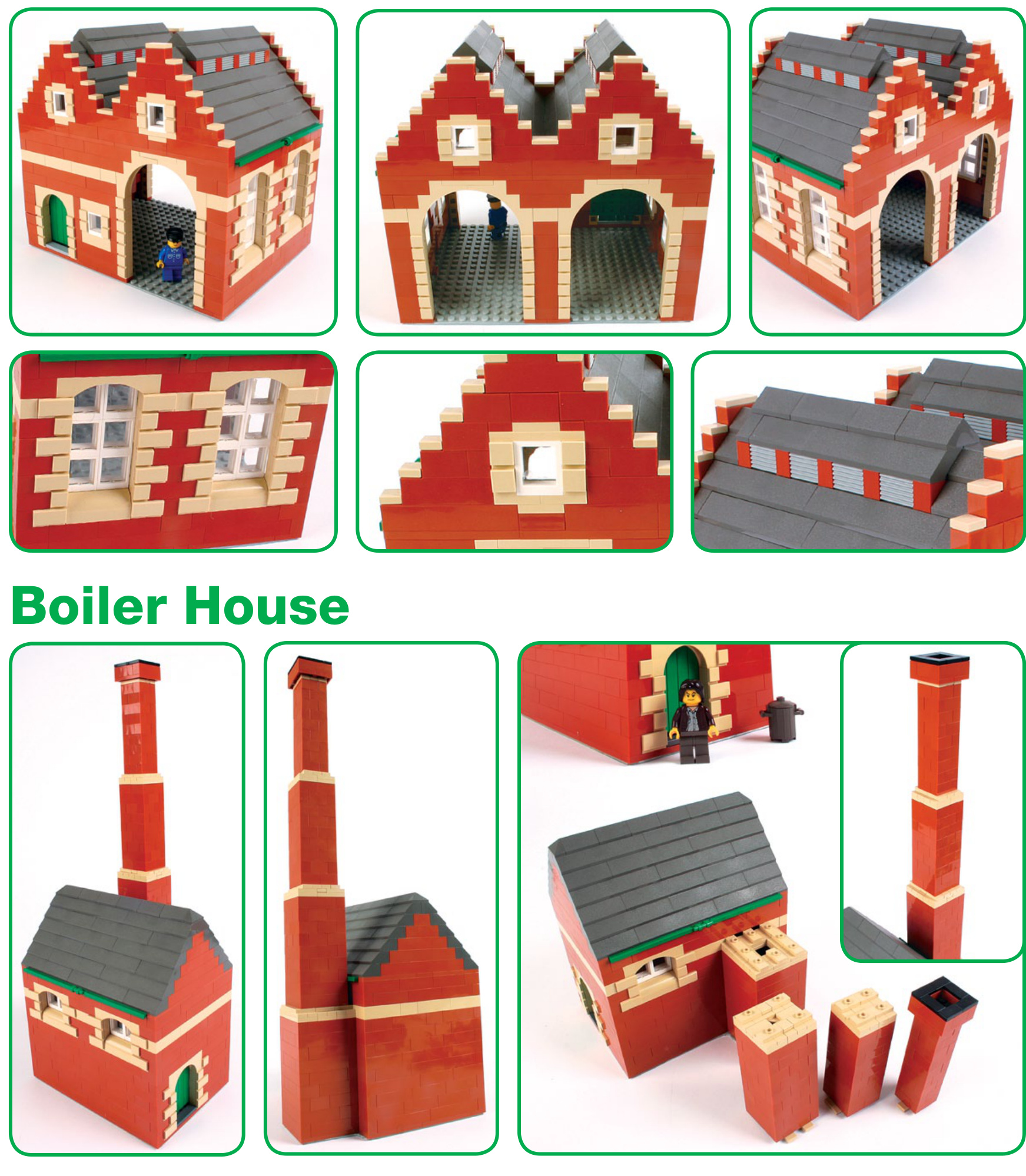
Scots Pine Tree
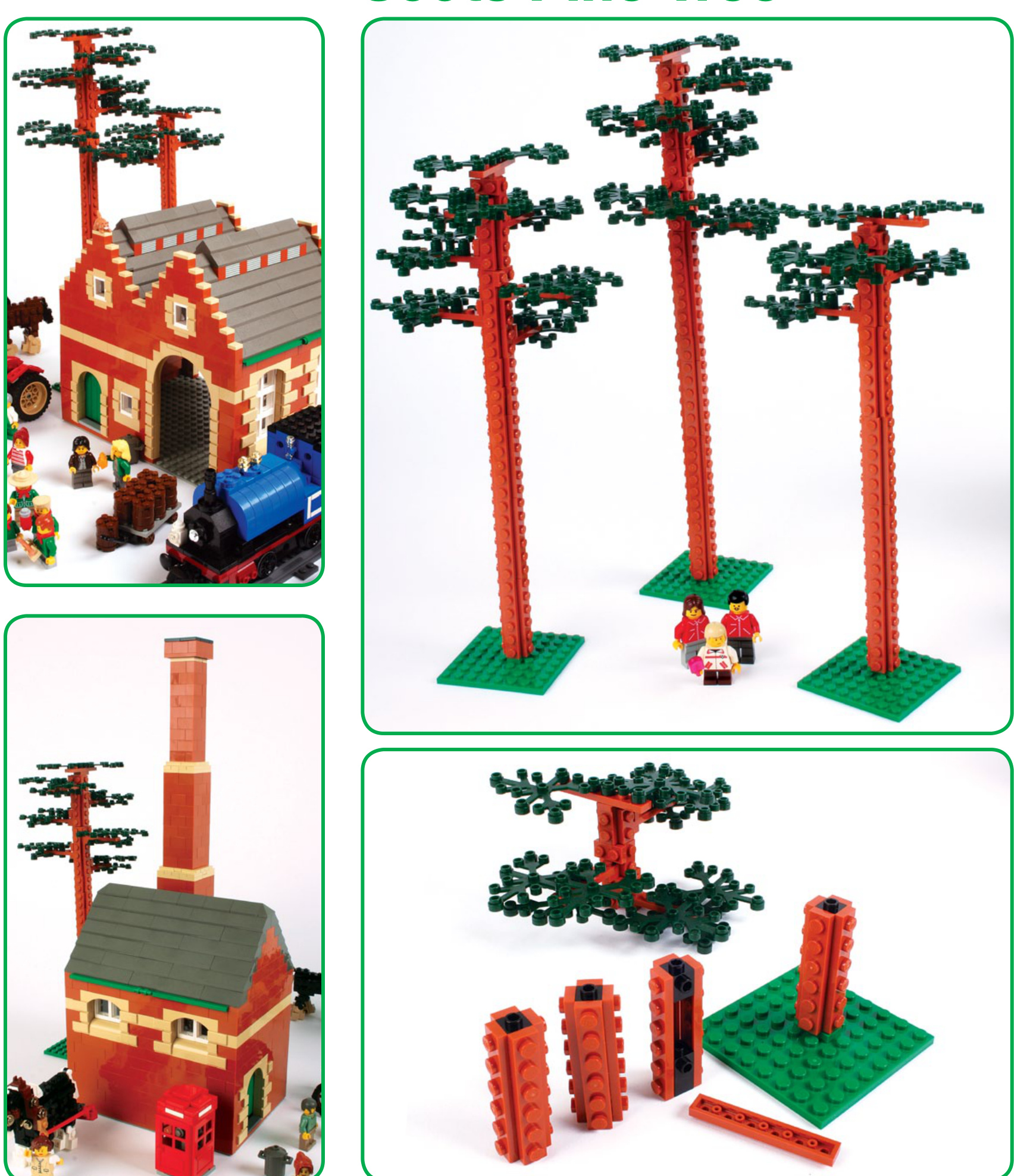
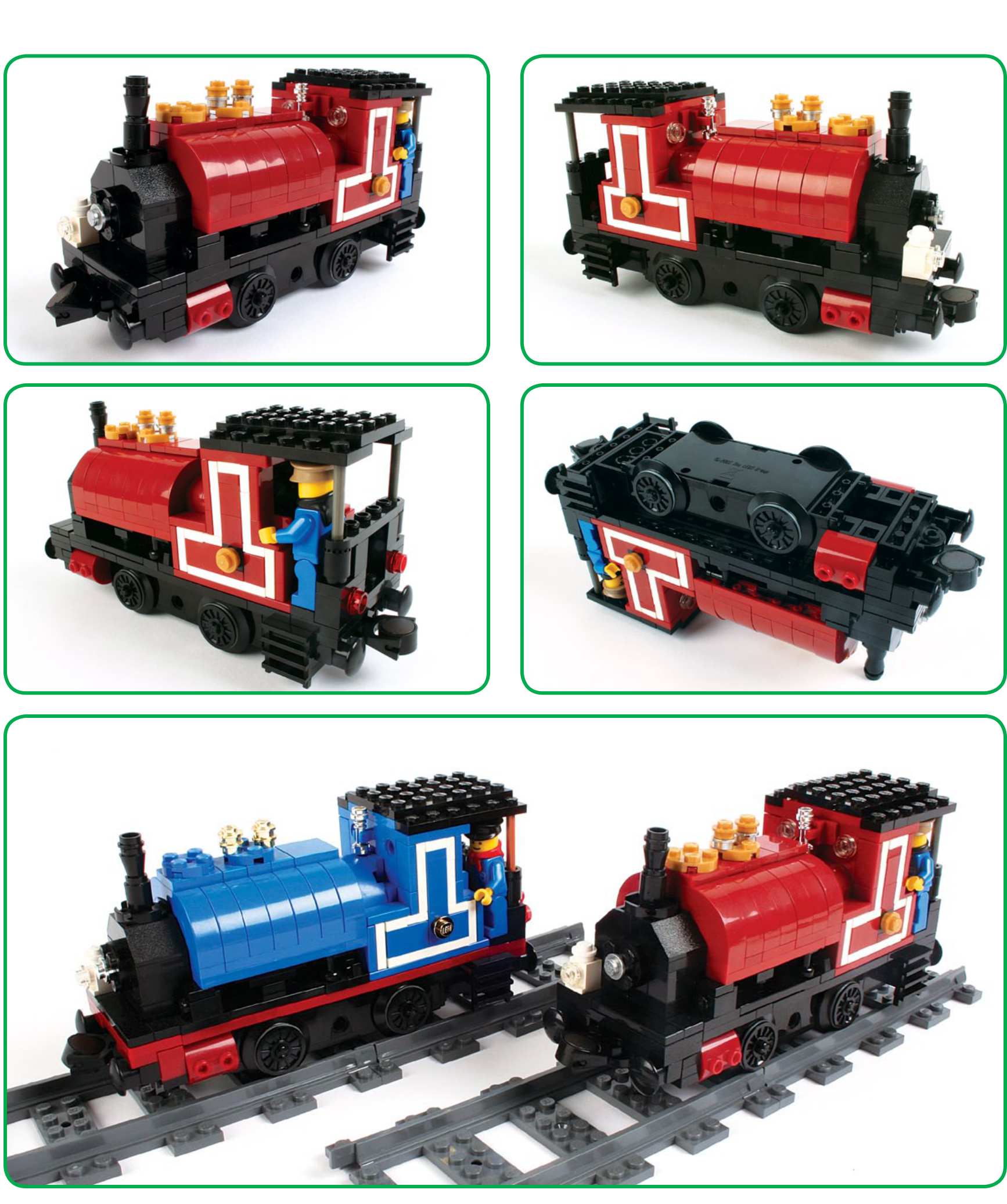
Trains
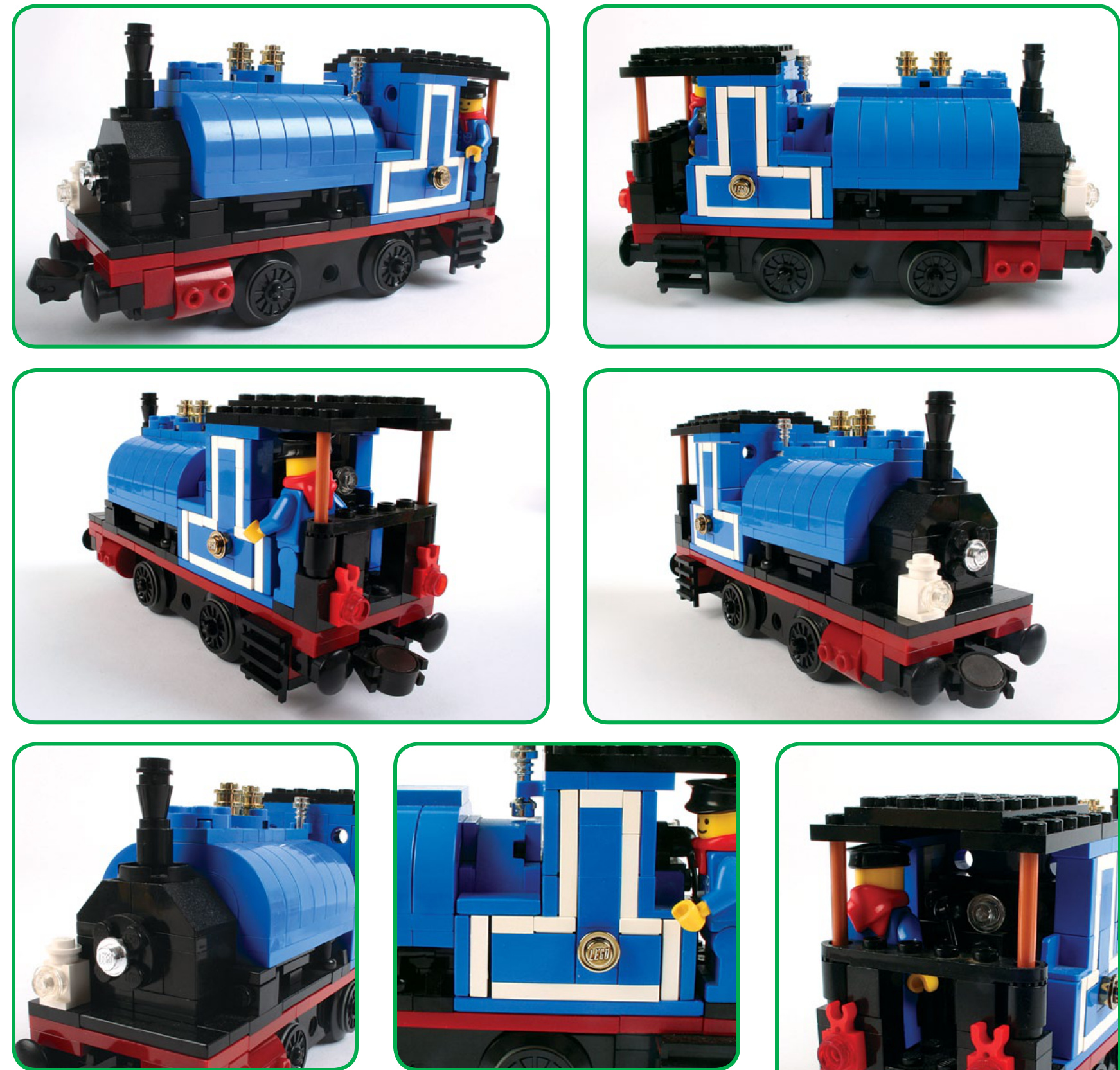
Building Tip
Instead of building a large diesel or electric locomotive, try building a smaller steam engine straight onto the motor module. Use your favorite color for the bodywork and just use black for all the little details. Remember to leave a gap for the engine’s cable to come out at the back. If you’re using a battery box, it can be hidden in a wagon that follows the engine.
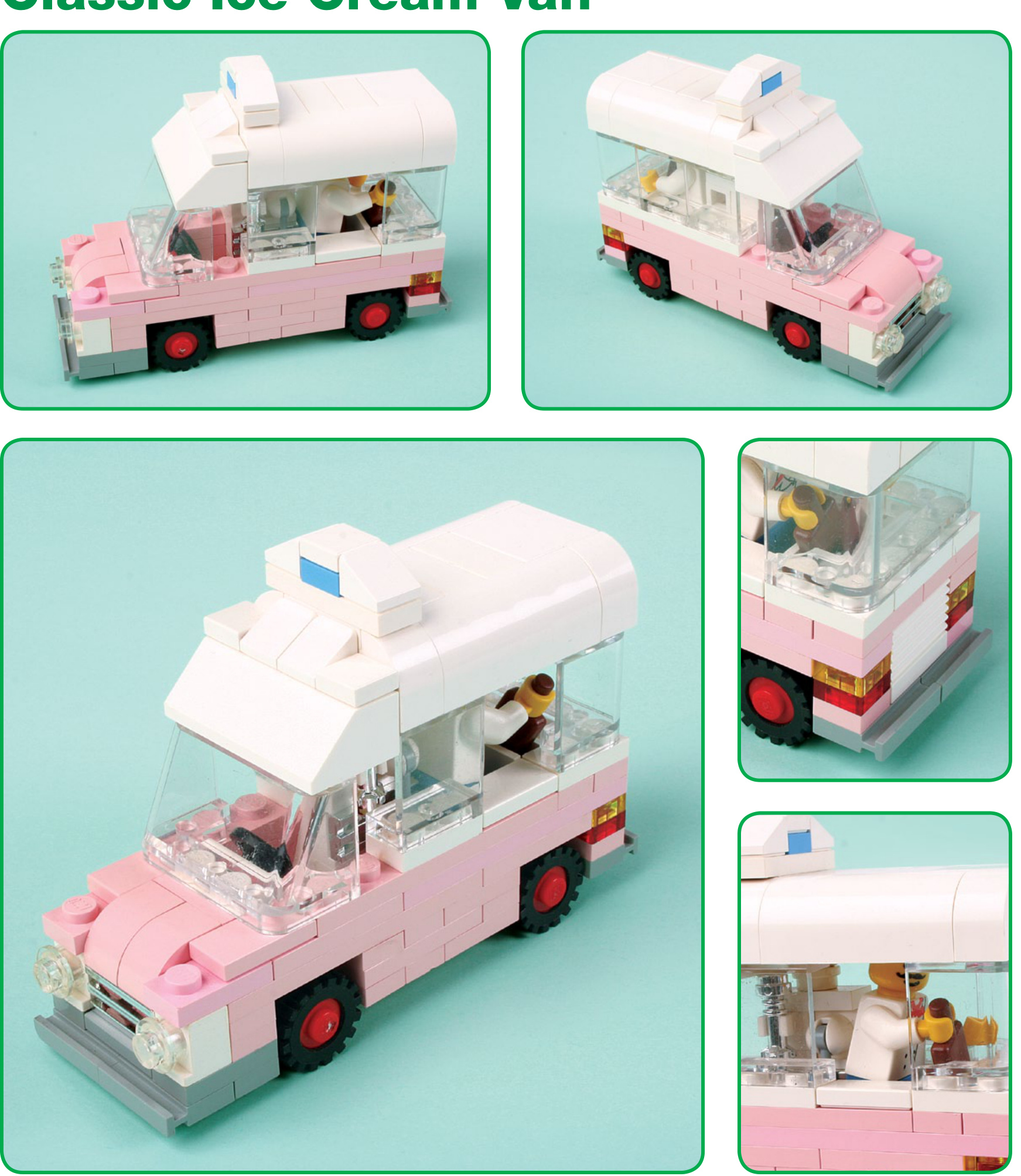
Classic Ice Cream Van
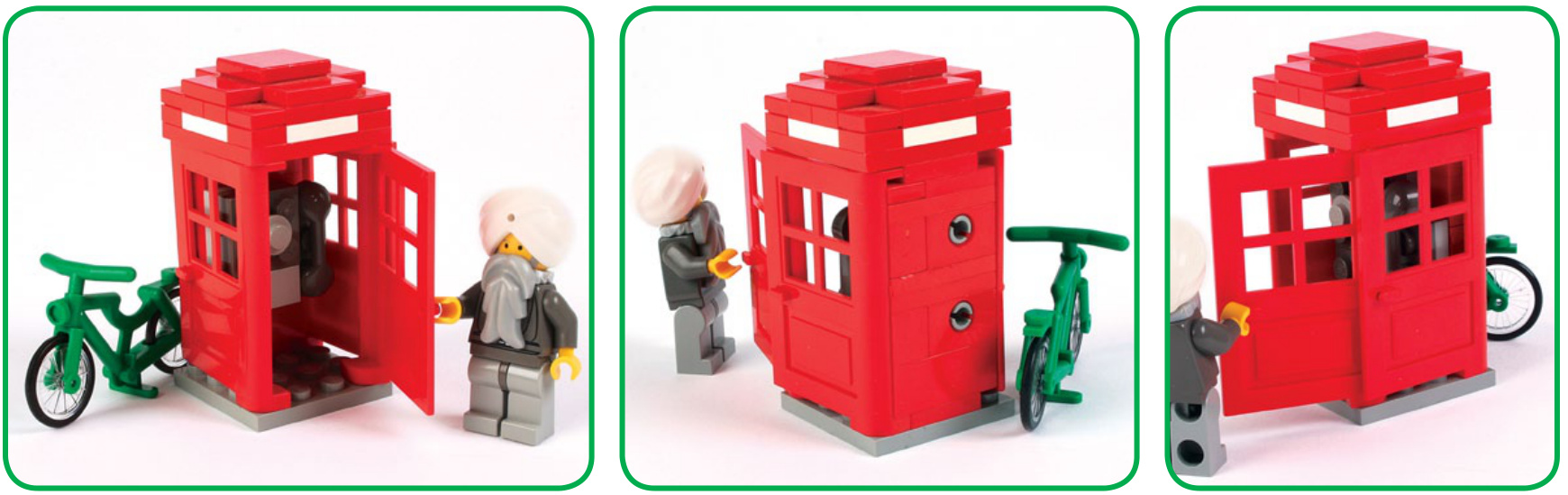
British Phone Box
Scouts

Building Journal
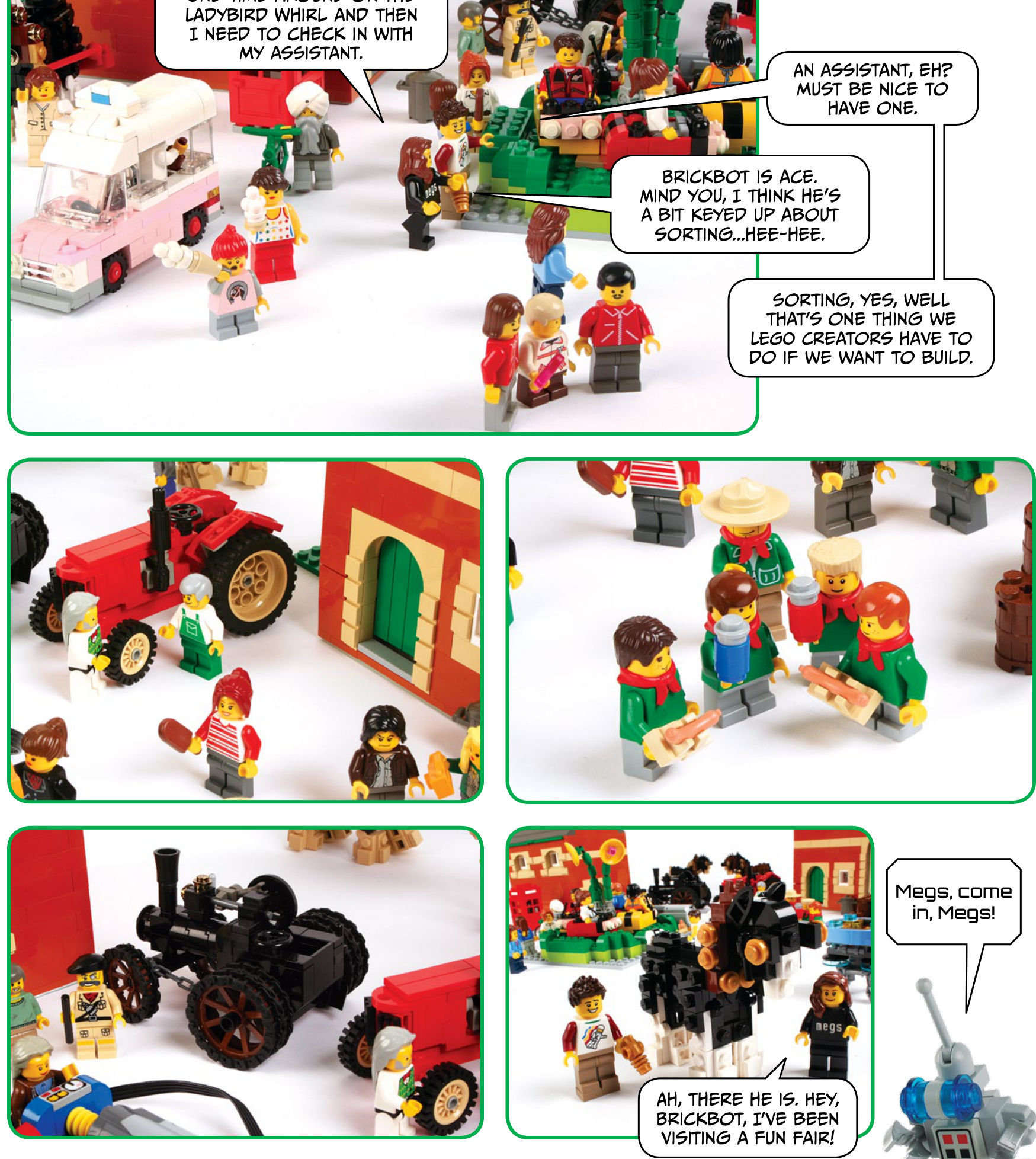
Jason’s fair models are fabulous! He’s put a lot of time into planning how things will move and function. Adding gears and motors really brings his models to life. Jason told me that he likes to use a lot of plates to sculpt shapes, as he did for the muscles on his Shire horses. His use of different colored ladybirds with pink noses adds a sense of whimsy, perfect for a fun fair ride!
Out of Scale!
Stephan Sander

Nickname: x_Speed! Profession: IT Specialist Nationality: German Website: www.x-brick.de

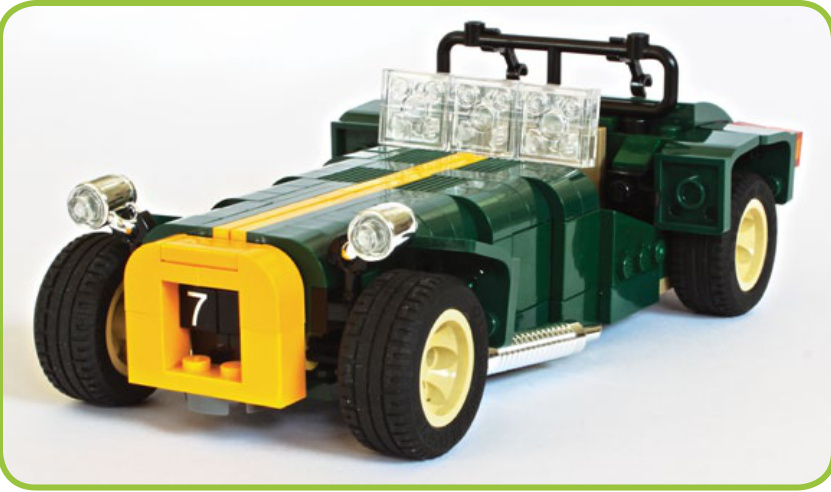
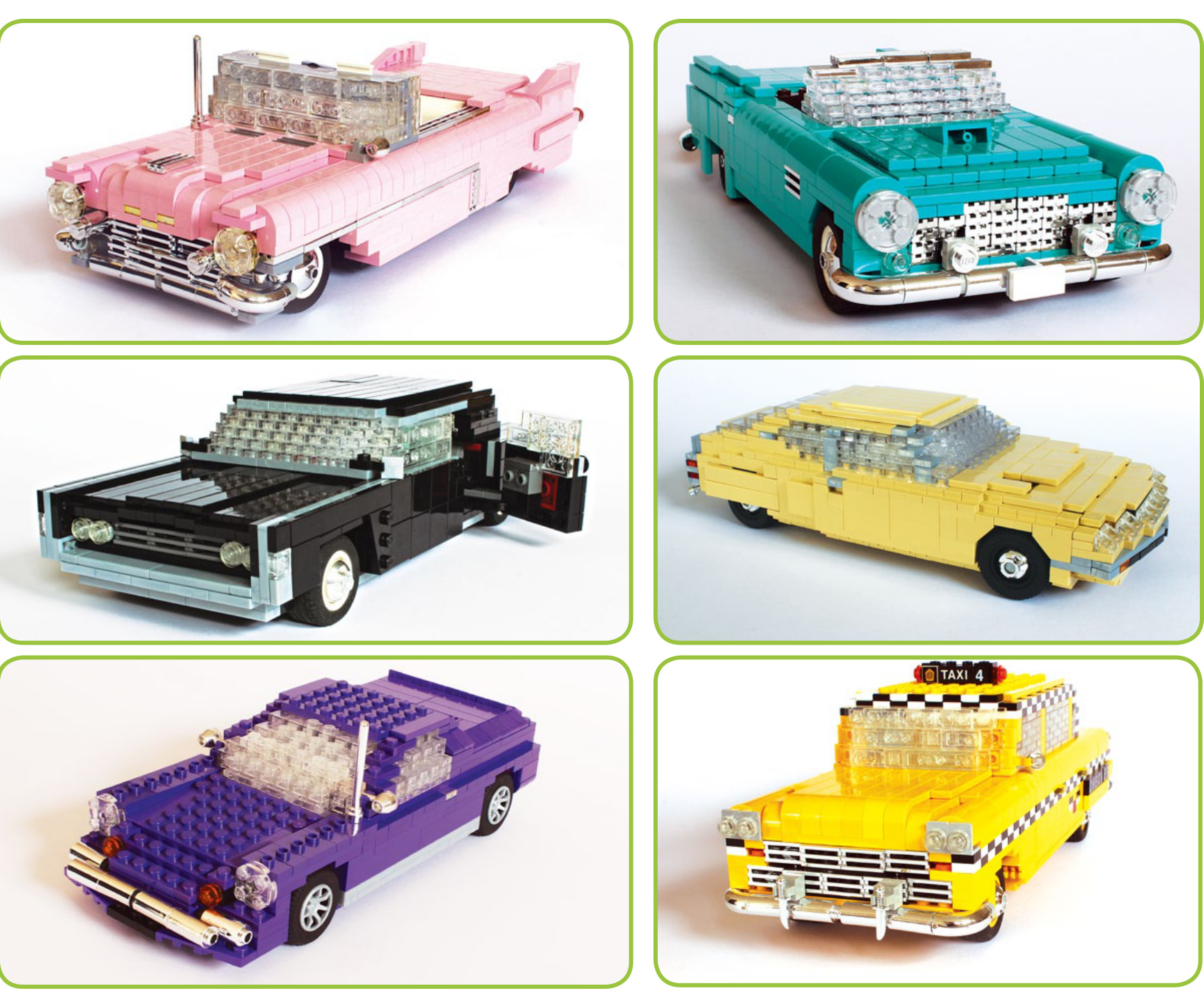
Classic Rides
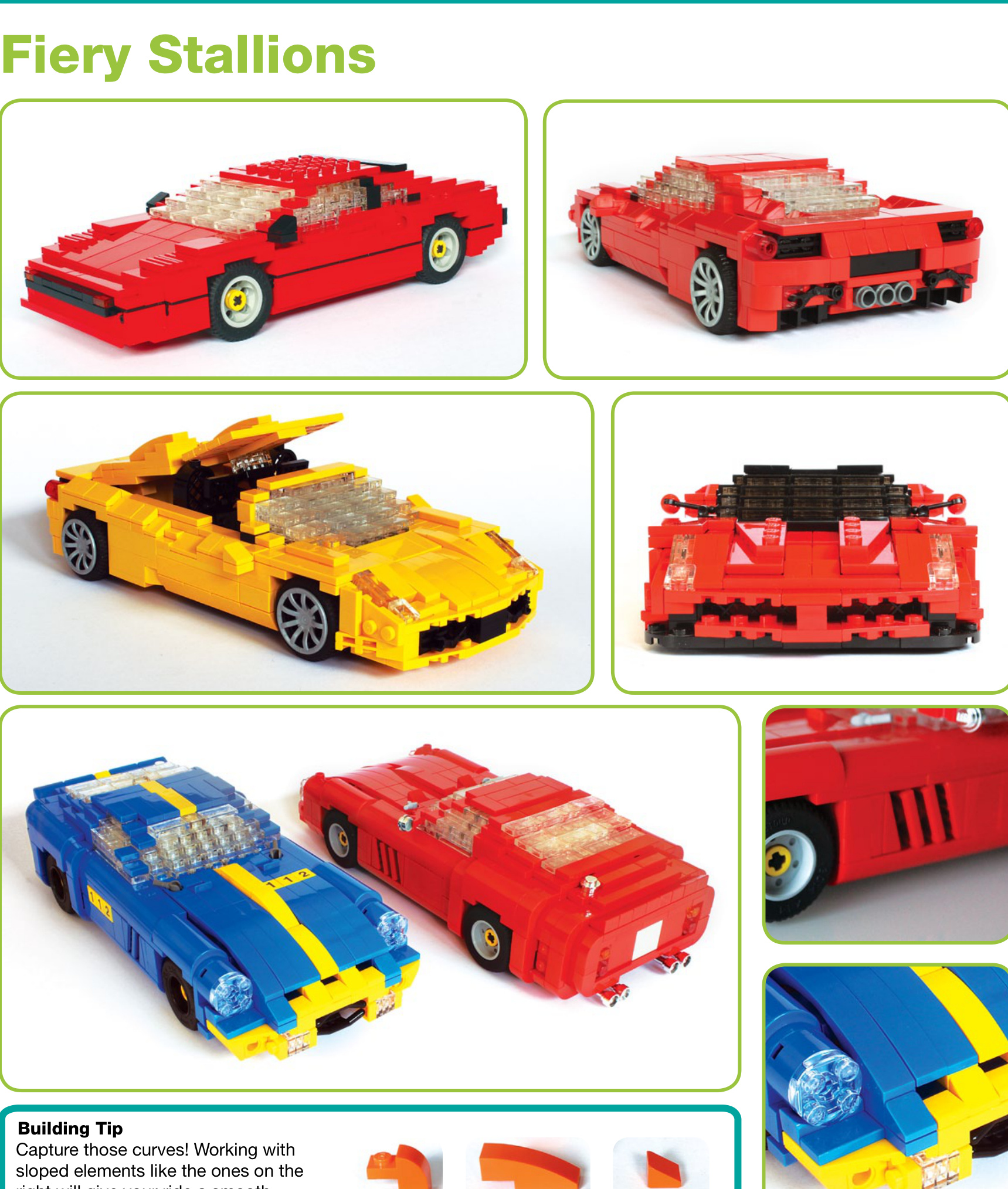
Supercars
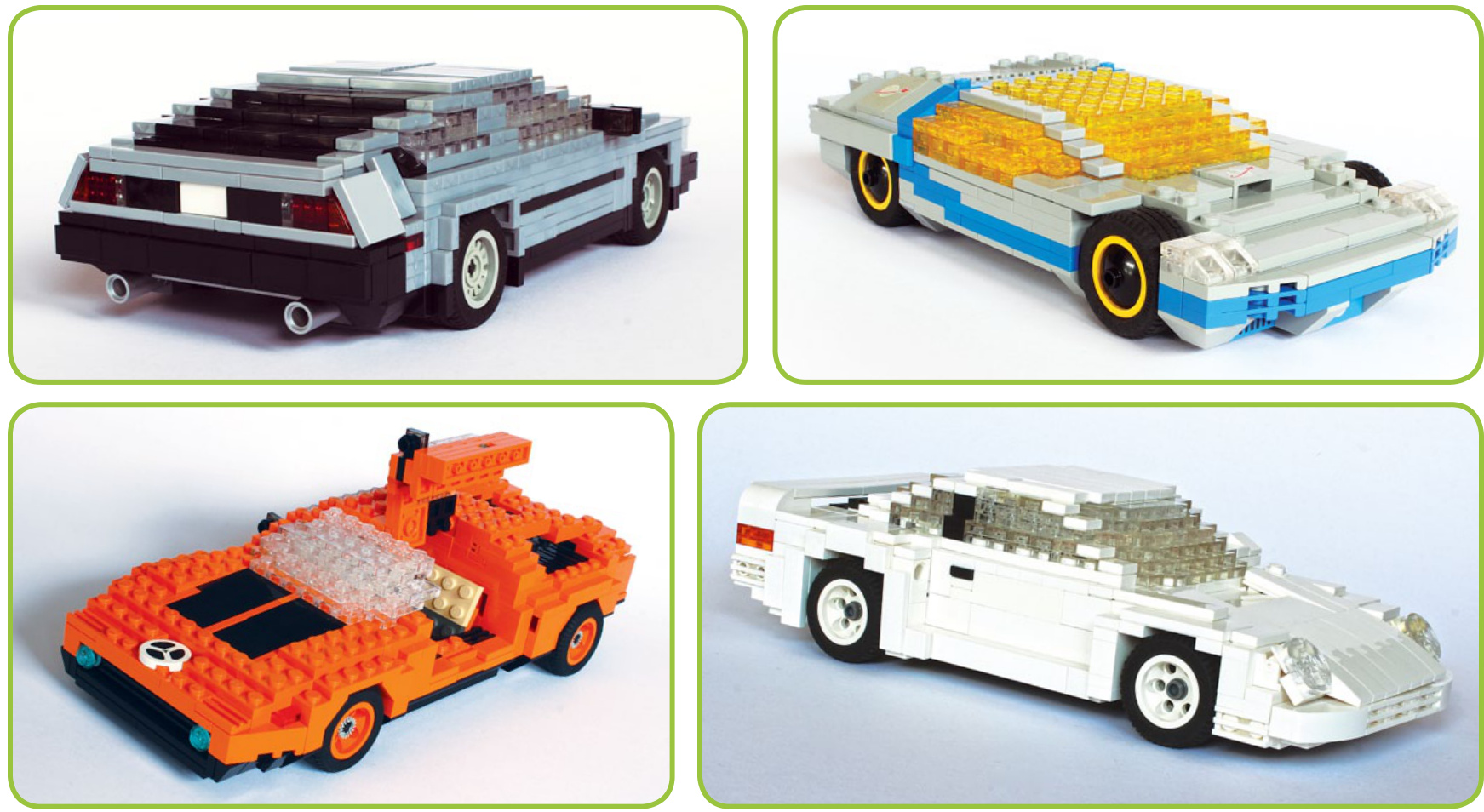
Street Rides
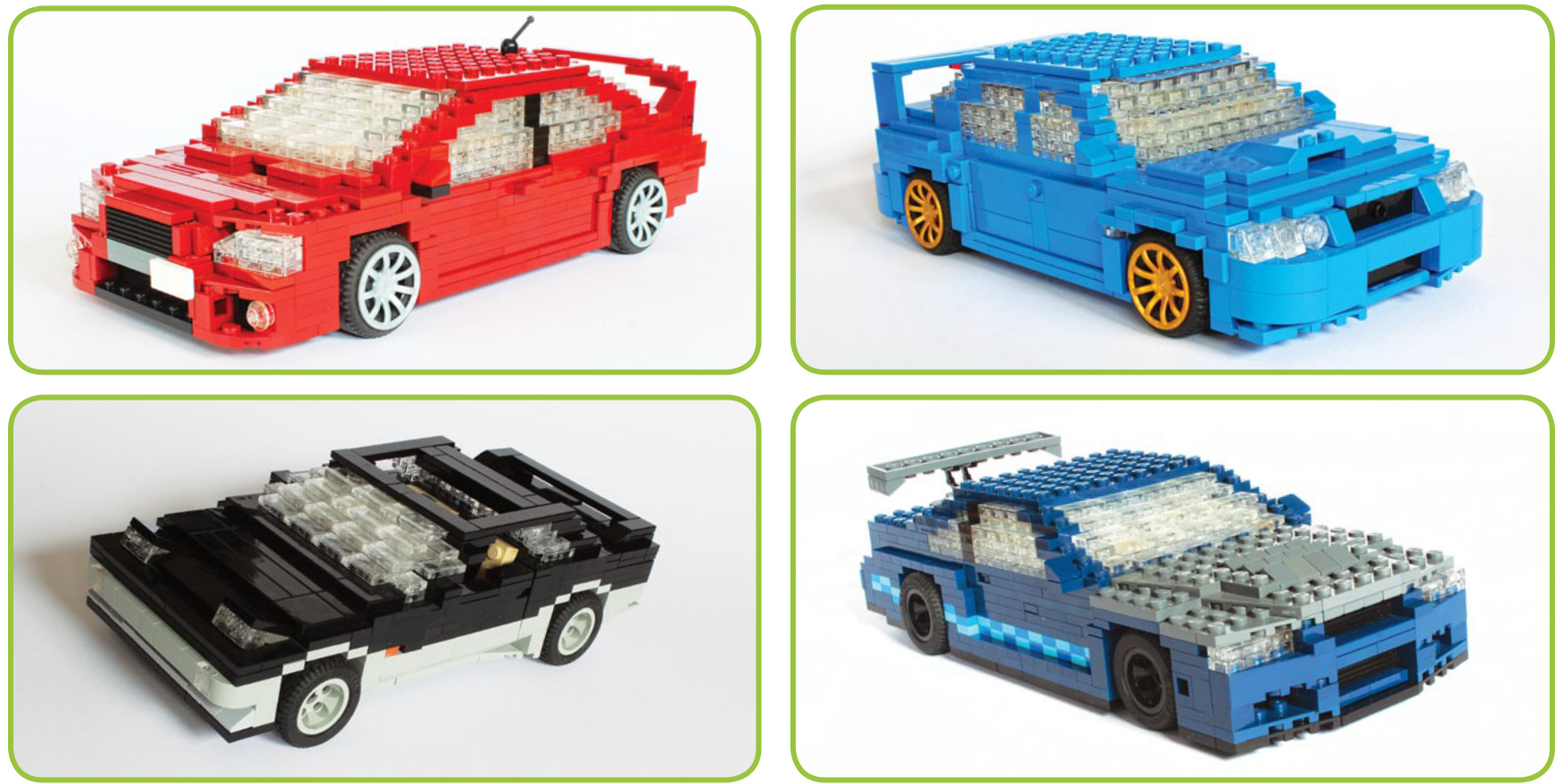
Time Machine
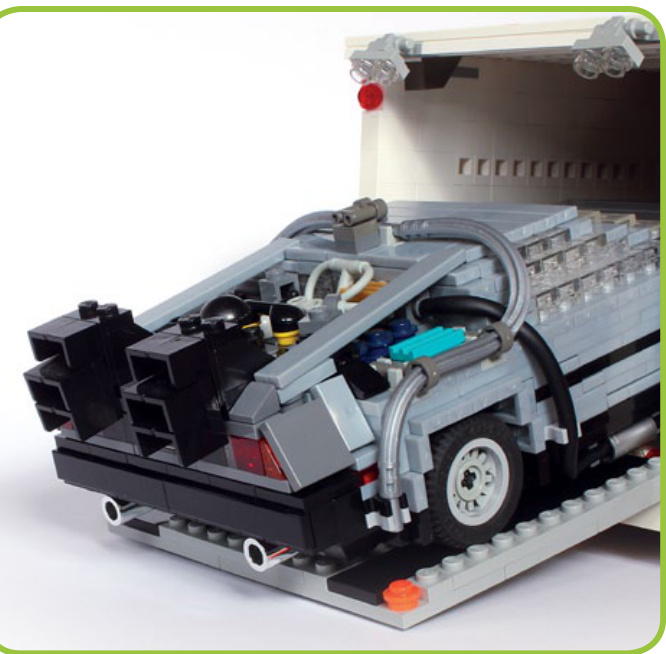
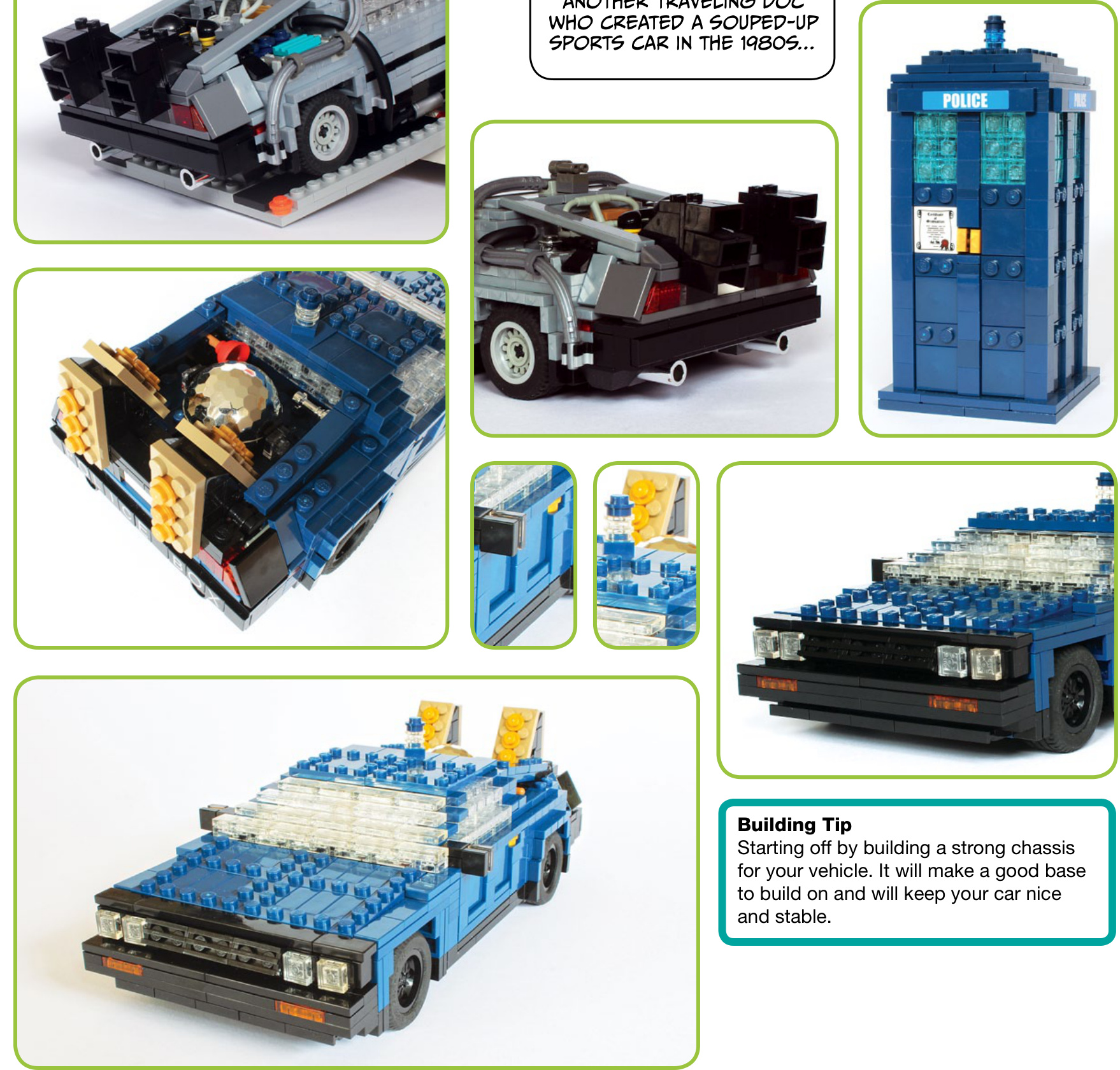
Details Make the Ride

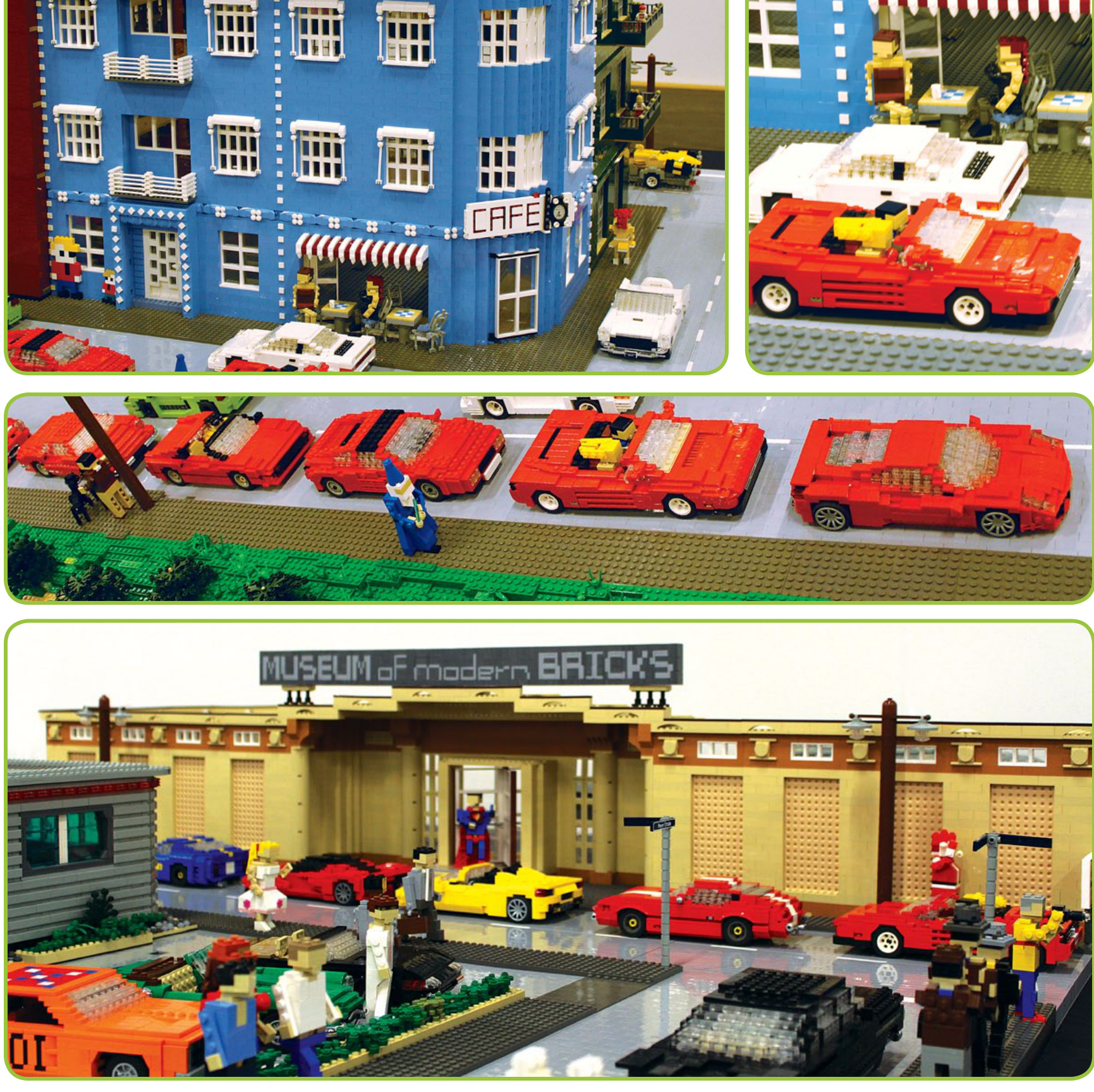
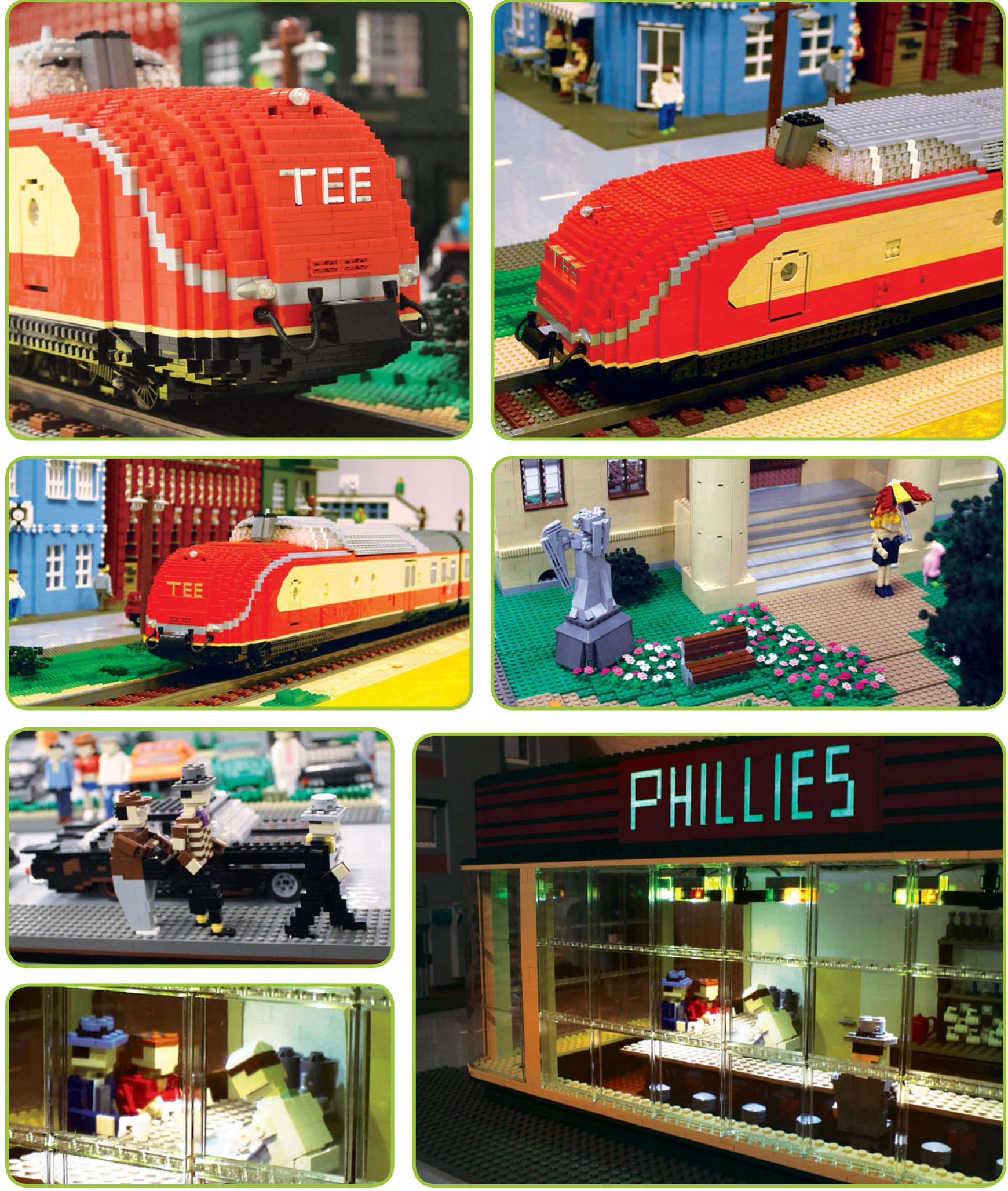
Brick Valley
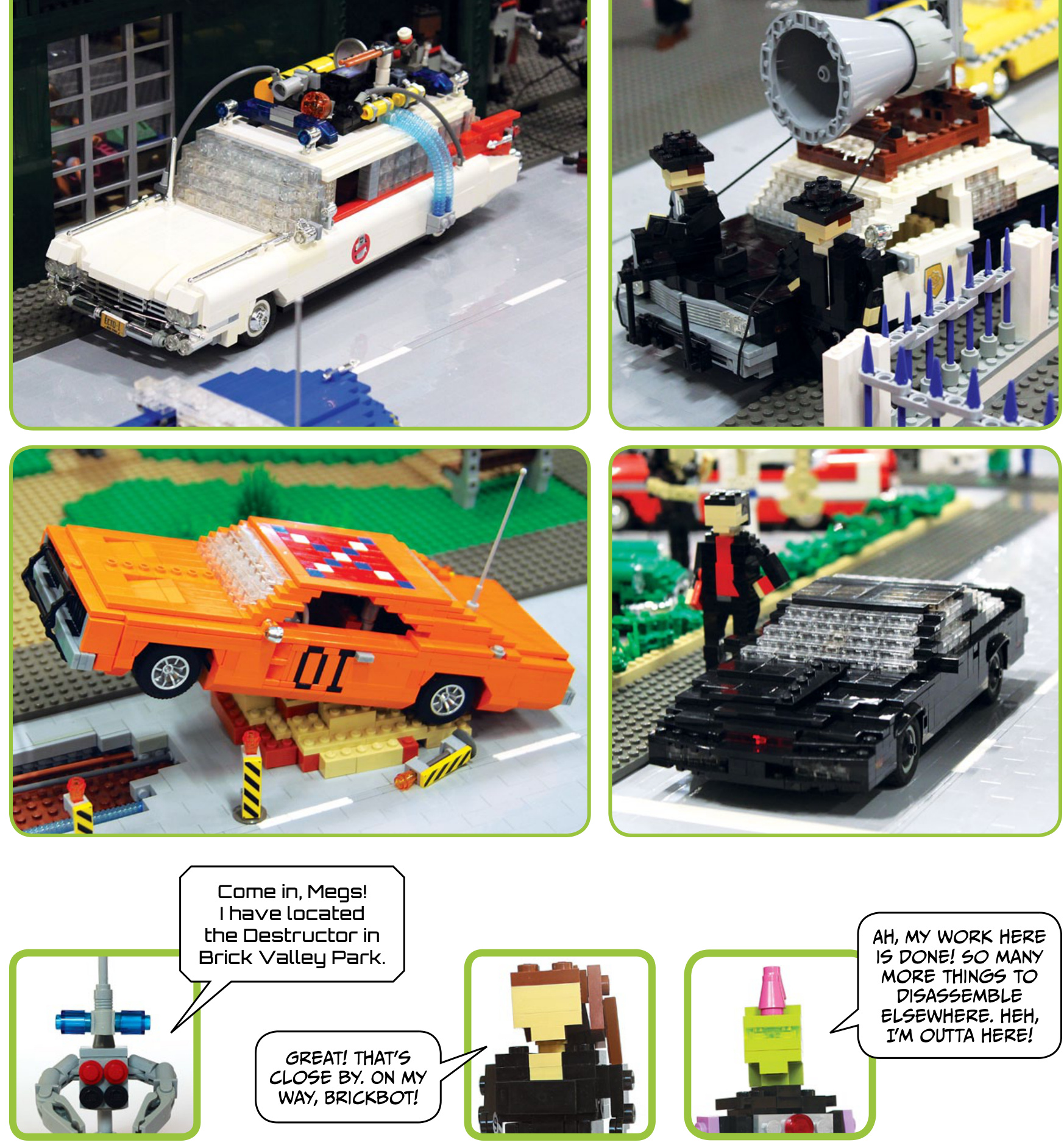
Hollywood Inspiration

A Seaside Situation
Alex Bidolak

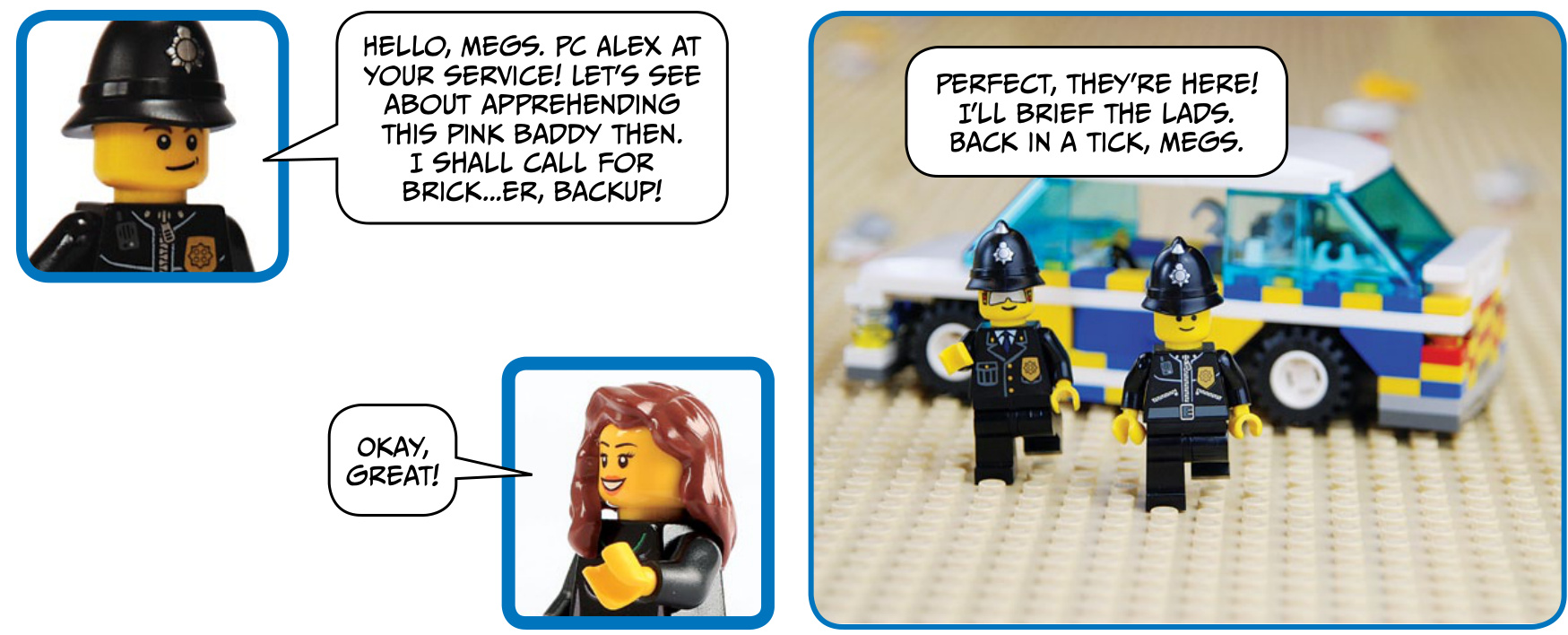
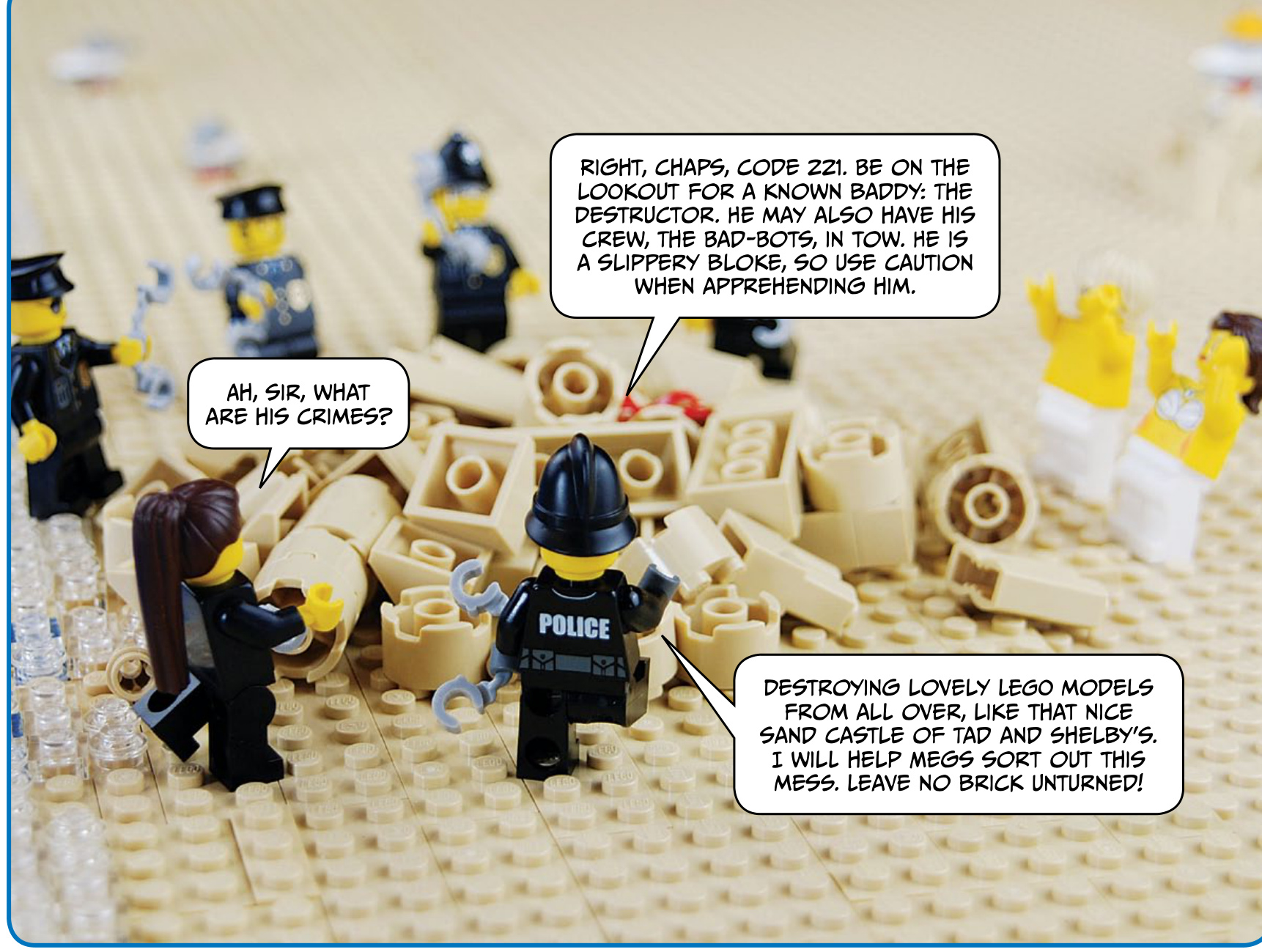
Nickname: Brick-A-Lak Profession: Master Model Builder and Police Constable
Nationality: British
Website: www.flickr.com/photos/bidolak/sets/ 72157630913115524/
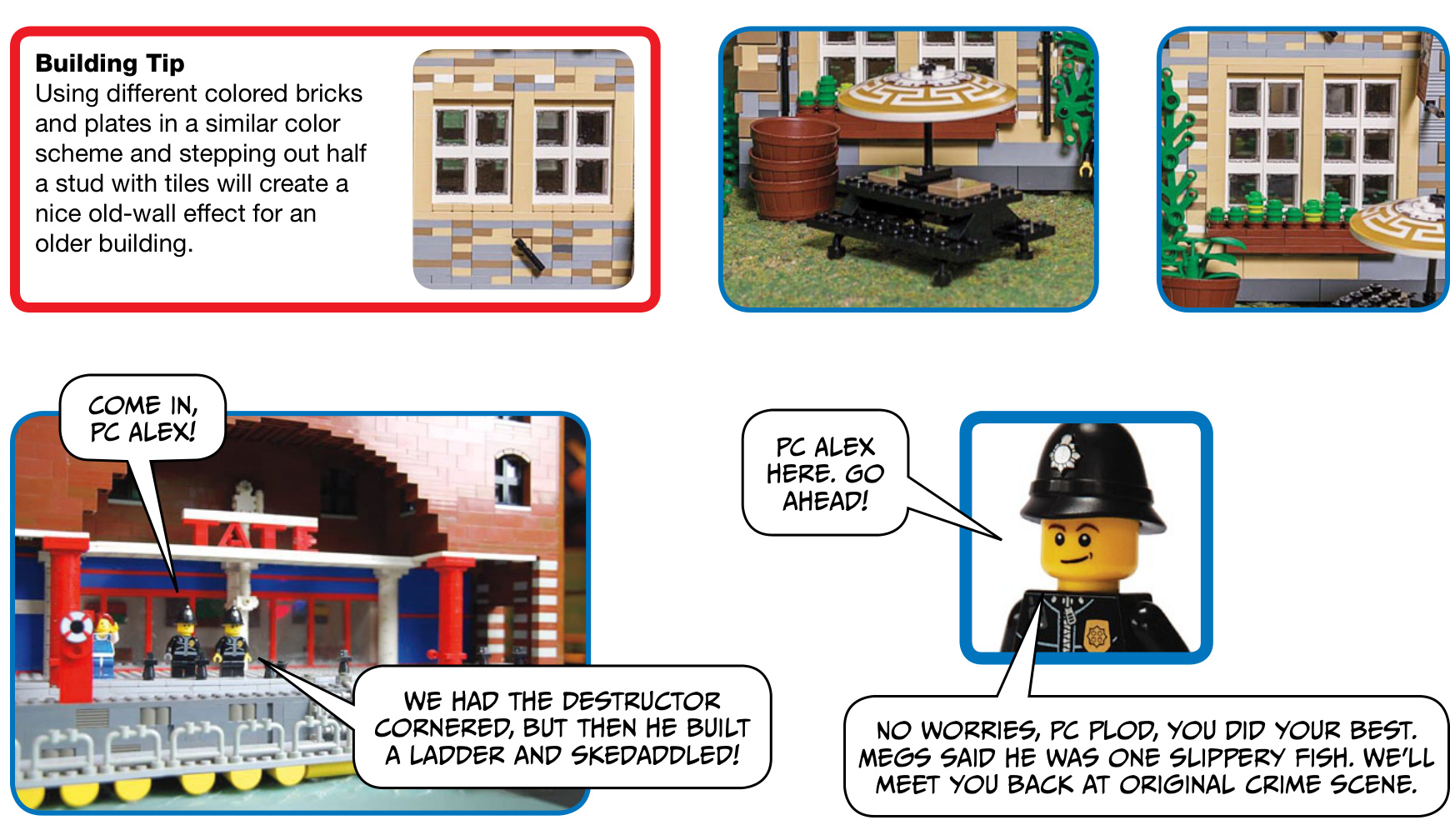
Building Tip
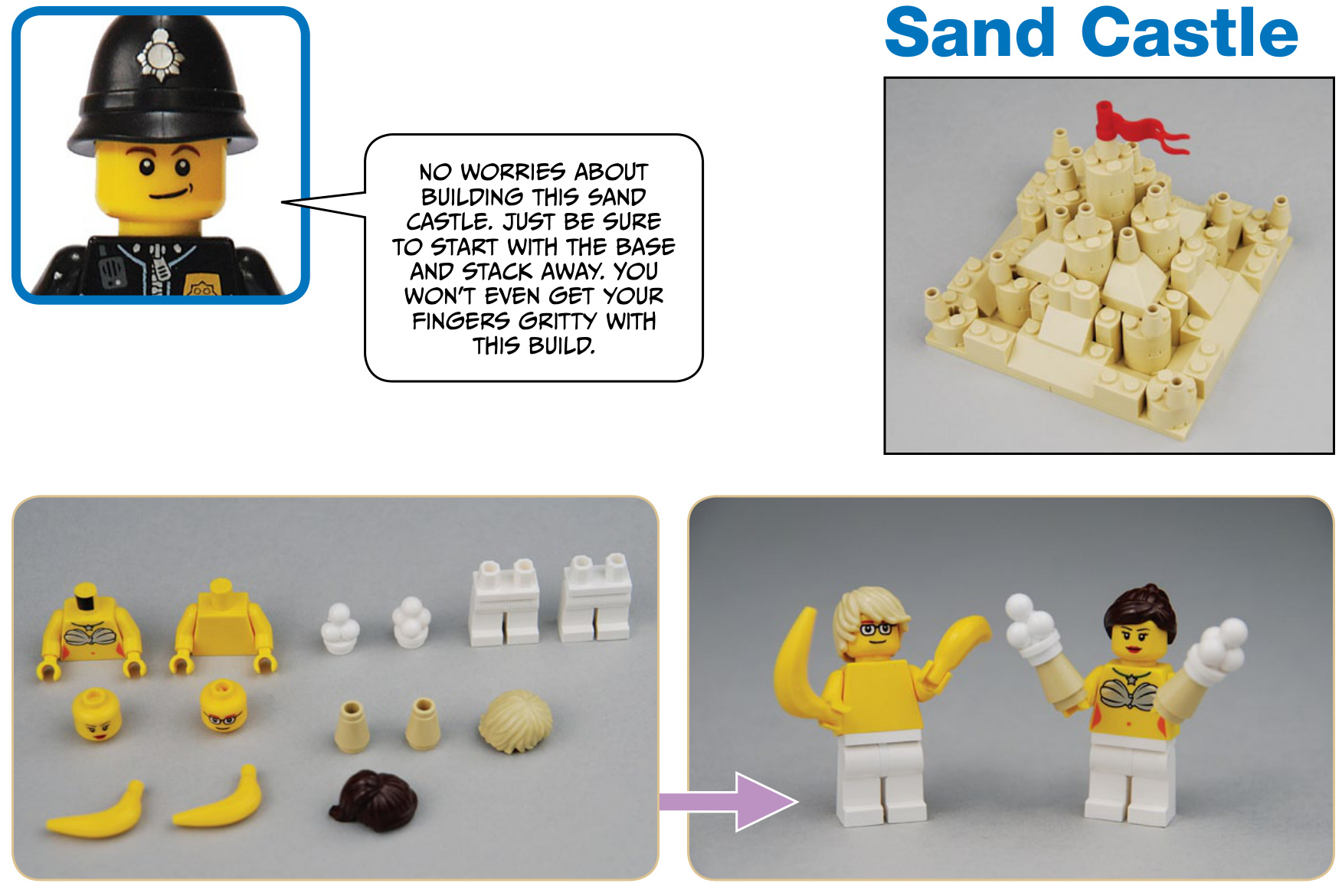
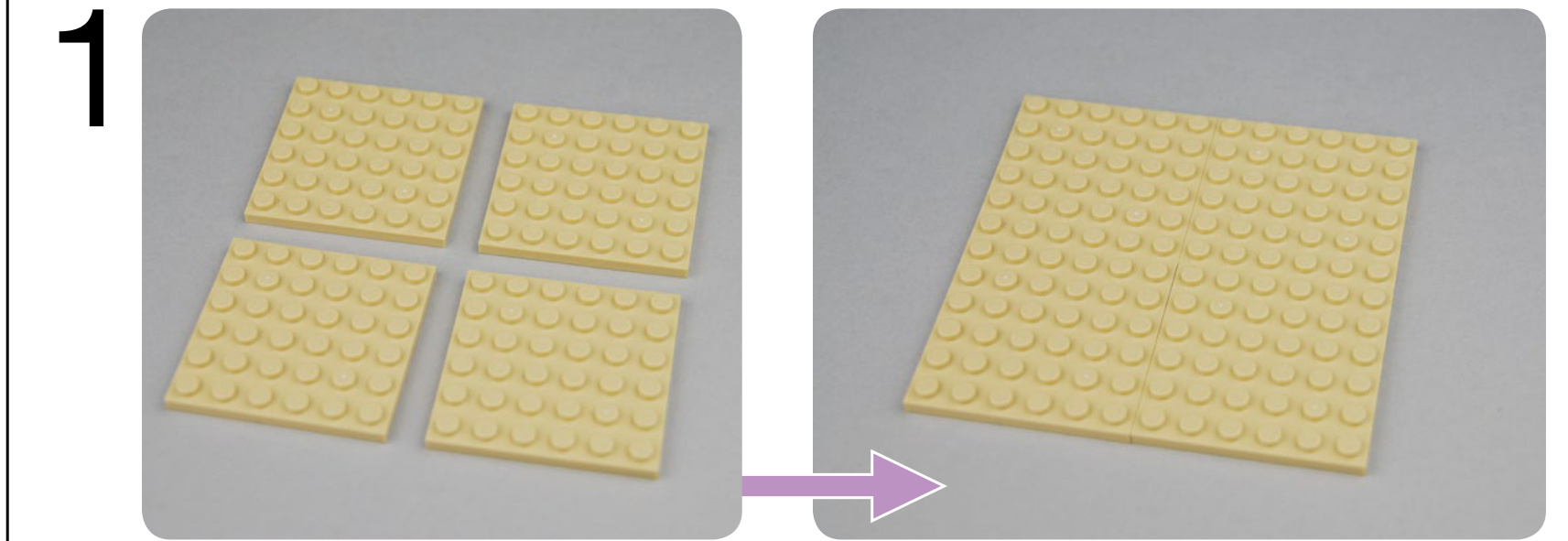
When building a solid object like a sand castle, start by working out a base to stack on, just as you would when building a real sand castle.
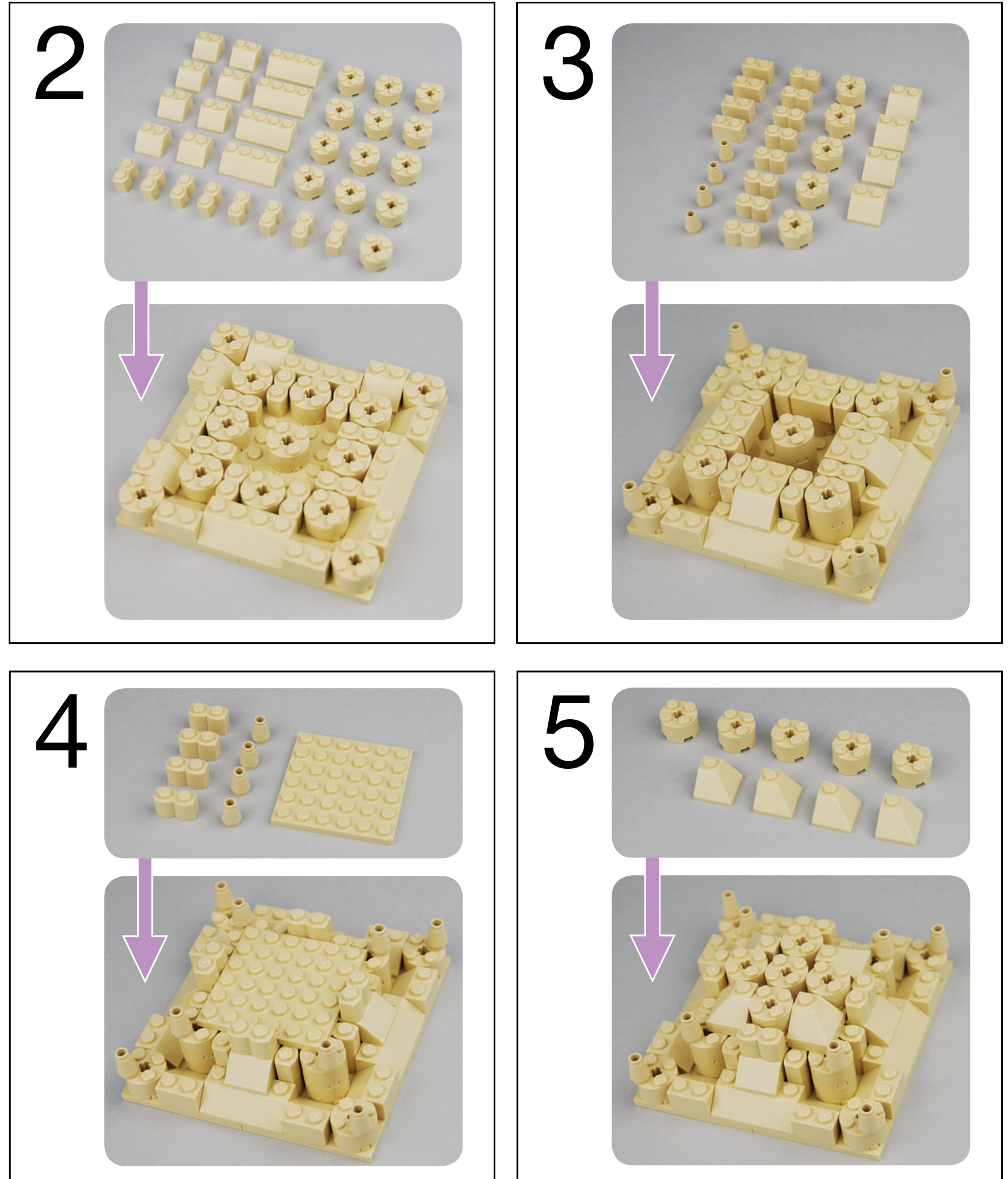
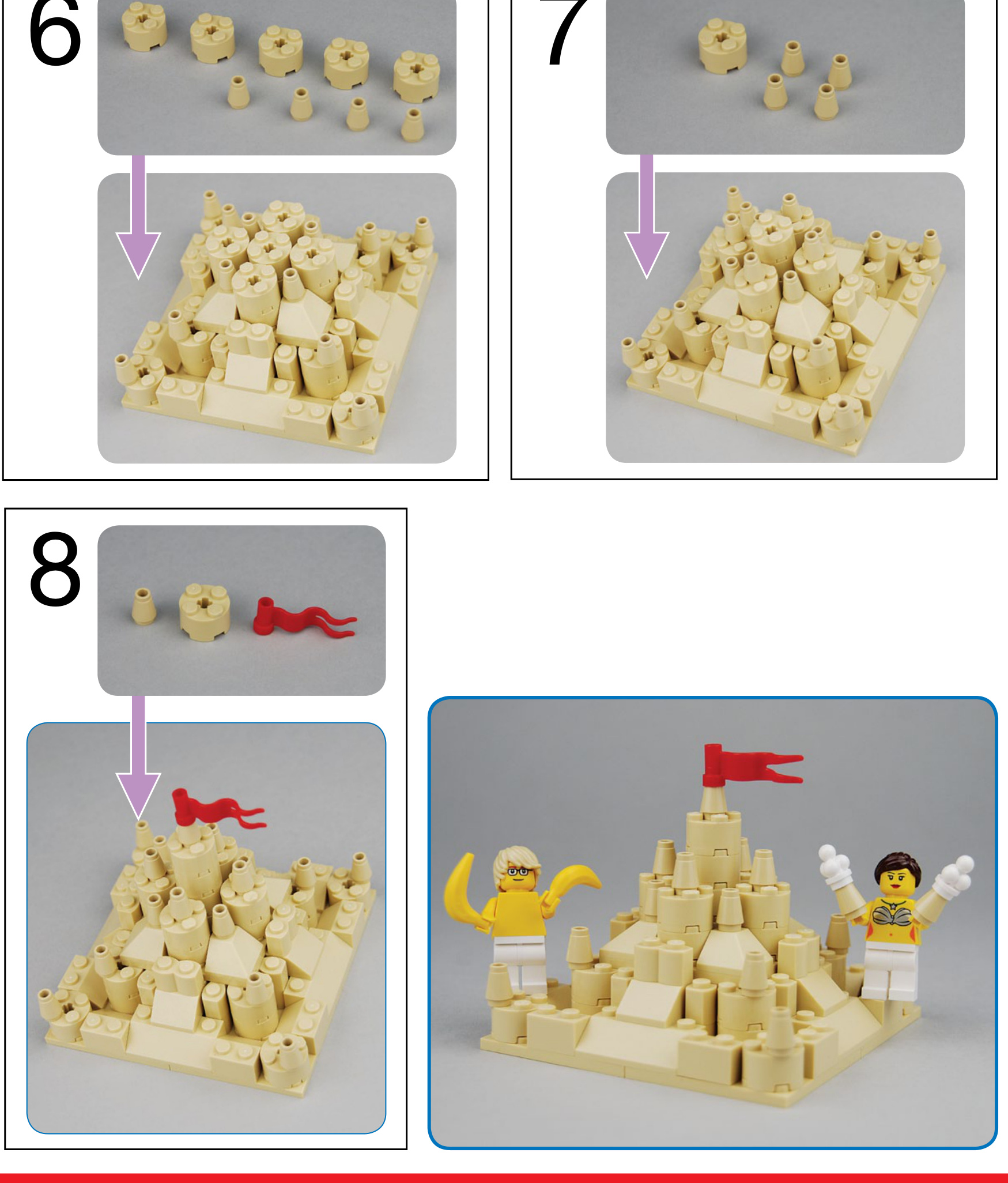
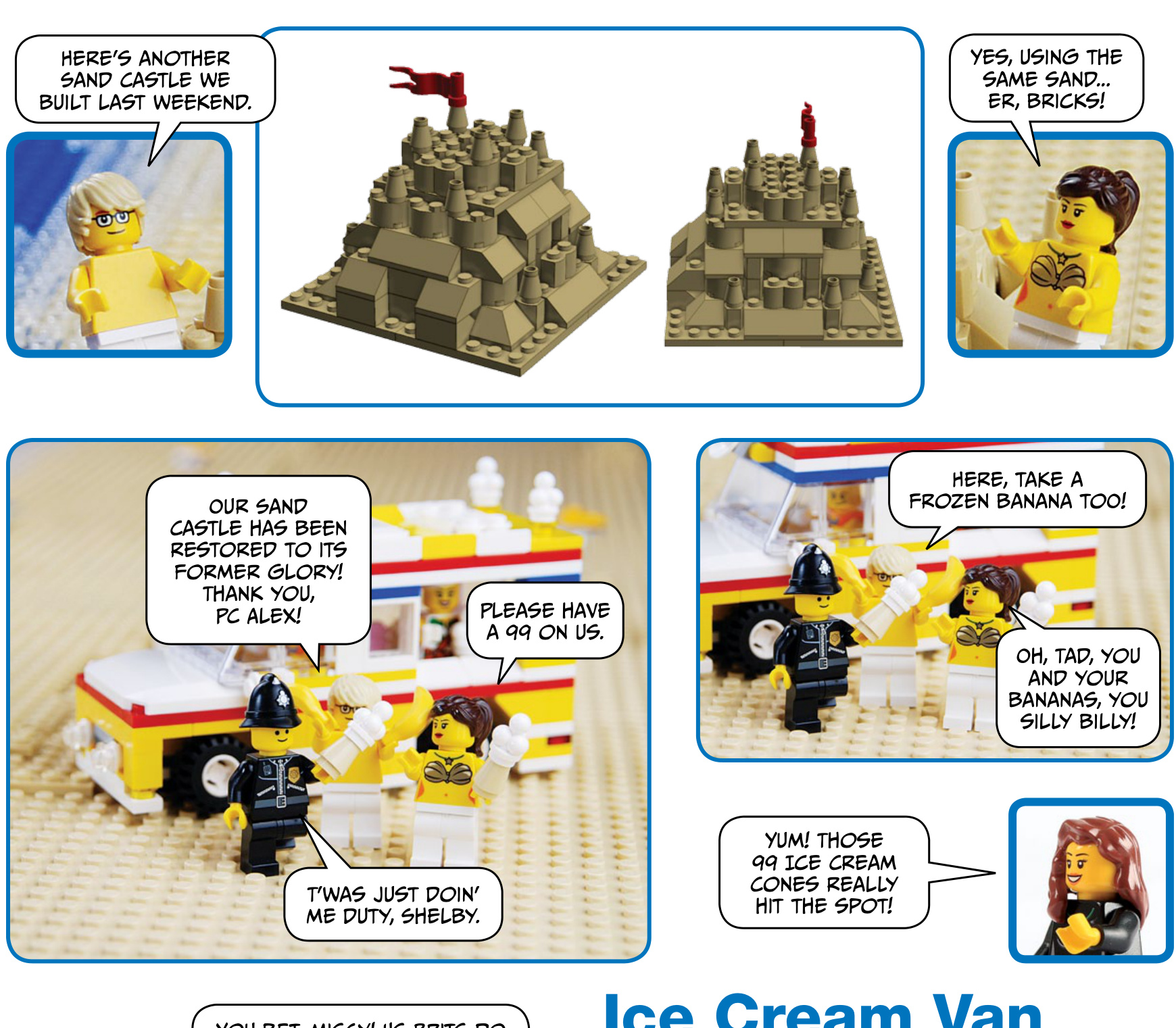

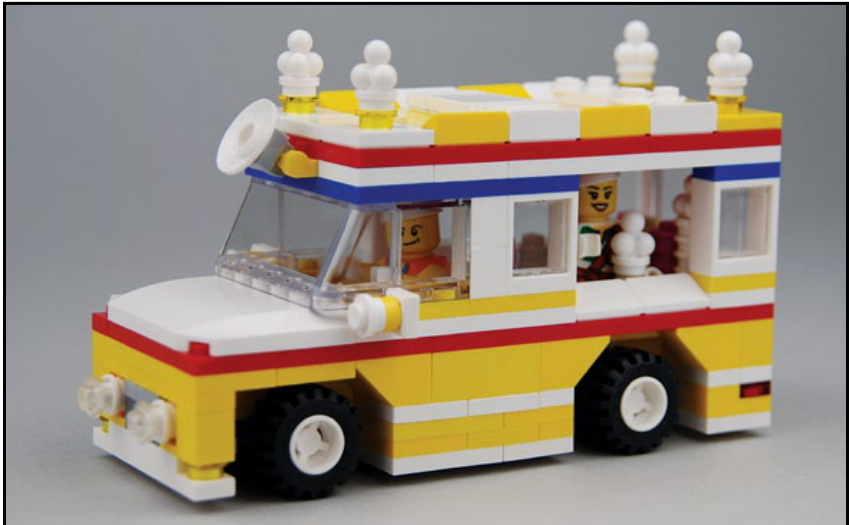
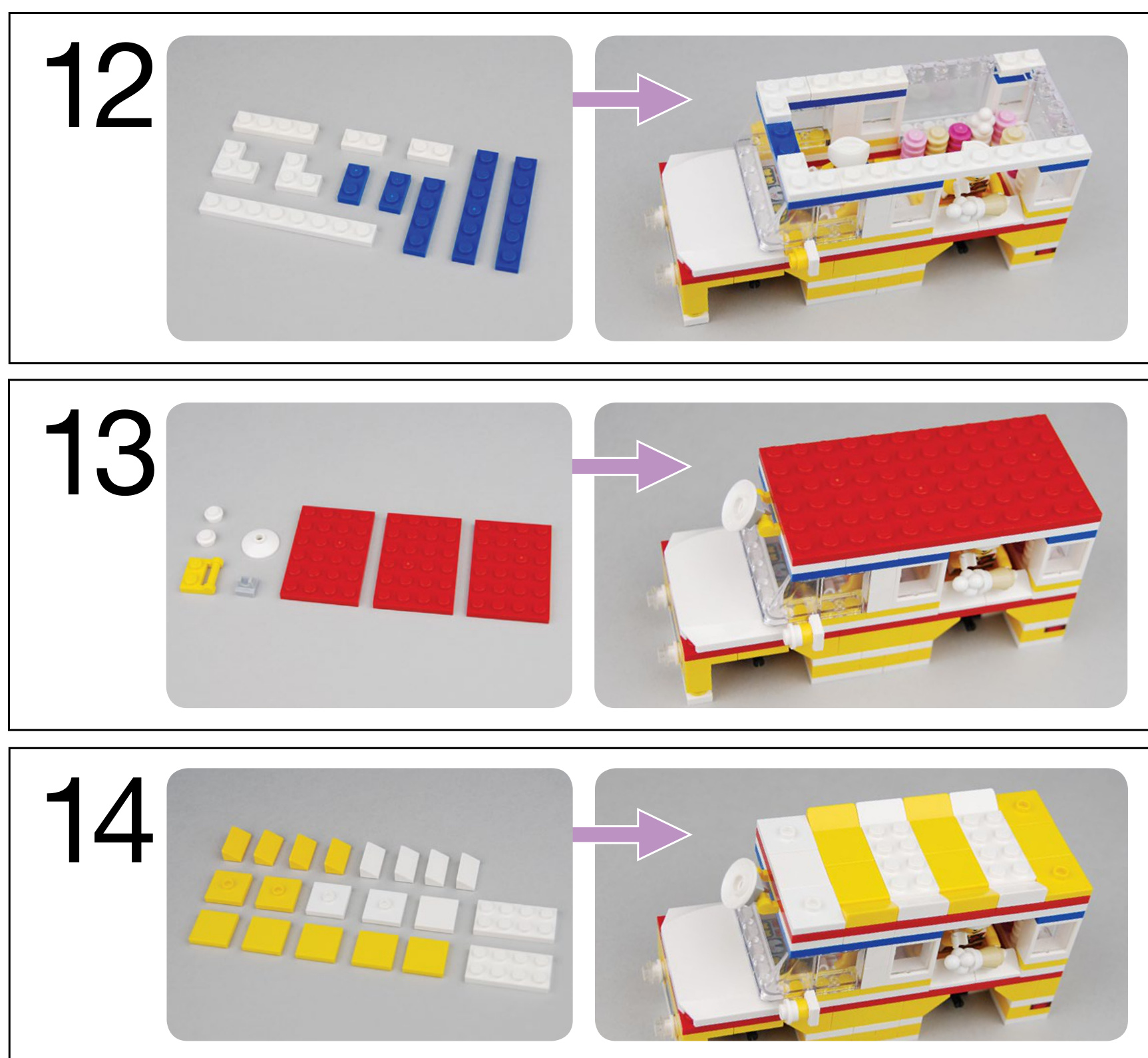
BUILDING JOURNAL
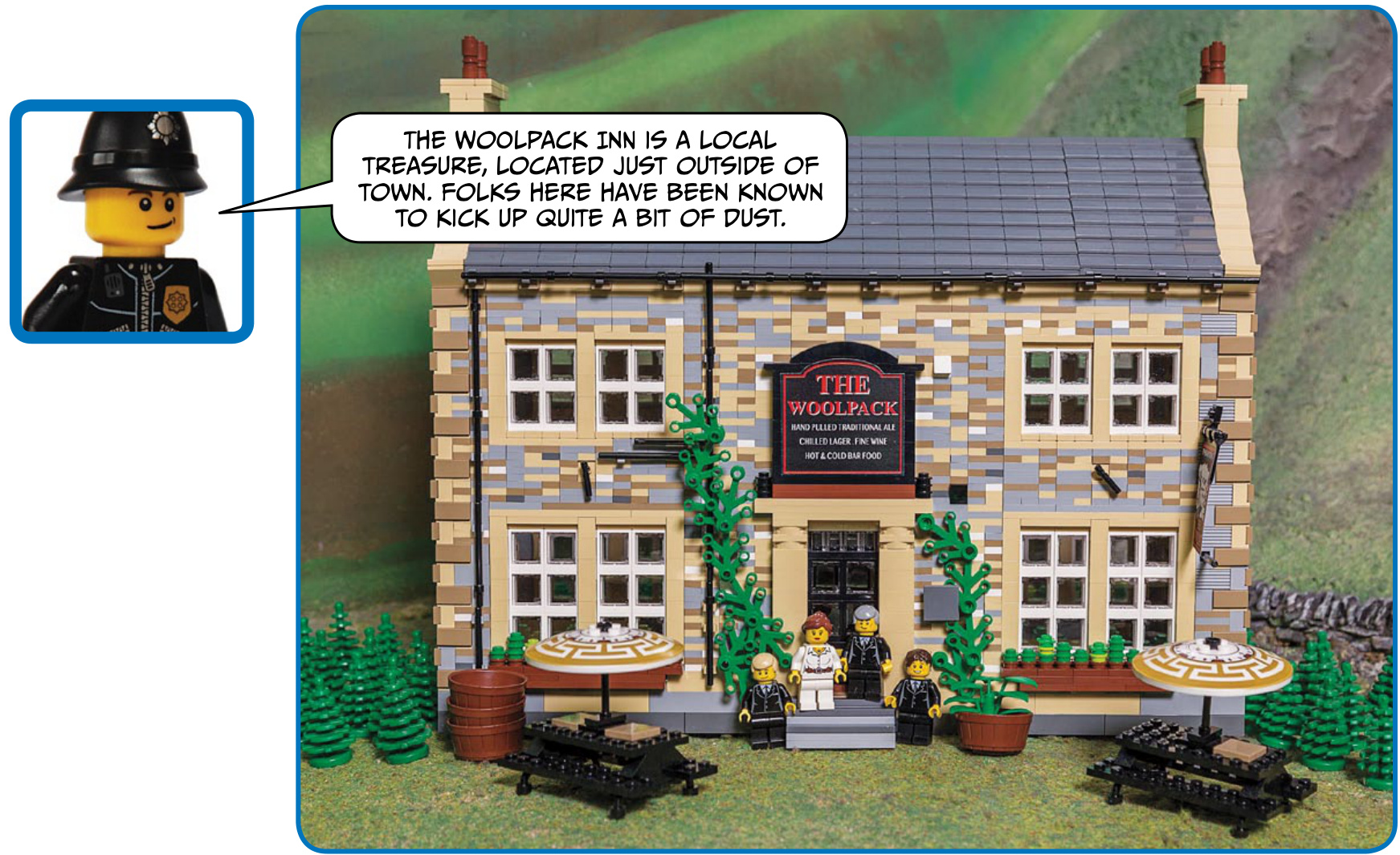
Alex draws a lot of inspiration from his daily life. Living in Manchester in the United Kingdom, he explores the city and builds local landmarks and vehicles out of LEGO bricks. “What I love most about building is that there are loads of building solutions to choose from. LEGO bricks are a universal form of playing and learning. For me, LEGO building is more than just playtime; it is a timeless, versatile, and creative art form.”
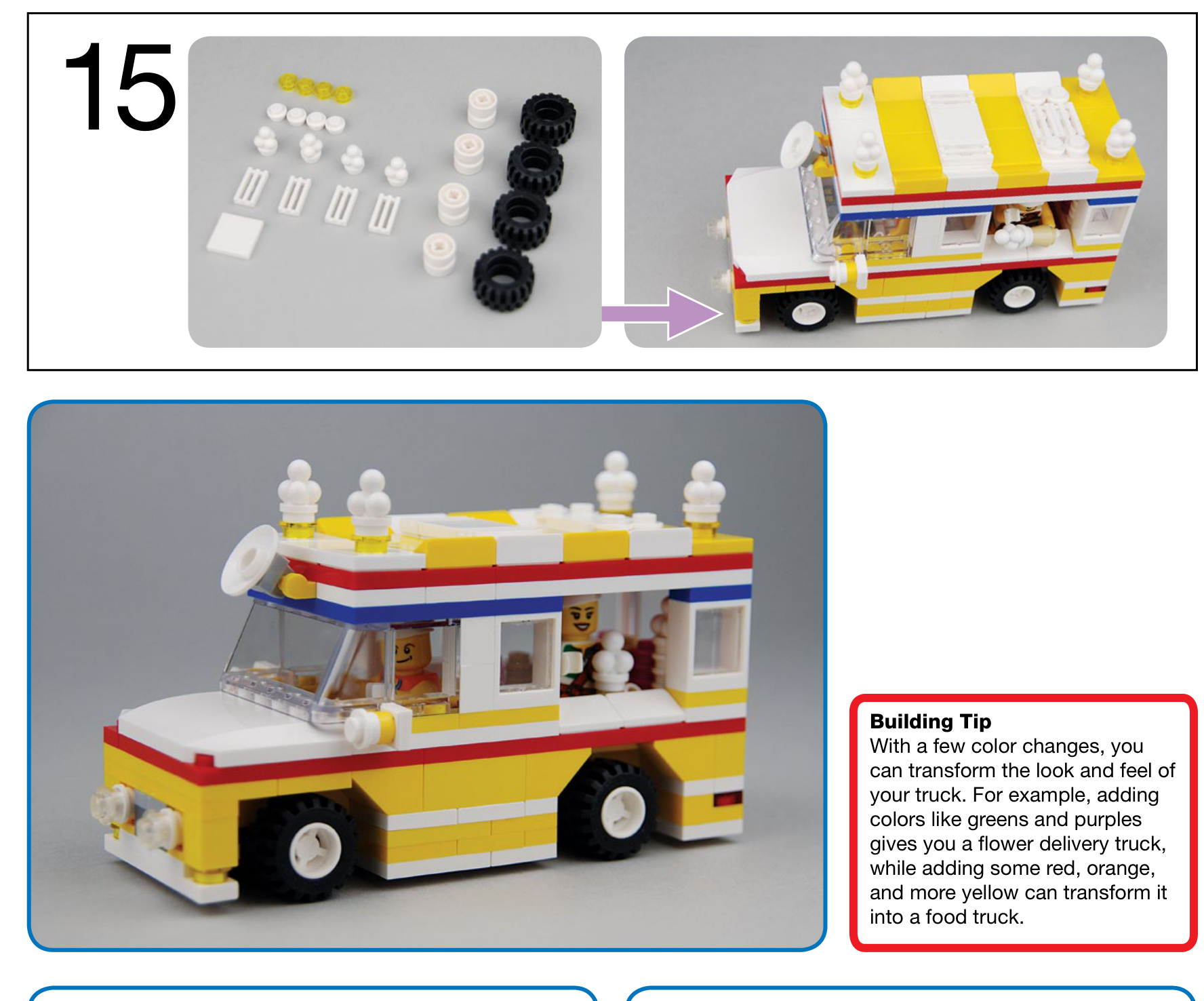
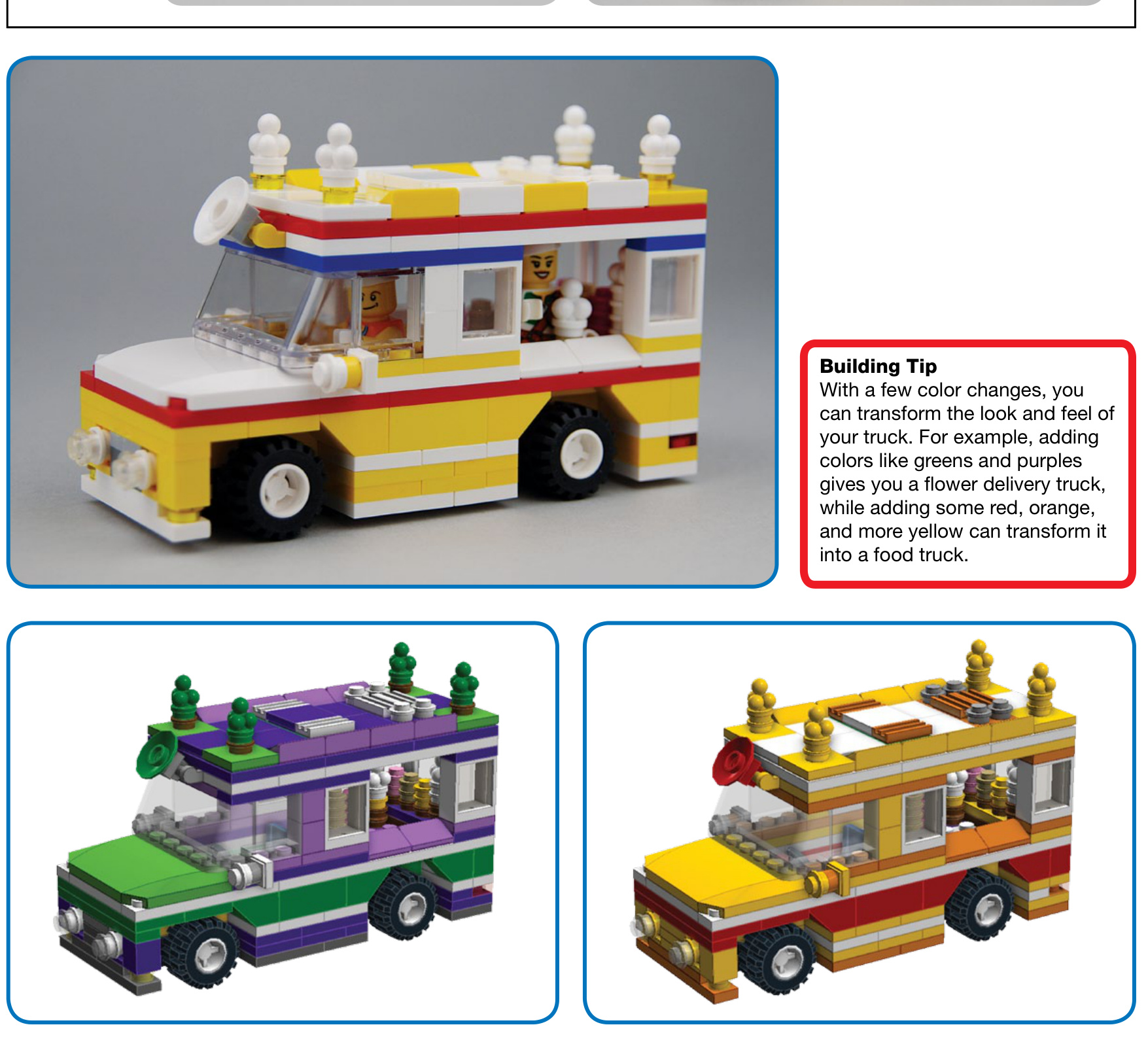
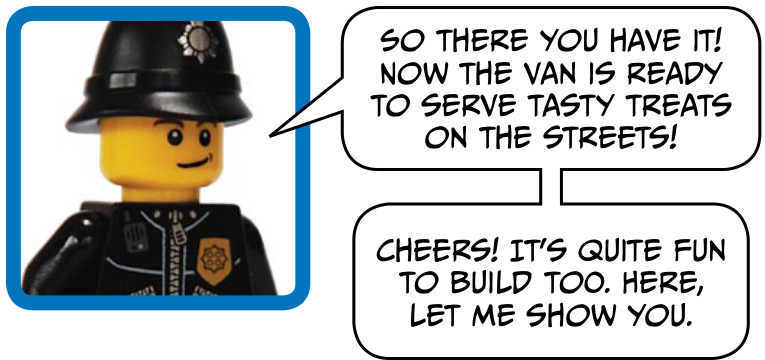
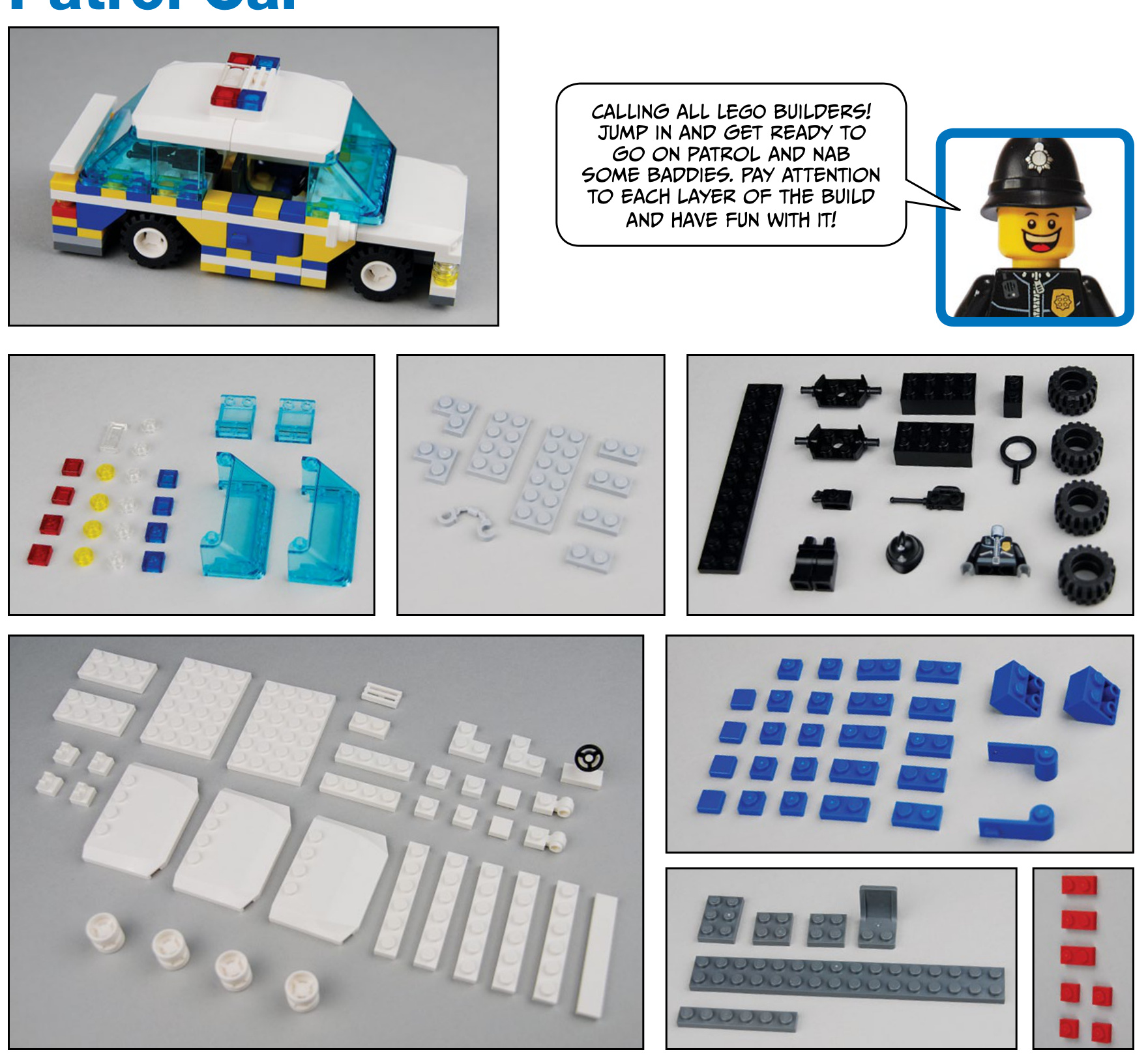
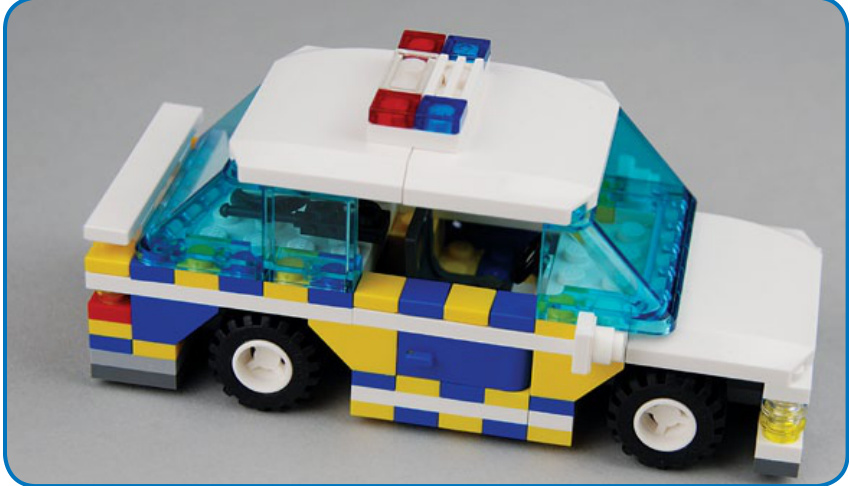
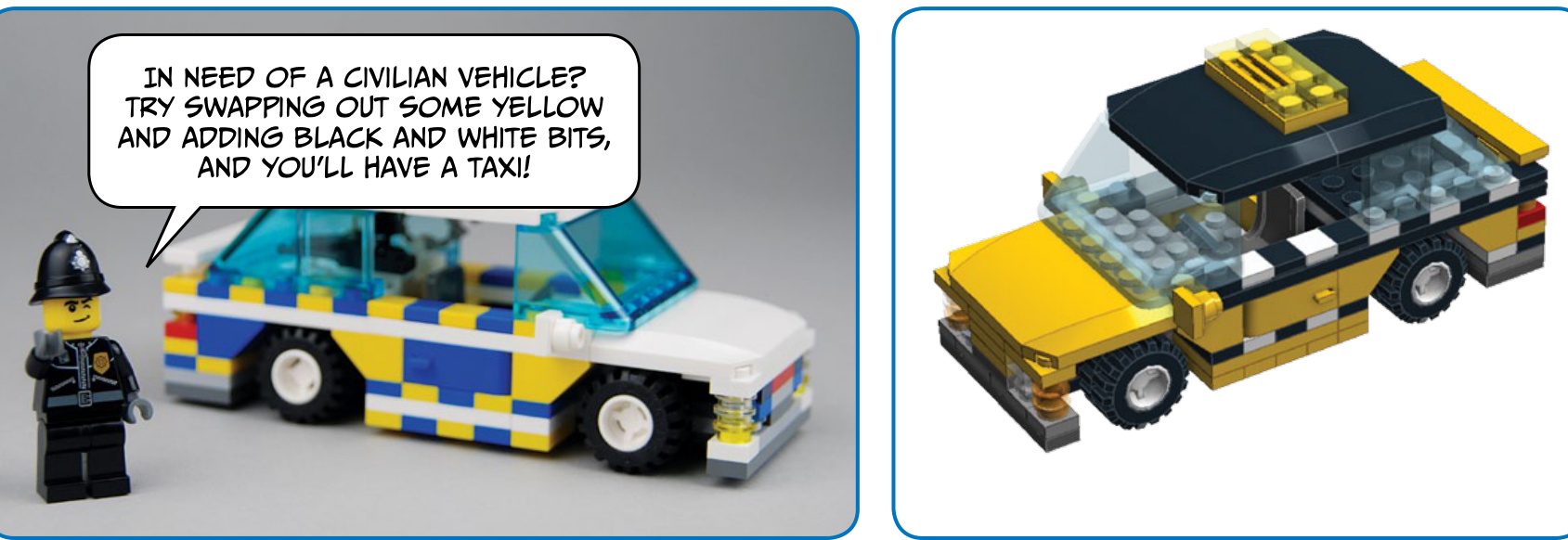
Patrol Car
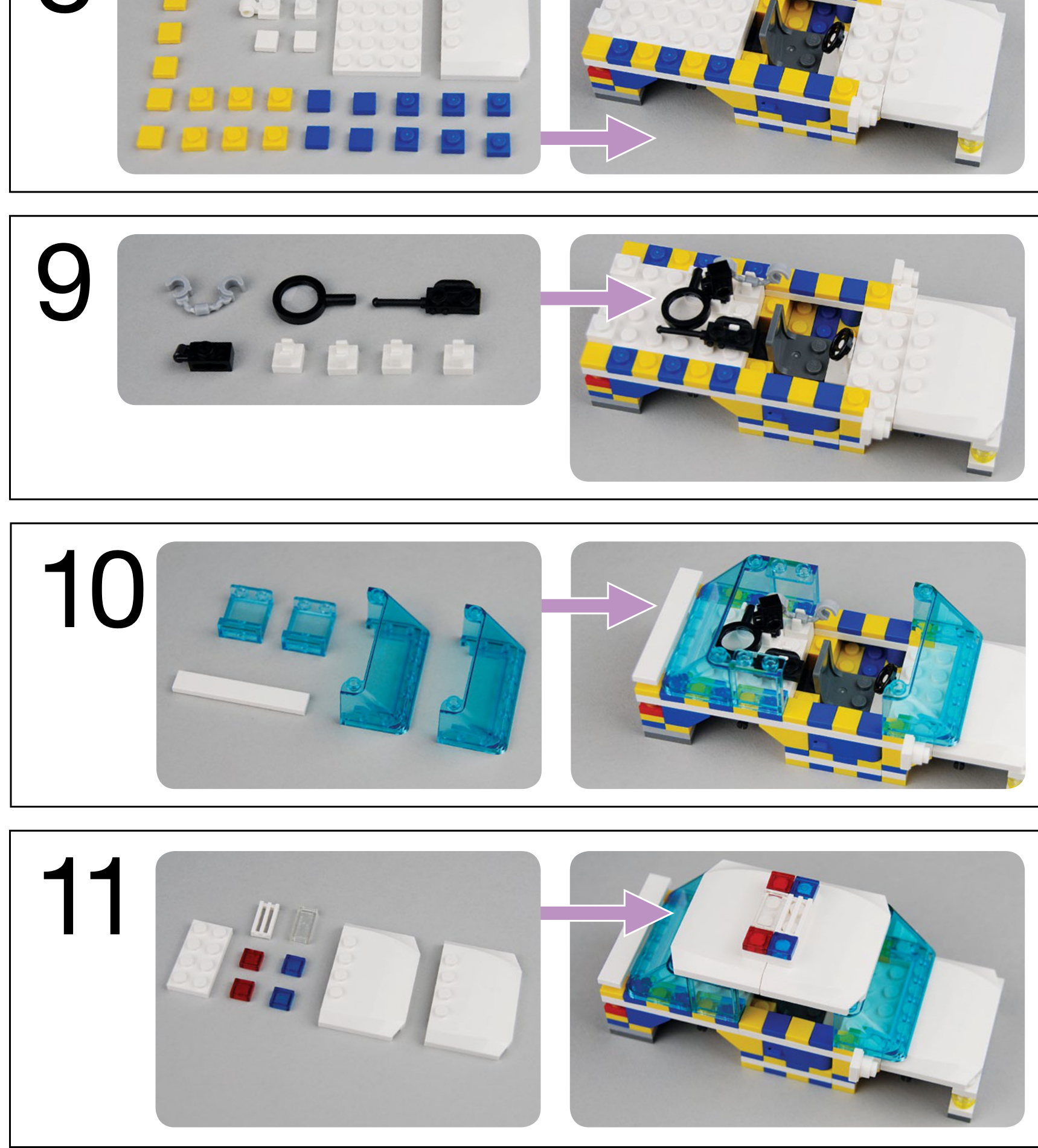
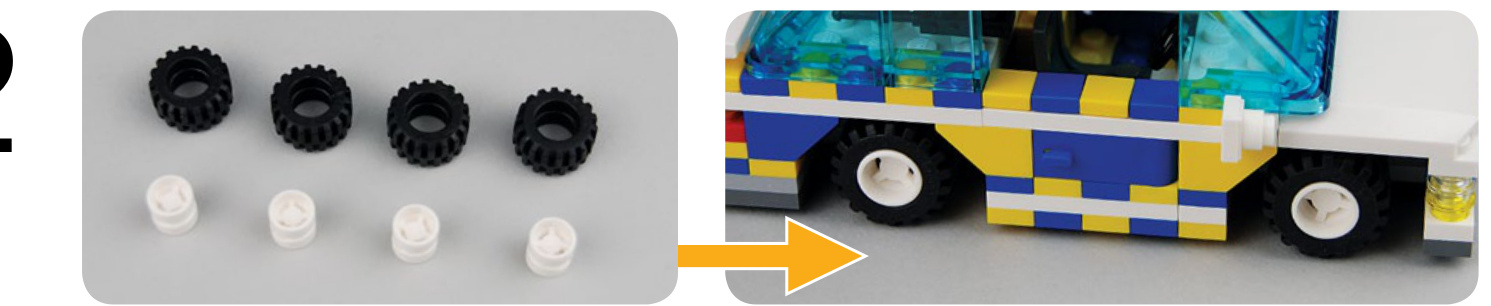
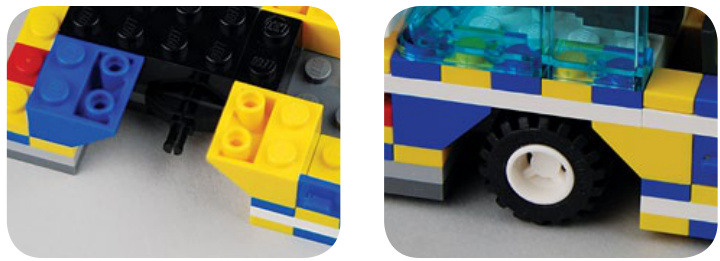
Building Tip
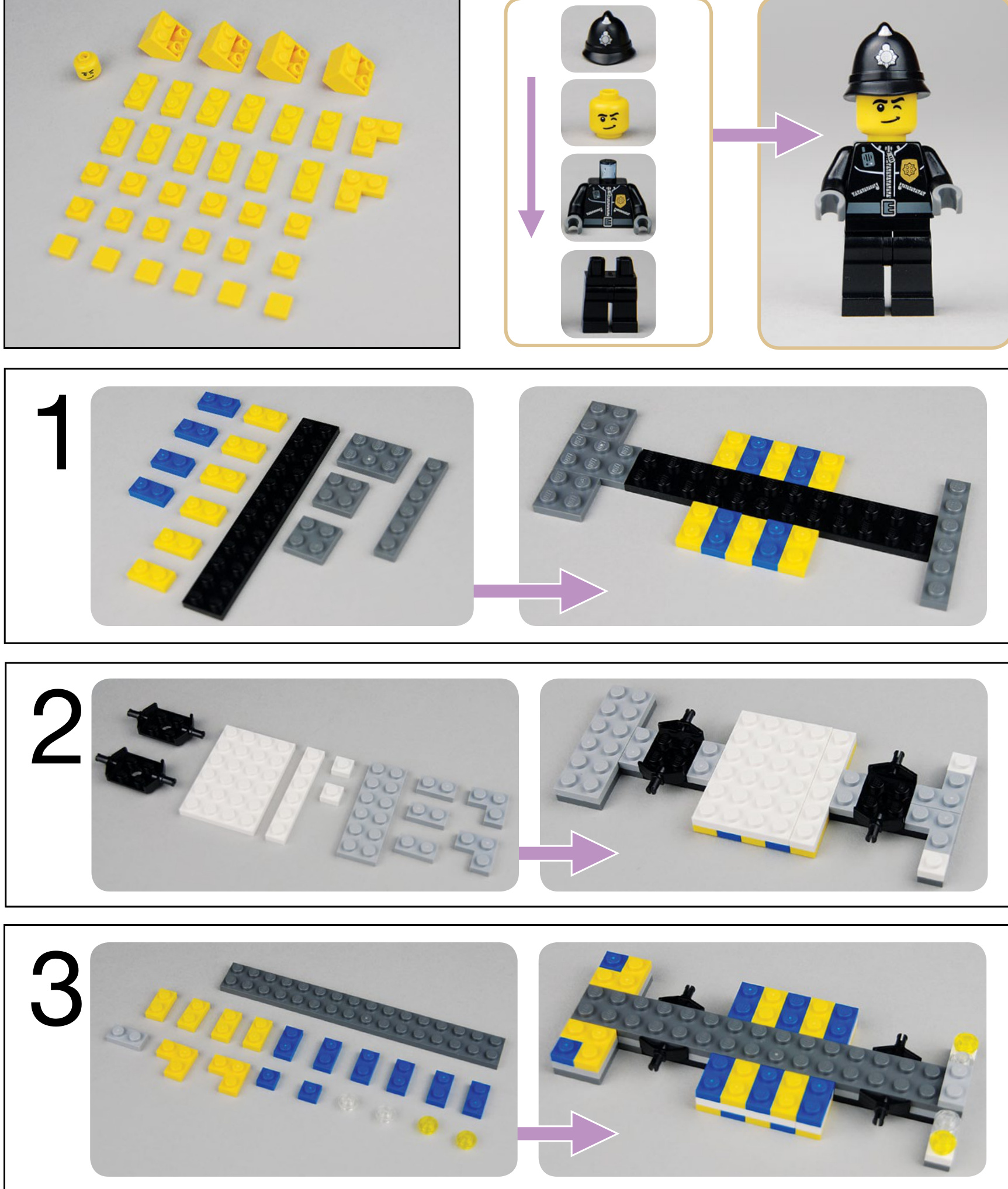
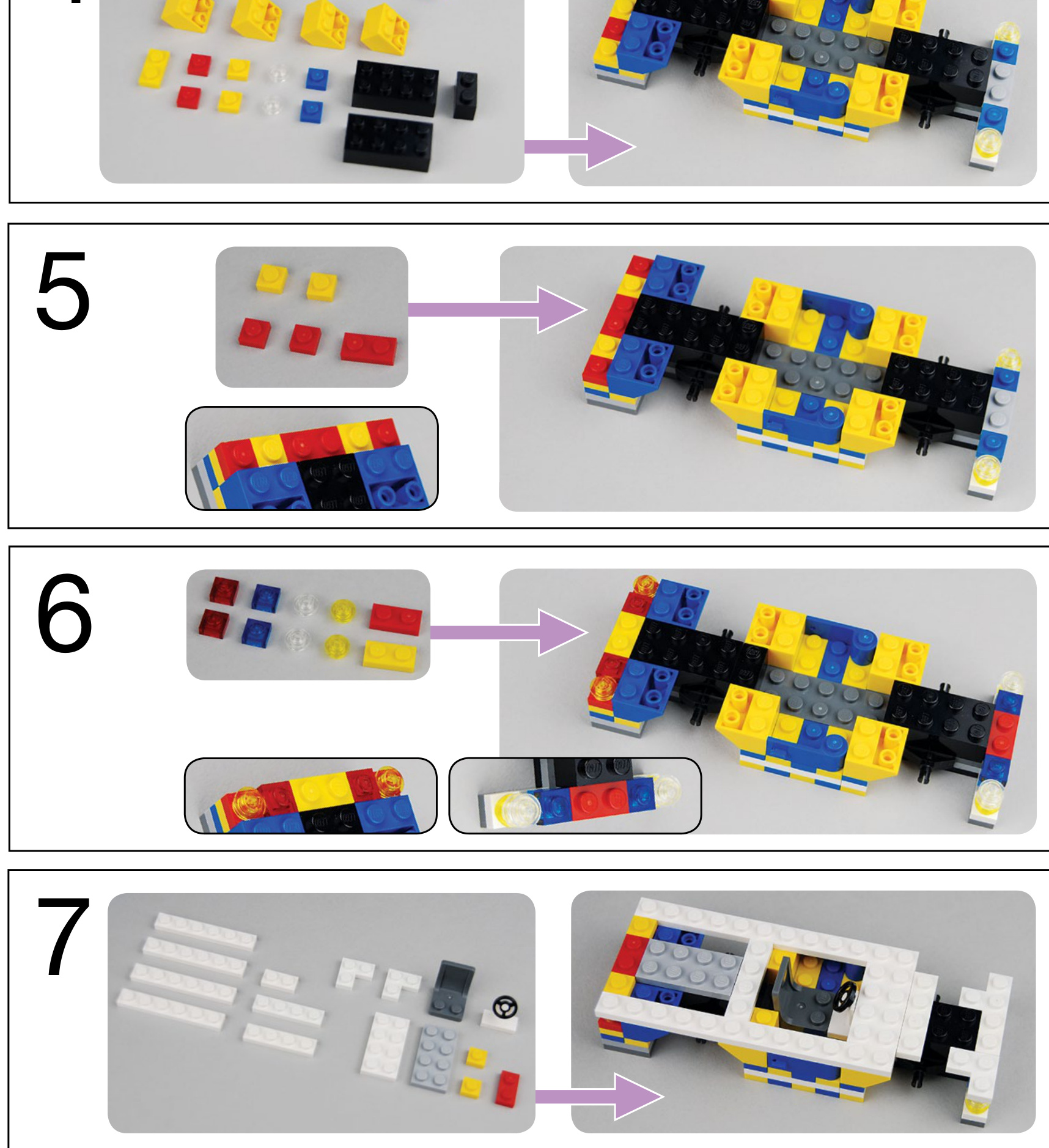
Using inverted slopes and stepping out by two studs from the inside of the chassis is a simple and clean way to build in a fender.
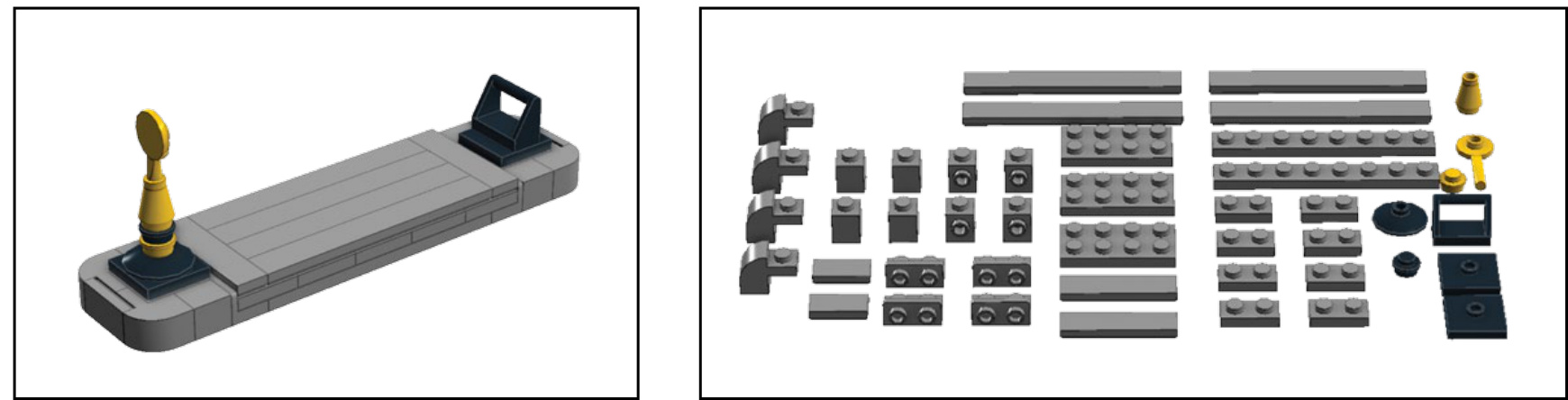
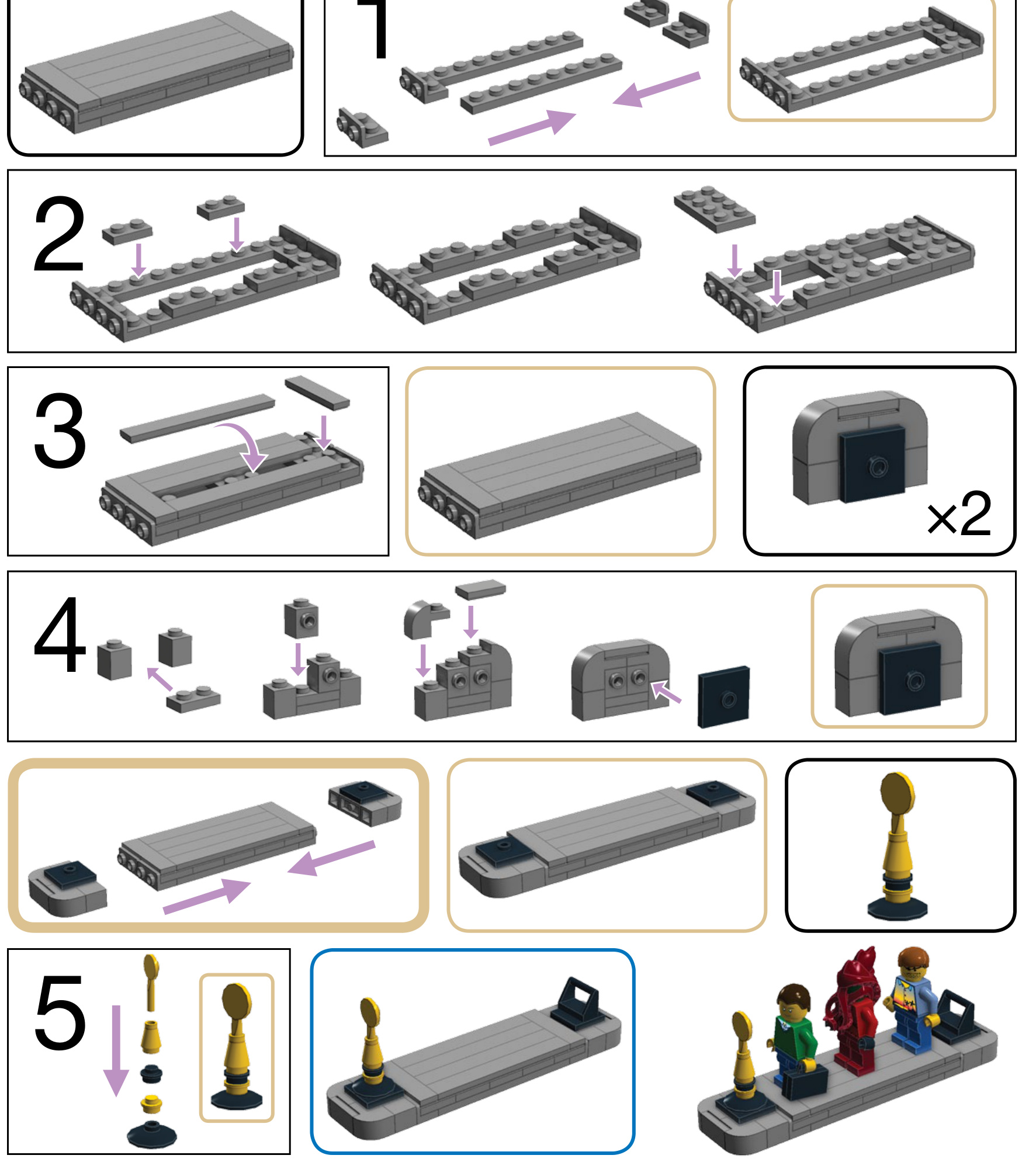
Taxi Stand
BUILDING JOURNAL
Alex’s LEGO models are ace! He told me, “I like to build from my imagination. I often reflect upon my own childhood, thinking about those amazing LEGO models I could only dream about building then.” He starts most of his LEGO models by sketching on specially designed LEGO brick paper and later works with real LEGO bricks.
He says always keeping a sketchbook nearby is a great way to record all of your ideas, and having your LEGO bricks sorted will speed up your building productivity. “Don’t be afraid to share your ideas with your friends and family. Have fun and never stop building!” Like me, his hope is to inspire future LEGO model builders, and I think he is well on his way there!

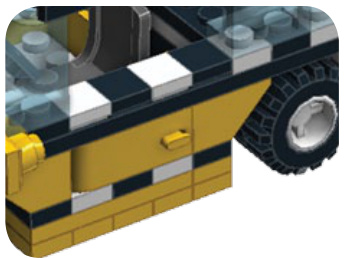
Building Tip
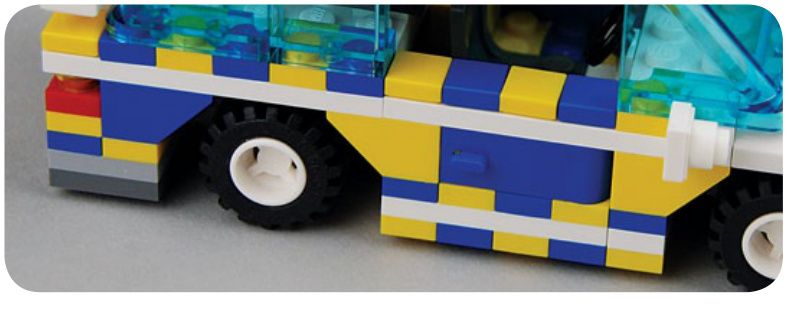
Using two colors of plates results in a nice checkerboard pattern for the side of your vehicle. You can add a pretty slick pinstripe in a single contrasting color.
Dinner and a Show
Matija Pužar

Nickname: Matija/Puma
Profession: LEGO Certified Professional and IT Developer
Nationality: Norwegian
Website: www.matija.no/
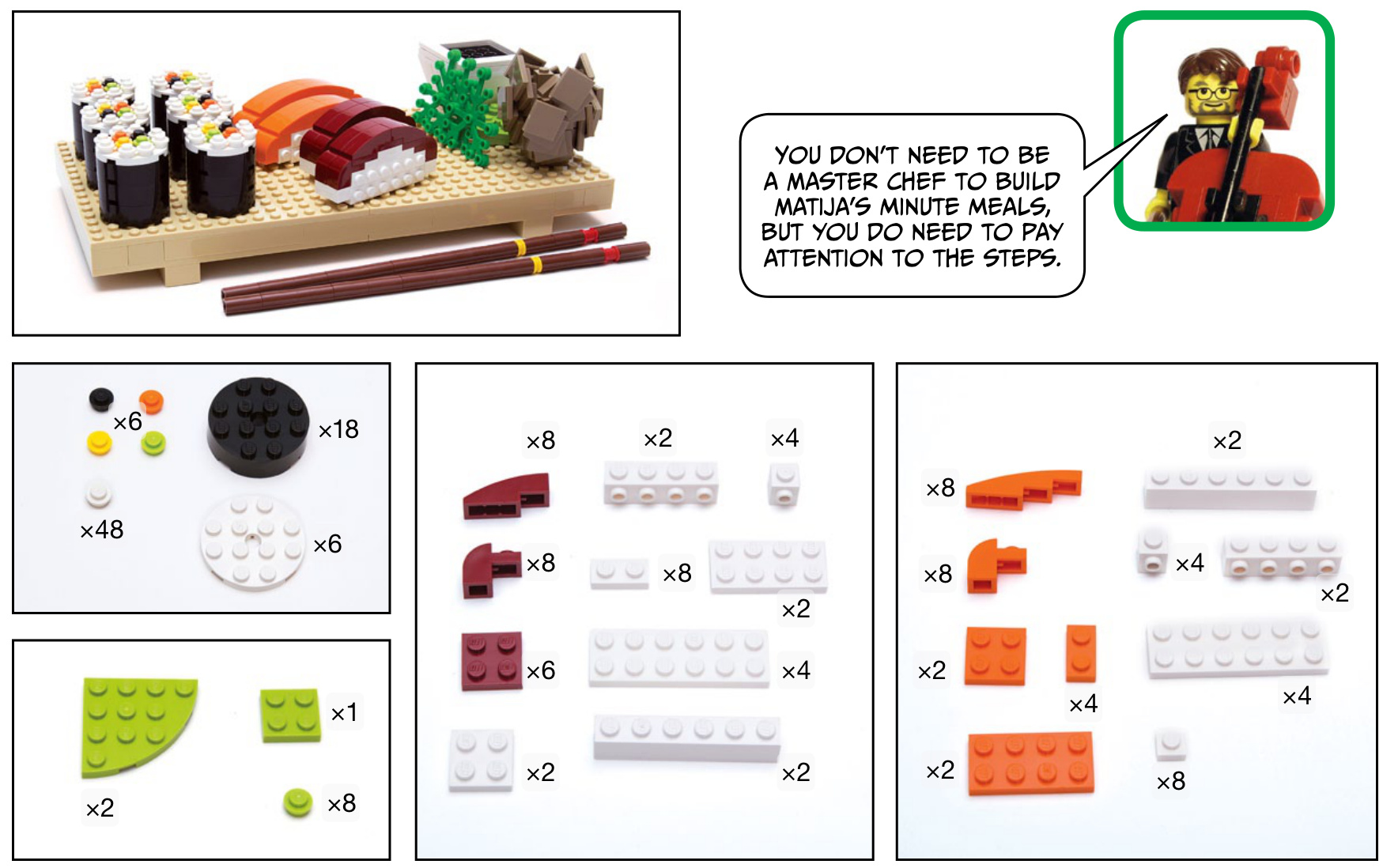
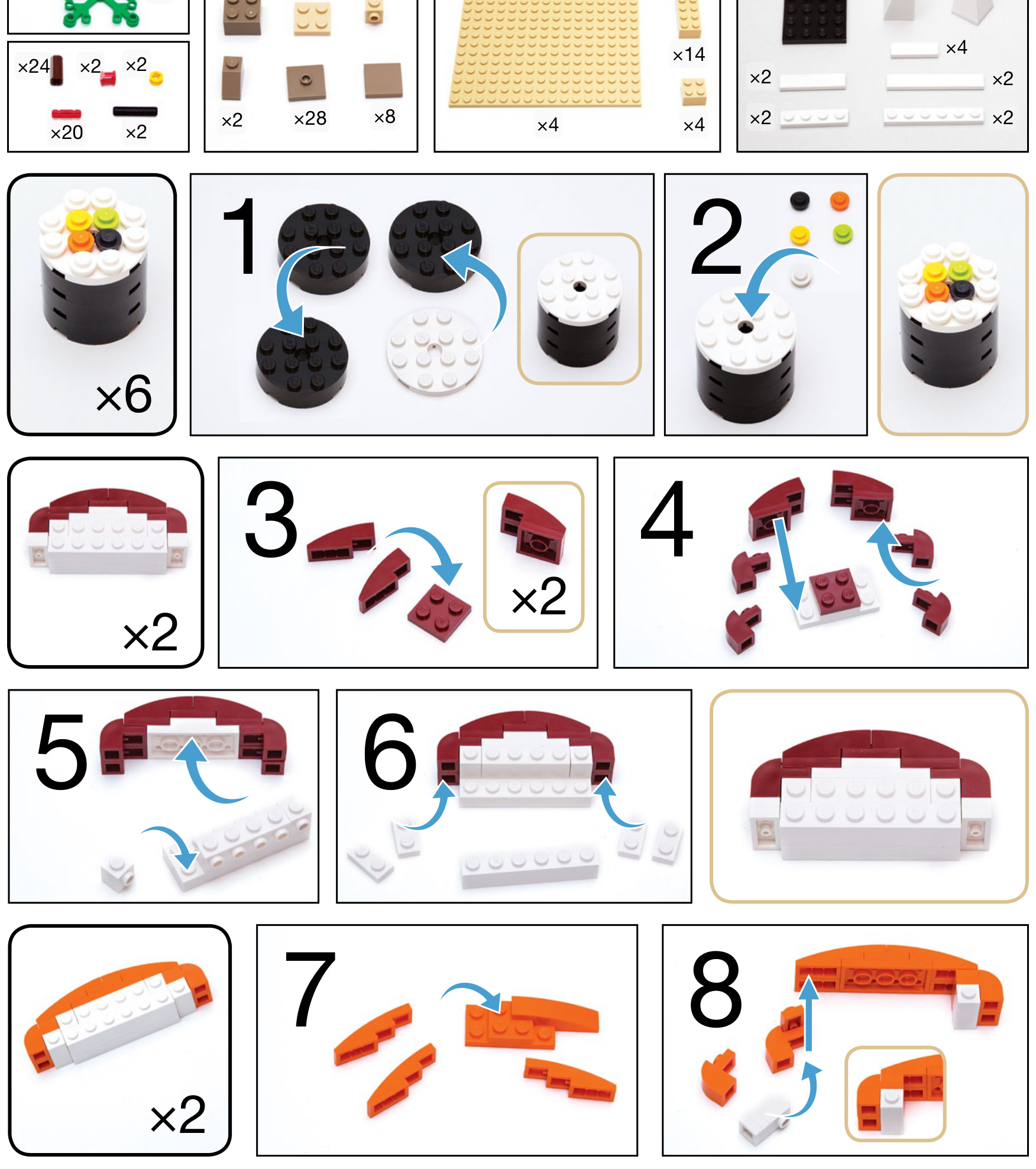
Scrumptious Sushi
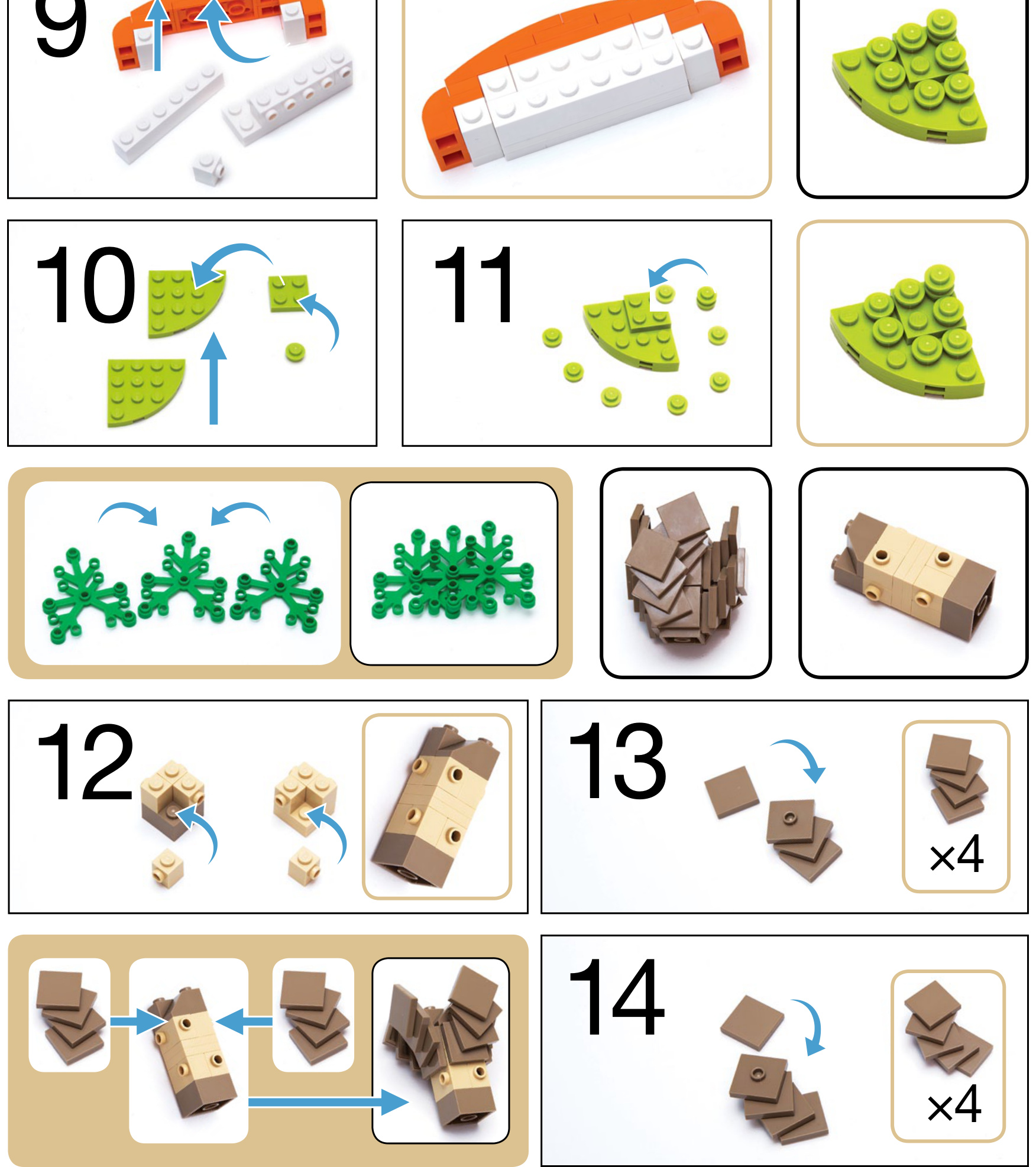
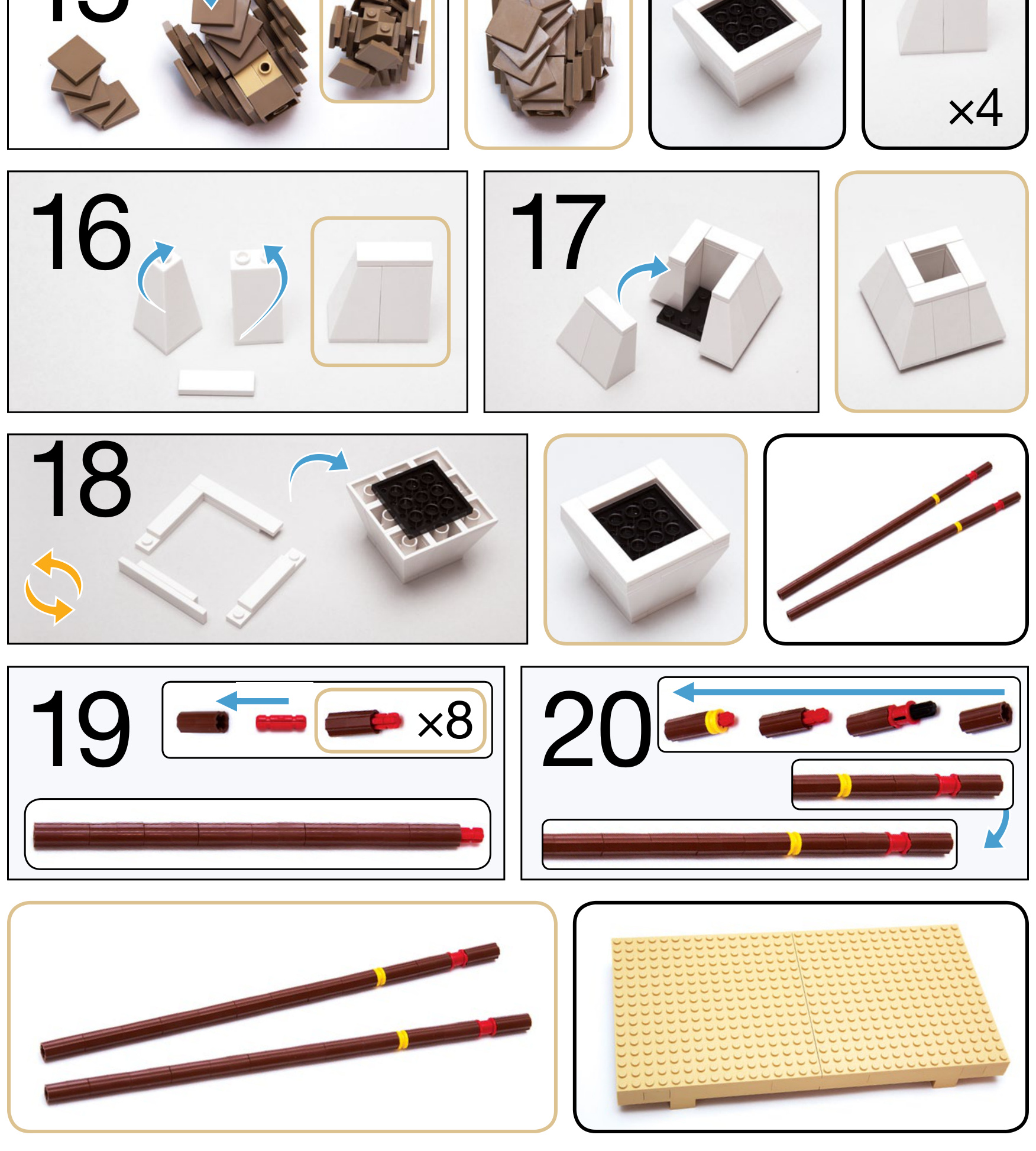
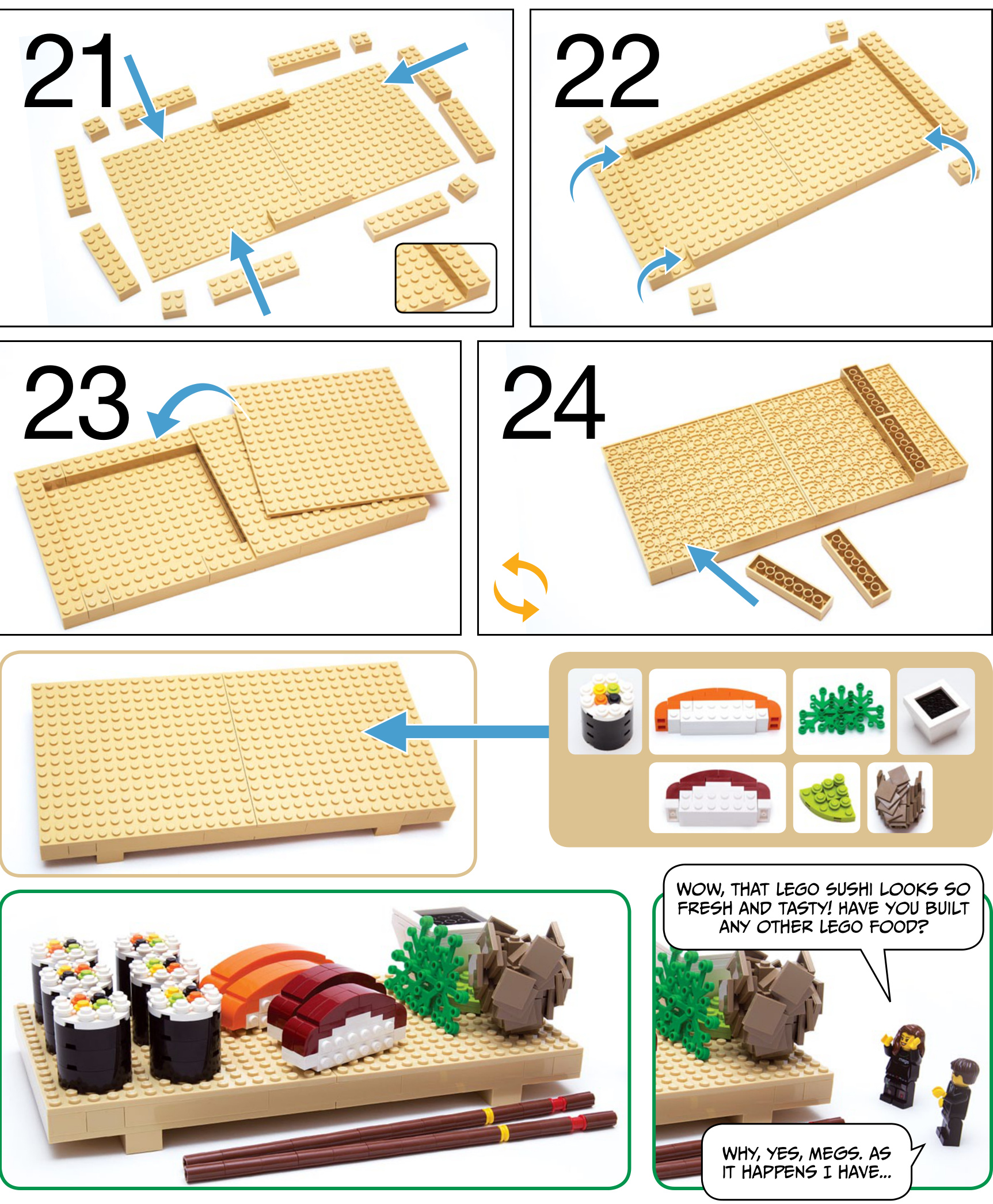
Brick Burger
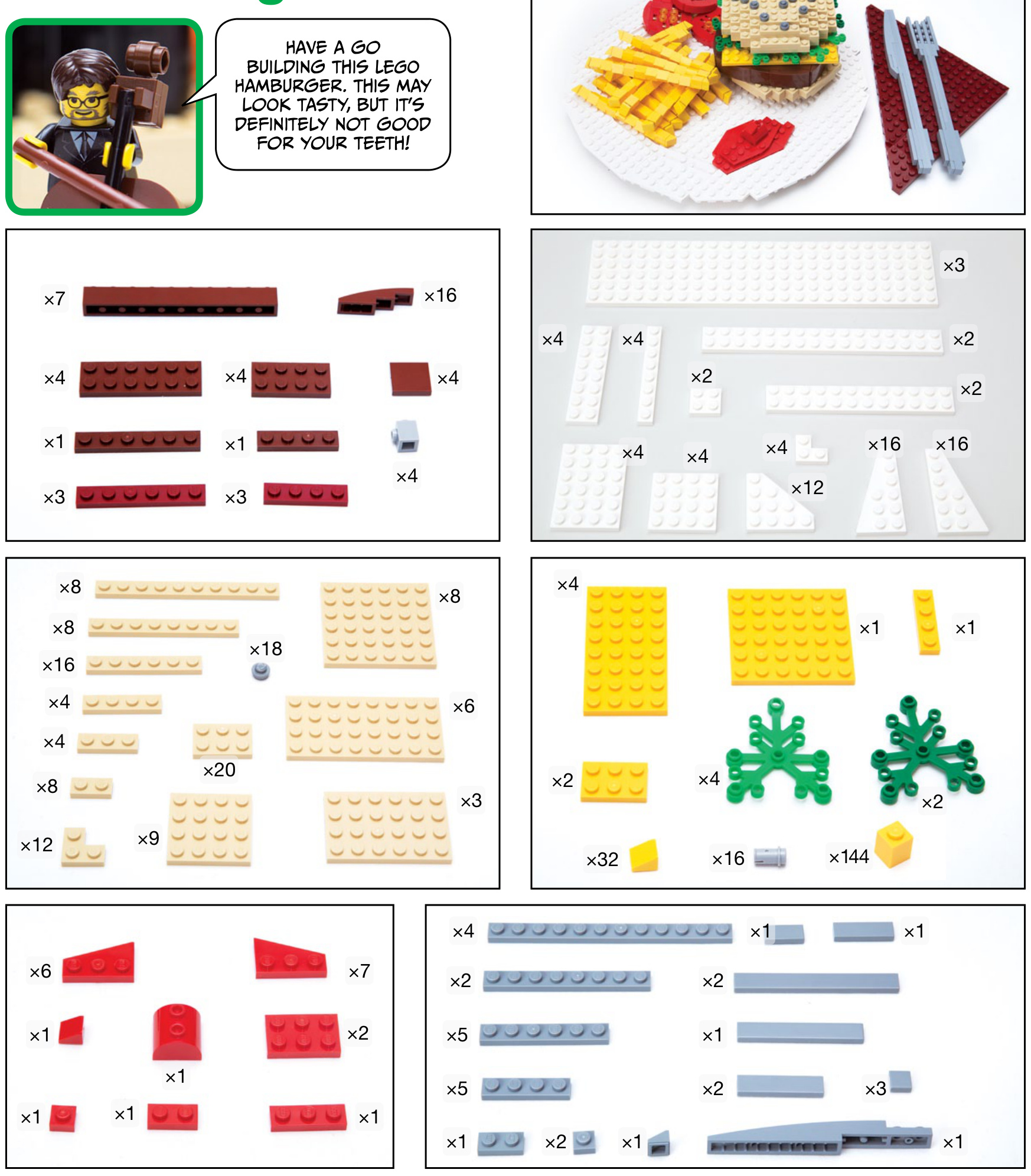
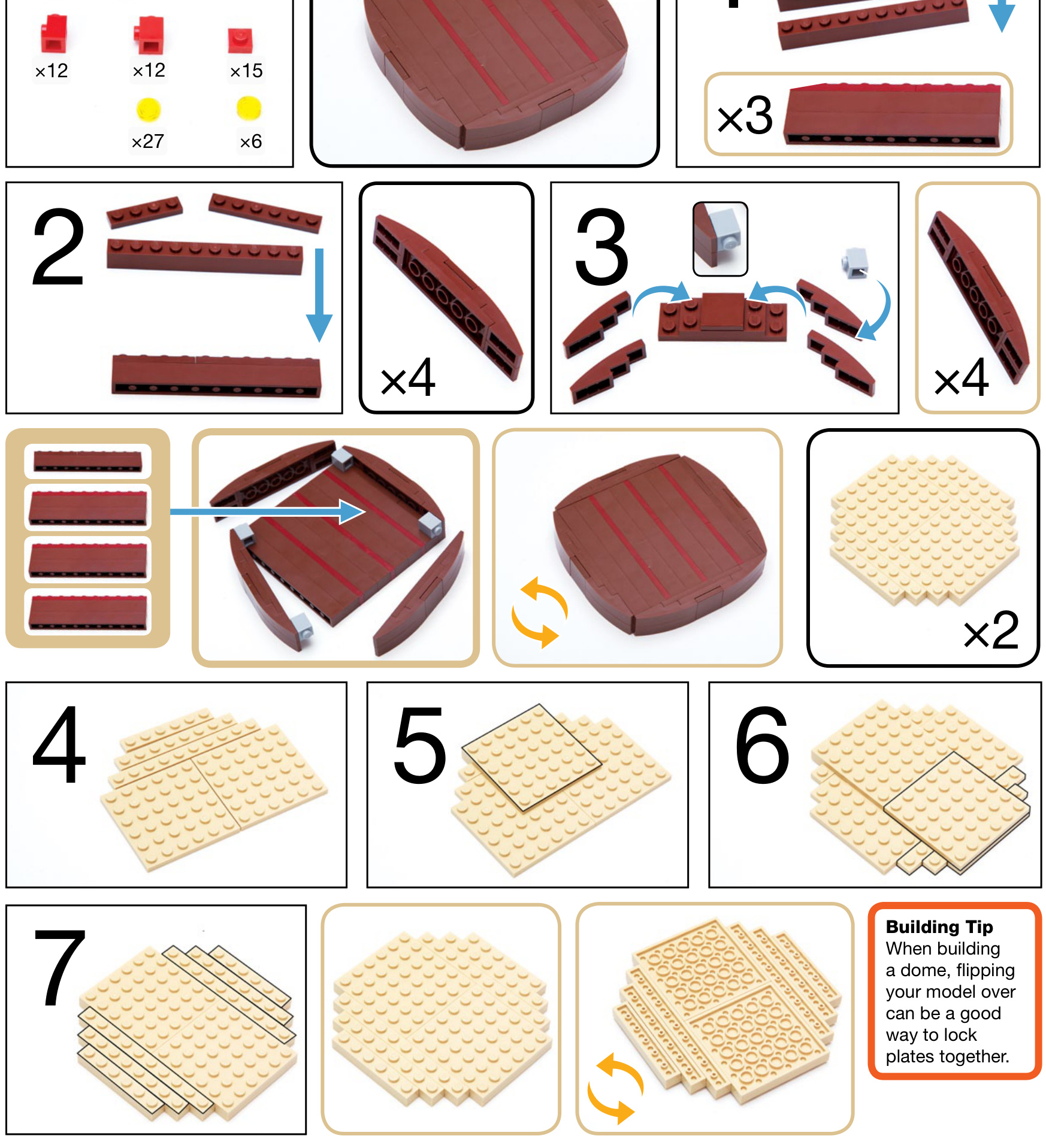
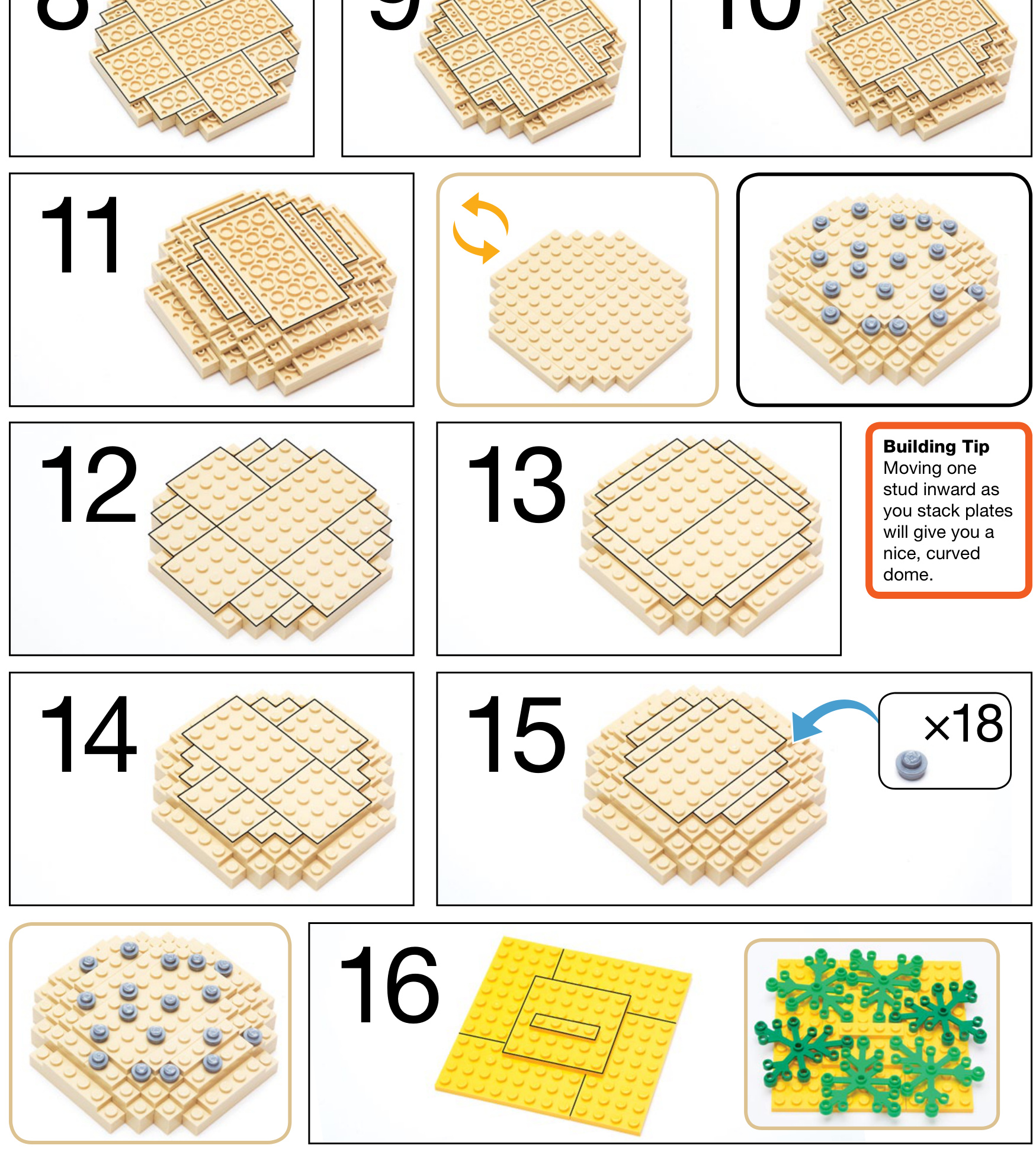
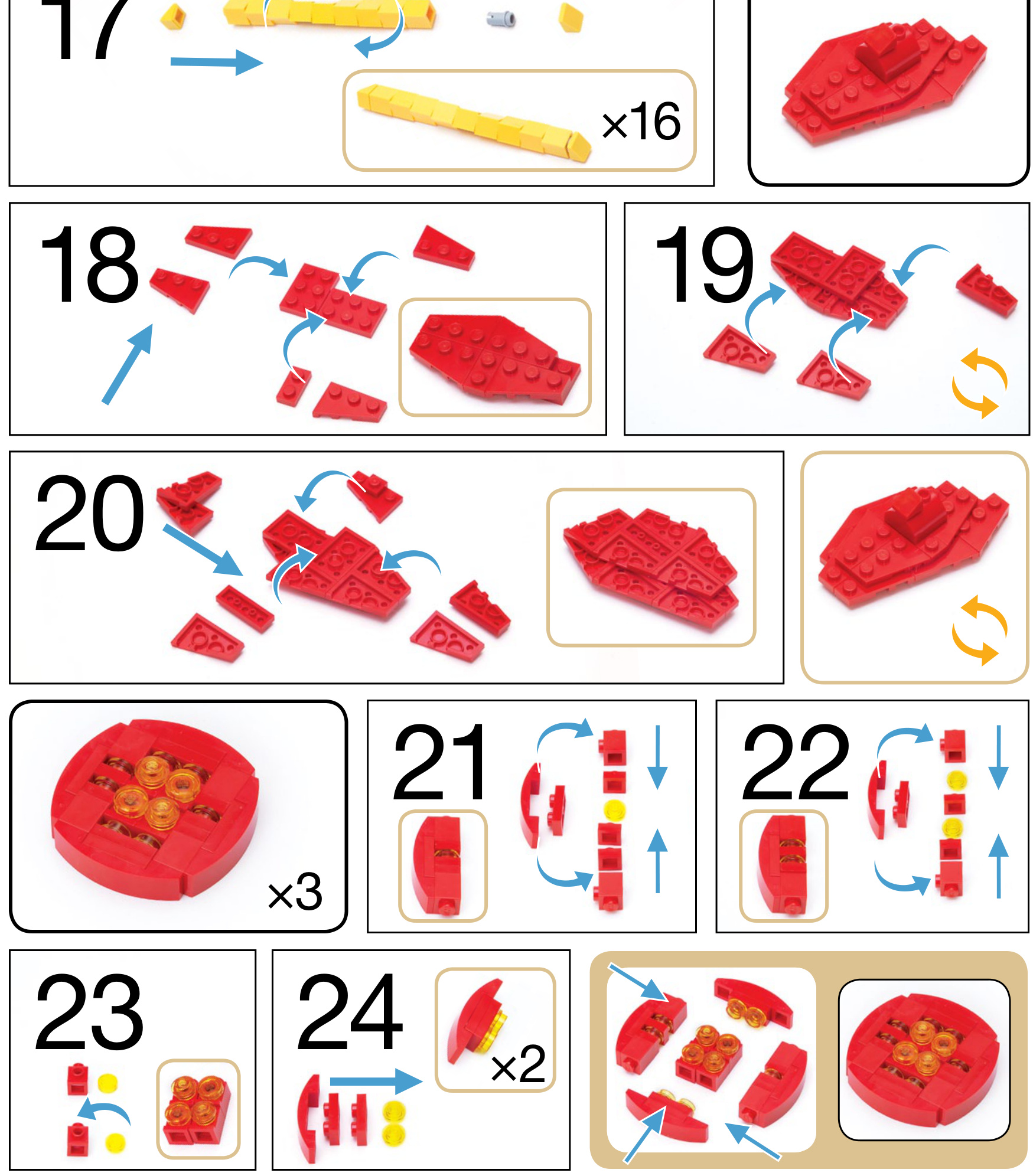
Building Tip
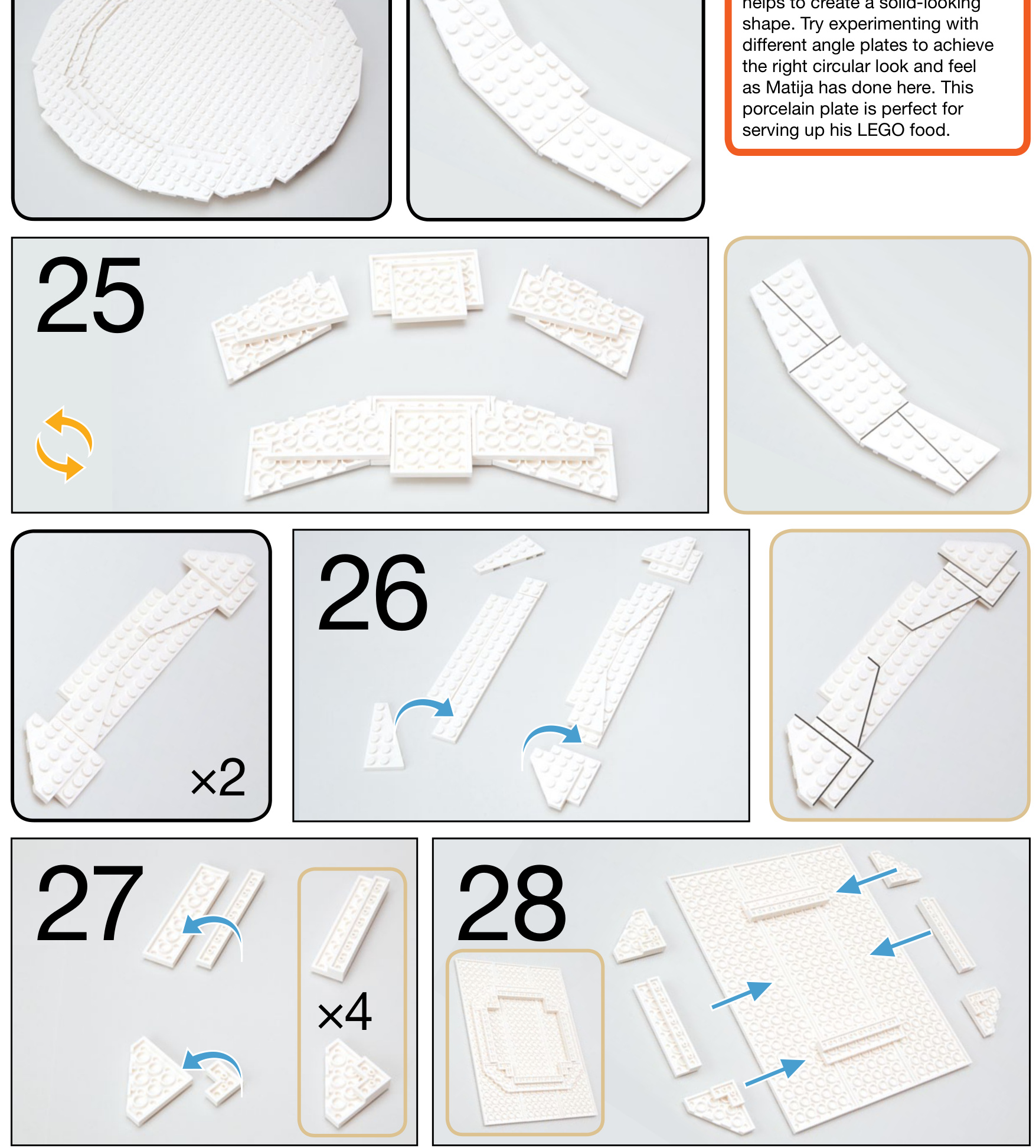
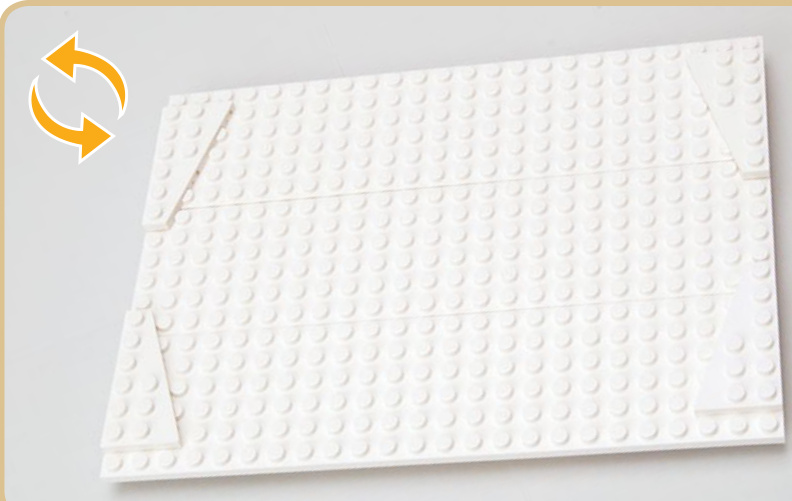
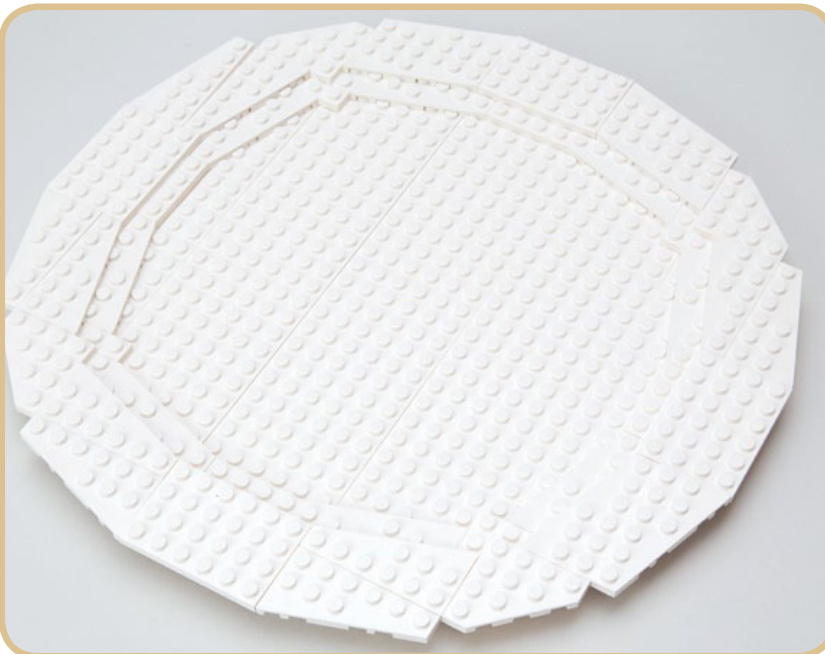
BUILDING JOURNAL
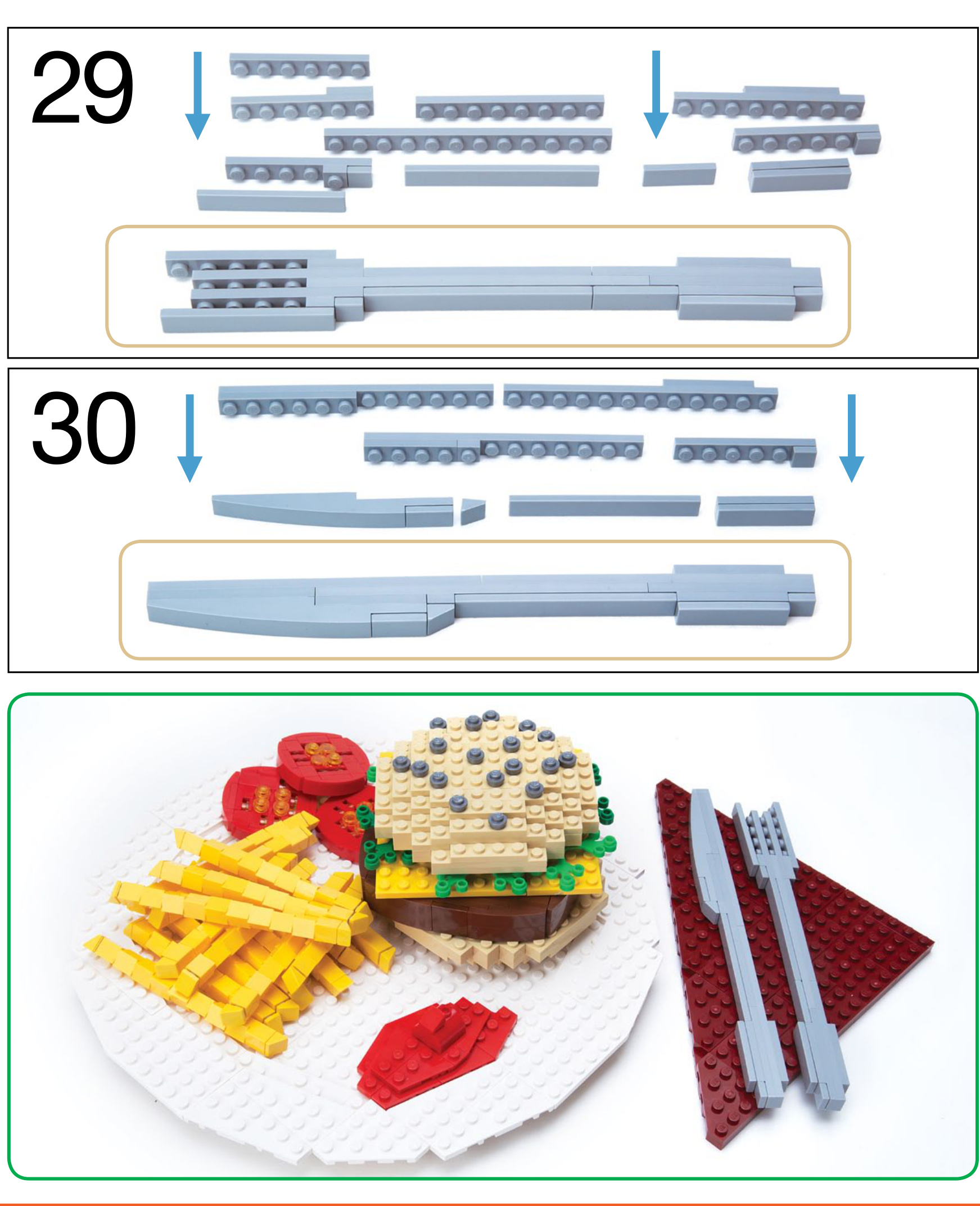
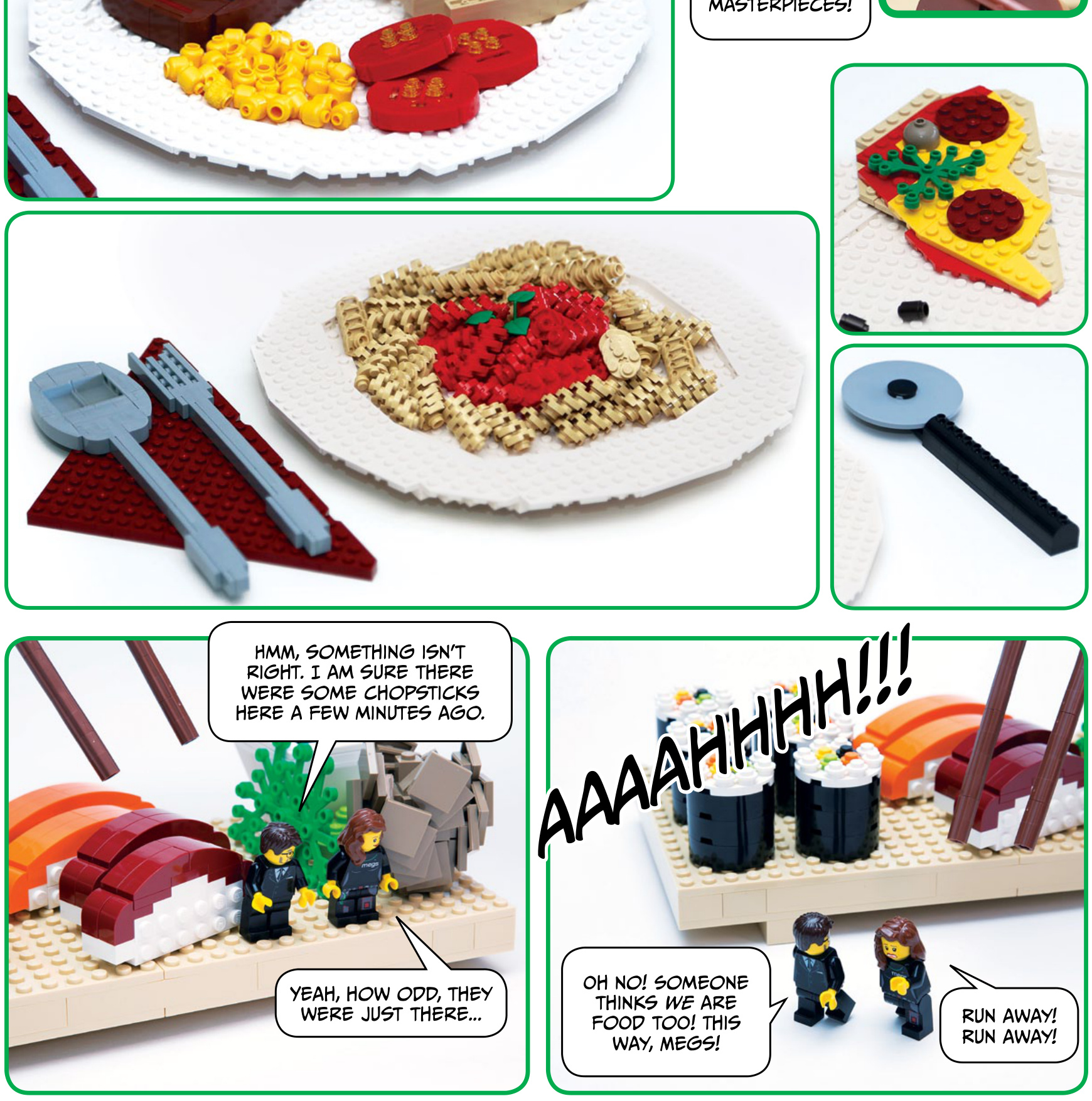
Matija’s minute meals are ace! His use of 1:1 scale and choice of color schemes make his food very realistic. Combining brown with dark red on the brick burger tricks your eye into thinking it is real and fresh off the grill.
The presentation of the food on a plate just adds to the realism. Matija told me he pays close attention to the natural color, shape, and texture of food to capture it properly. Working from either reference images or real food will help you build something realistic and appetizing. I wonder if my yard could use a giant watermelon?
Matija’s Minute Meals
Once you
start, you just can’t stop.
Here are some
more culinary
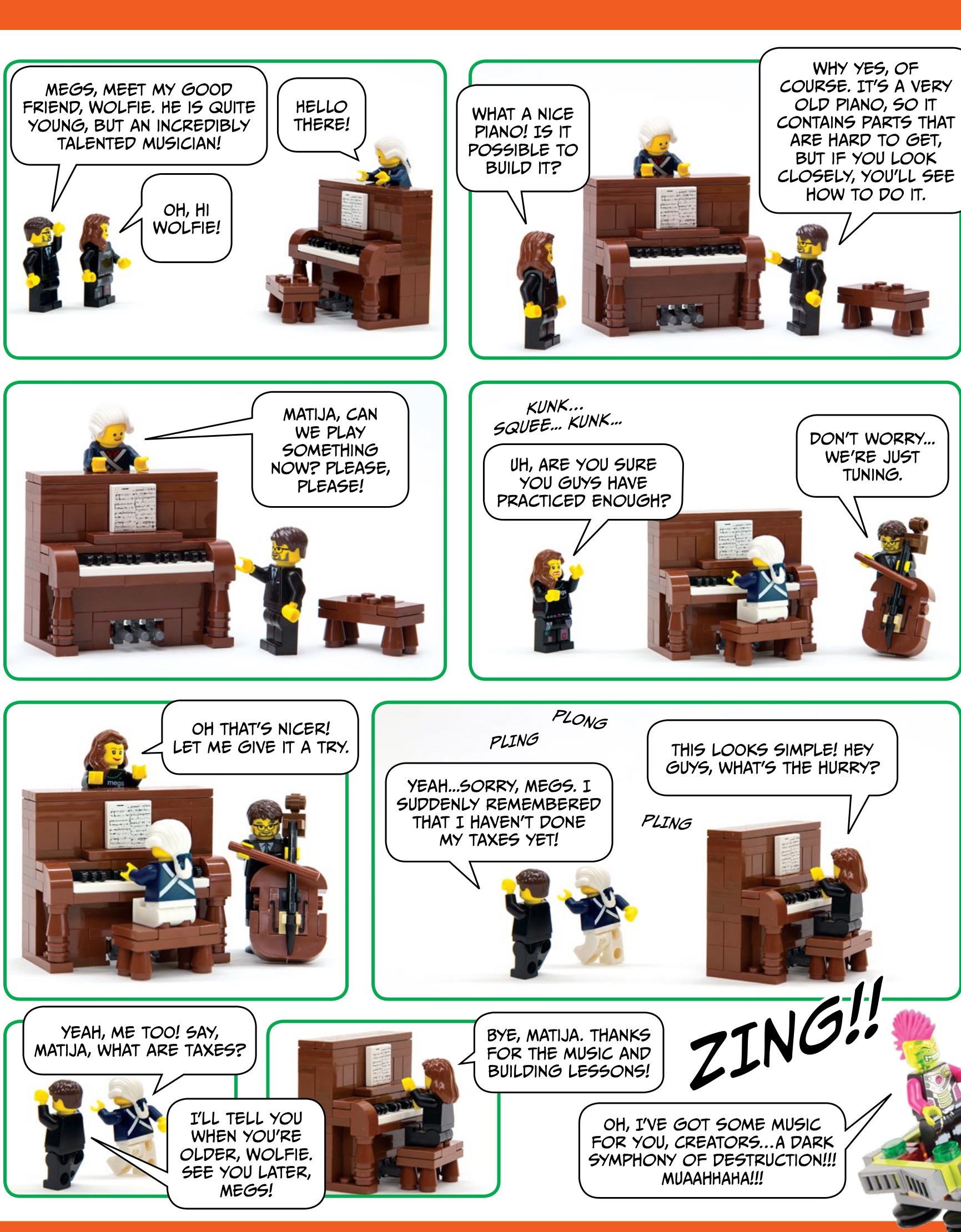
At the Symphony
Croatian National Theatre
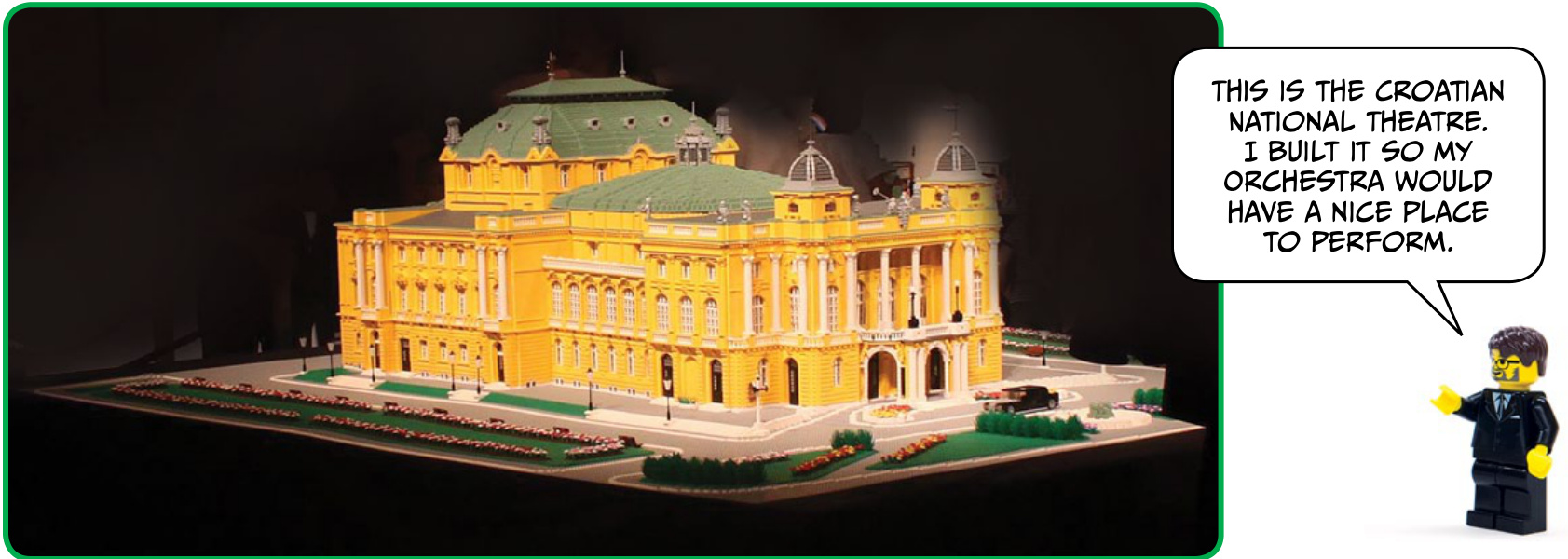
BUILDING JOURNAL
Matija’s professional LEGO work is so inspiring! He can build pretty much anything he sets his mind to.
As a LEGO Certified Professional, he builds a lot of models for a wide client base. He told me it is very important to be able to understand clients’ needs and pay close attention to your parts budget. Keeping a model simple and retaining the iconic details can be challenging, but the end result is well worth it. Time management and a good solid plan will get you far. His passions for music and LEGO model building go hand in hand. He has shown me there are no limits to turning what you love to do into a career!
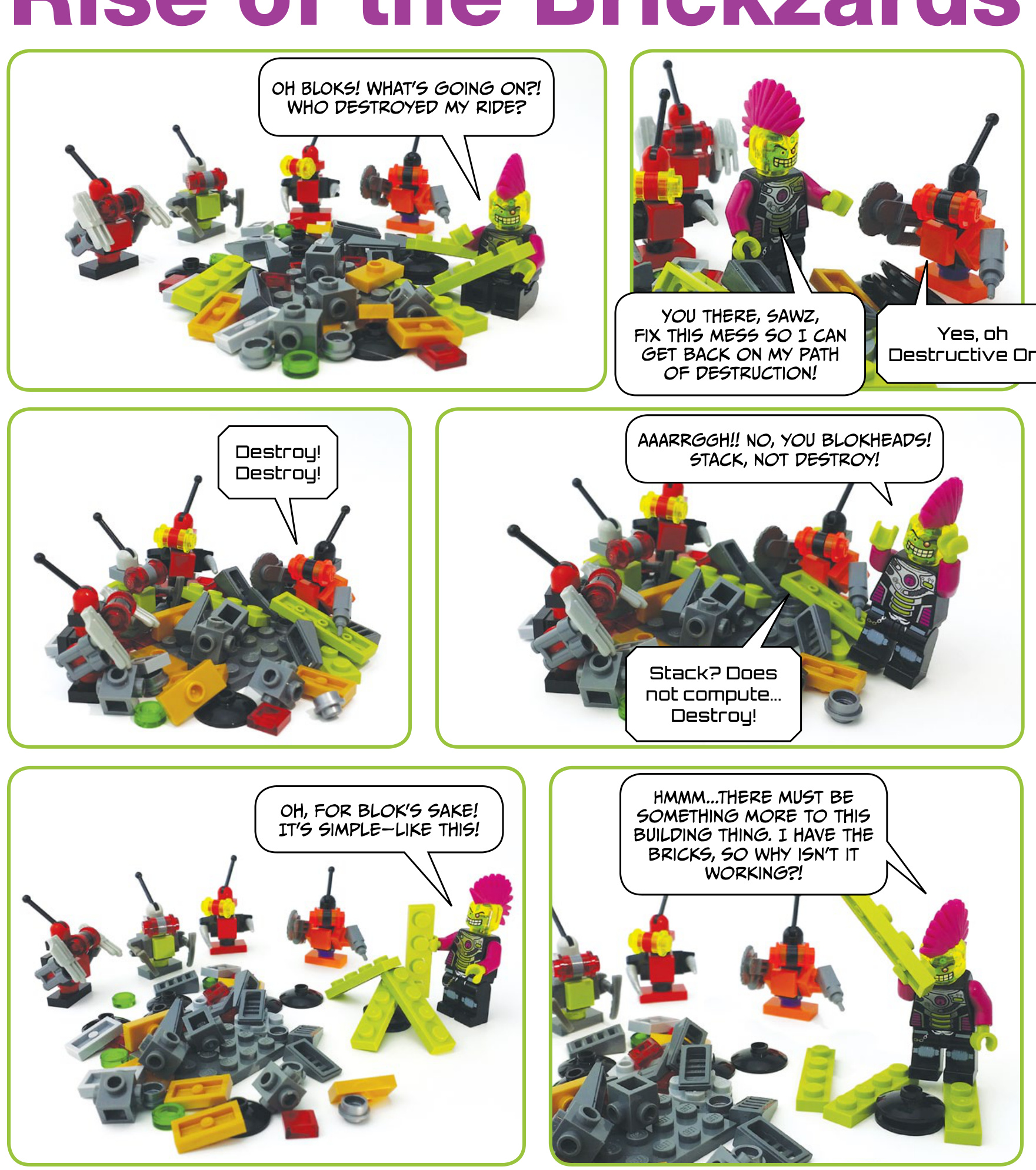
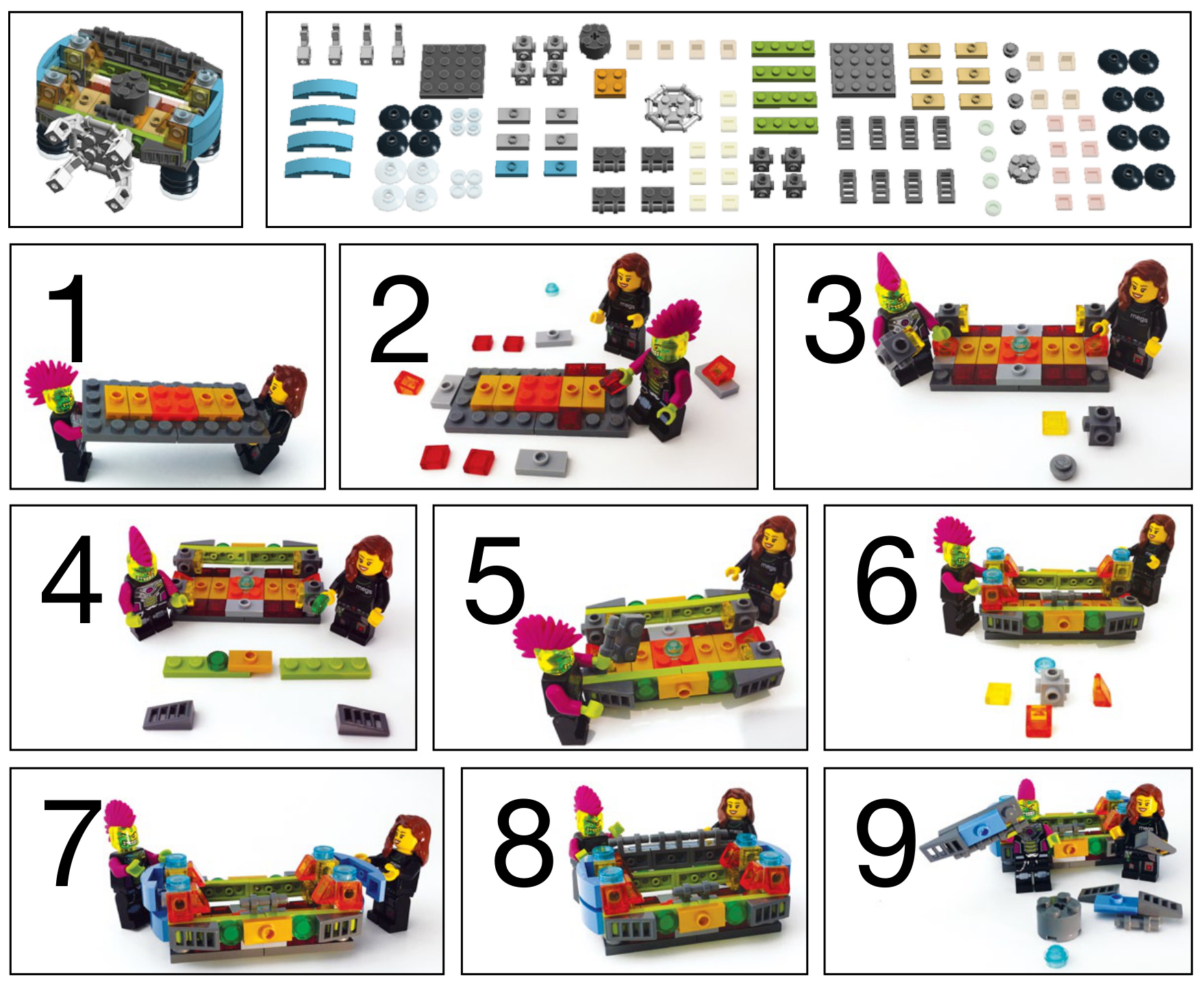
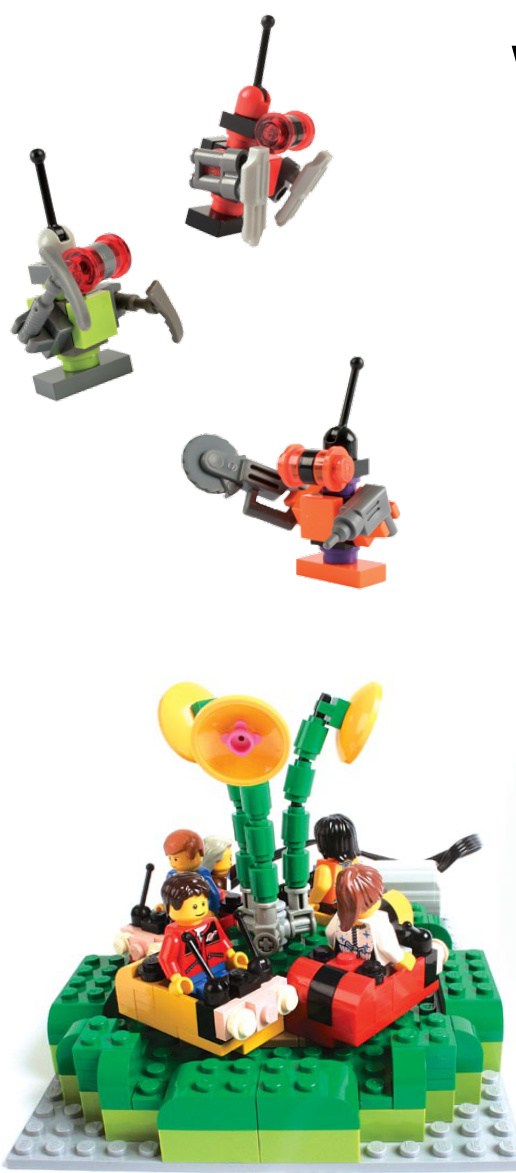
Rise of the Brickzards
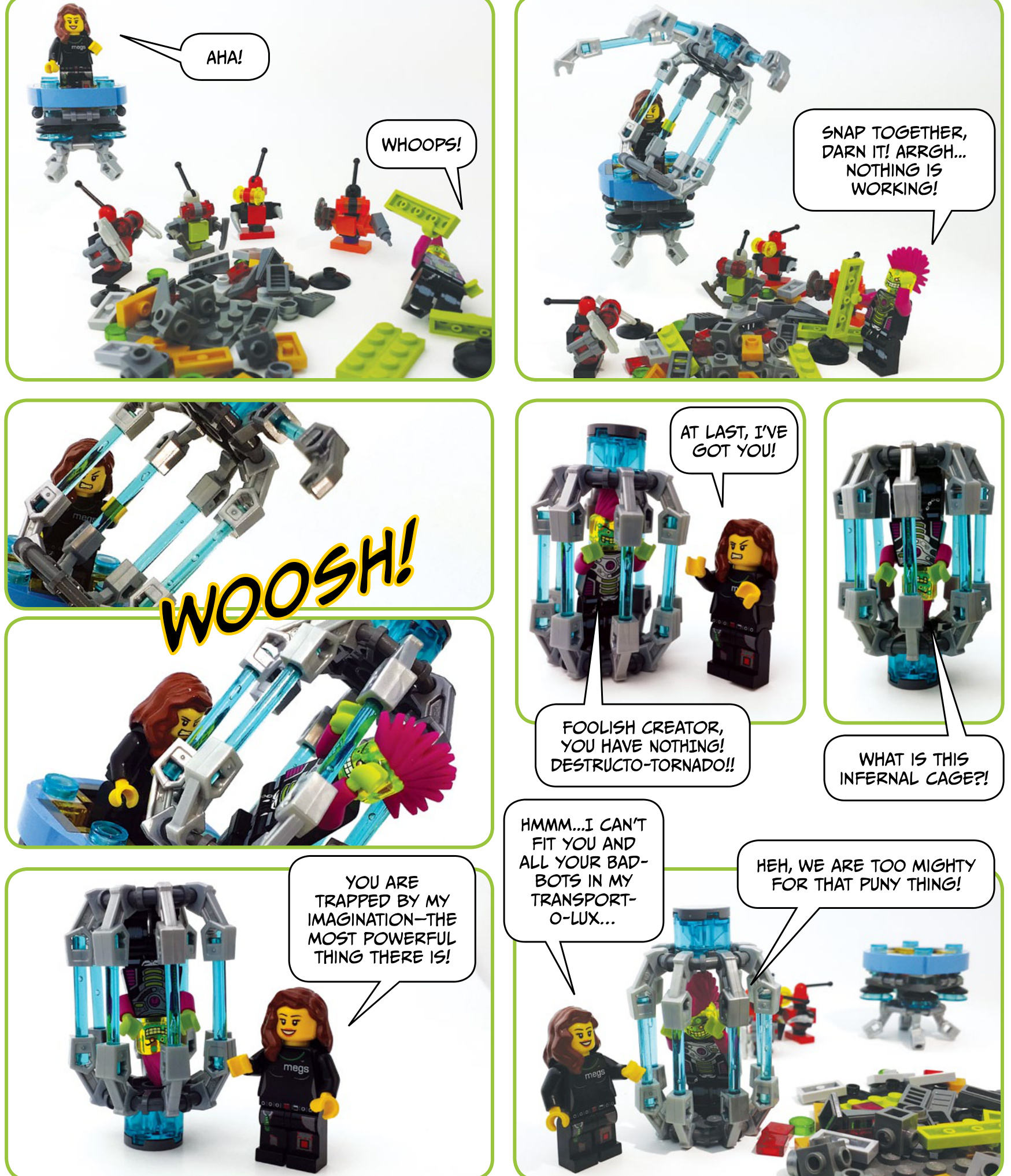
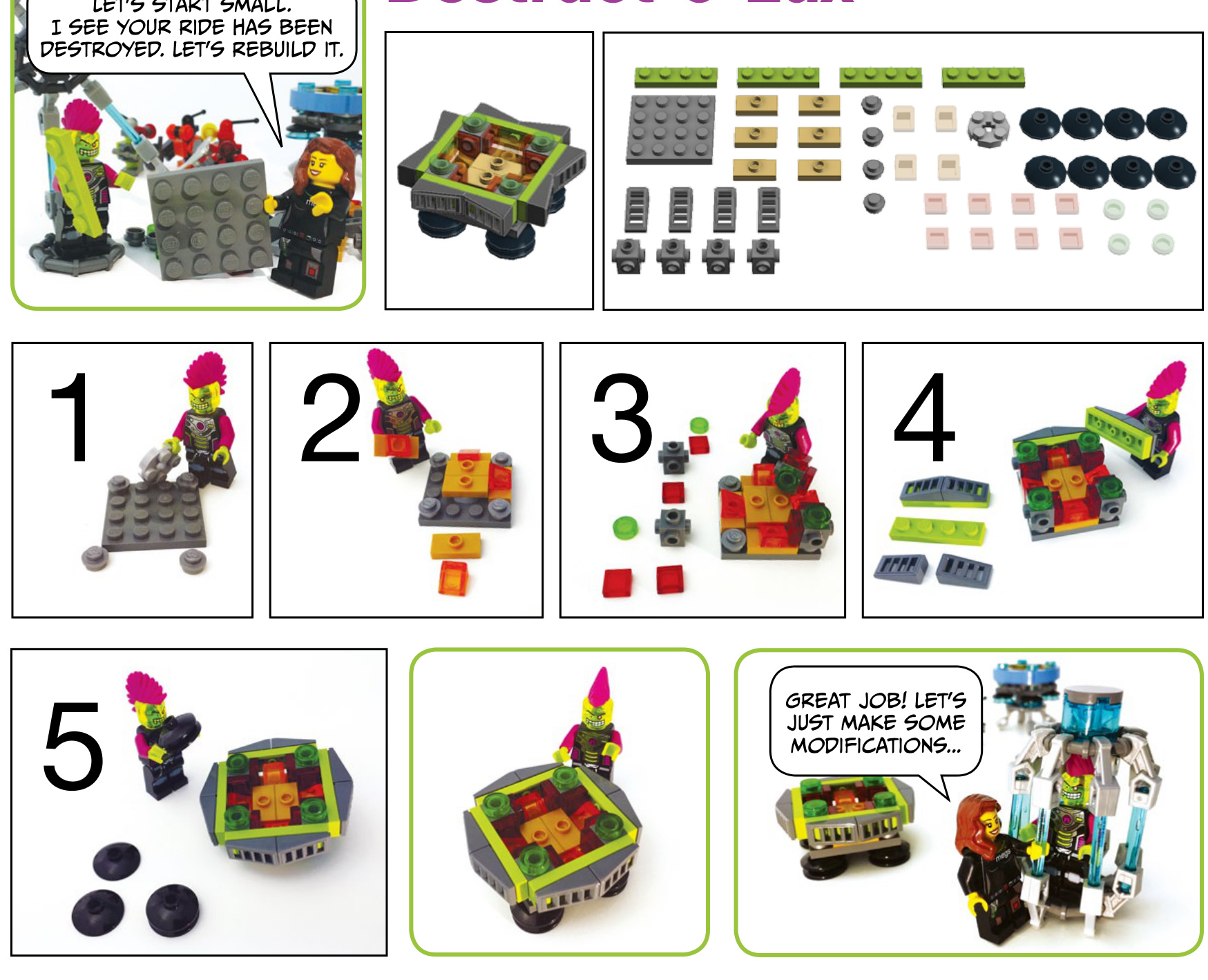
Destruct-o-Lux
Transport-o-Lux Deluxe
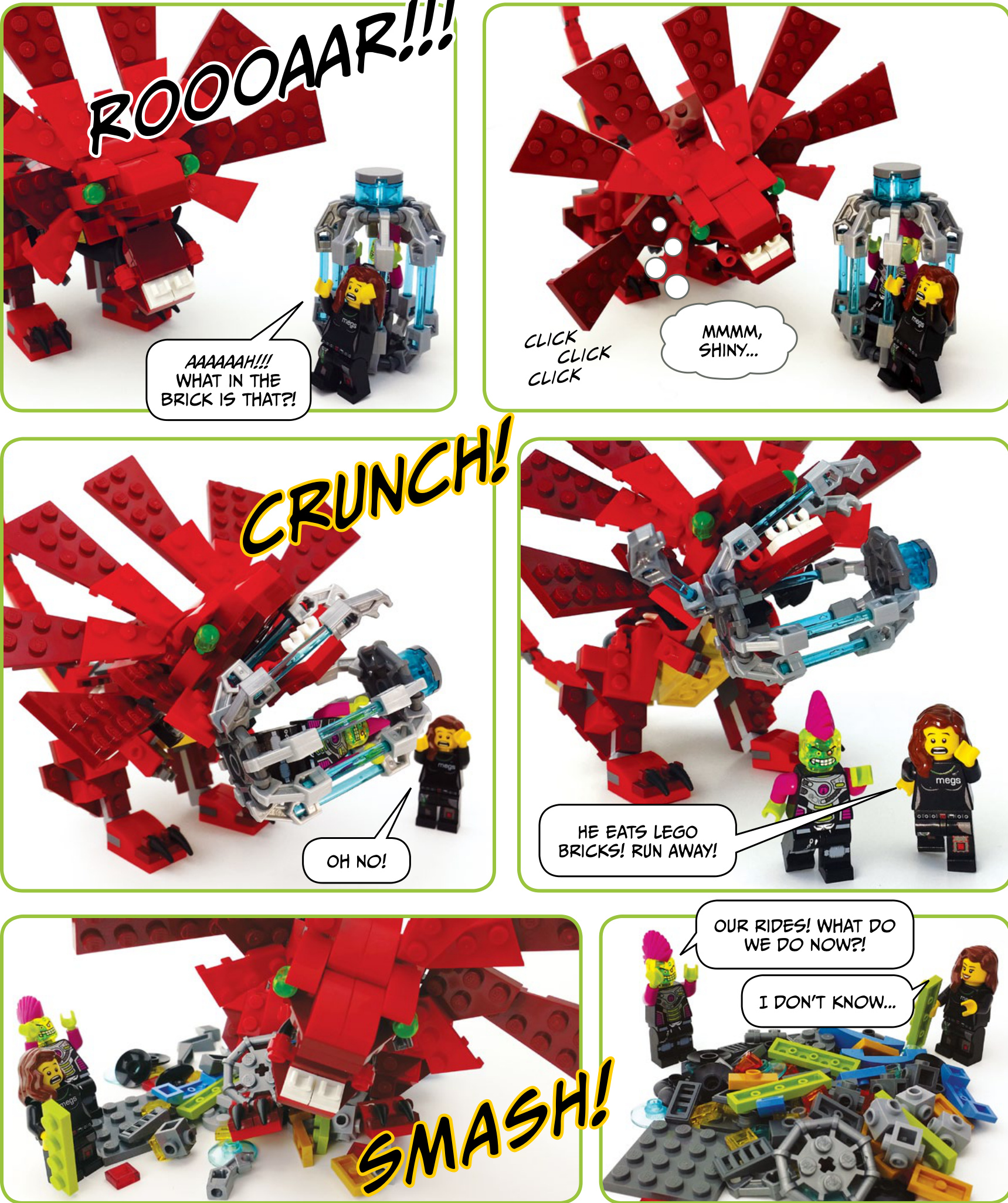
Frilled Brickzard
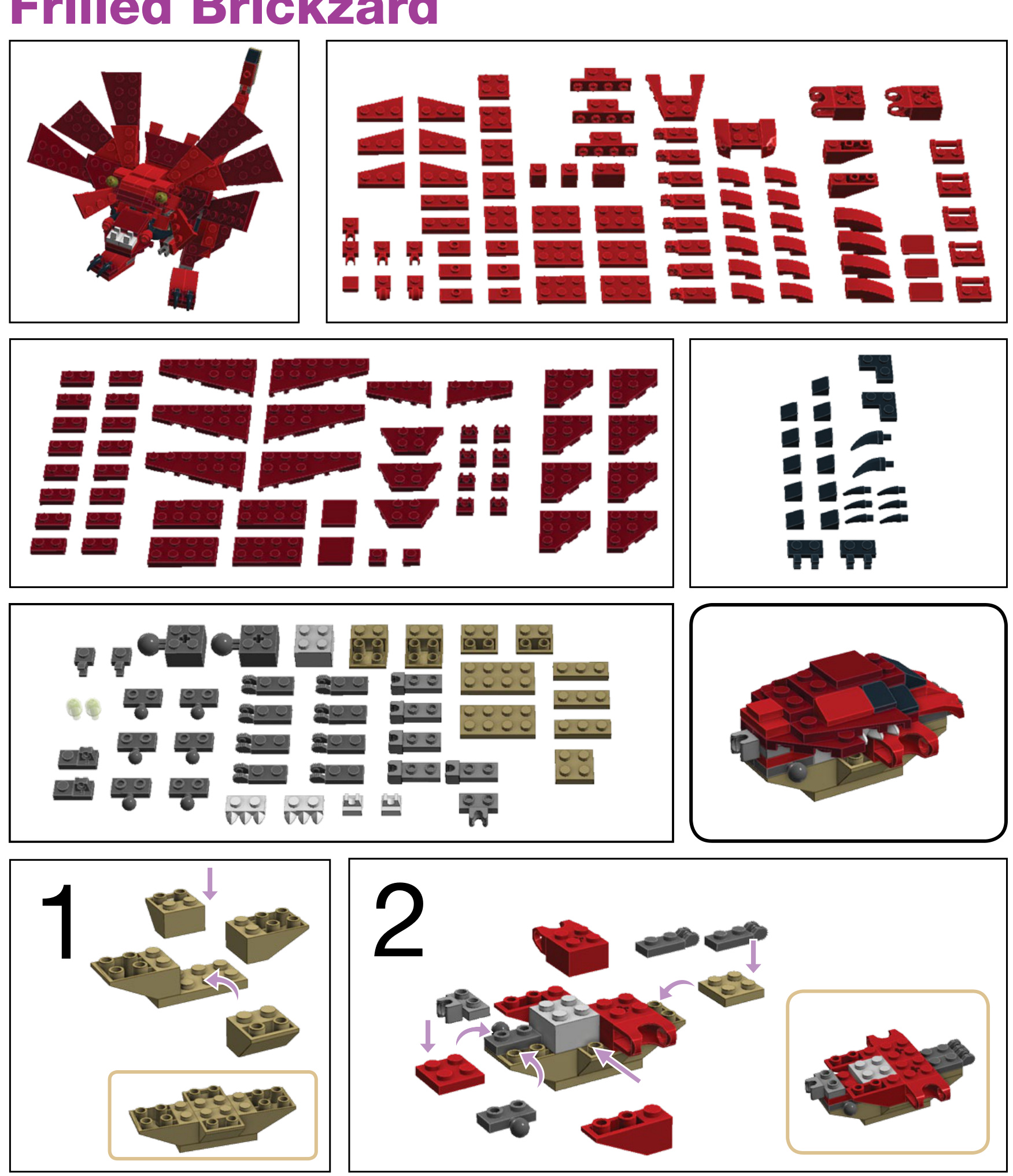
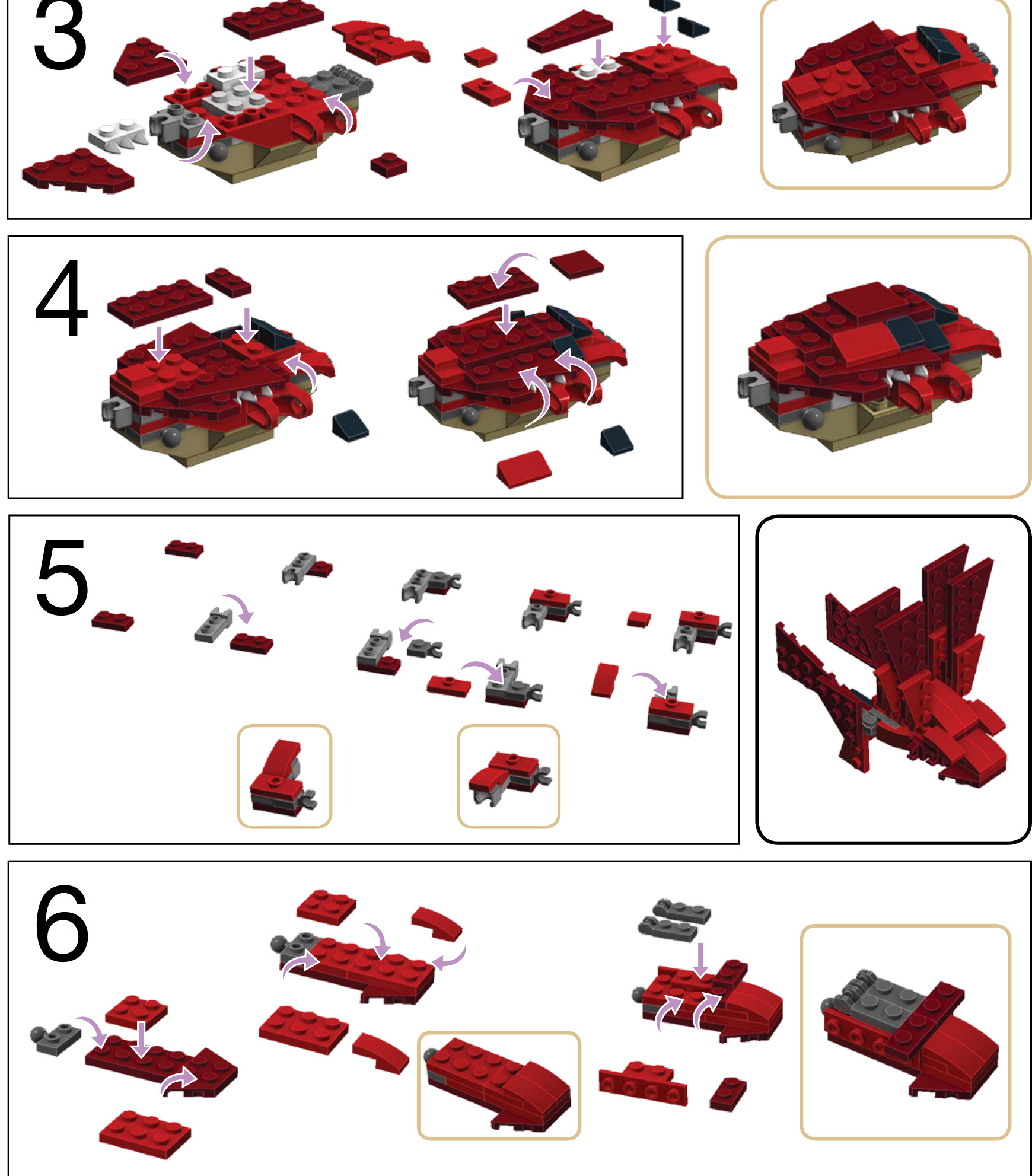
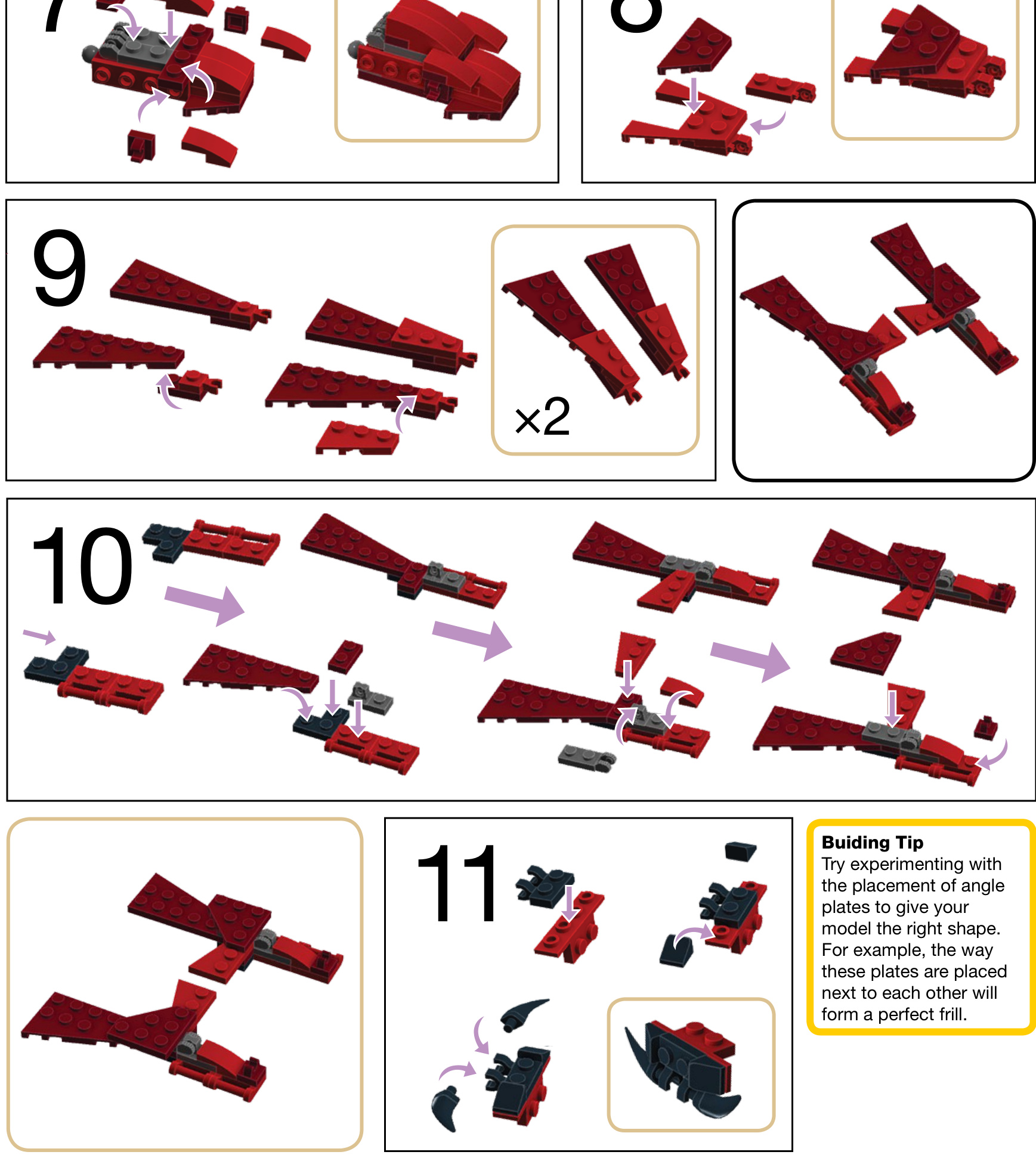
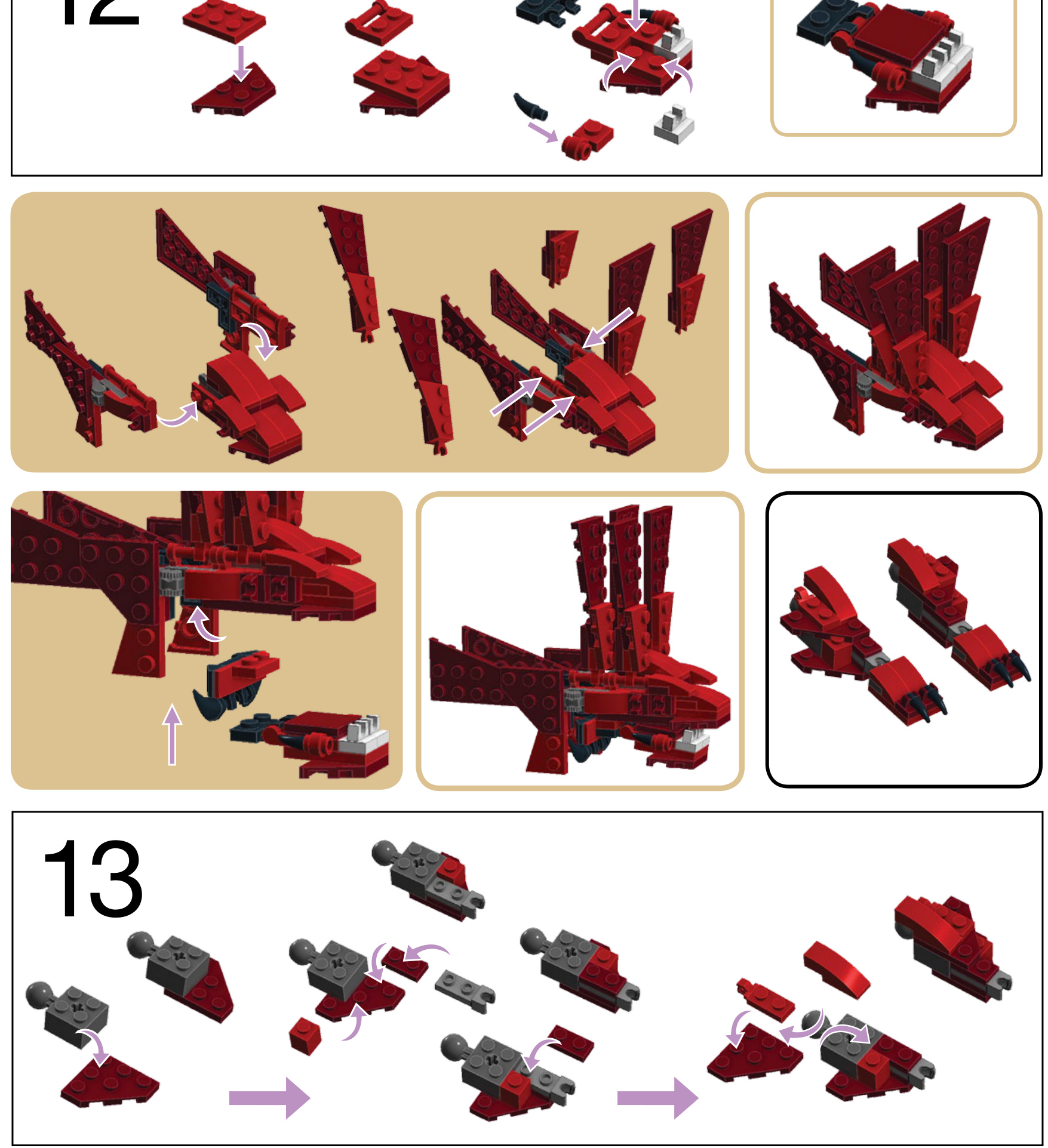
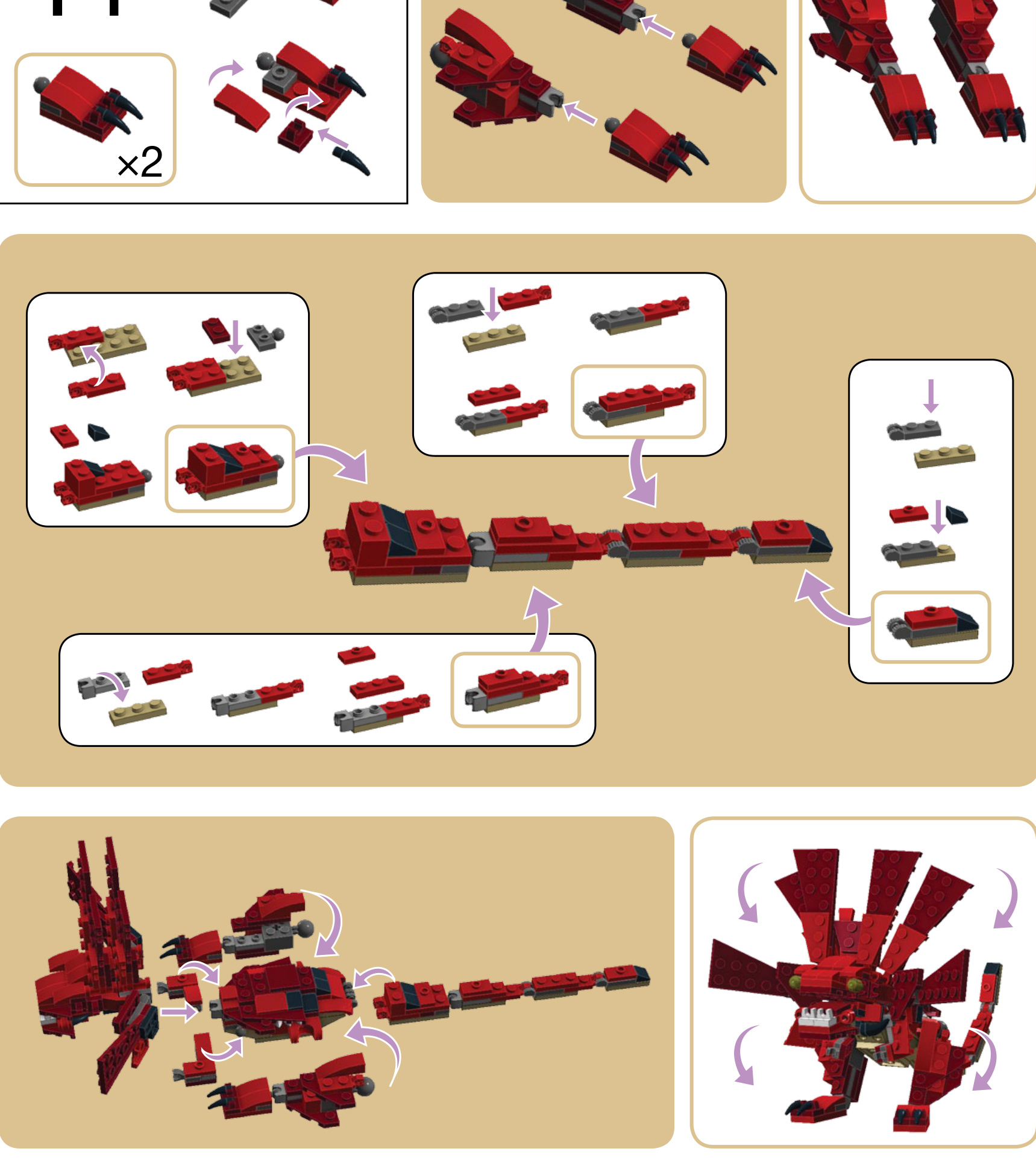

Building Journal
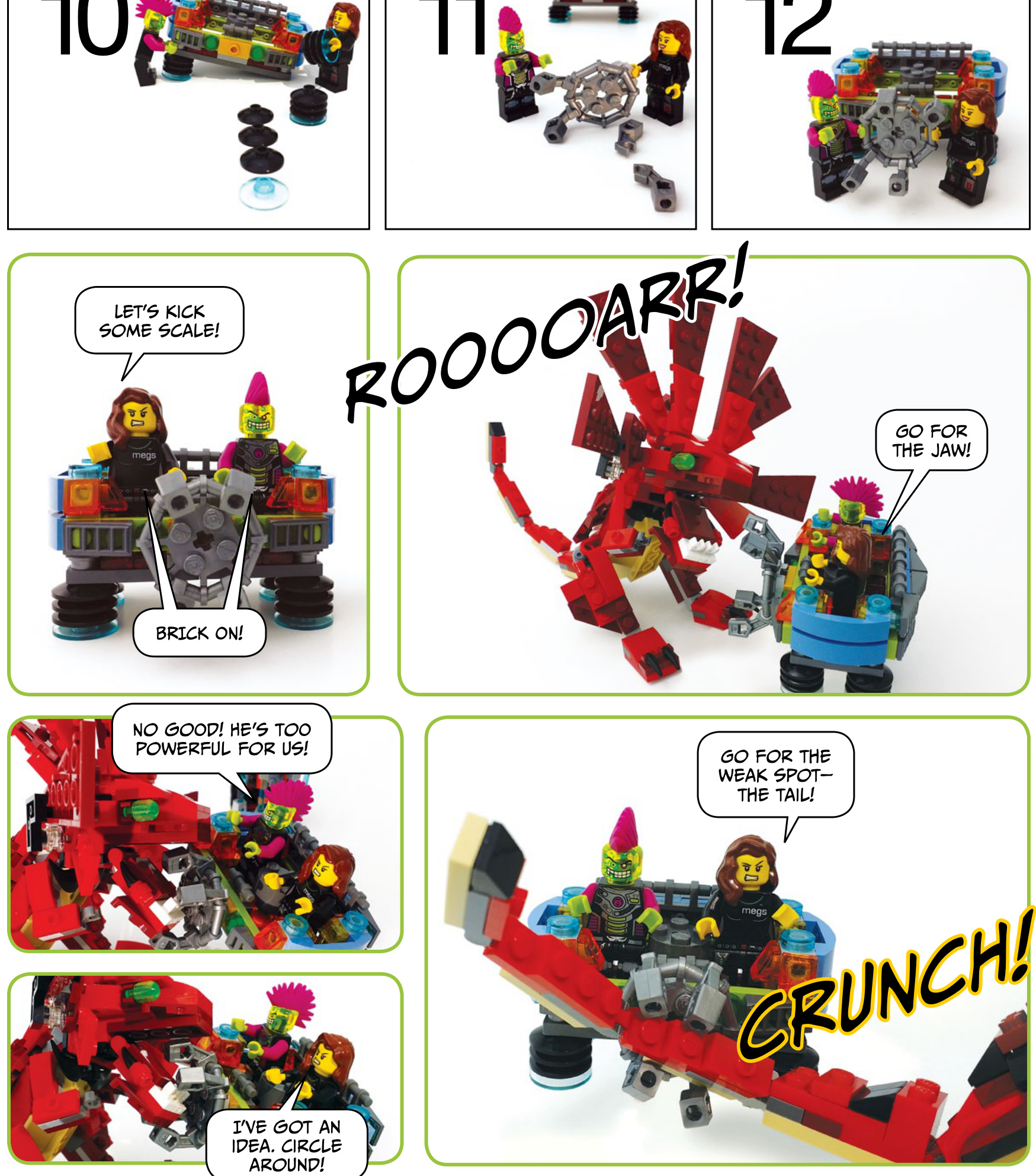
A giant beastie that eats LEGO bricks?! Oh dear!
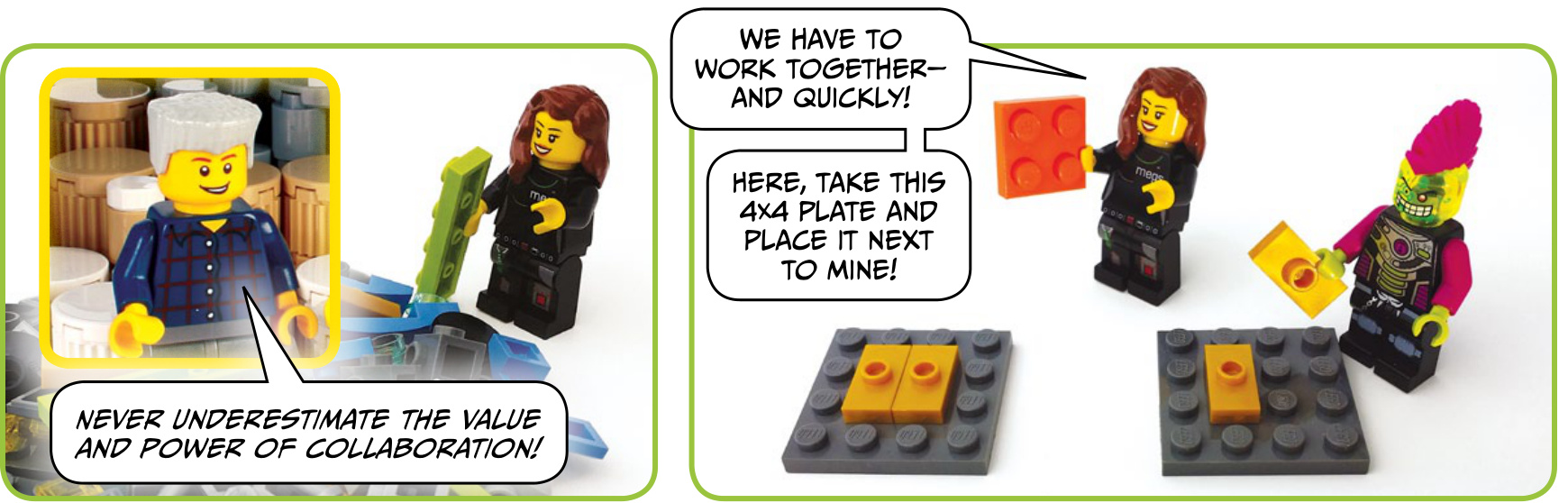
I find these Frilled Brickzards quite scary, but at the same time, I’m oddly fascinated by them. Perhaps it is because of my affinity for scaled creatures. The Brickzards seem to be intelligent communicators that have a pack mentality. In any case, it is quite clear that ingenuity and collaboration is the only way out of this situation!

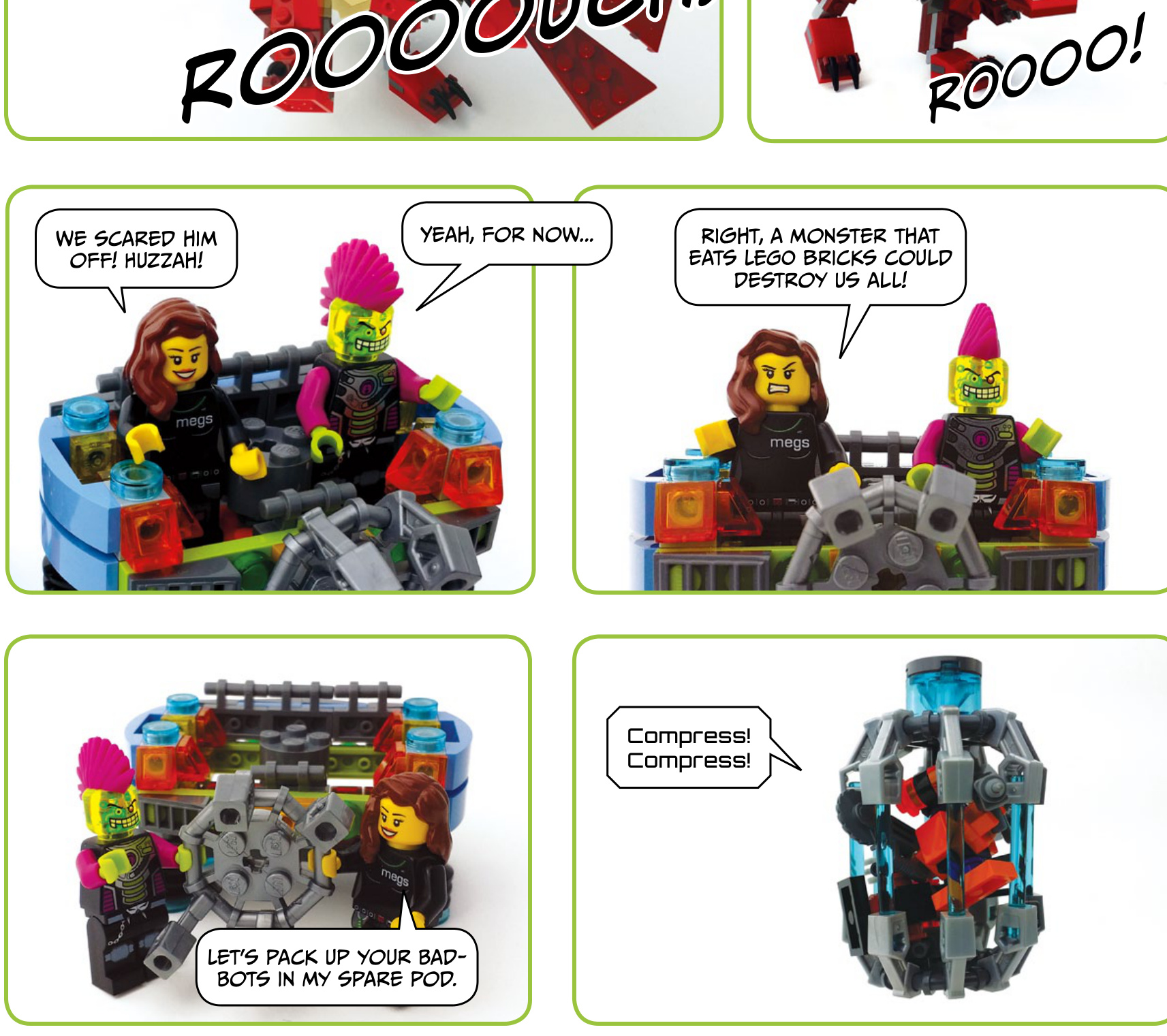
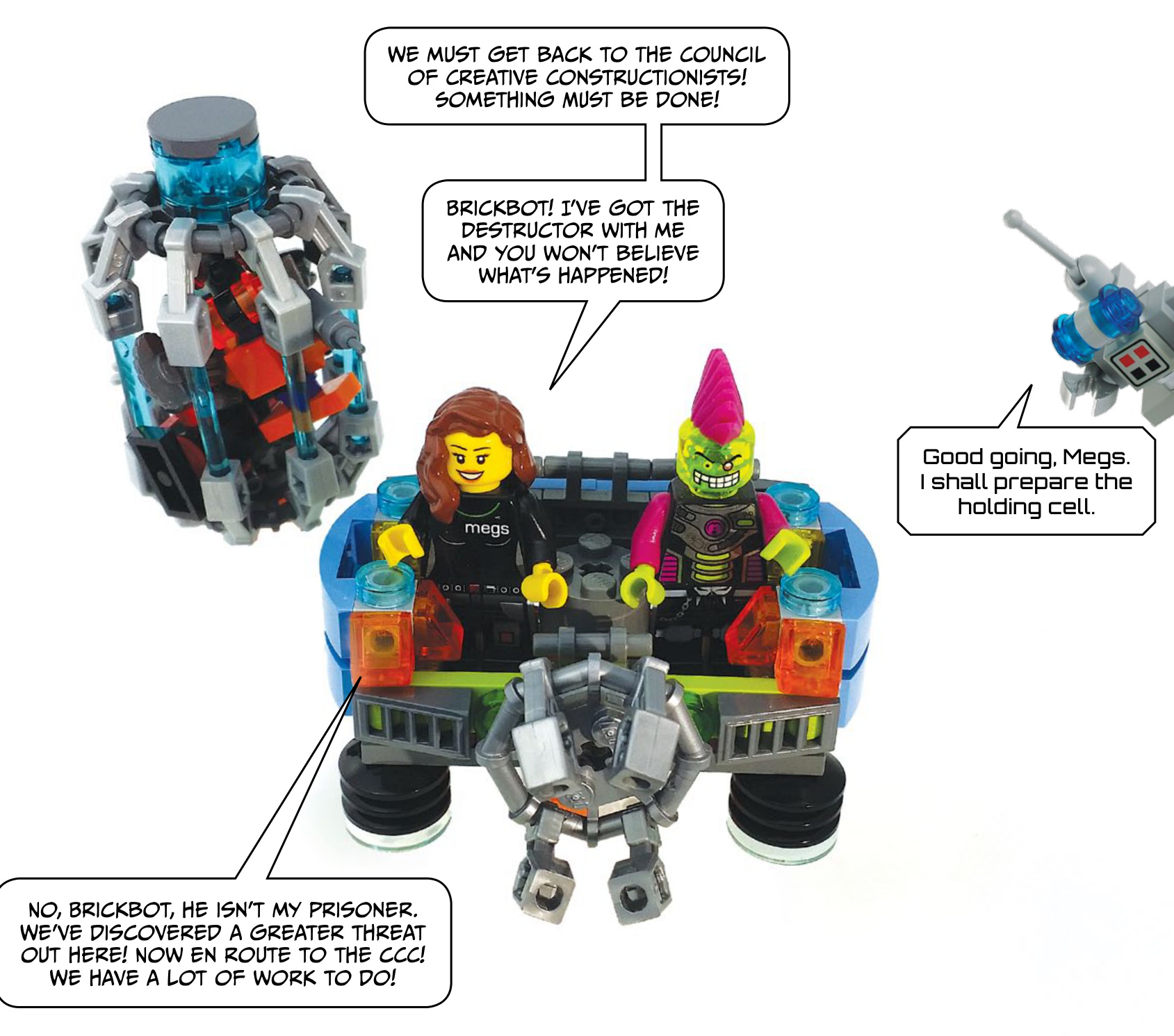
The adventure continues…
Megan H. Rothrock

Nickname: megs/megzter 1 Profession: Toy Designer and Author Nationality: American Website: www.flickr.com/photos/megzter/
Featured Builders
The Adventure Book series is dedicated to all the dreamers and lovers of LEGO building with LEGO bricks around the world.
Thank you to all of the creative and brilliant featured builders!
Join the LEGO Adventure Book community!
Facebook: www.facebook.com/LegoAdventureBook/ Flickr: www.flickr.com/groups/2021445@N23/ No Starch: www.nostarch.com/legoadventure3/
WHAT WILL YOUBUILD?
In this volume of the Adventure Book series, Megs and Brickbot face their toughest challenge yet. The Destructor is on the loose again, demolishing LEGO models and shaking things up! Join Megs as she rebuilds the models and meets some of the world’s best builders. Learn to create a Renaissance house, a classic movie theater, sushi, Miniland-scale marvels, an ice cream truck, street lamps, and even a chicken coop. With 40 step-by-step breakdowns and nearly 150 example models, The LEGO Adventure Book will surely inspire you and keep you building!
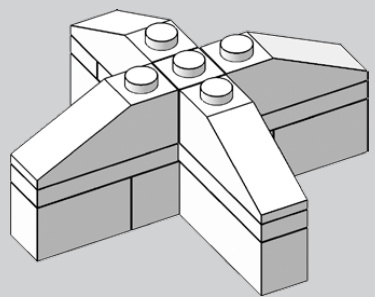
8
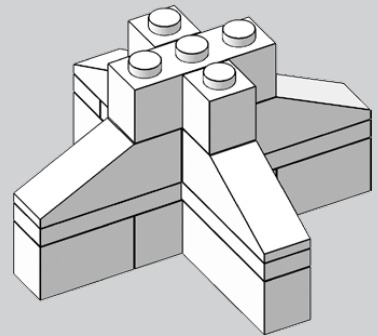
9
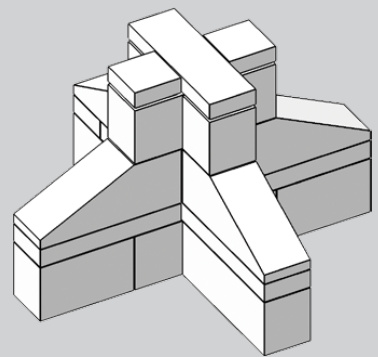
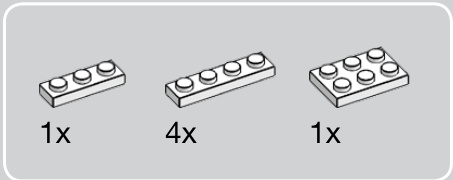
10
11
12
13
14
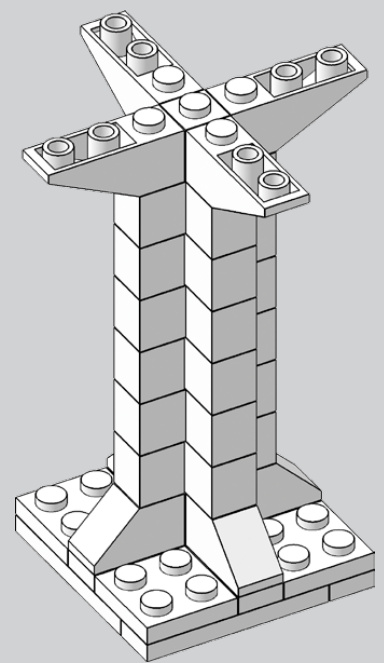
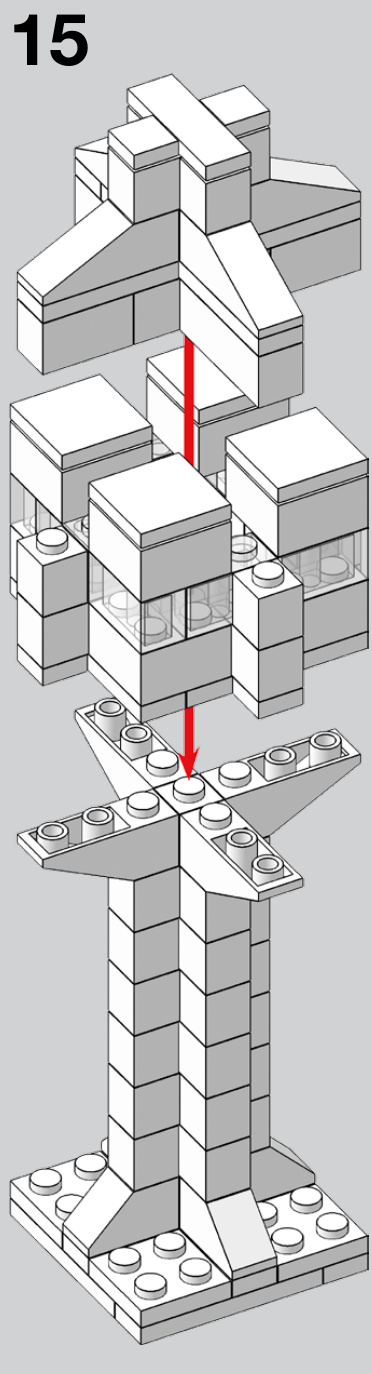
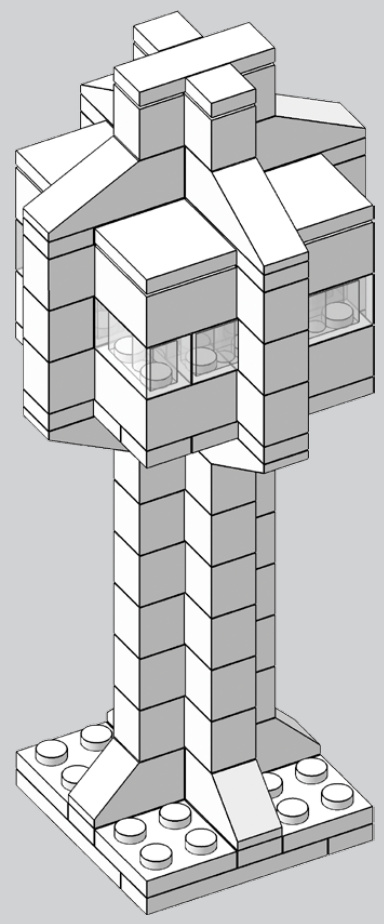

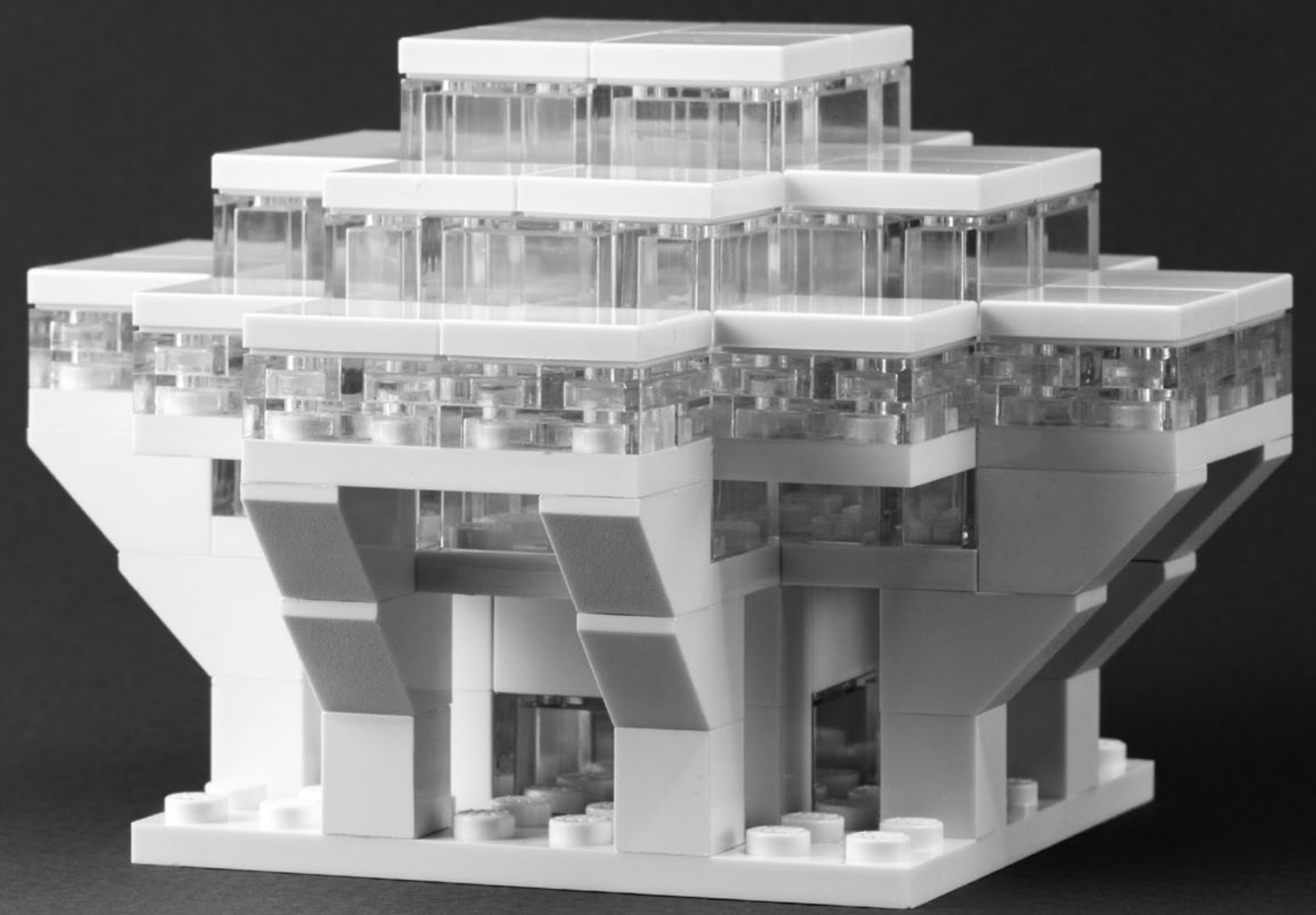
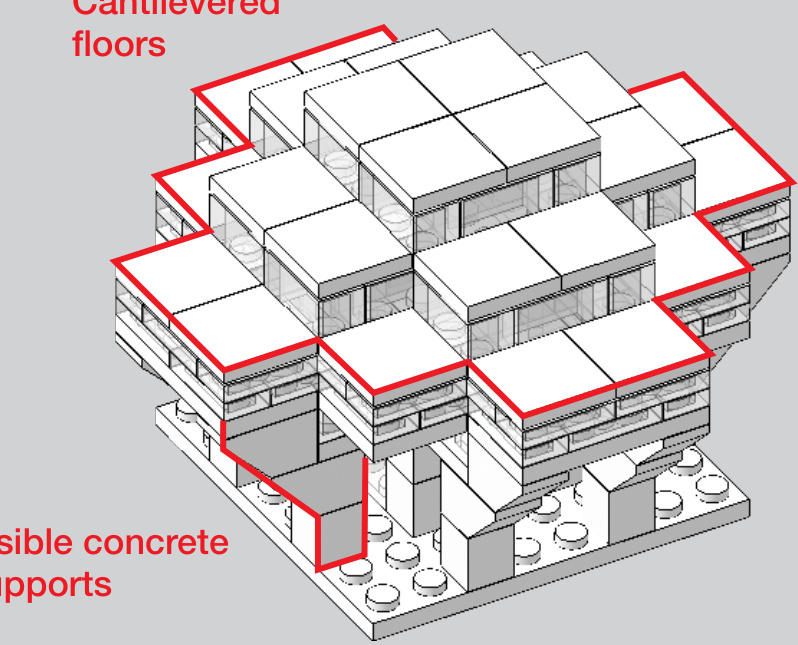
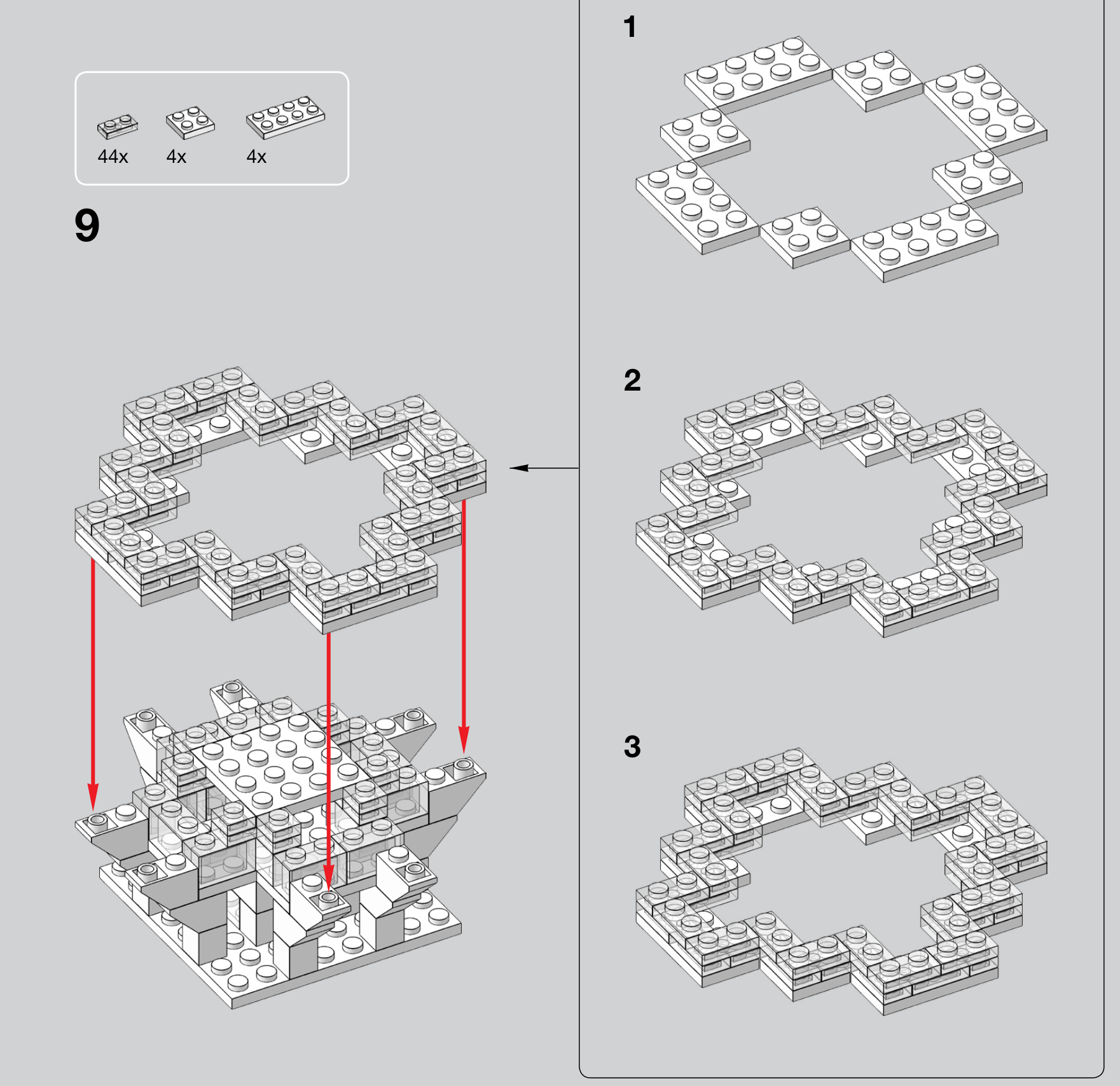
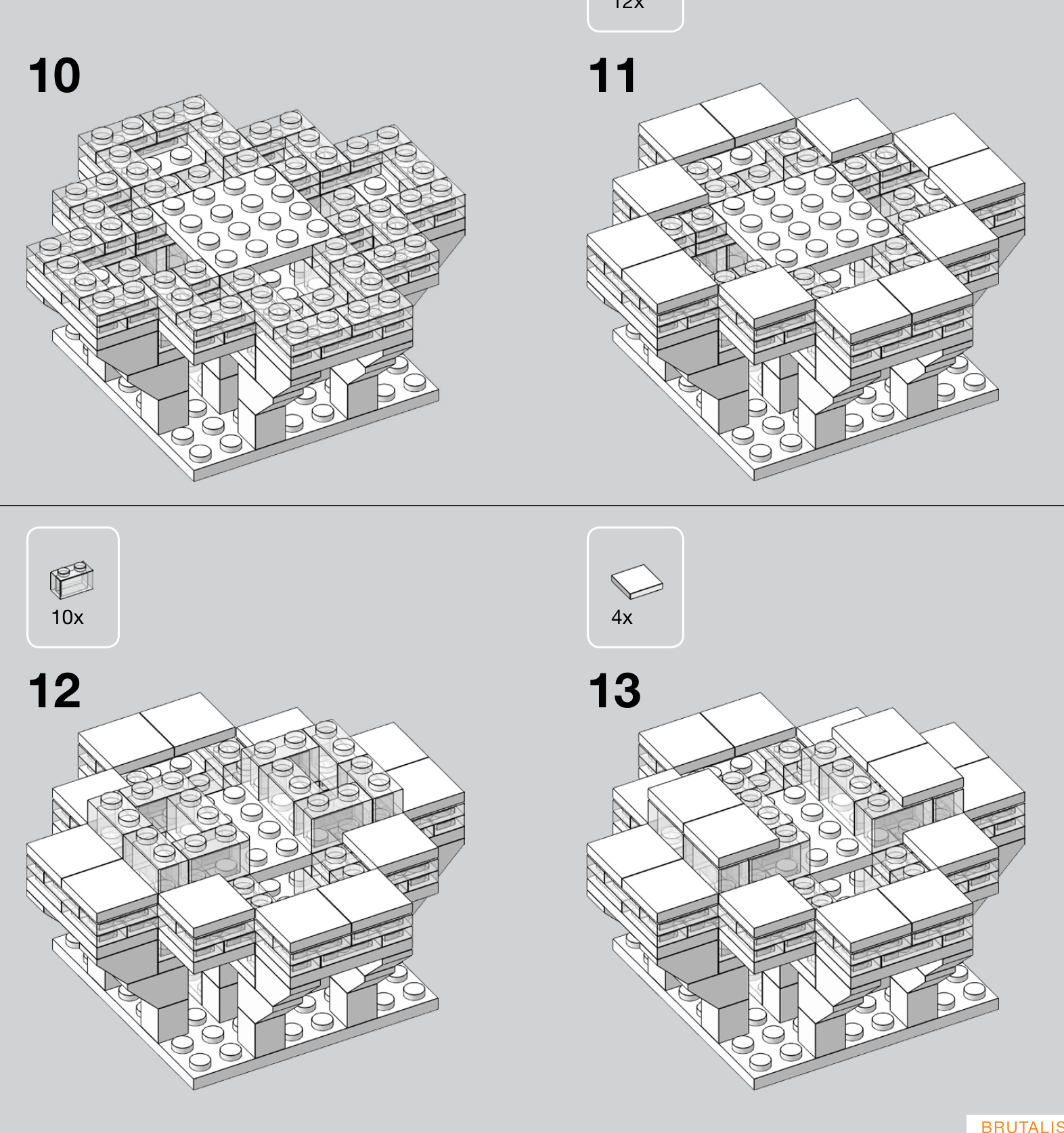
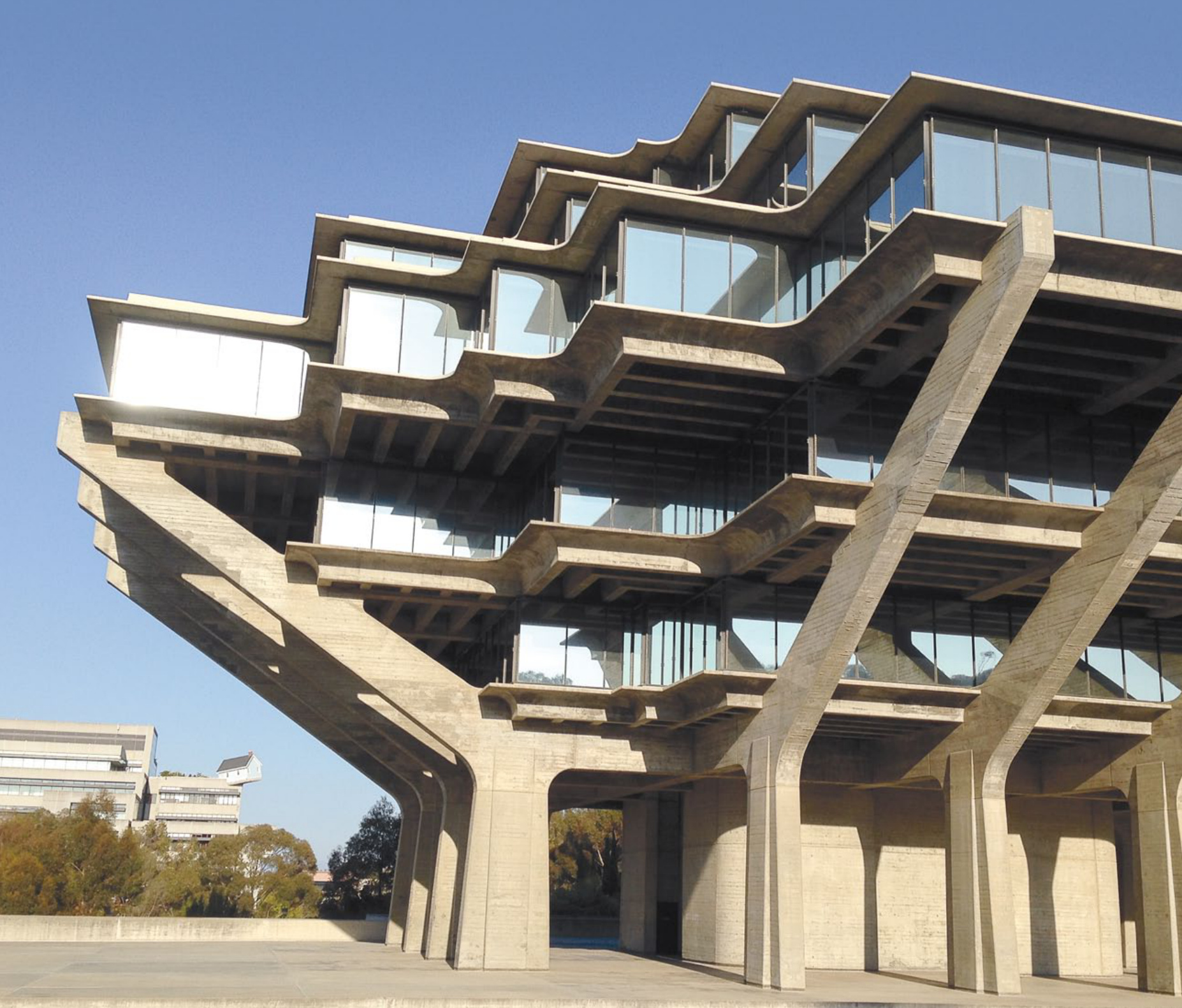
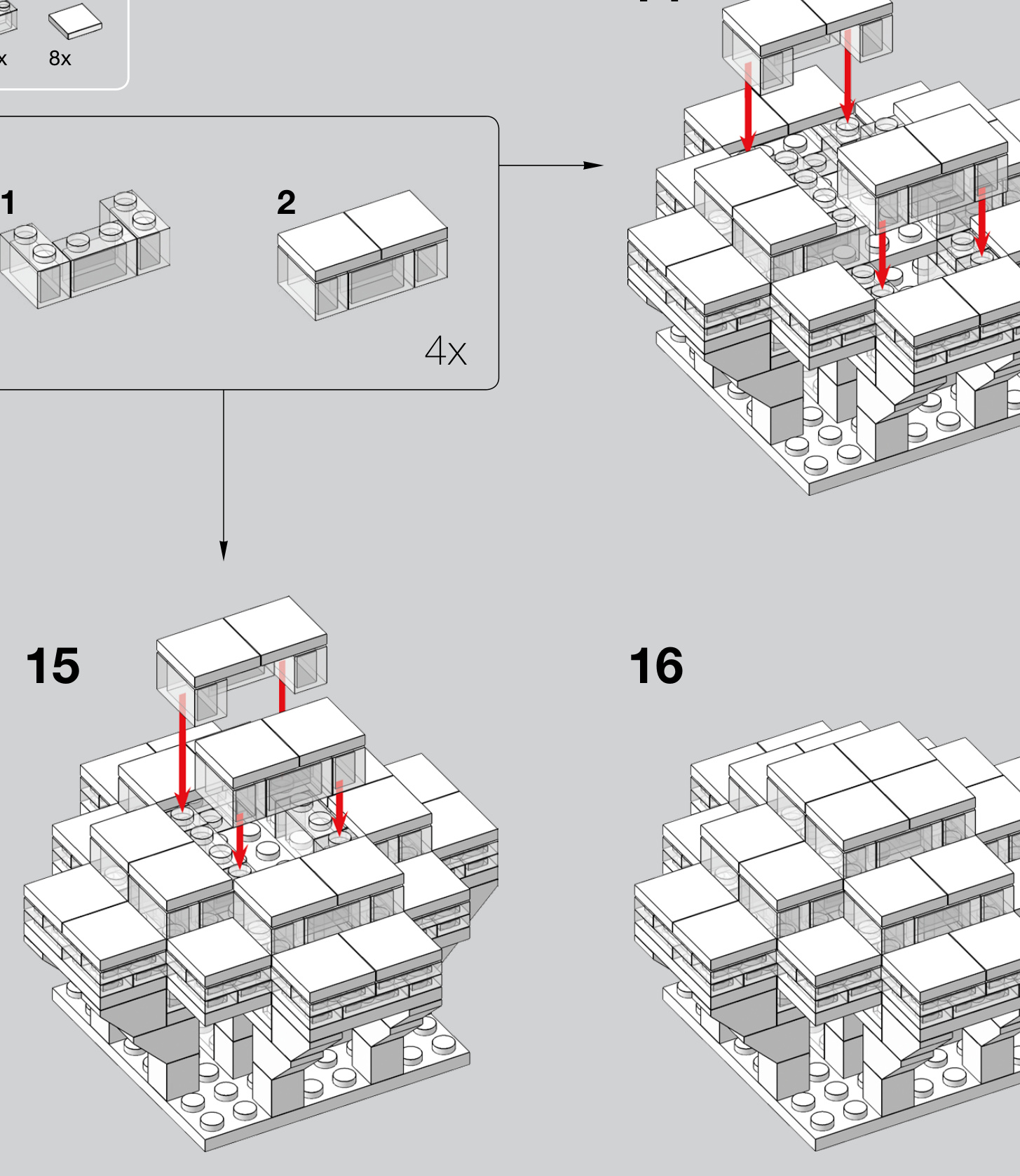
Glass Library
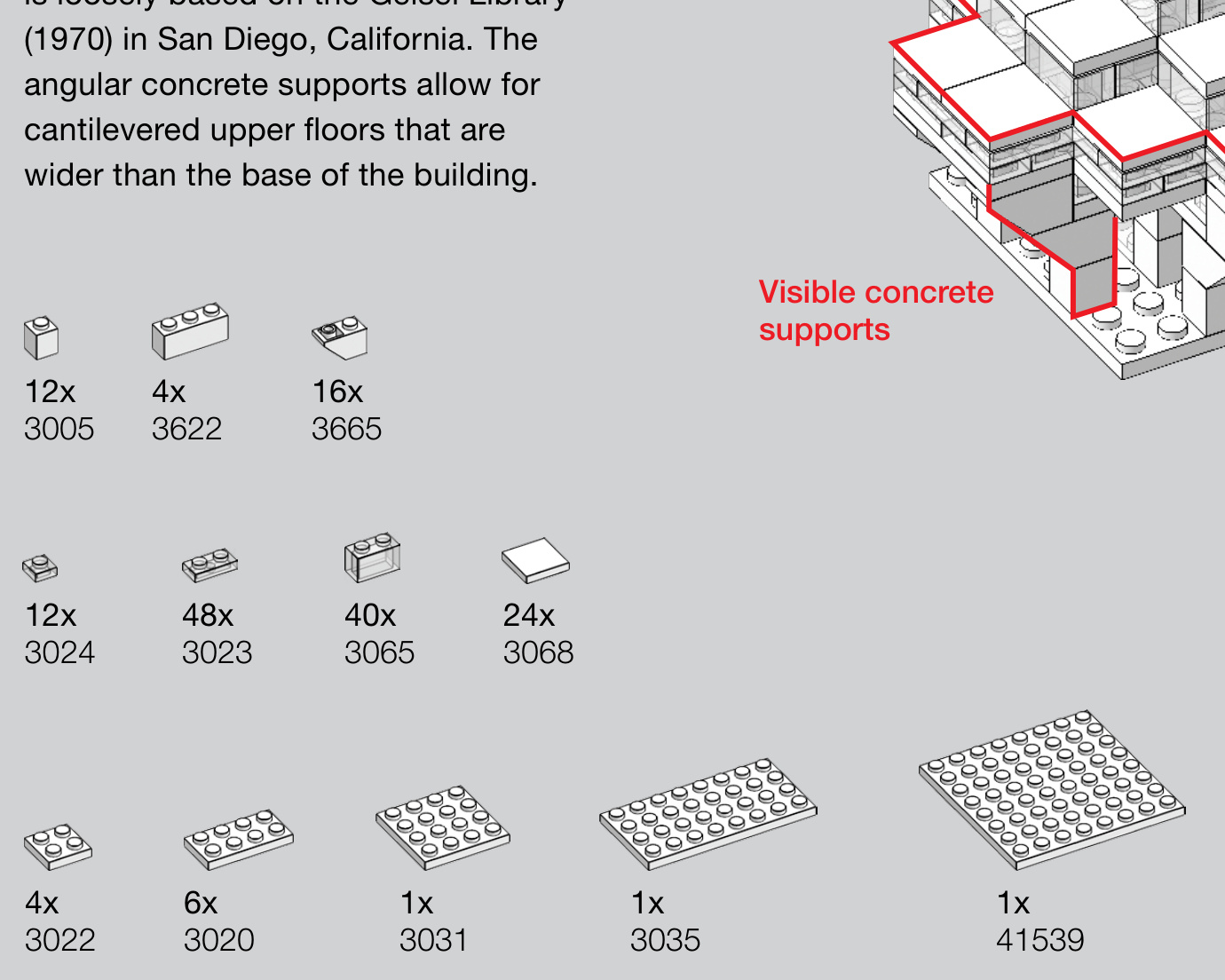
This building has a bold, rational, and unquestionably Brutalist form despite the large windows, which are uncommon for the style. This model is loosely based on the Geisel Library
Cantilevered
1
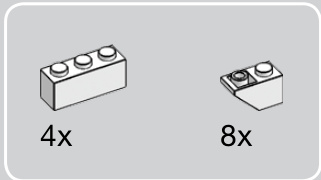
3
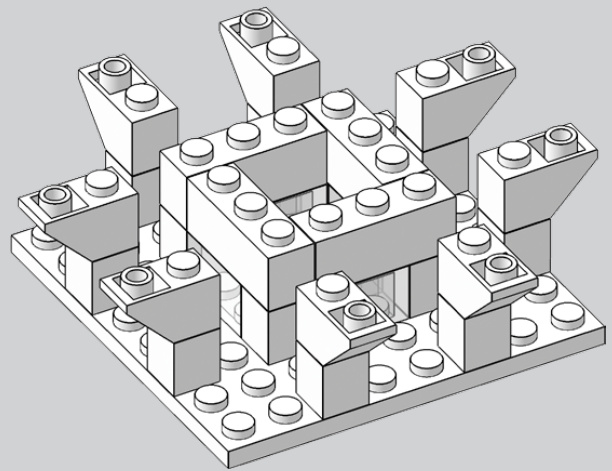
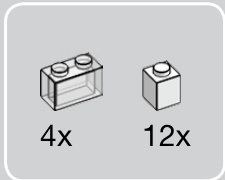
2
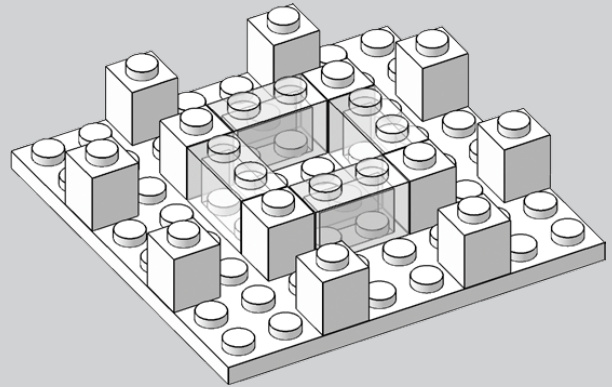
4
Postmodern
After 40 years in the spotlight, Modernism lost some of its luster, giving way to a more decorated, historically rooted style. Postmodern architecture explores a variety of alternatives to the Modernist glass and steel boxes that were taking over the world. In response to Modernist architect Mies van der Rohe’s famed statement “Less is more,” Robert Venturi claimed, “Less is a bore.”
At the heart of the Postmodern movement is a desire for a more-human architecture, fueled by a strong reaction against the sterility of Modernism. Postmodern architects remix shapes, patterns, and styles from the past to create something that is both familiar and new.
Robert Venturi is most commonly cited as the first Postmodern architect. He is recognized both for his buildings and for his writings about architectural theory. He was extremely critical of the “puritanically moral language of orthodox Modern architecture.” He preferred to celebrate historic forms by creating buildings designed to
meet the needs of the people who use them. Vanna Venturi House (1964) is likely the first Postmodern building, which Venturi designed and built for his mother based on these principles.
By understanding how people respond to common architectural forms like arches, doorways, and columns, architects can take advantage of these subconscious meanings to design buildings that are innovative but easy to navigate. As an example, Modernist architects often leave the entrances to their buildings undecorated, but a Postmodern architect might place a decorative triangular
MATERIALS
Most Postmodern buildings are constructed with modern elements like steel and glass, but they are often clad with more-traditional exterior materials like stone, marble, or stucco.
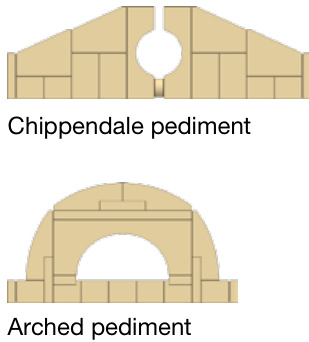
LEGO PEDIMENTS
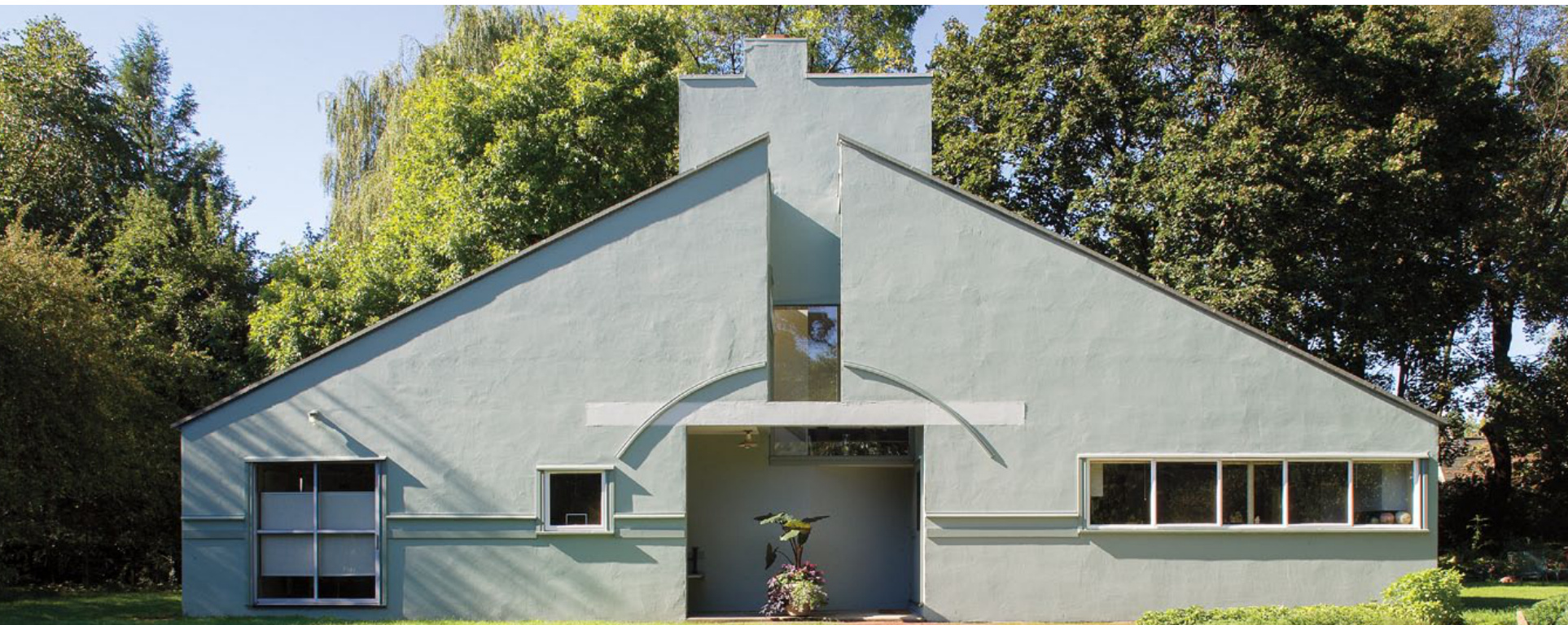
Vanna Venturi House, Philadelphia, Pennsylvania, 1964, Robert Venturi.
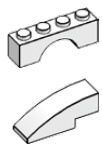
LEGO Bricks


Headlight bricks can be used to create a wall of tiny windows.
Arches and curves are common in many Postmodern designs.
Slopes are required for pitched roofs.
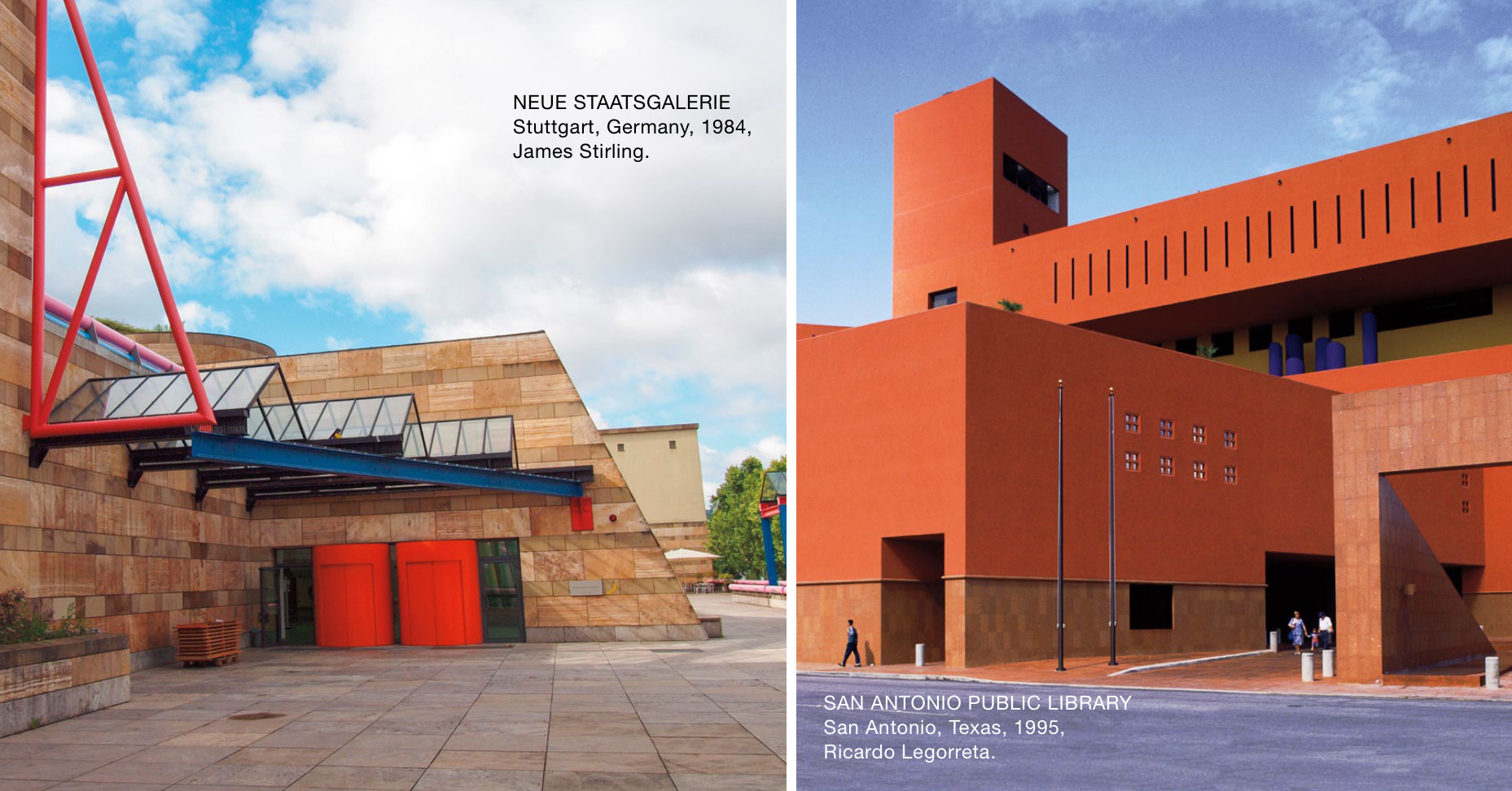
pediment above the door, leveraging the visual grammar of historic architecture to indicate that this must be the entrance. The Neue Staatsgalerie (1984) is a playful example of this, with simple glass pedi ments above the main entrance.
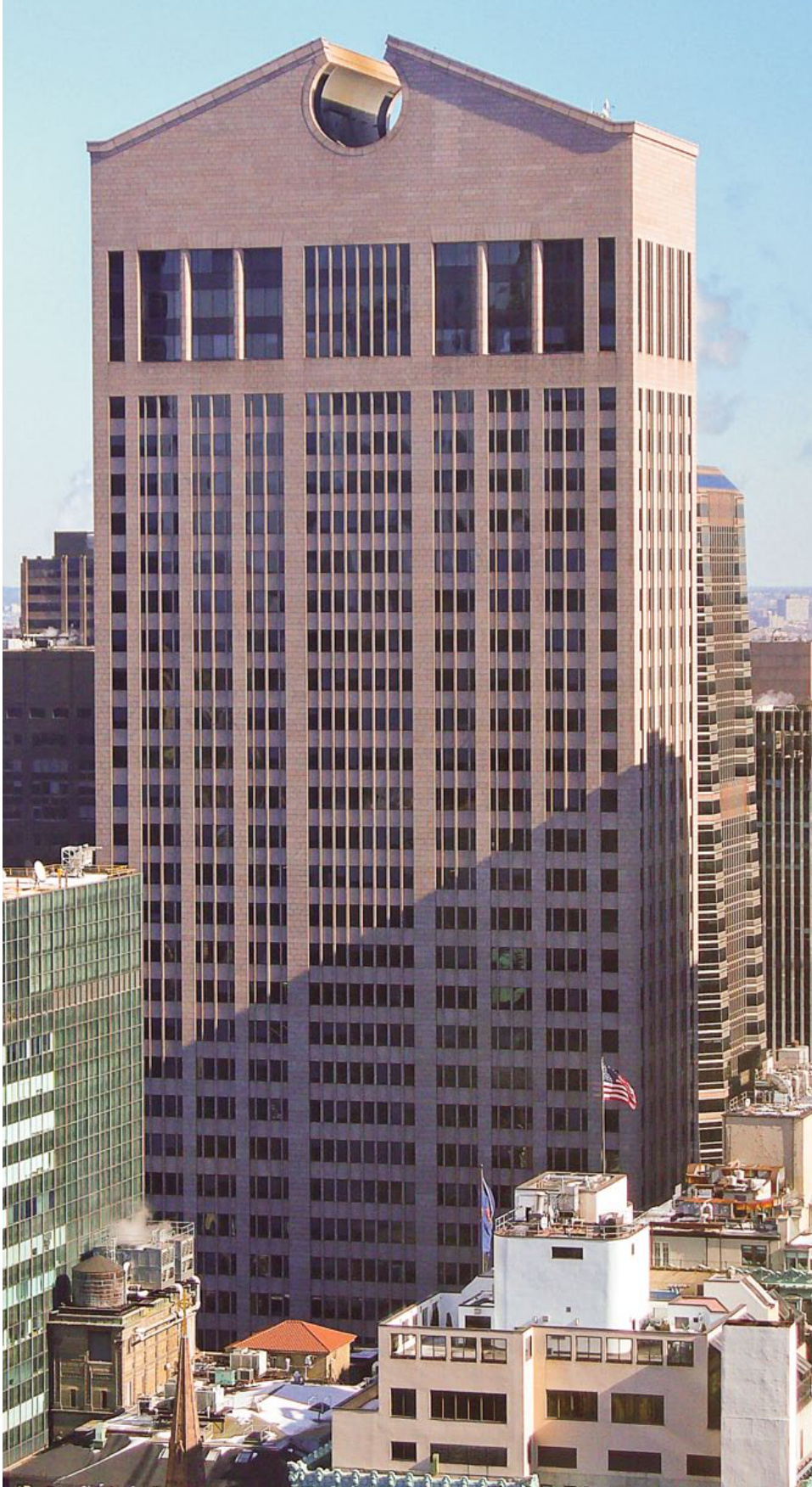
Another signature of Postmodern archi tecture is to use recognizable forms at an exaggerated scale, such as the House in Katonah (1975), which has a massive round window that dominates the front of the home. We also see distortions of common forms, like the famous Chippendale pedi ment on the top of the AT&T Building
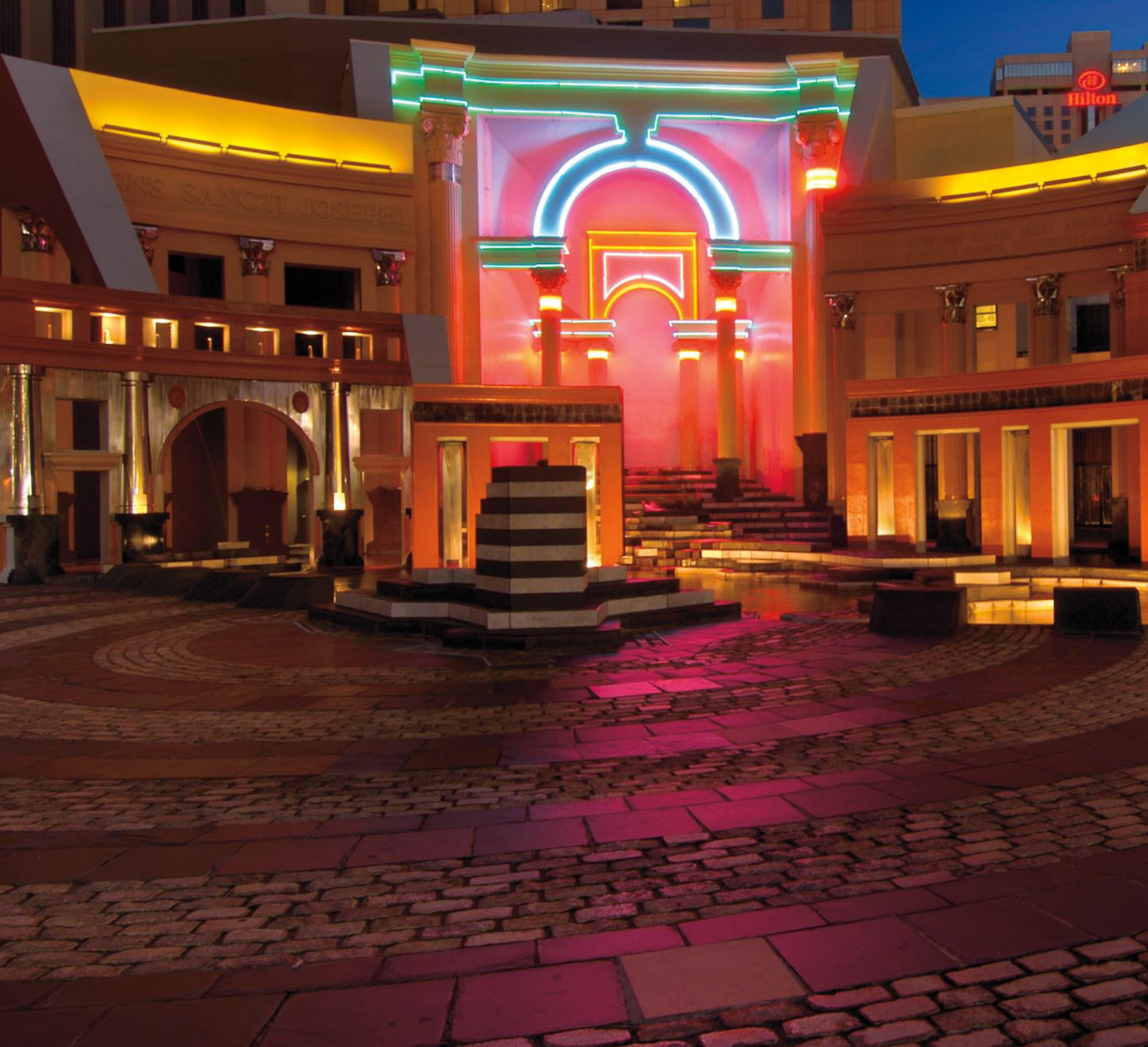
(1984), now called the Sony Tower, or the neon outlines of classical forms in the Piazza d’Italia (1978).
While many Postmodern architects draw inspiration from classical forms, they explore other styles as well. Ricardo Legorreta based the San Antonio Public Library (1995) on designs from the South west. The Postmodern movement isn’t limited to Western architecture: Taipei 101 (2004), one of the tallest buildings in the world, has a Postmodern design inspired by the pagoda, a tiered tower common in traditional Asian architecture.
Critics of the style suggest that Post modern architects are simply exploiting social or historical cues for the benefit of corporate brands. For example, a building might include a facade with decorative columns because they are a subconscious symbol of strength. Of course, the same could be said for the many corporations that embraced Modernism just 30 years earlier. Several iconic Postmodern buildings have become central to the corporate brands they represent, such as the Transamerica Pyramid (1972).
Postmodern in LEGO
Since many Postmodern buildings utilize simplified representations of historical design elements, capturing Postmodern architecture using LEGO bricks can be a challenge. The very process of reducing a large building into a small-scale LEGO model is similar to the way that Postmodern architects reduce historical architectural elements to their simplest forms. This is why LEGO re-creations of any architectural style will have a slightly Postmodern appearance. The models in this chapter are based on the strong geometric designs that are unique to this style.
LEGO Colors
Light bluish grey
Tan
Dark orange
Dark red
Medium blue
Sand green
Trans light blue

Postmodern LEGO Models
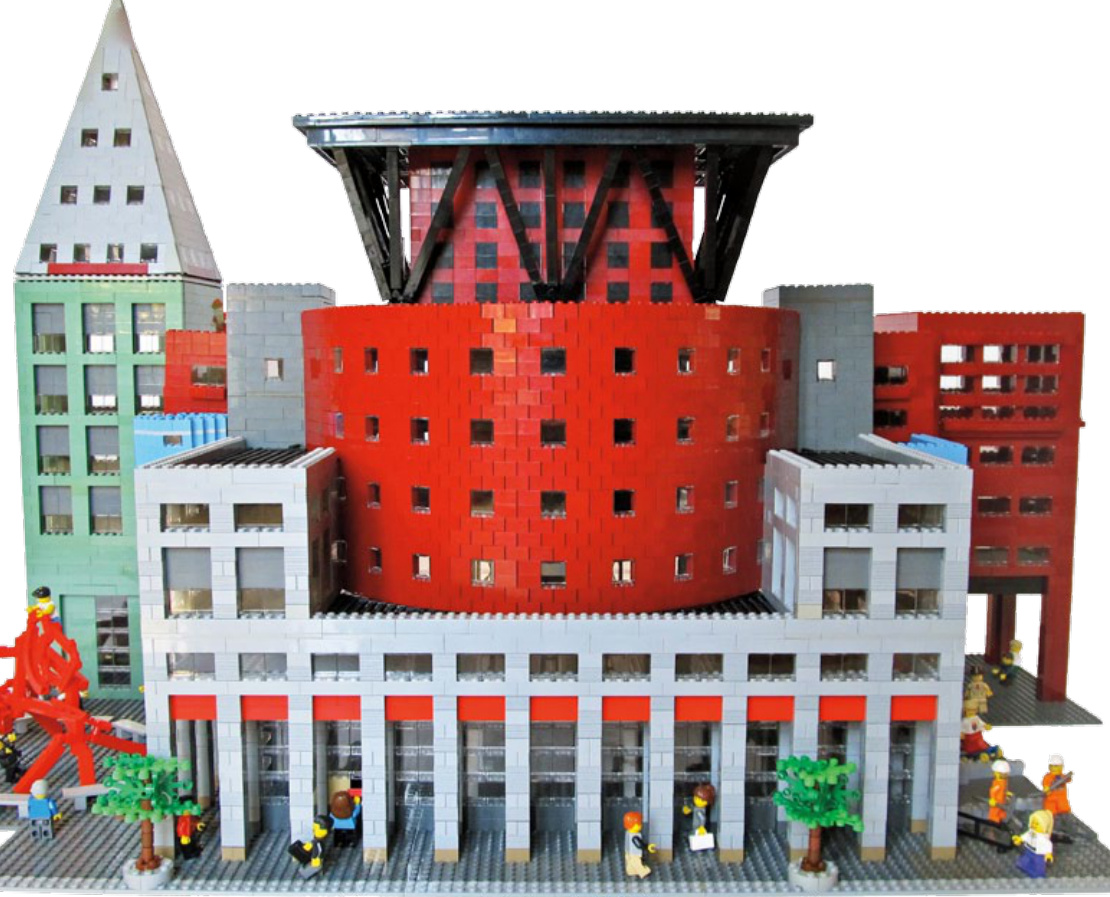
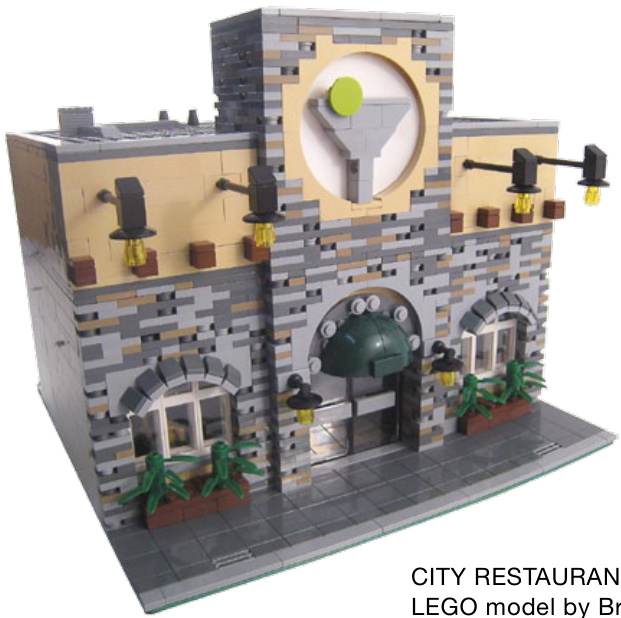
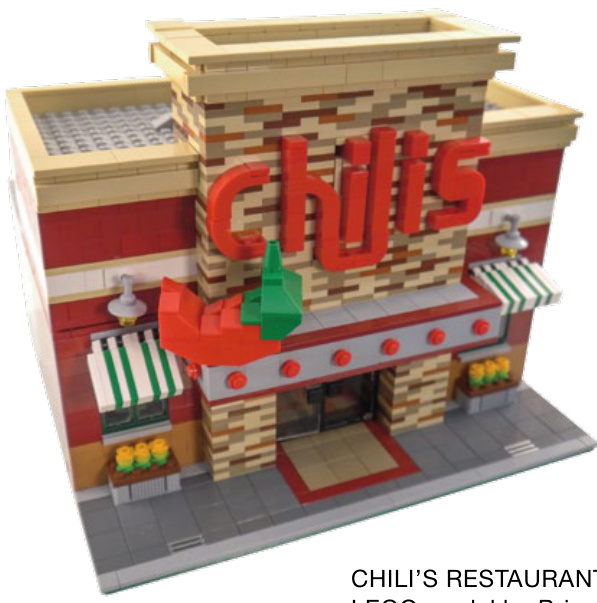
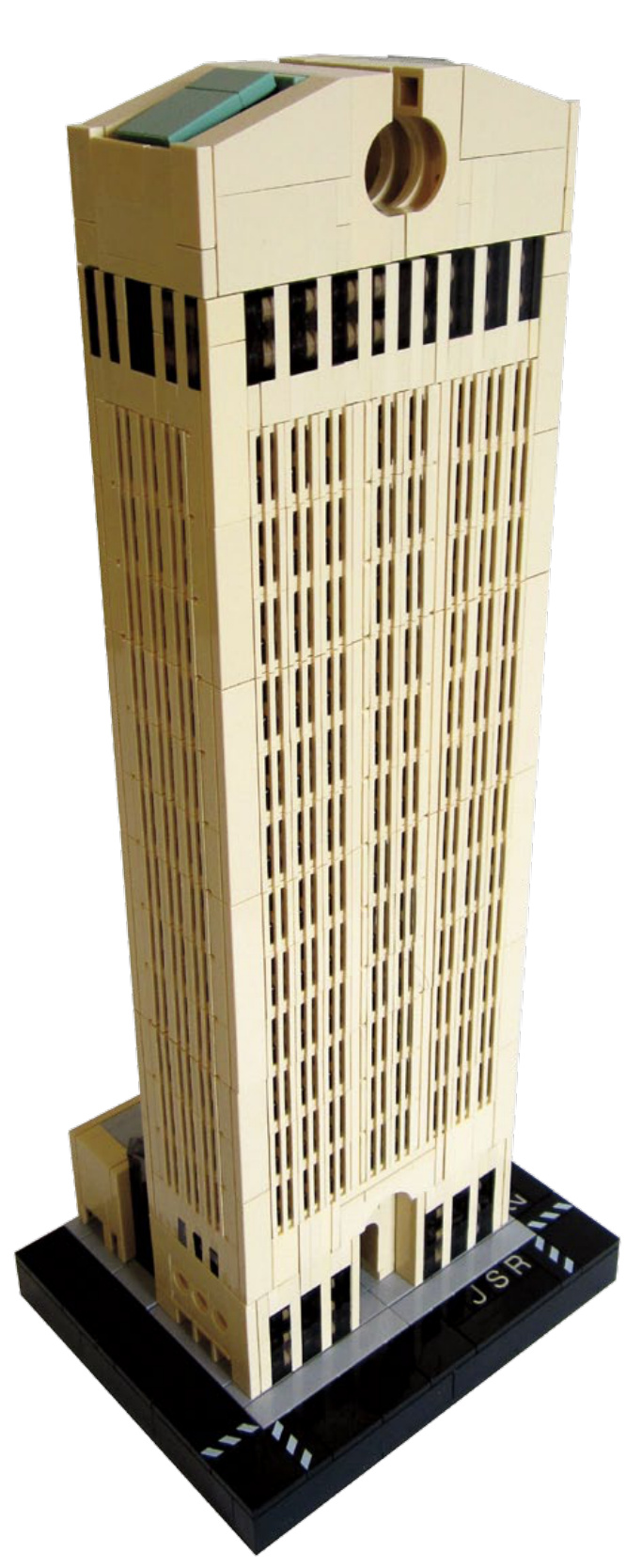
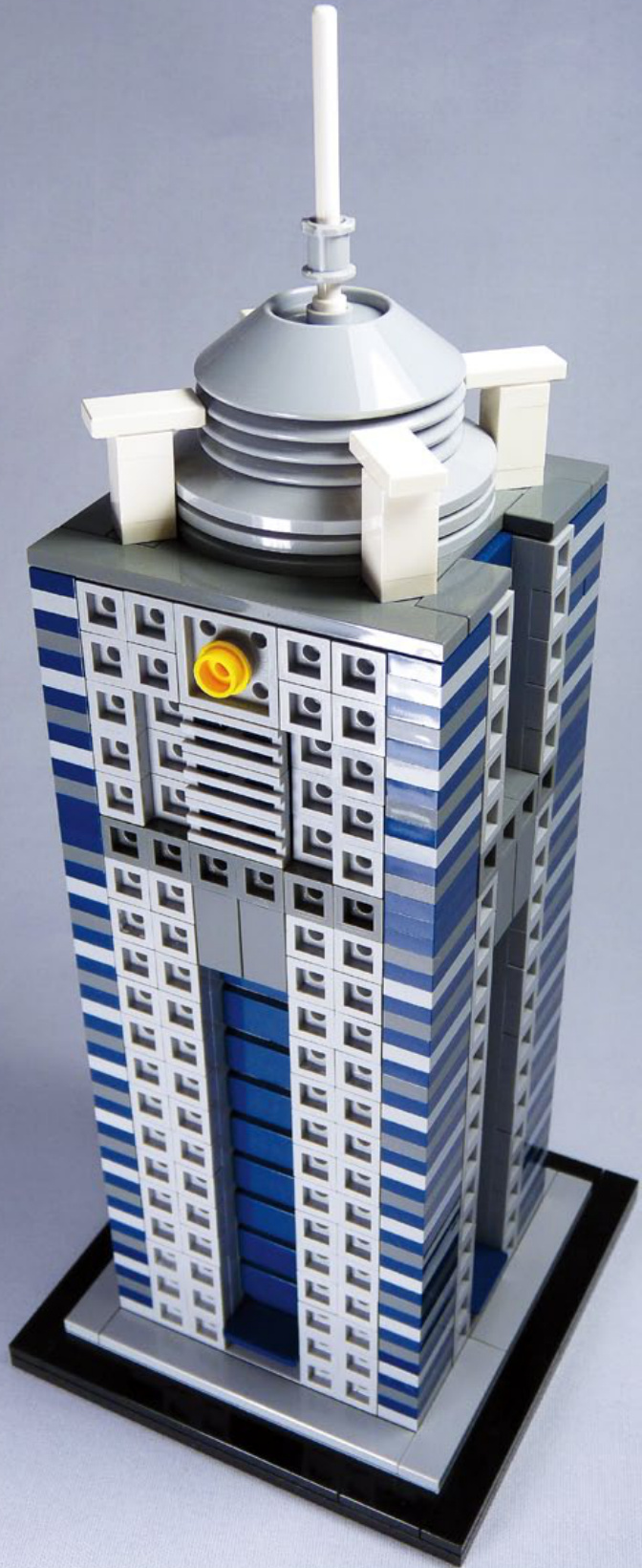
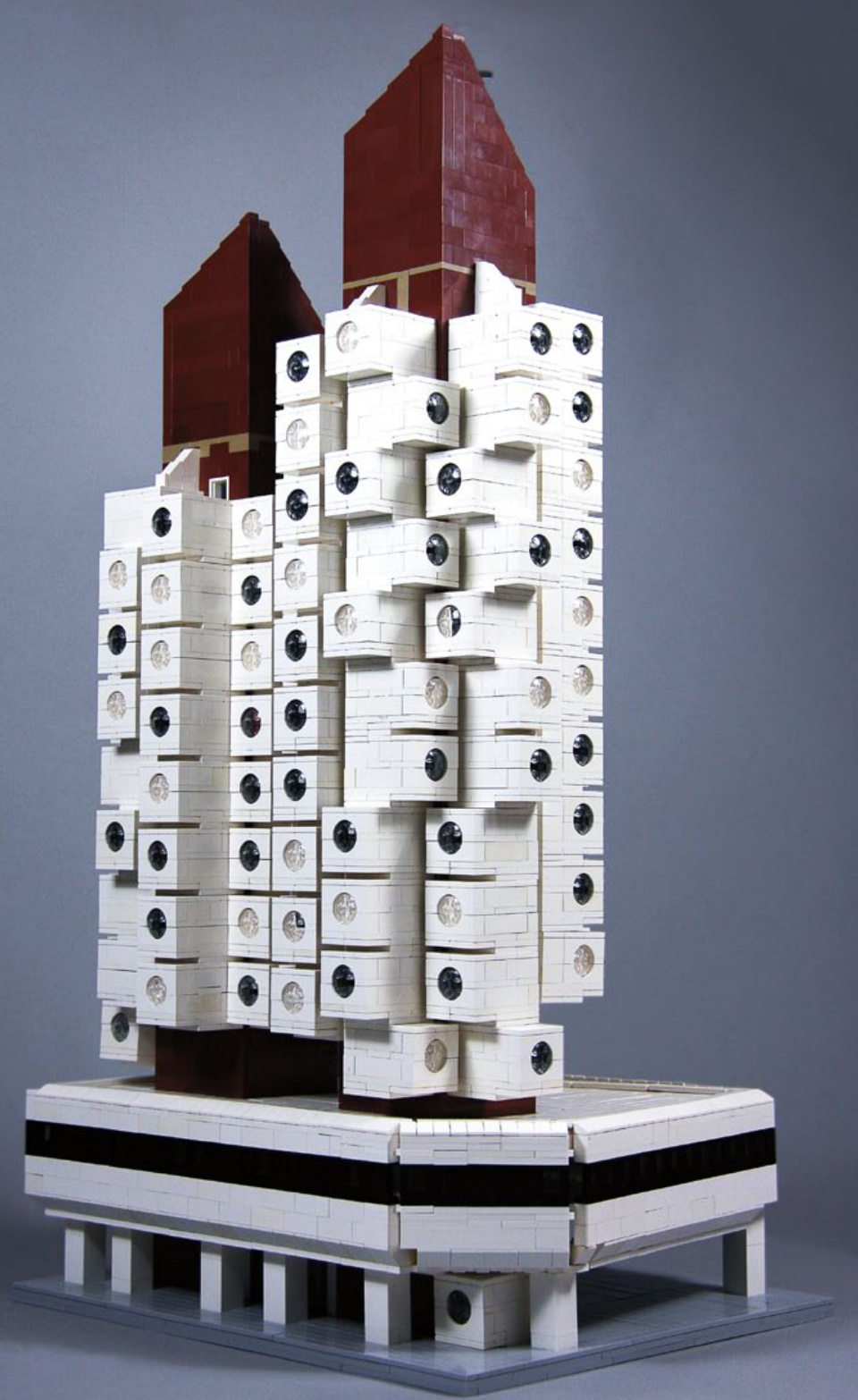
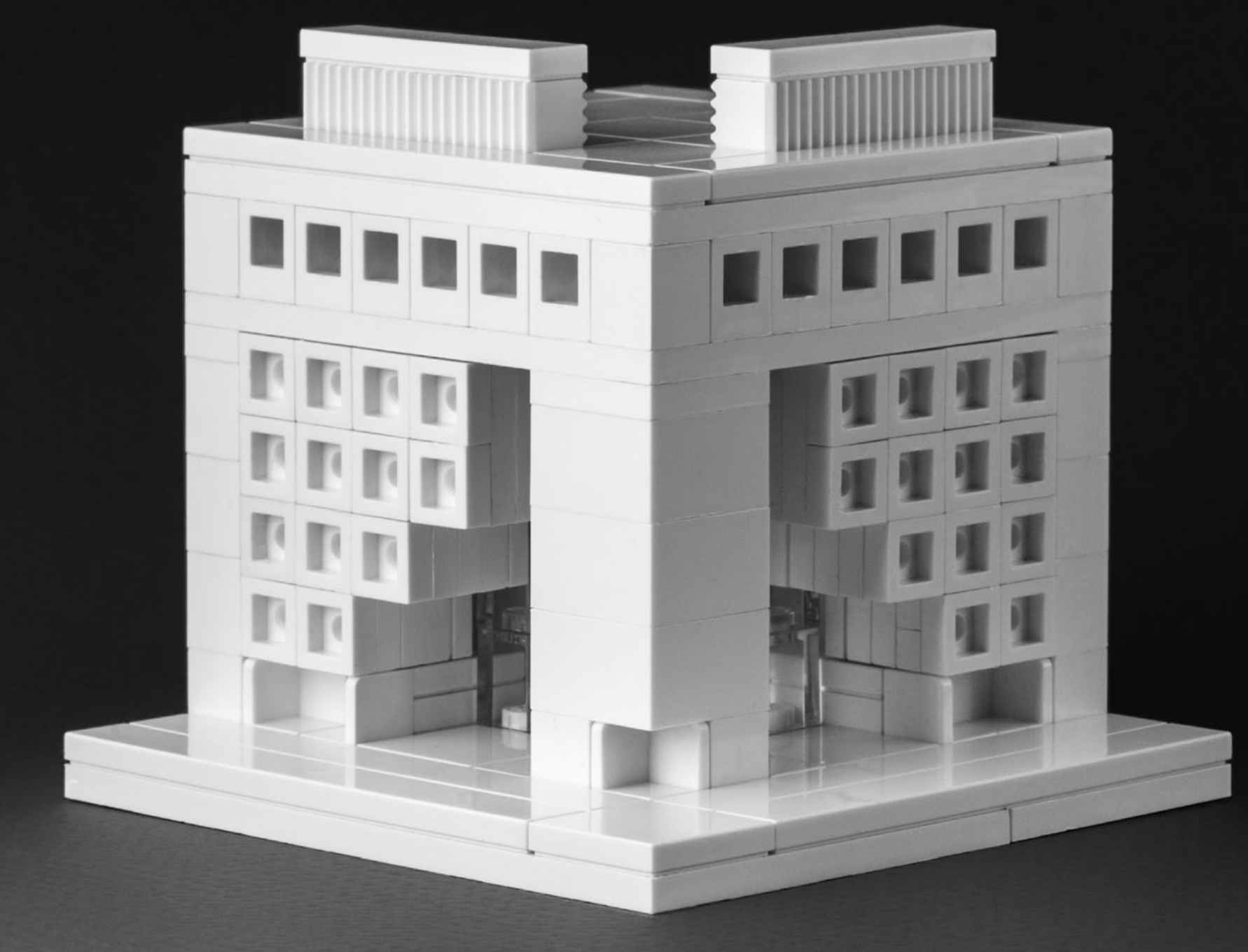
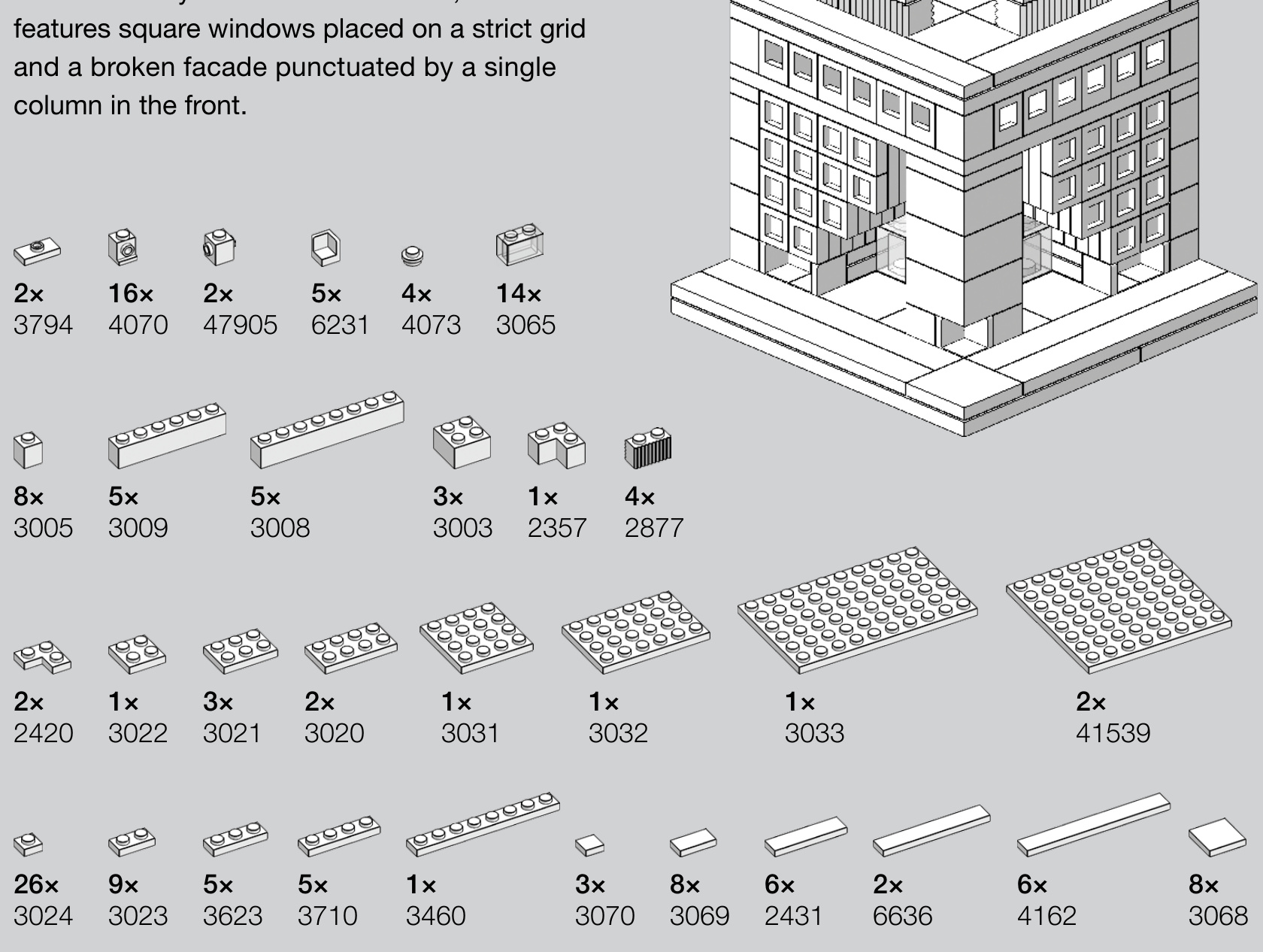
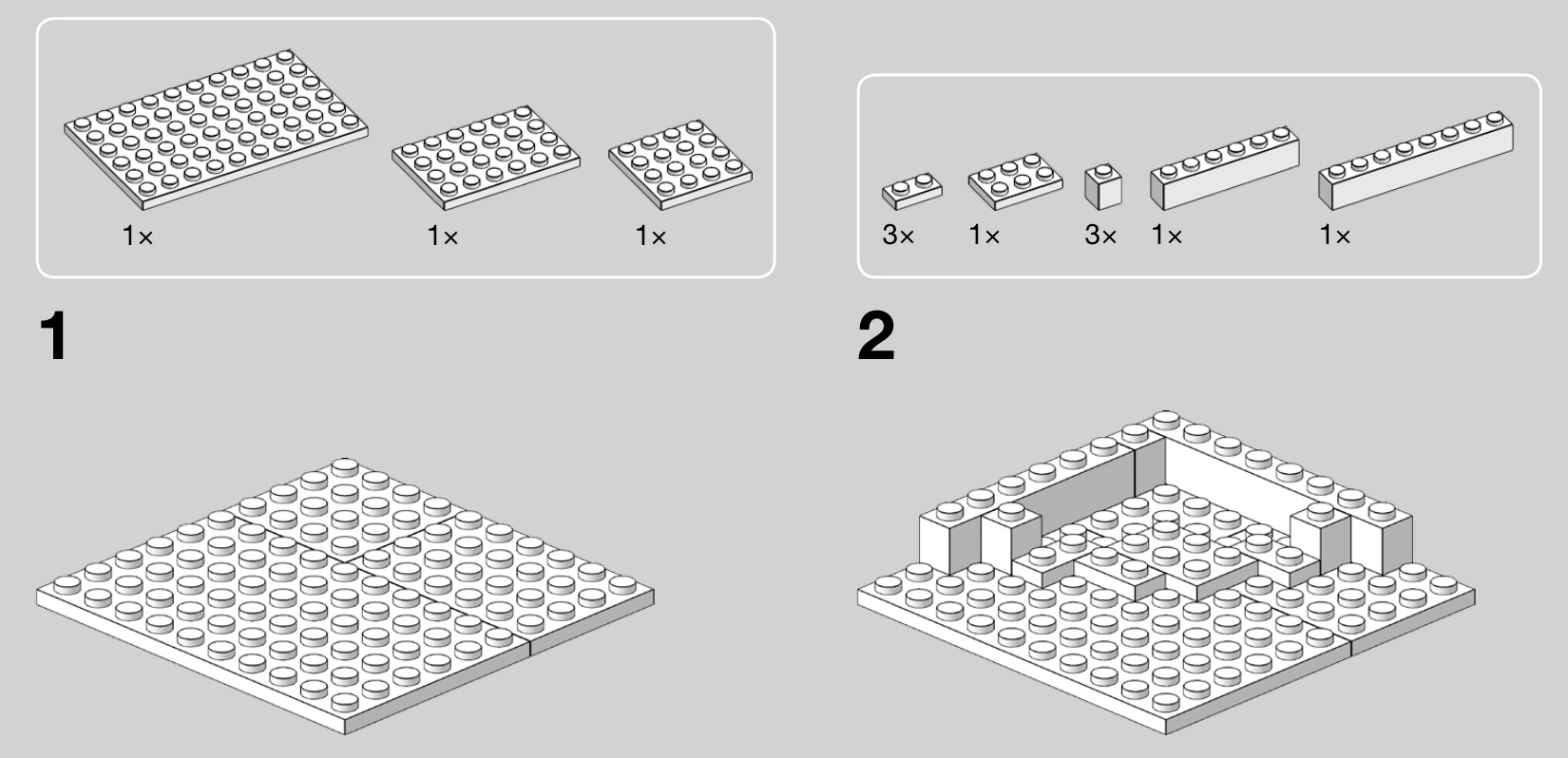
Office Building
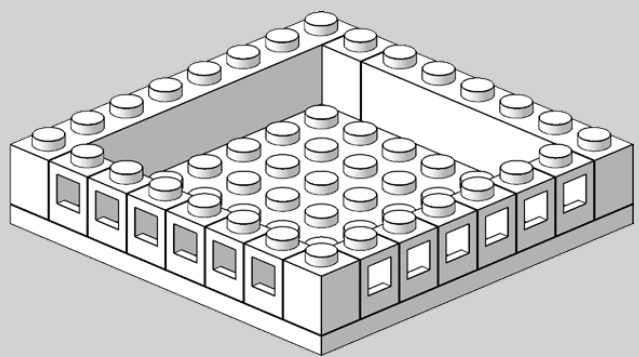
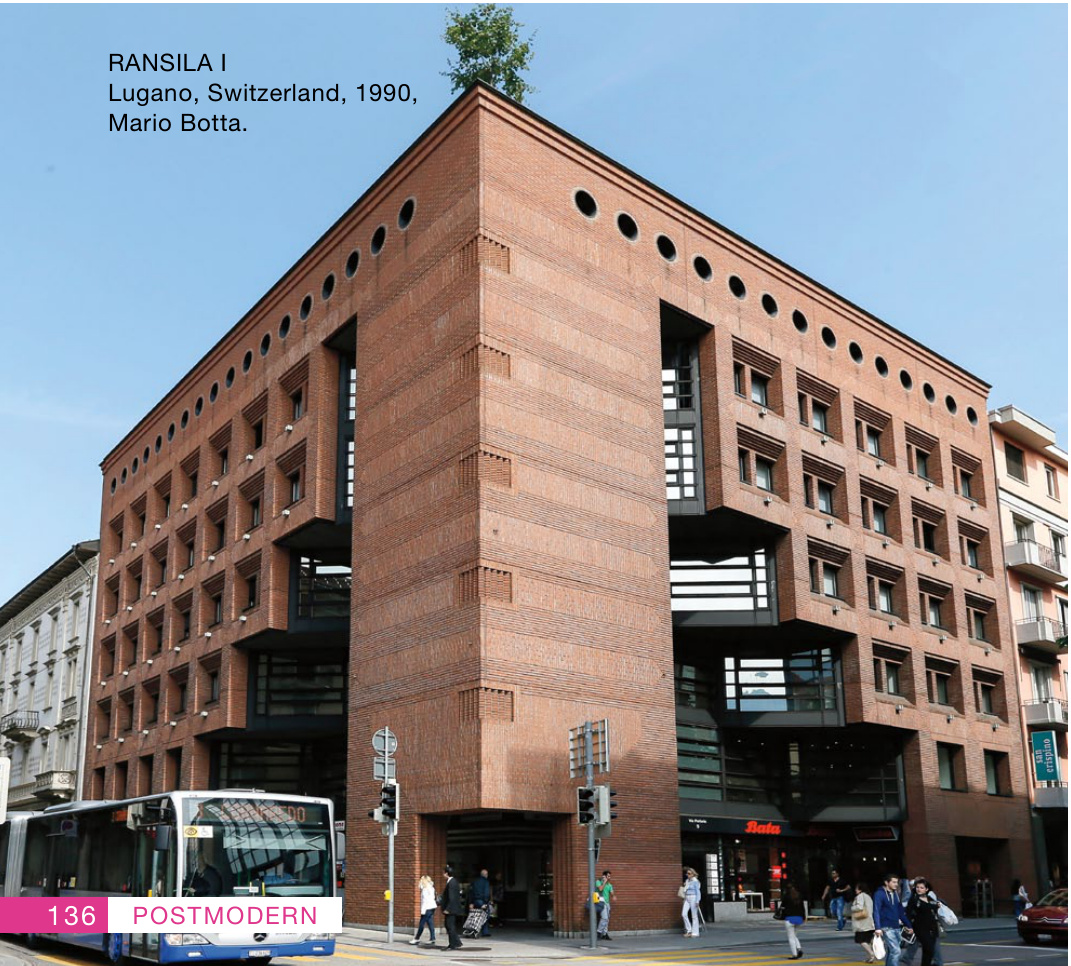
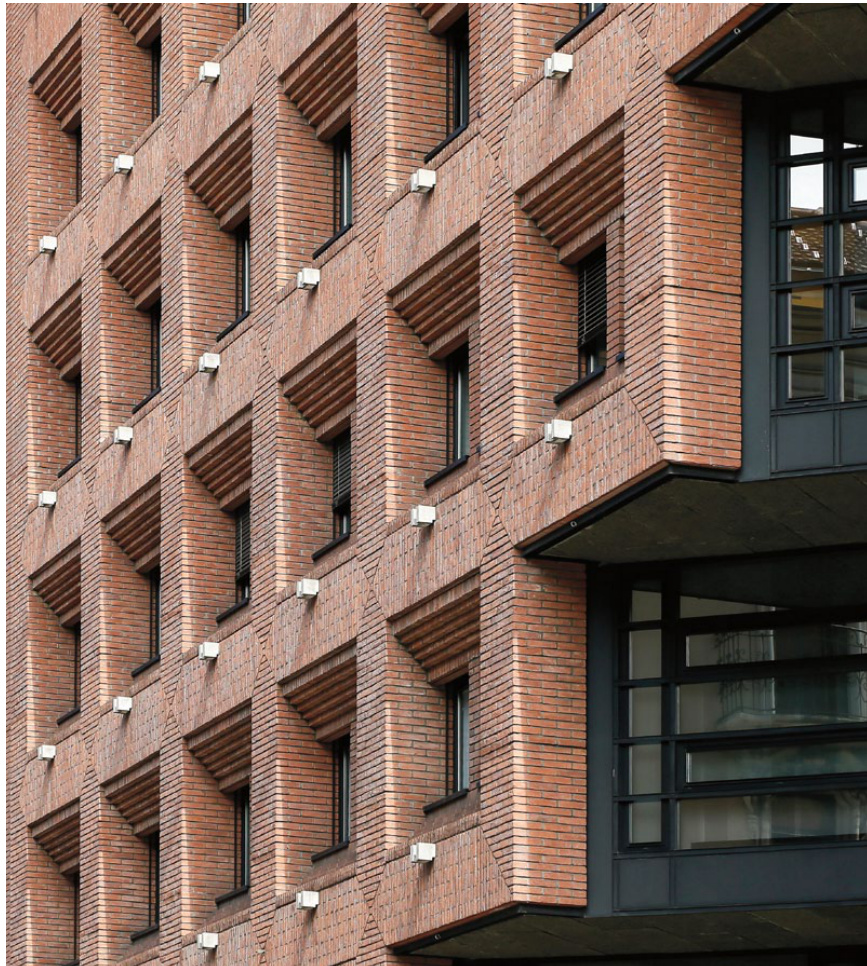
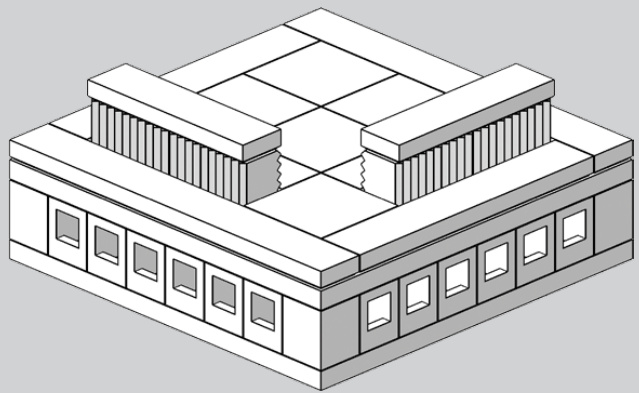
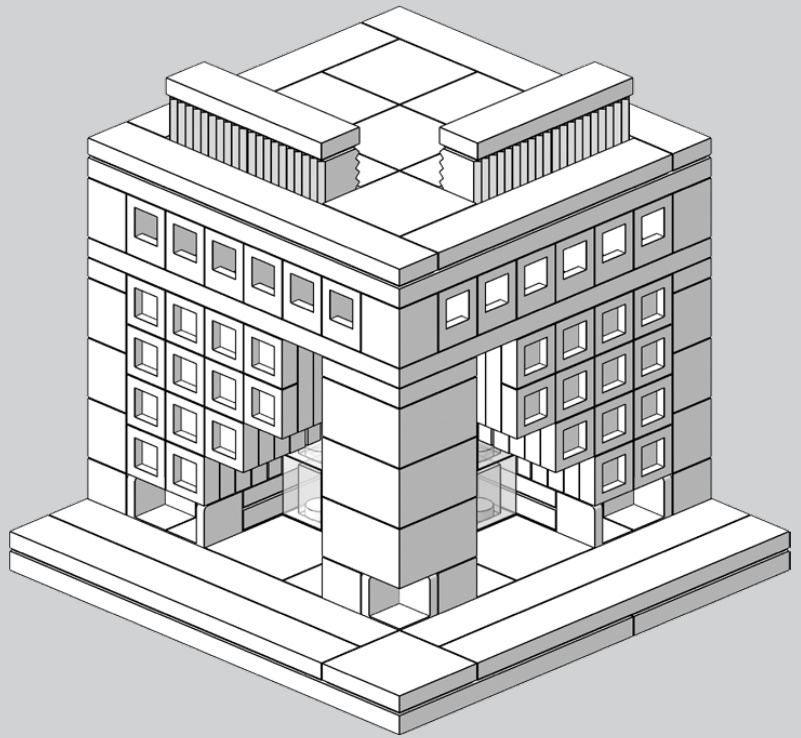
Based on Ransila I (1990), an office building in Switzerland by architect Mario Botta, this model
11
12
13
14
15
16
University Building
1
3
2
4
5
6
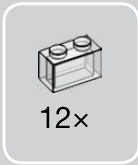
7
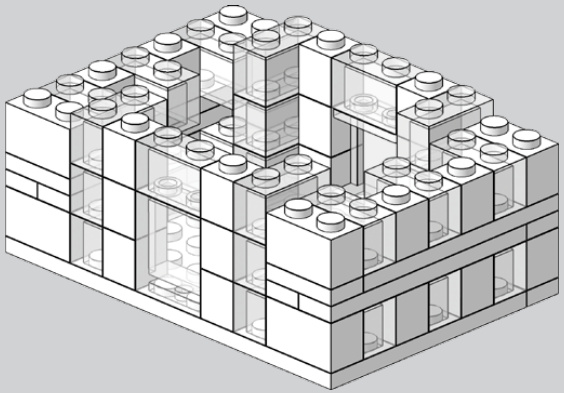
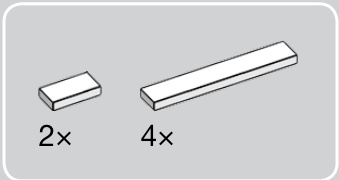
8
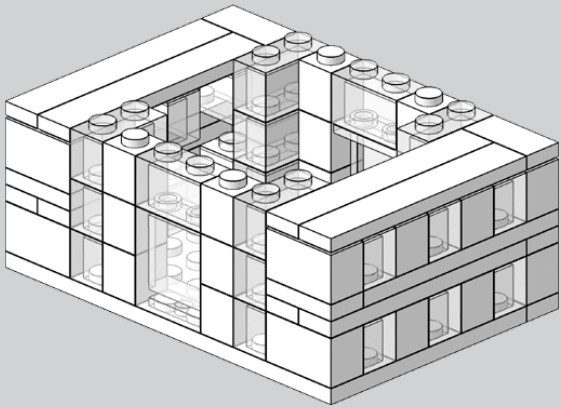

12

14
15
16
17
18
19
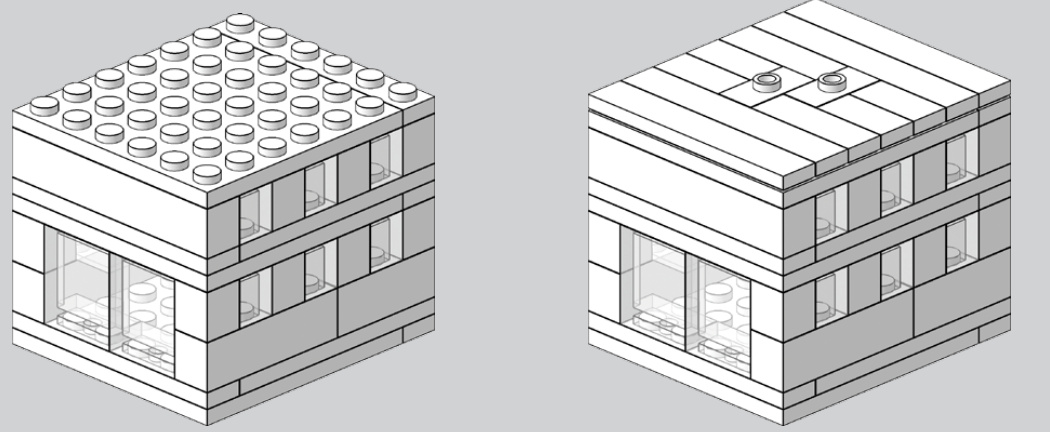
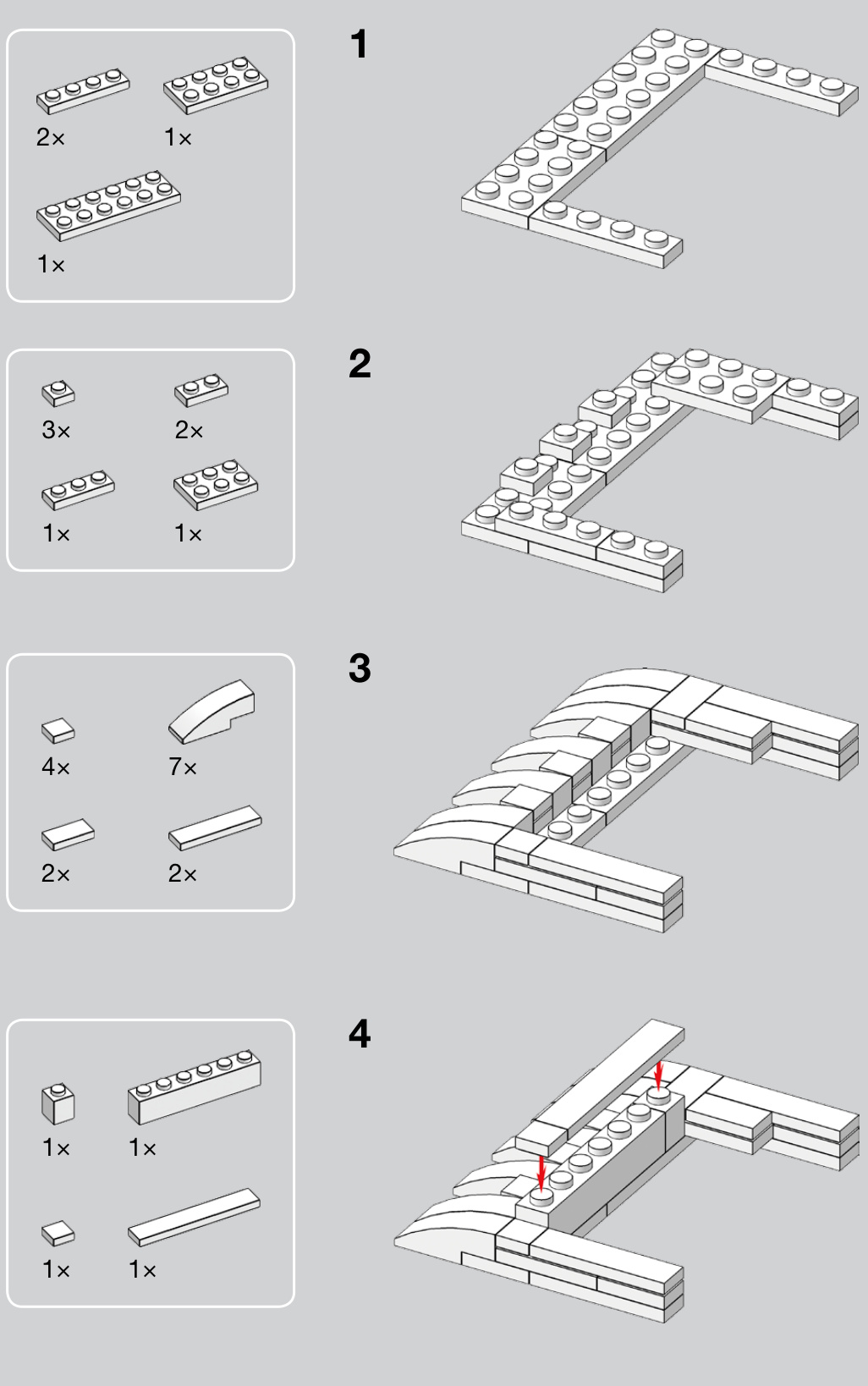
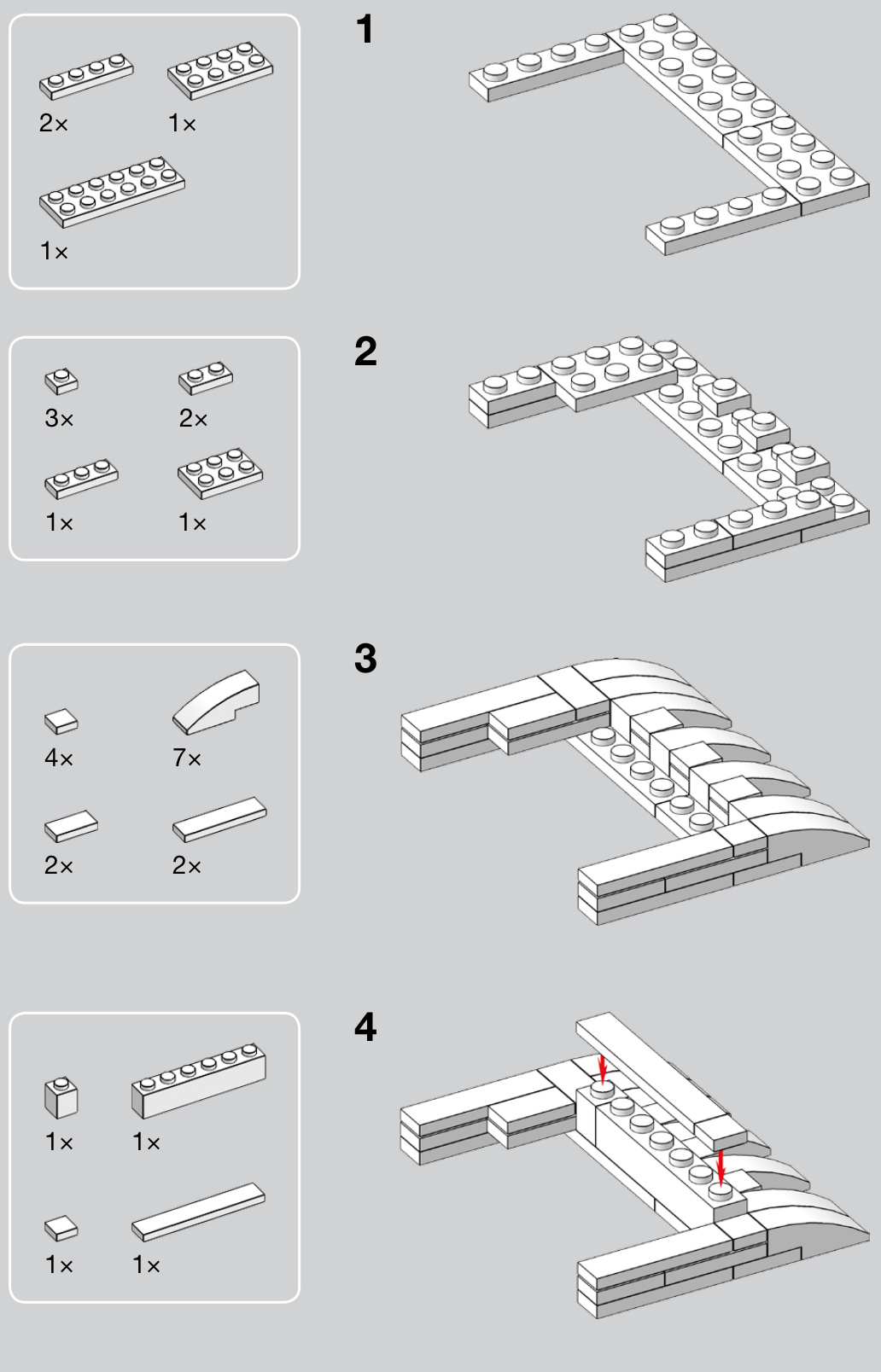
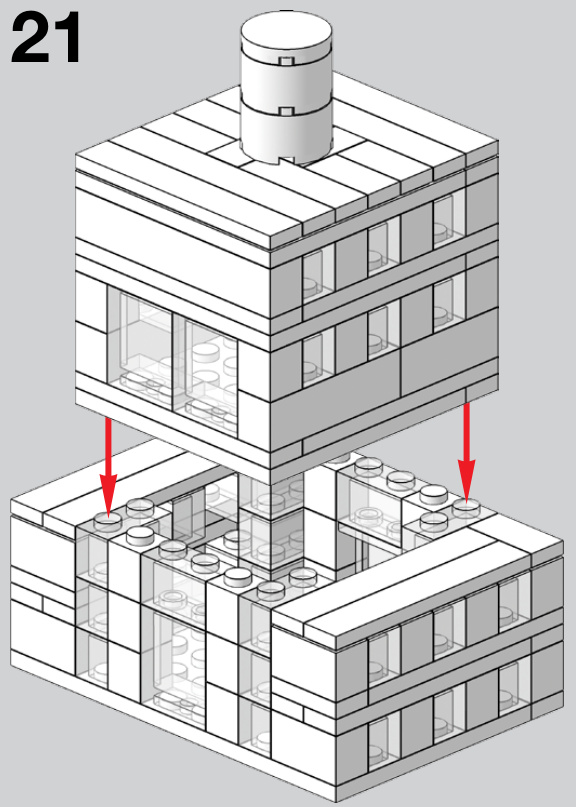
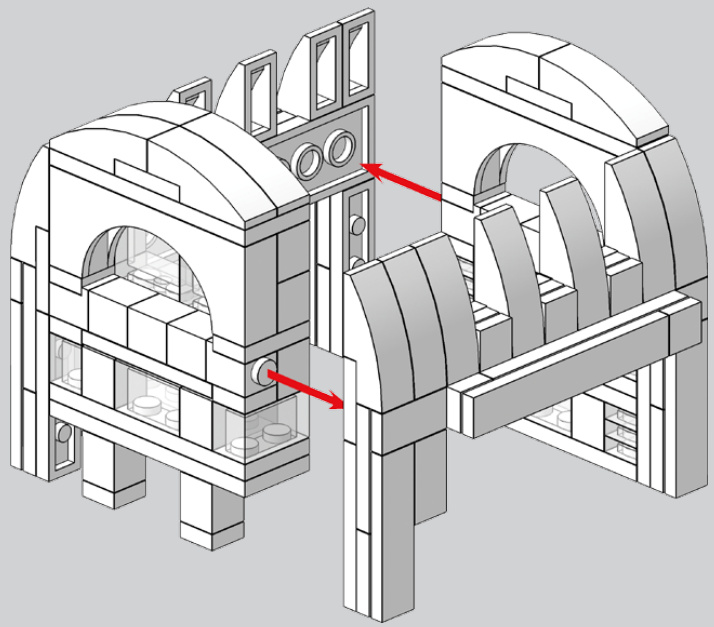
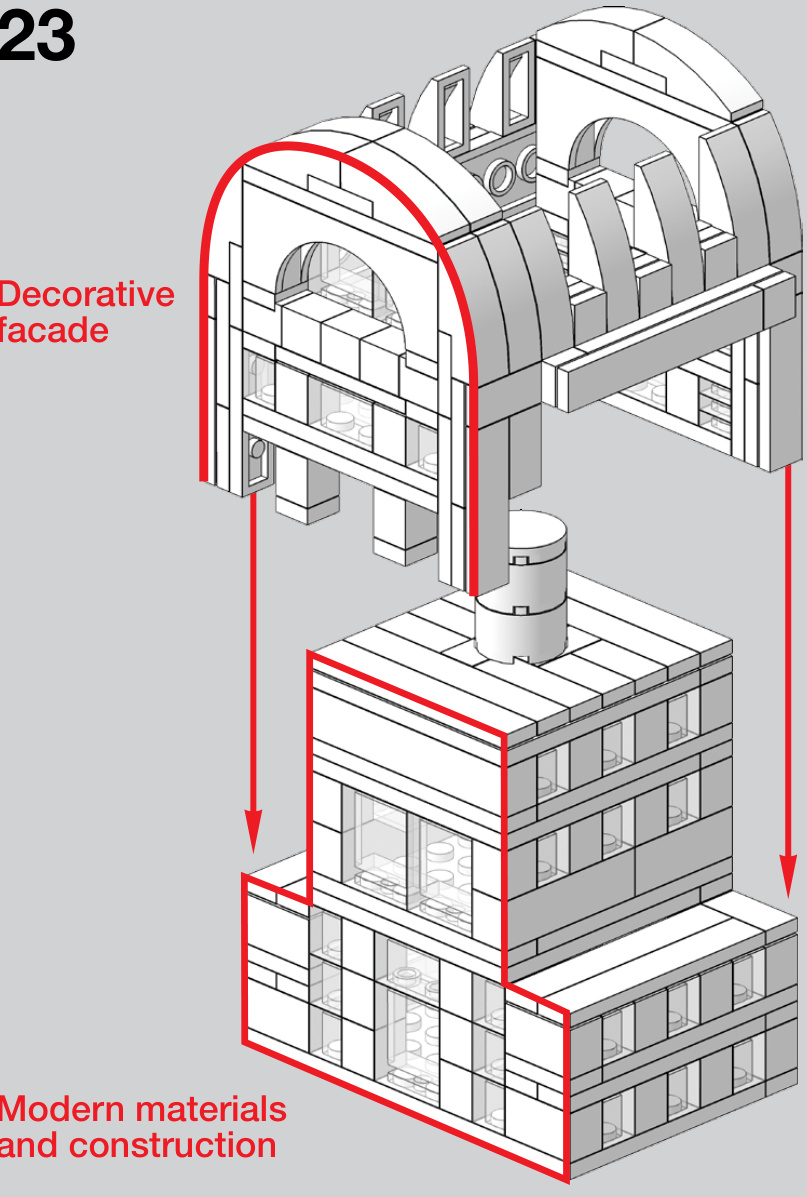
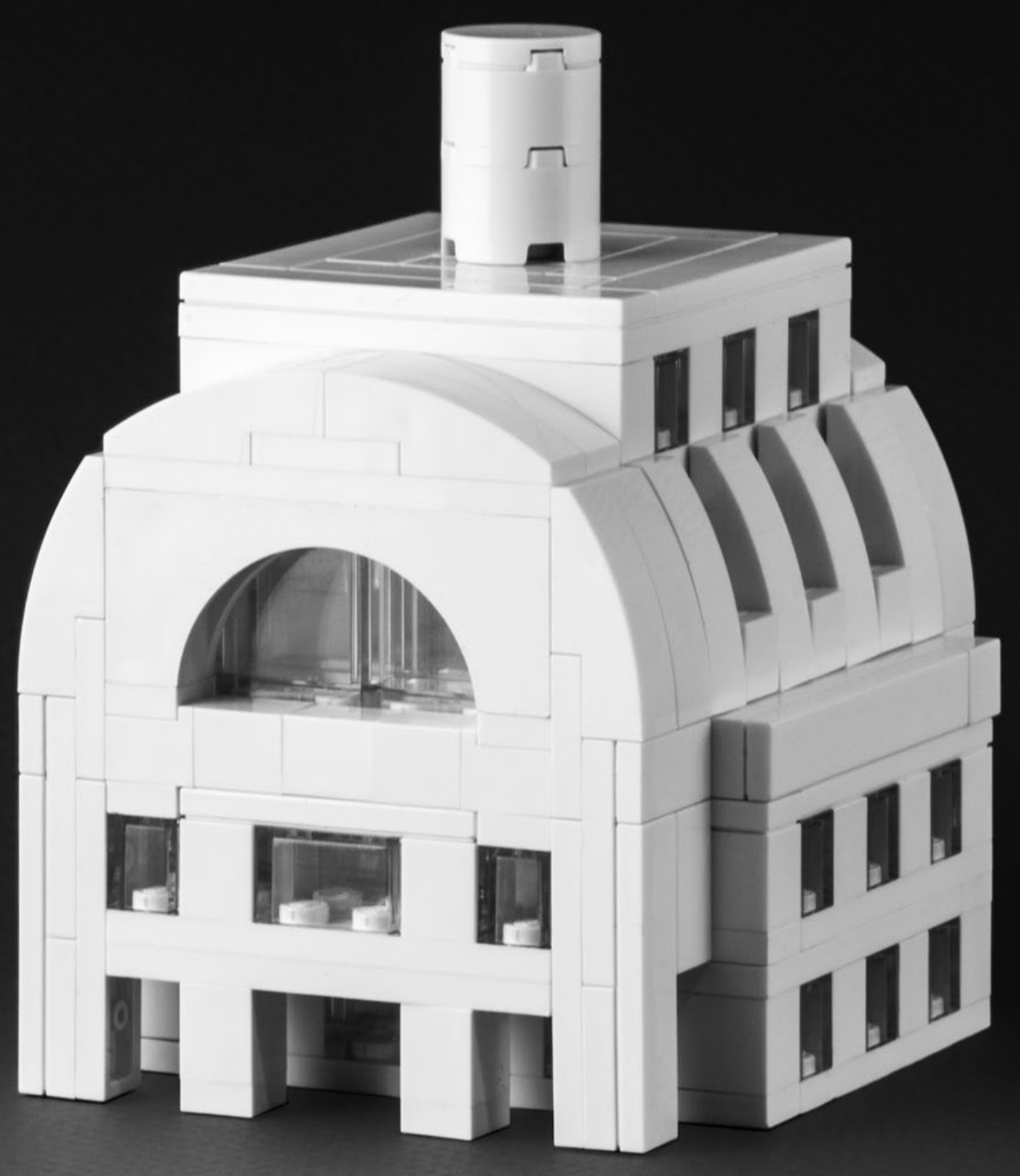
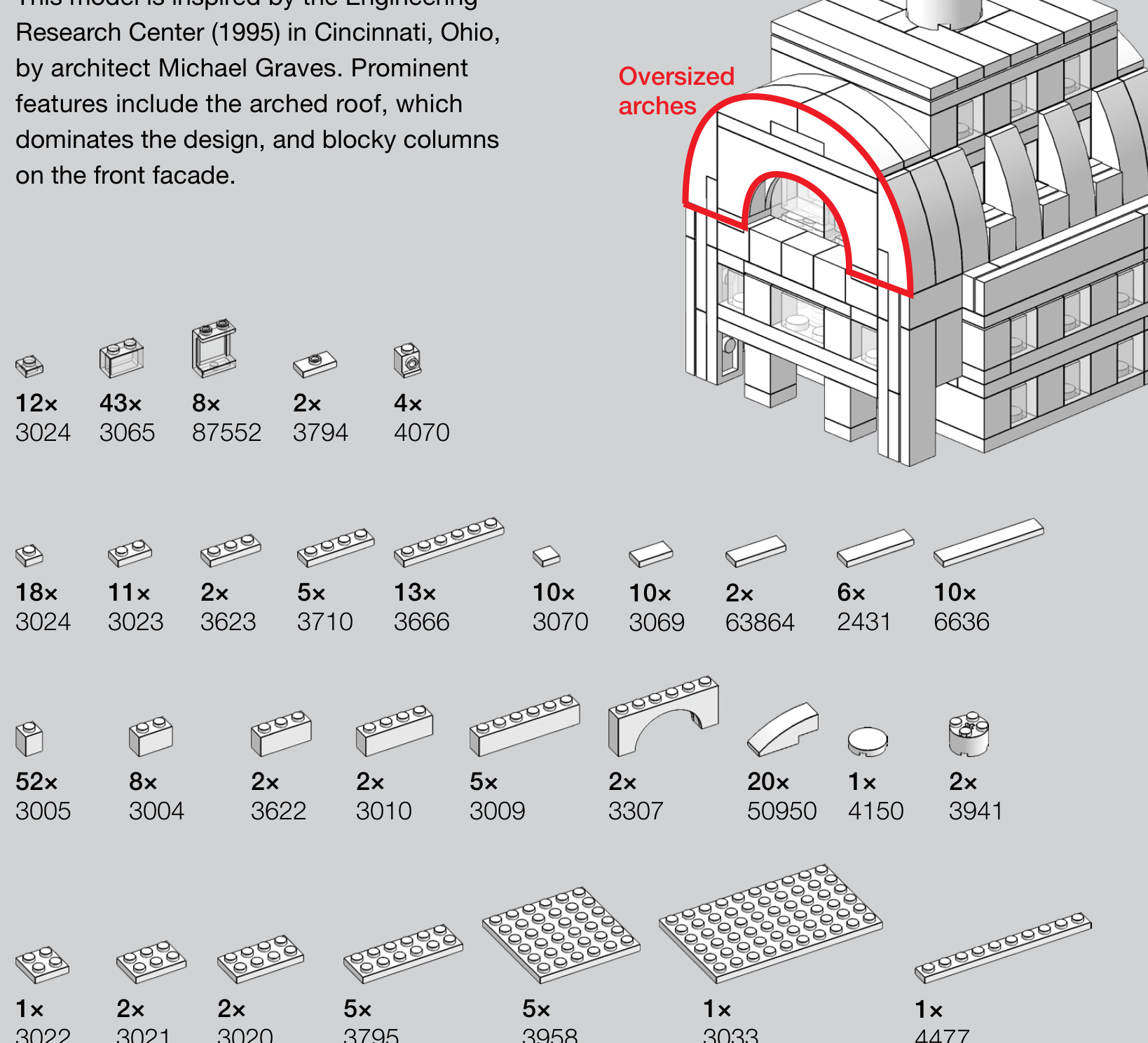
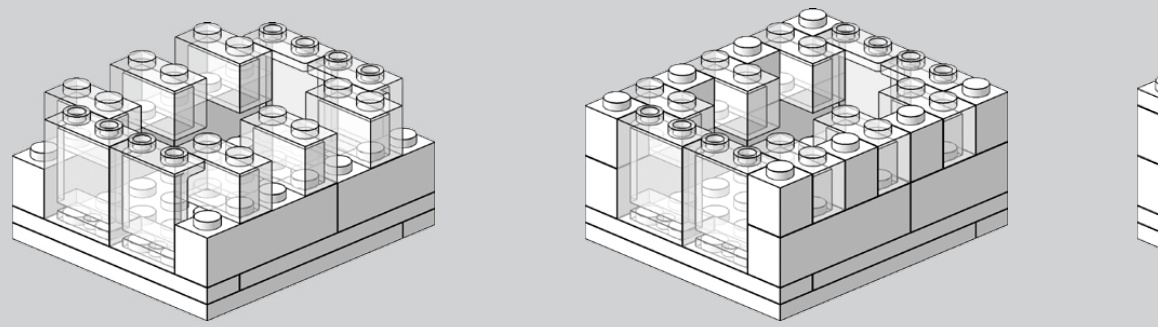
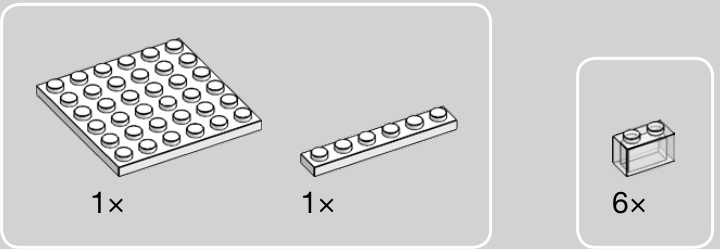
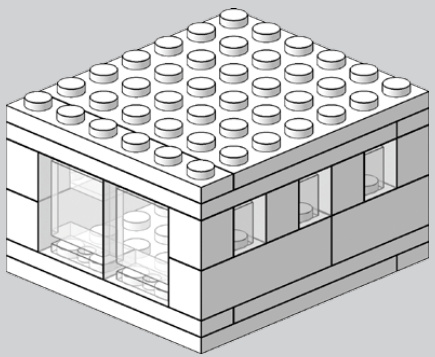
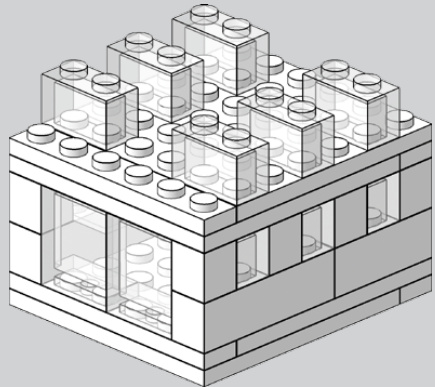
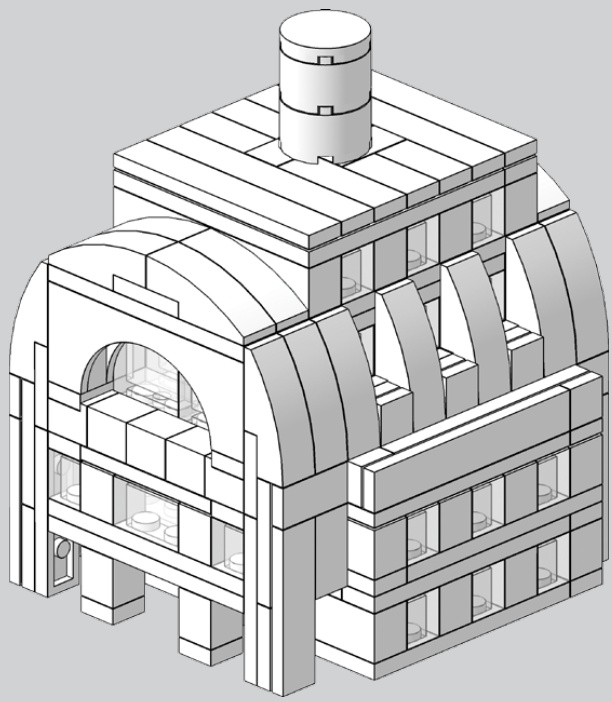
The model is built in two stages. A decorative facade covers a simple modern core. Most Postmodern buildings use cost-saving modern construction techniques and materials despite a classically inspired exterior.
The diverse architectural forms of the last 30 years have only become possible with the development of advanced computer modeling software. Computer-aided design and high-tech fabrication methods have allowed architects to create buildings with shocking, abstract sculptural forms.
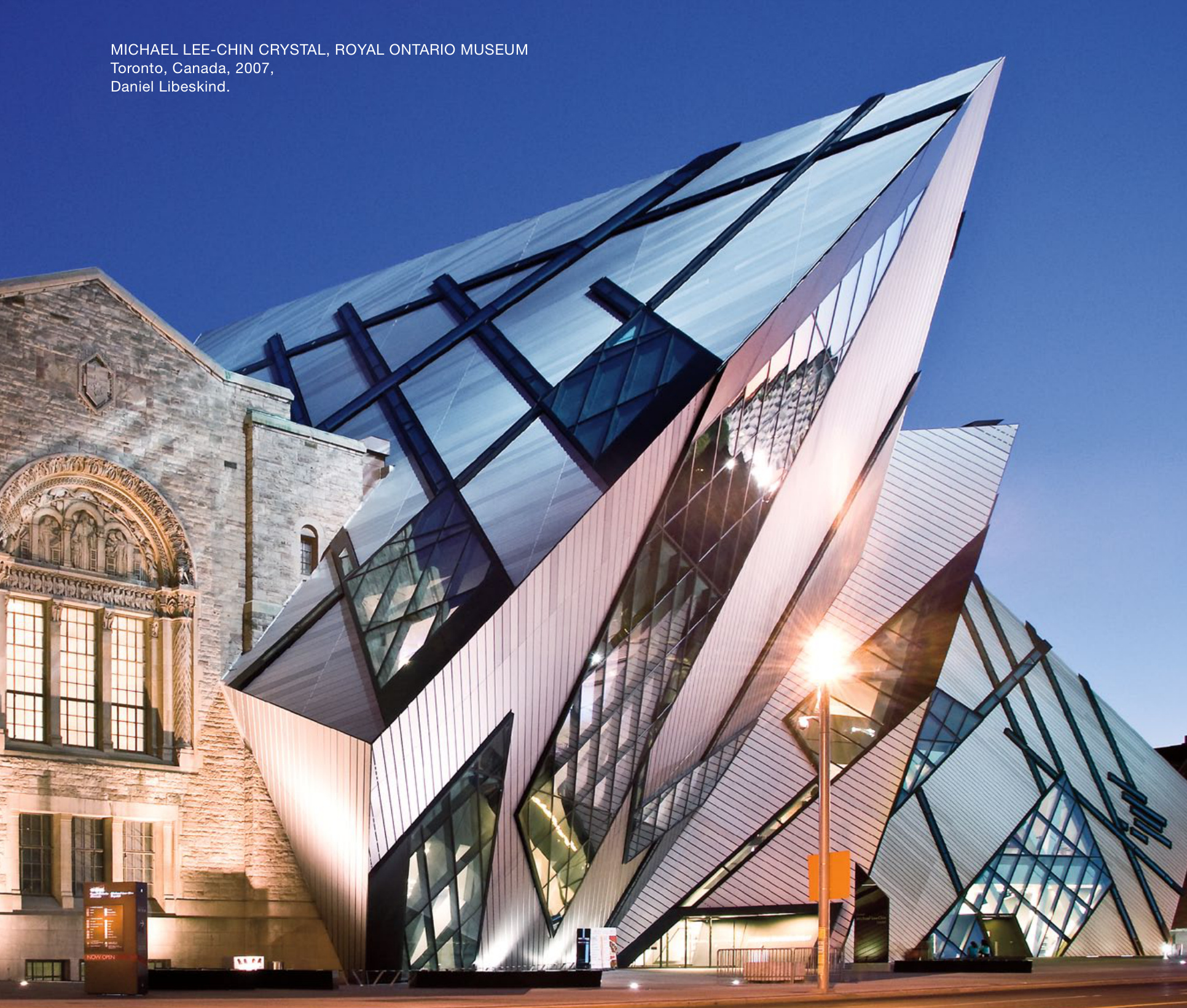
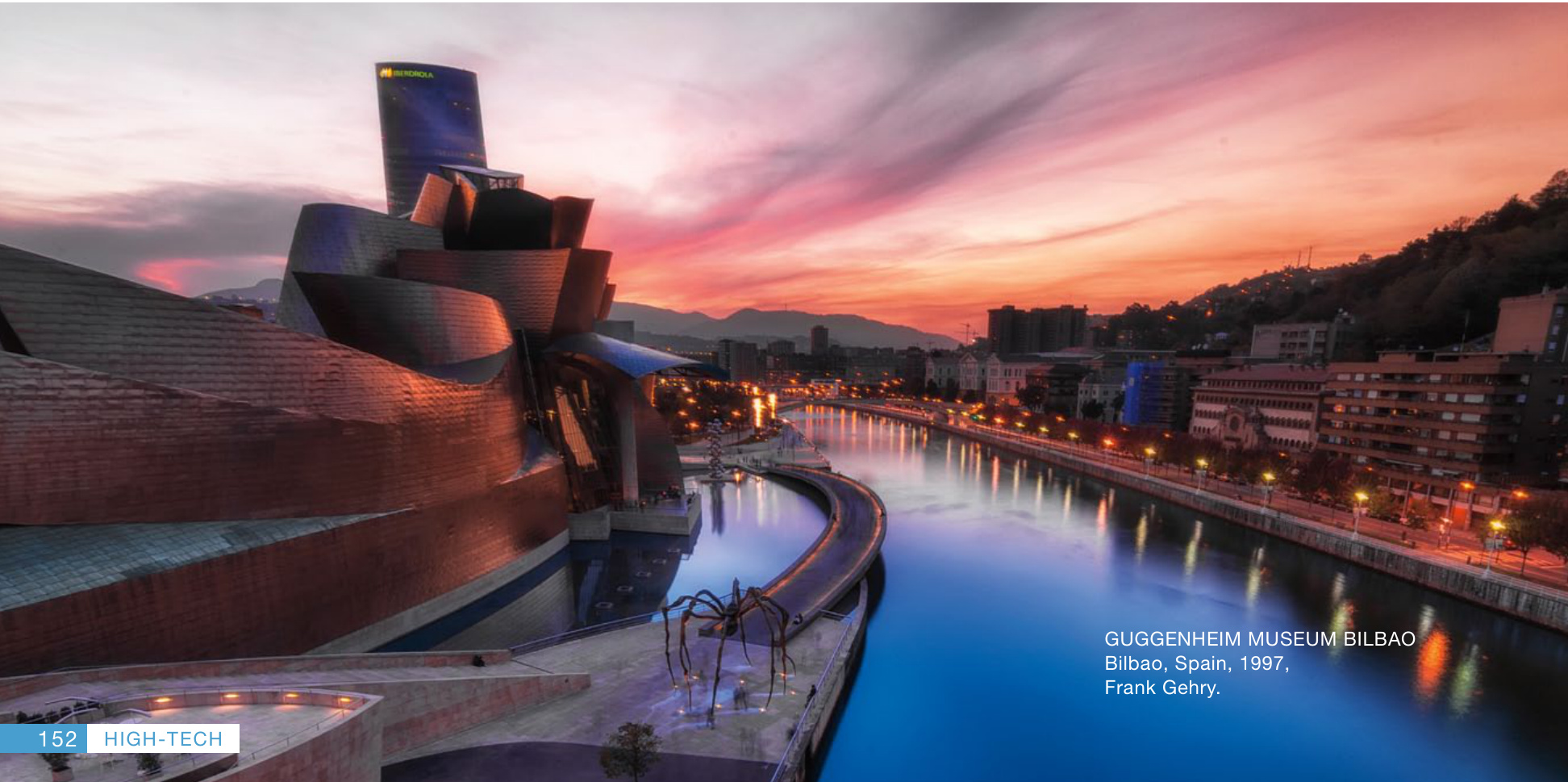
The iconic shell-shaped Sydney Opera House (1973) is one of the first buildings where computers were used throughout the design process, ushering in a new High-Tech style. Primitive computer models helped the design team calculate the structure needed to support the huge concrete shells and provided the precise measurements required to ensure that each rib of the shells lined up seamlessly.
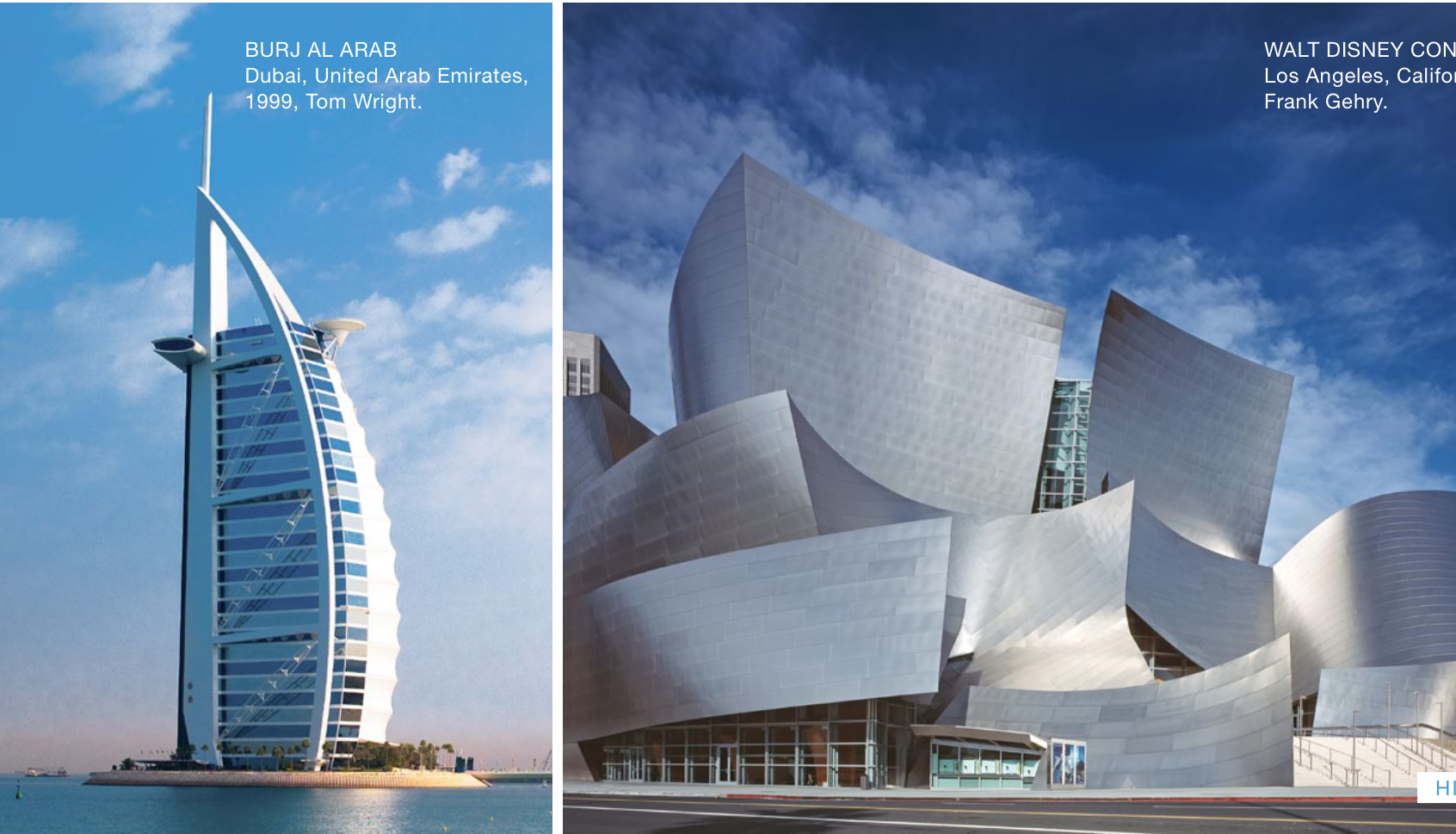
In 1997, architecture with complex curved forms reached a new level with the Guggenheim Museum Bilbao by Frank Gehry. This building’s popularity made Gehry into a celebrity architect, or “starchitect.” He has built similar buildings all over the world, including the Walt Disney Concert Hall (2003) in Los Angeles.
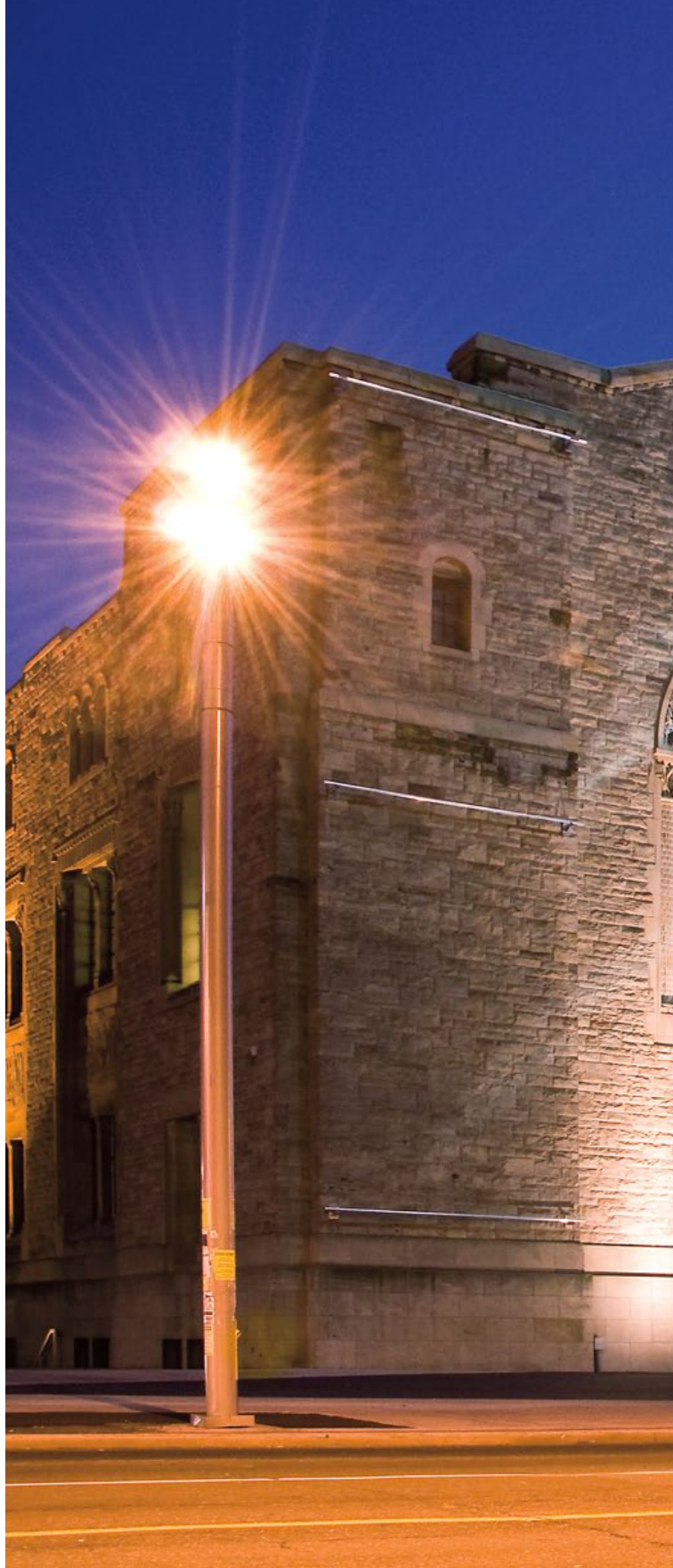
We see similar abstract forms but with sharp, chiseled angles in the Michael Lee-Chin Crystal (2007), the Royal Ontario Museum’s main entrance. It is an aggressive High-Tech design by Daniel Libeskind that is made all the more shocking by being grafted onto the classically designed museum.
This style is sometimes called Deconstructivism, because the basic shapes of the buildings have been visibly
MATERIALS
High-Tech buildings employ a wide range of materials, including advanced plastics, machine-cut plywood, concrete, and lots of glass and steel. The Guggenheim Museum Bilbao is covered in titanium panels that are just one-third of a millimeter thick!


LEGO Bricks
Technic parts can be used to re-create structural elements of a building.
Wedges and curved parts can approximate the curves of a complex sculptural form.
Hoses can be bent into curved forms and attached with clips.
disassembled, broken, and crumpled, with the structural supports usually hidden from view.
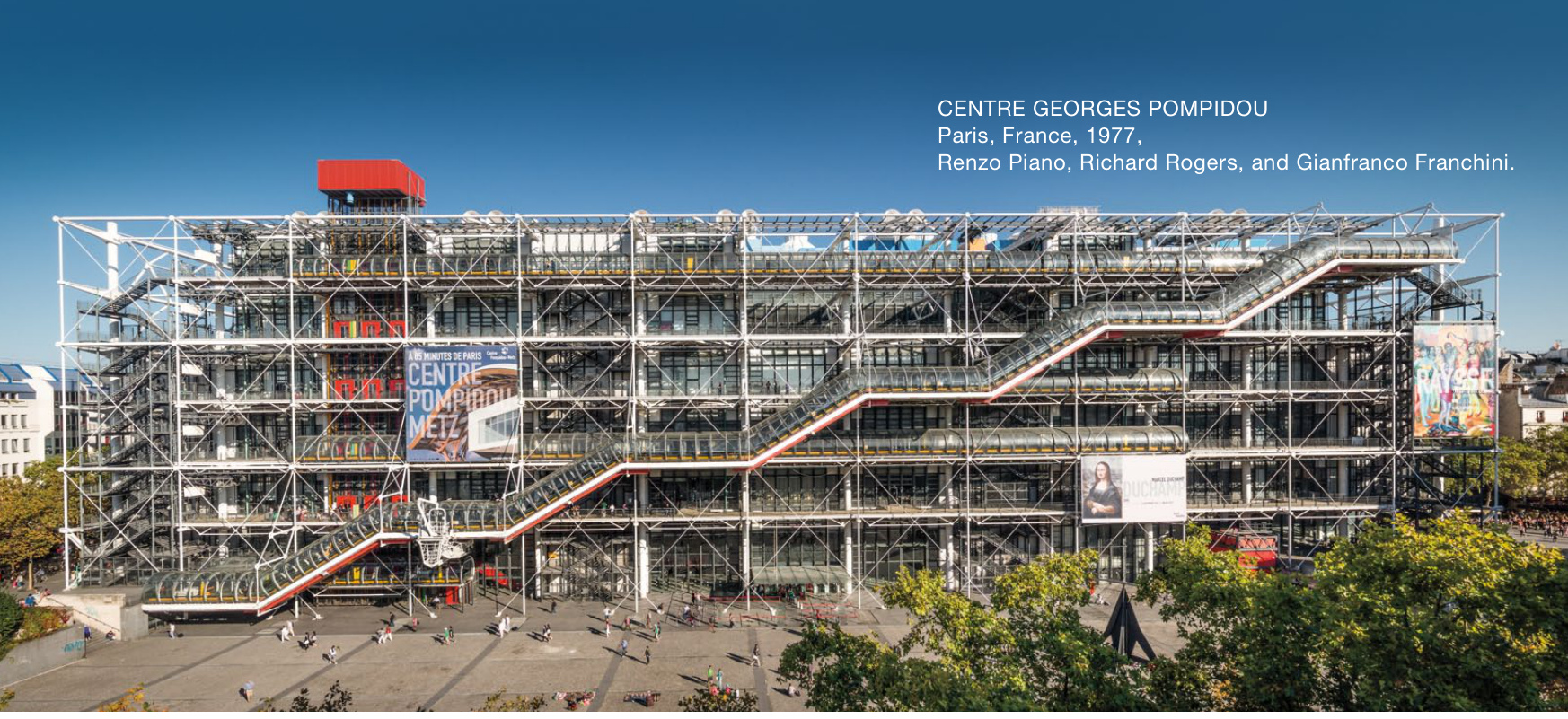
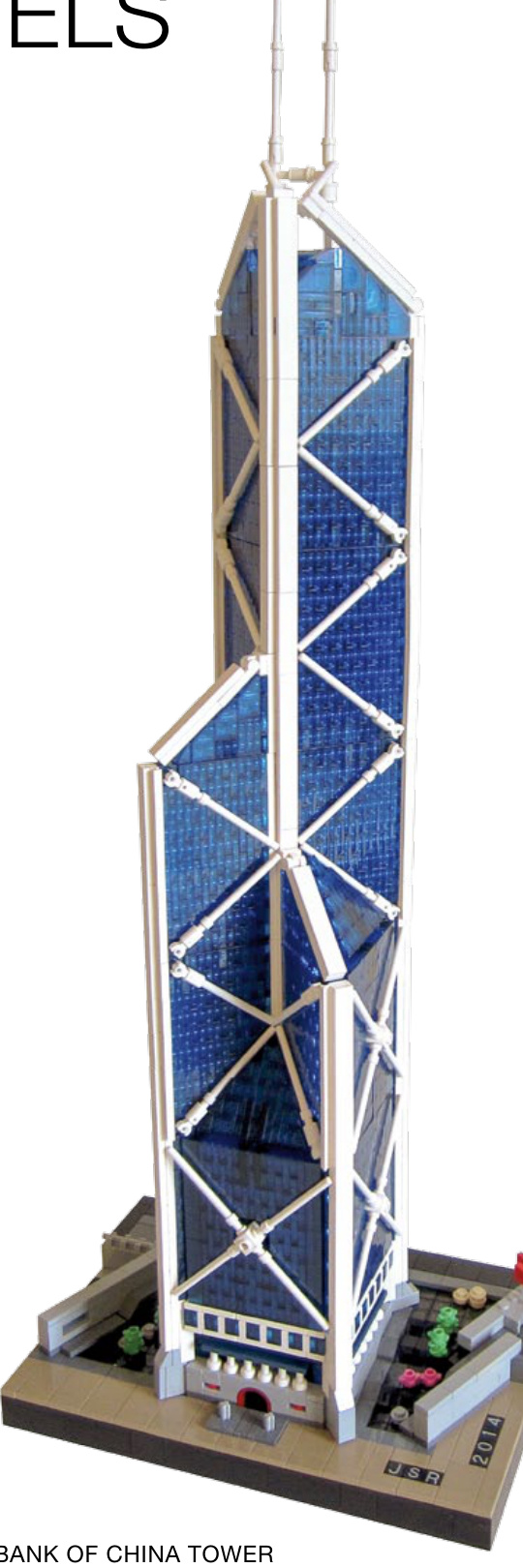
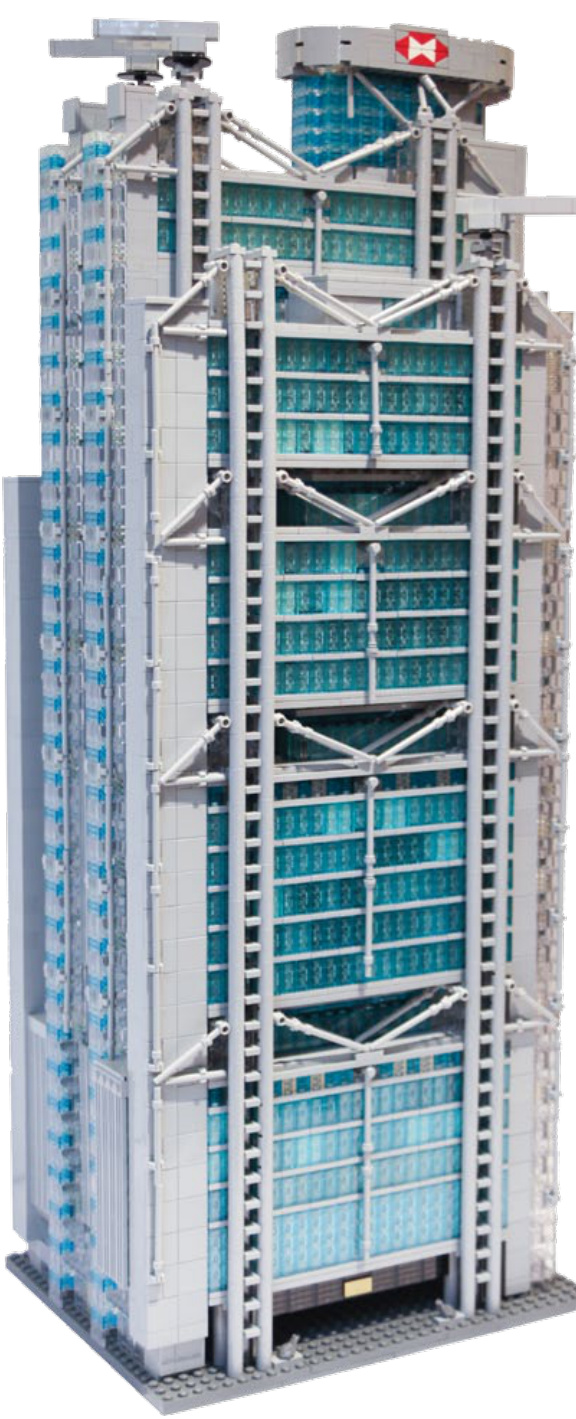
At the other extreme is the Centre Georges Pompidou (1977), which celebrates the structure and functions of the building by putting all the guts of the building on the exterior instead of trying to hide them on the inside. It’s an inside-out building! This is among the first of many High-Tech buildings to have a rectangular form harking back to Modernism, but with a more playful design. Other examples of this High-Tech Modernism include the HSBC Building (1985) by Norman Foster and the Bank of China Tower (1990) by I.M. Pei.
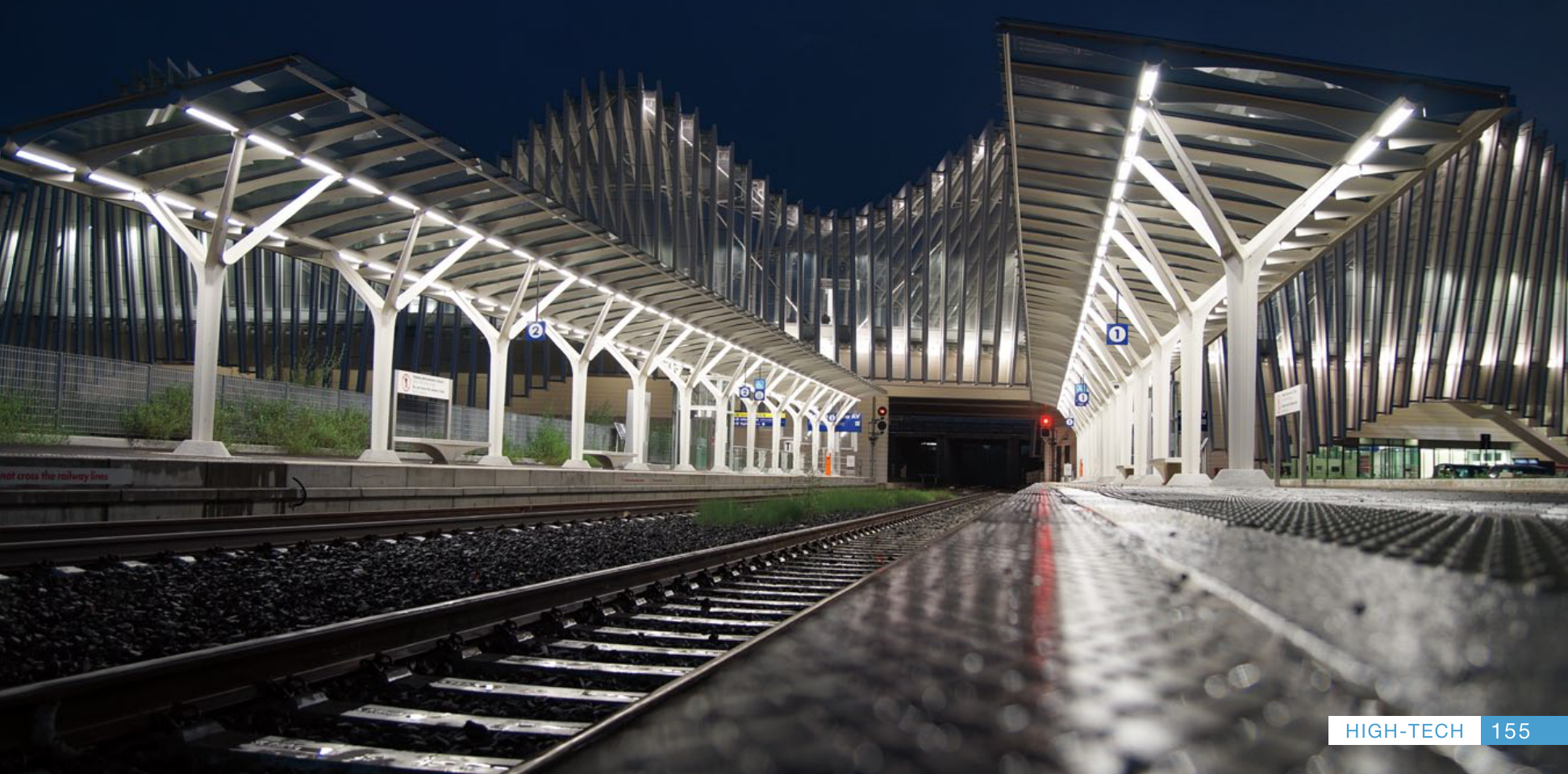
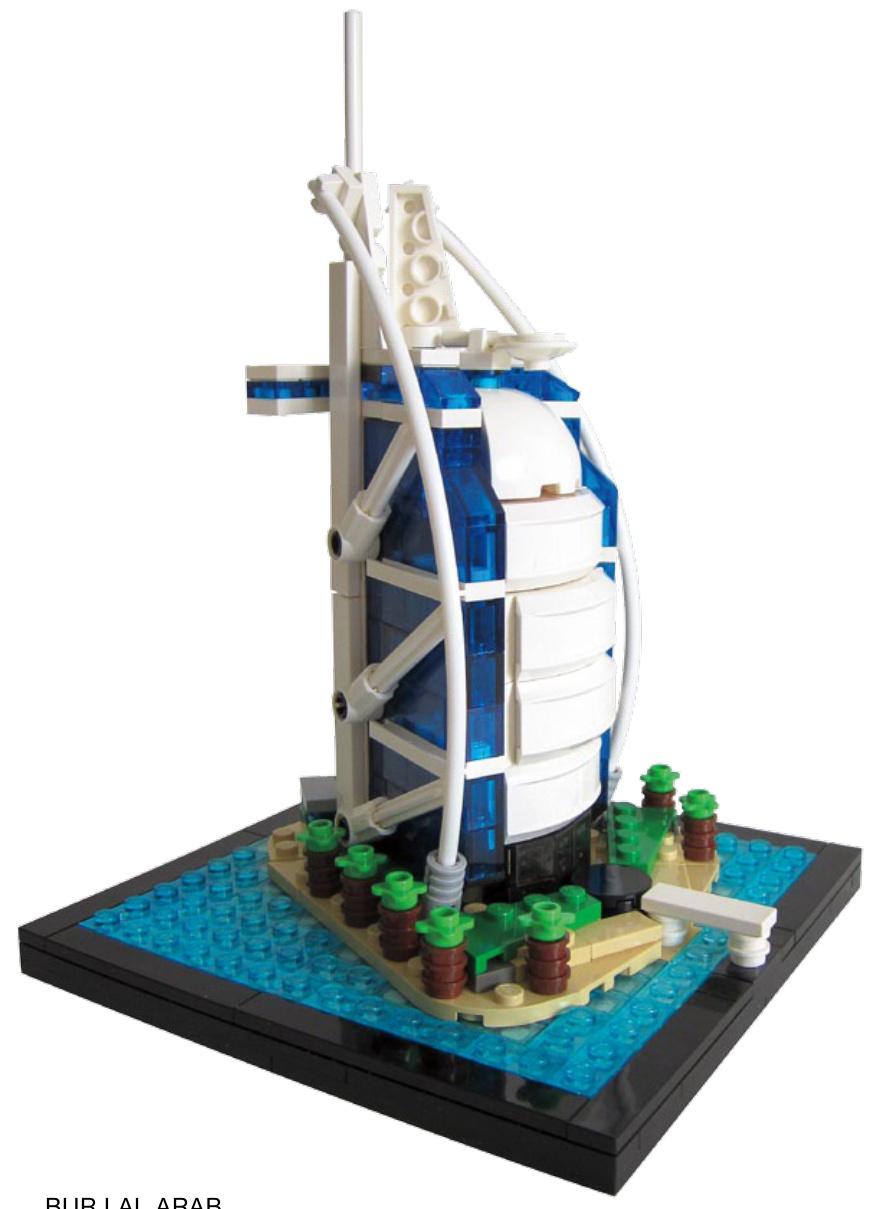
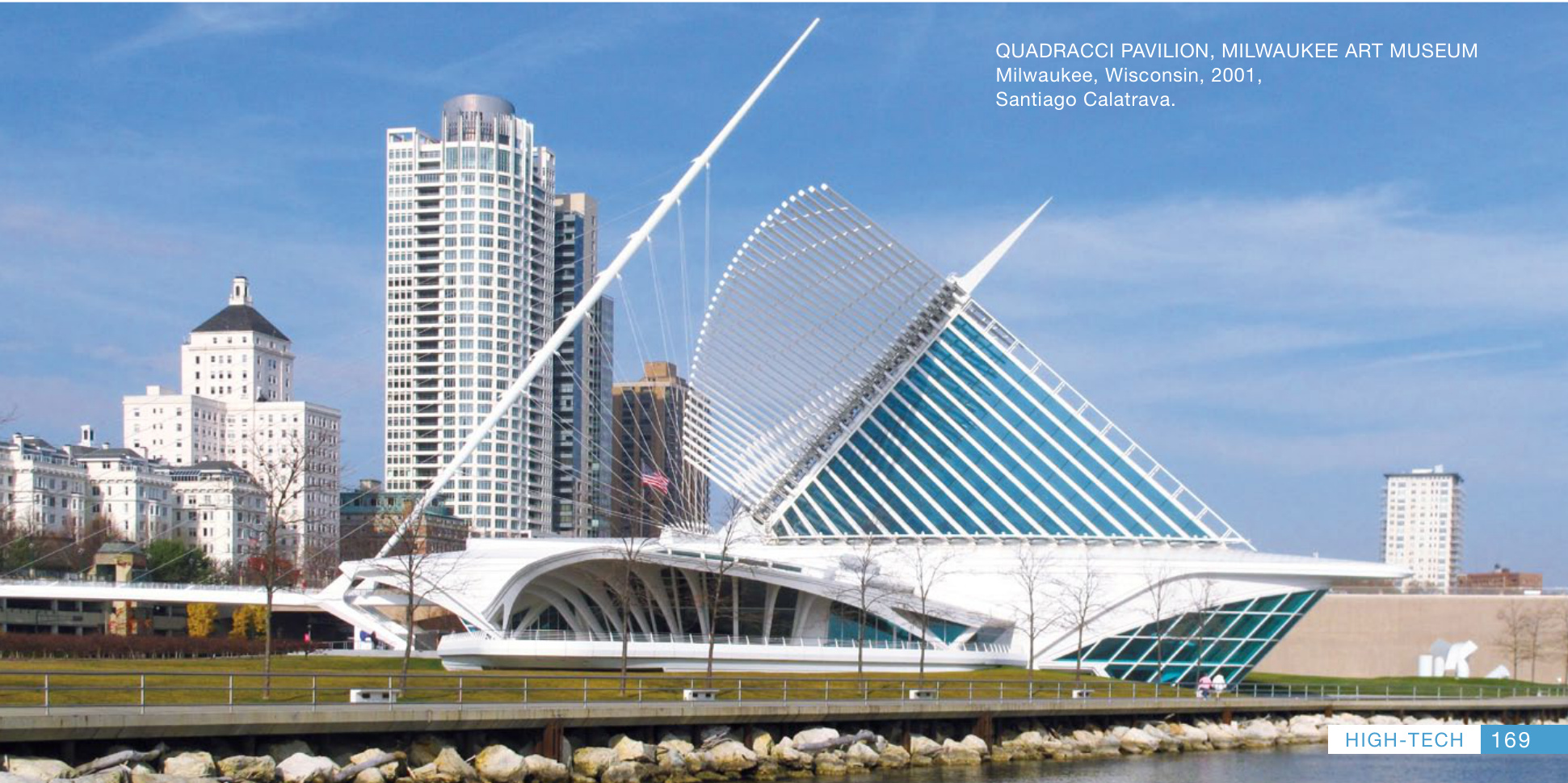
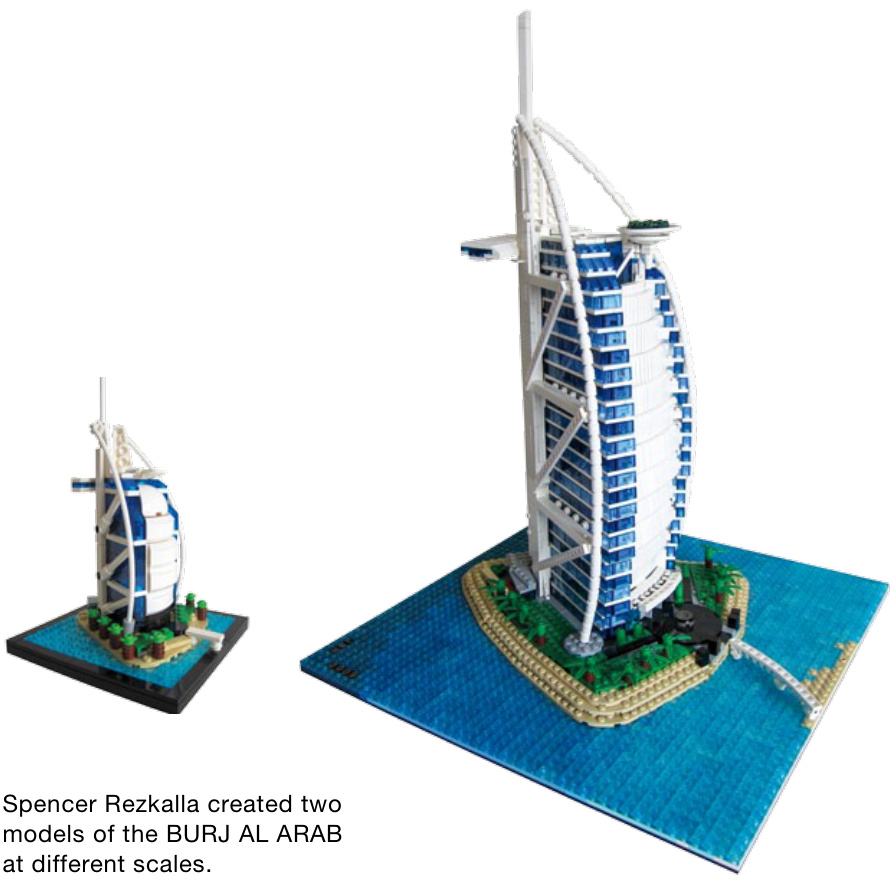
A few architects have blended HighTech Modernism and Deconstructivism into a single building where the support structure is the focus of the design. The most prominent examples are the work of Santiago Calatrava, a structural engineer, architect, and sculptor who has designed bridges and buildings such as the Reggio Emilia AV Mediopadana (2013), which has a soaring bridge-like structure. The Burj Al Arab (1999), designed by Tom Wright, is another iconic example of this blended style; the hotel’s exterior is sleek and curvy but still shows off the diagonal bracing in the final design.
In some extreme cases, High-Tech architects are literally allowing the computer to take over parts of the design process. Architects describe the shape they want to achieve and then rely on computer
algorithms to determine the most efficient way to construct it. In the future, computers might be able to design a whole building, but will they be able to compete with the creative genius of a great architect?
High-Tech in LEGO
LEGO, with its rectangular shapes and predictable proportions, is not the ideal medium for capturing the curved forms common in Deconstructivist designs like those by Frank Gehry. That said, you
can approximate curves in large-scale models using basic bricks, or look for curved pieces such as those normally used for an airplane nose.
Some of the more rectangular High-Tech buildings are more practical to construct with LEGO. You may be able to build them using basic LEGO bricks, or use Technic liftarms, axles, and pins to create advanced structural engineering forms, as well as building at unusual angles.
LEGO Colors
White
Light bluish grey
Black
Red
Orange
Lime
Medium blue
Trans light blue
Trans clear

High-Tech LEGO Models
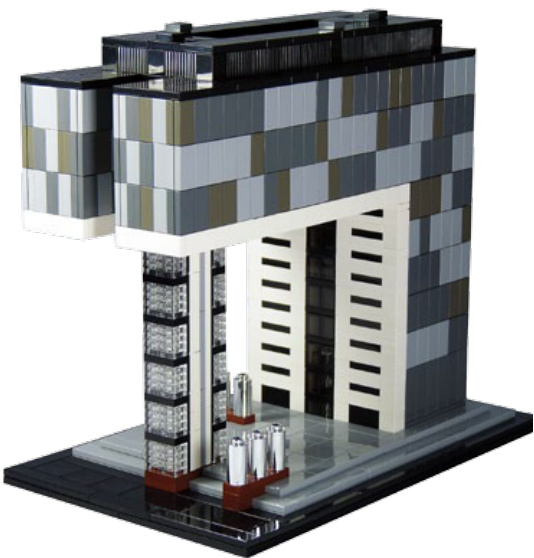
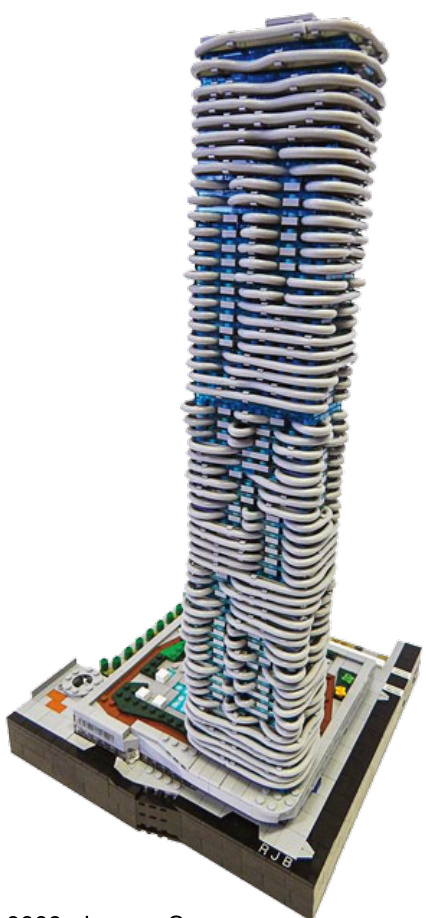
Kranhaus Süd
Cologne, Germany, 2011, Alfons Linster and Hadi Teherani. LEGO model by Jens Ohrndorf.
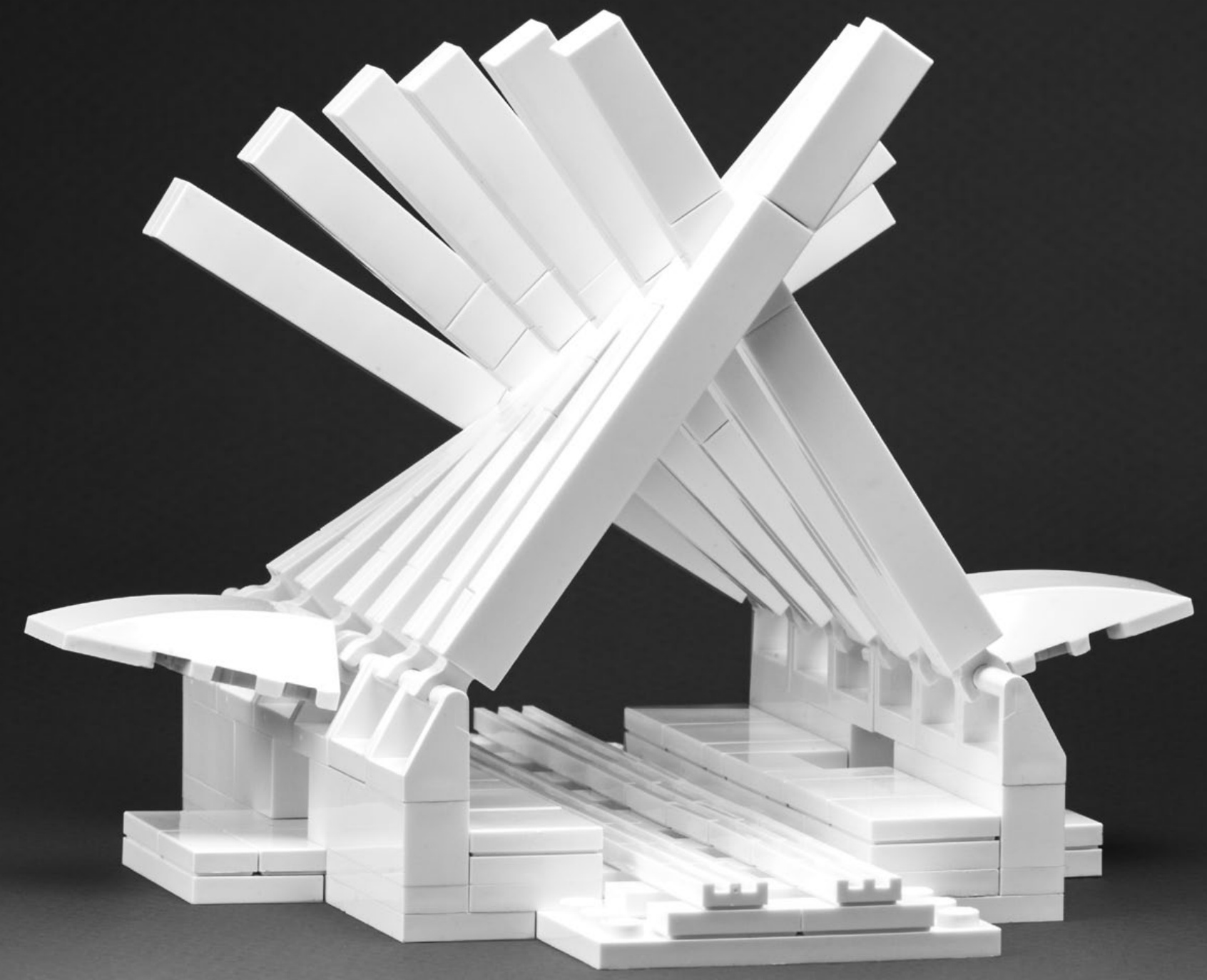
Train Station
This High-Tech train station has a visible structure inspired by several buildings designed by architect Santiago Calatrava.
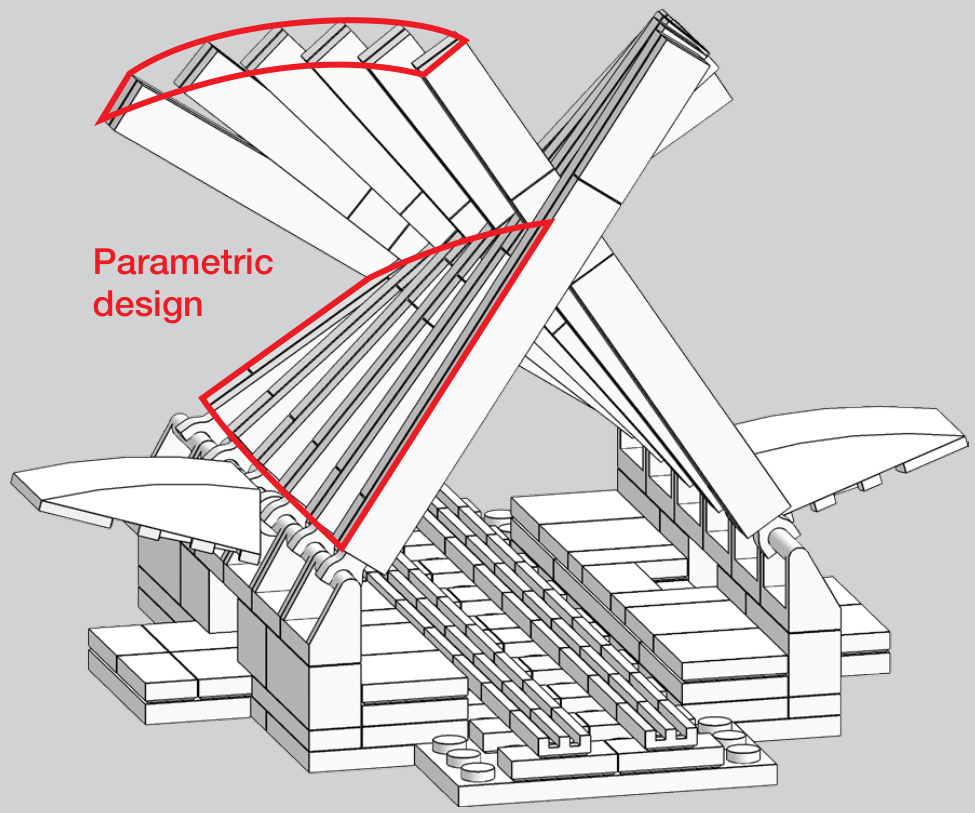
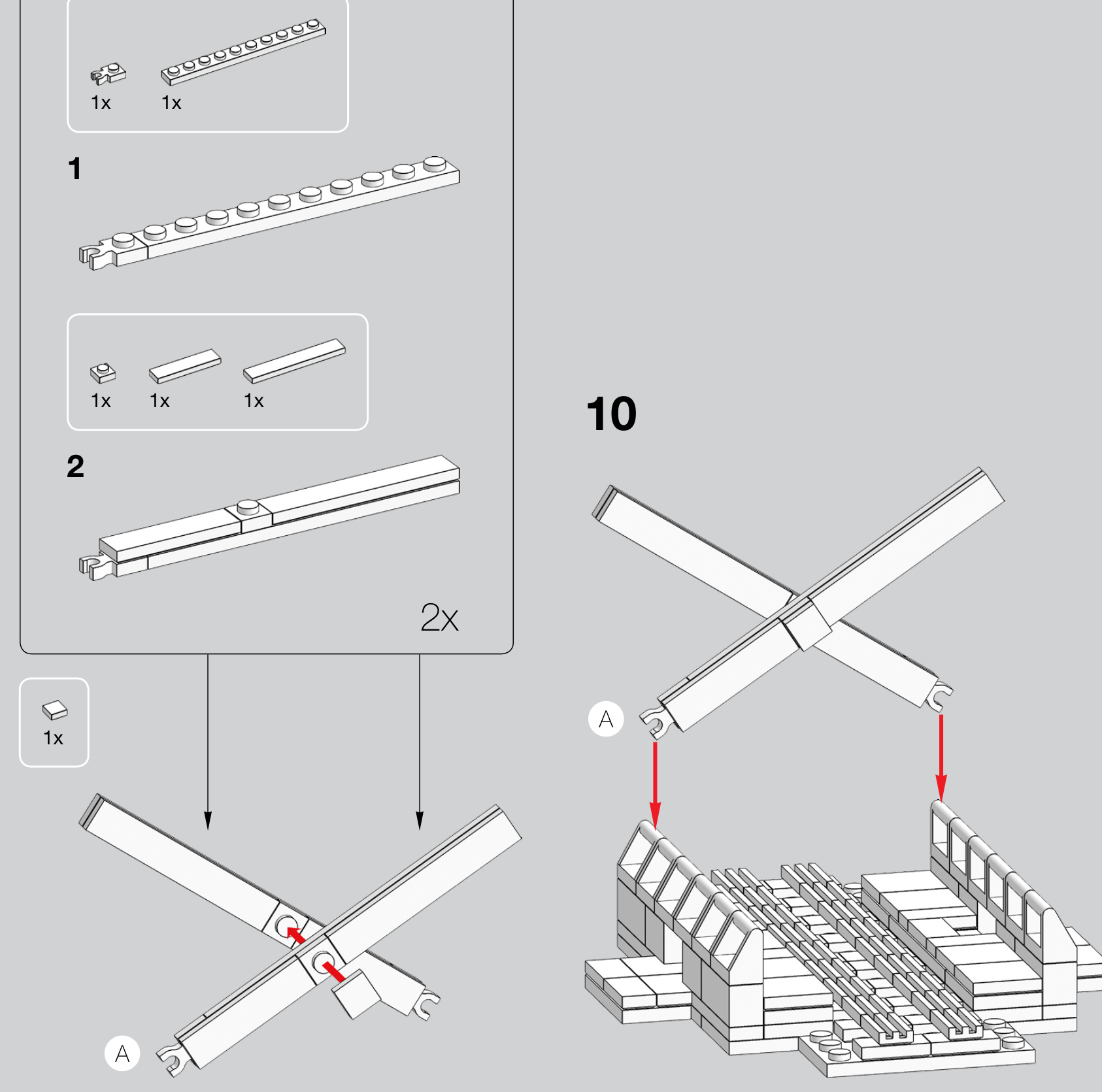
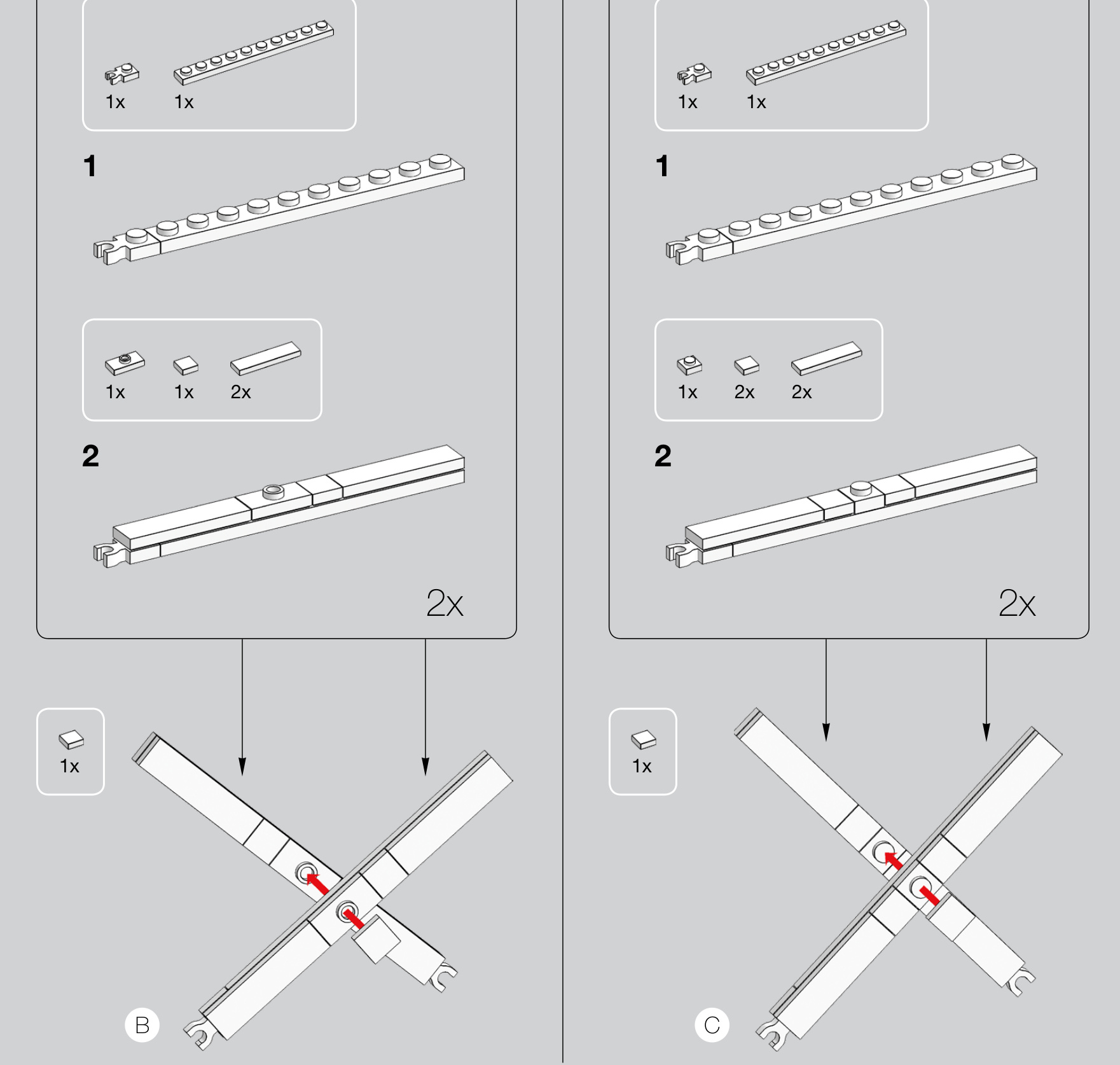
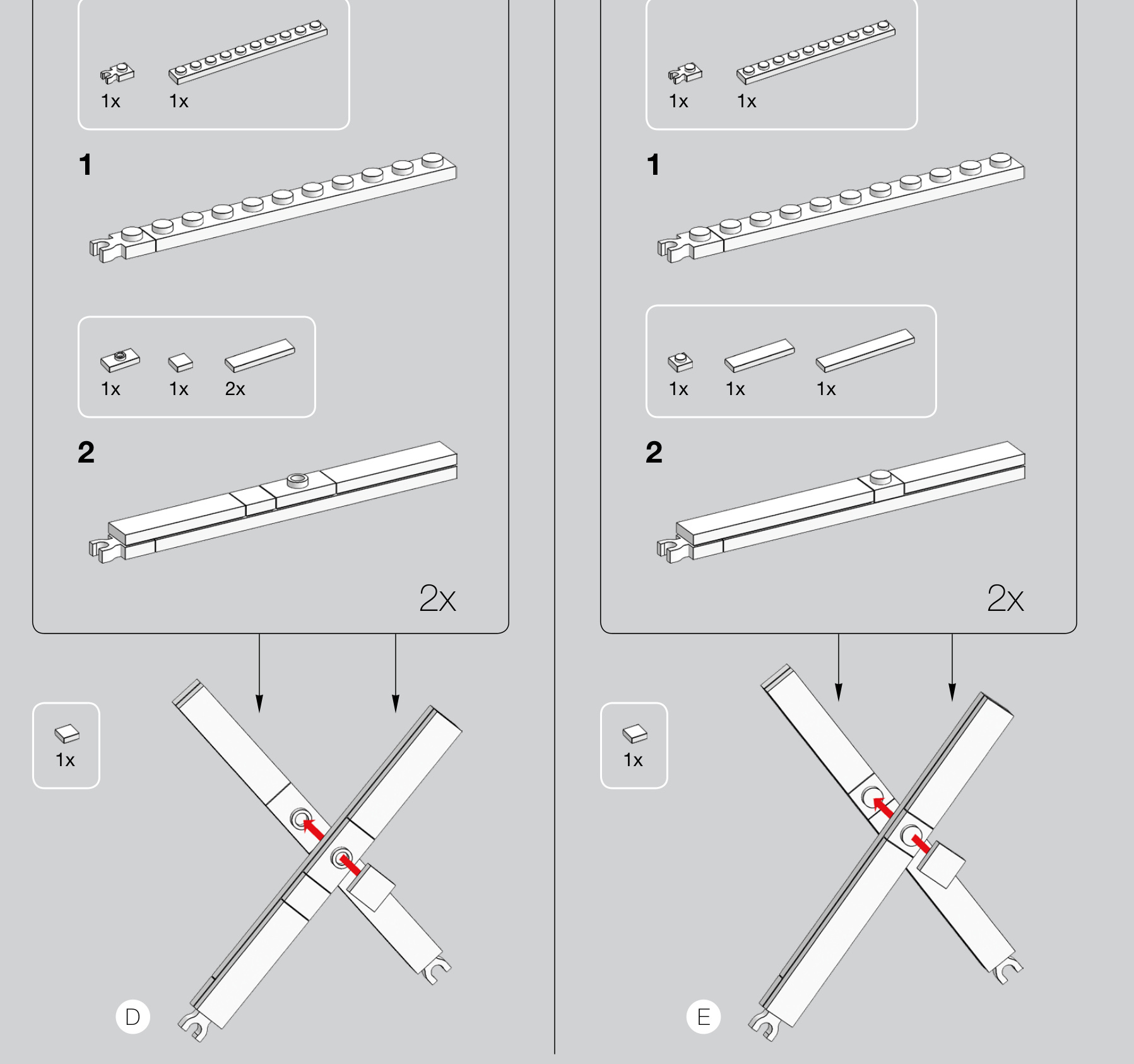
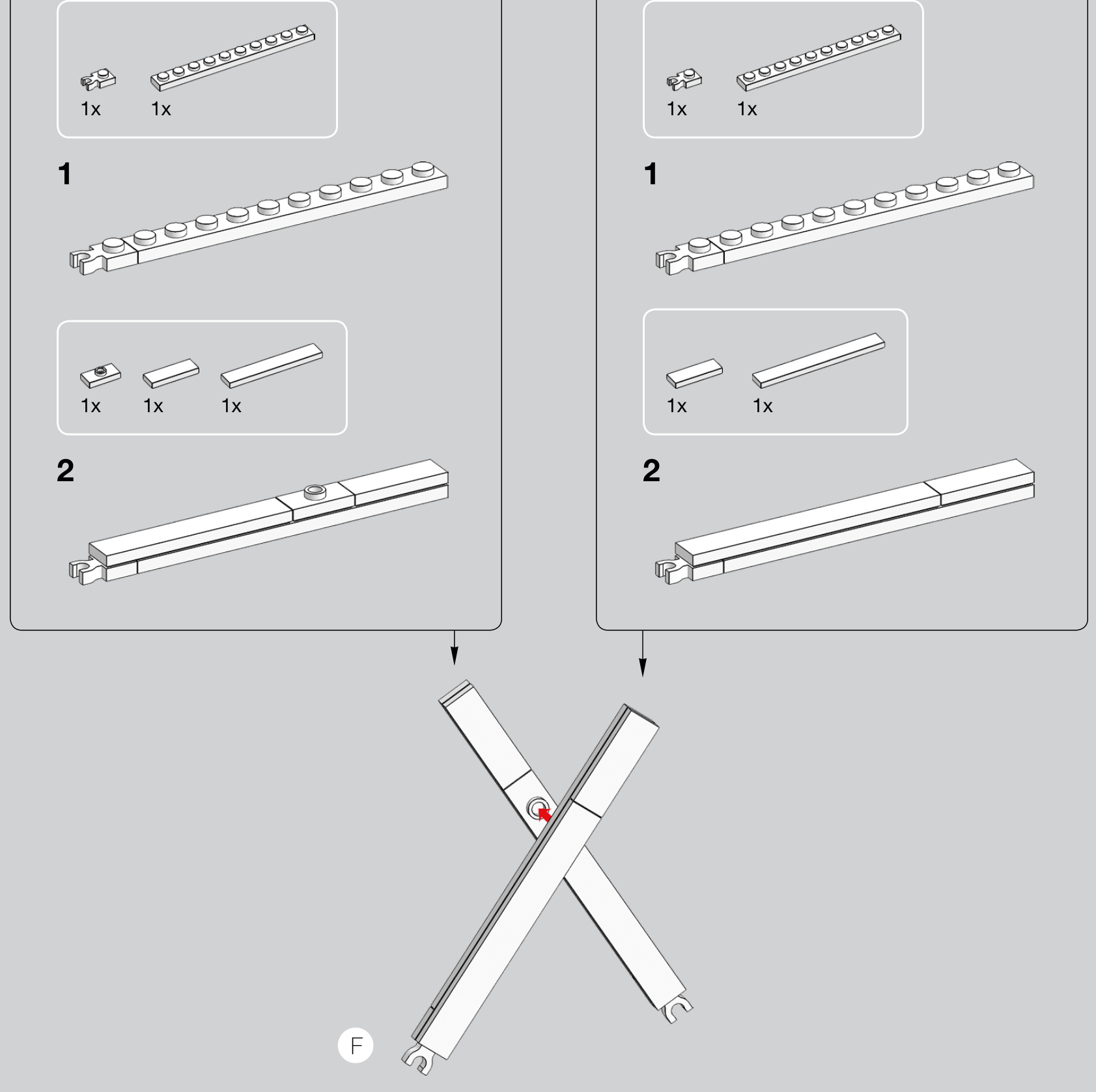
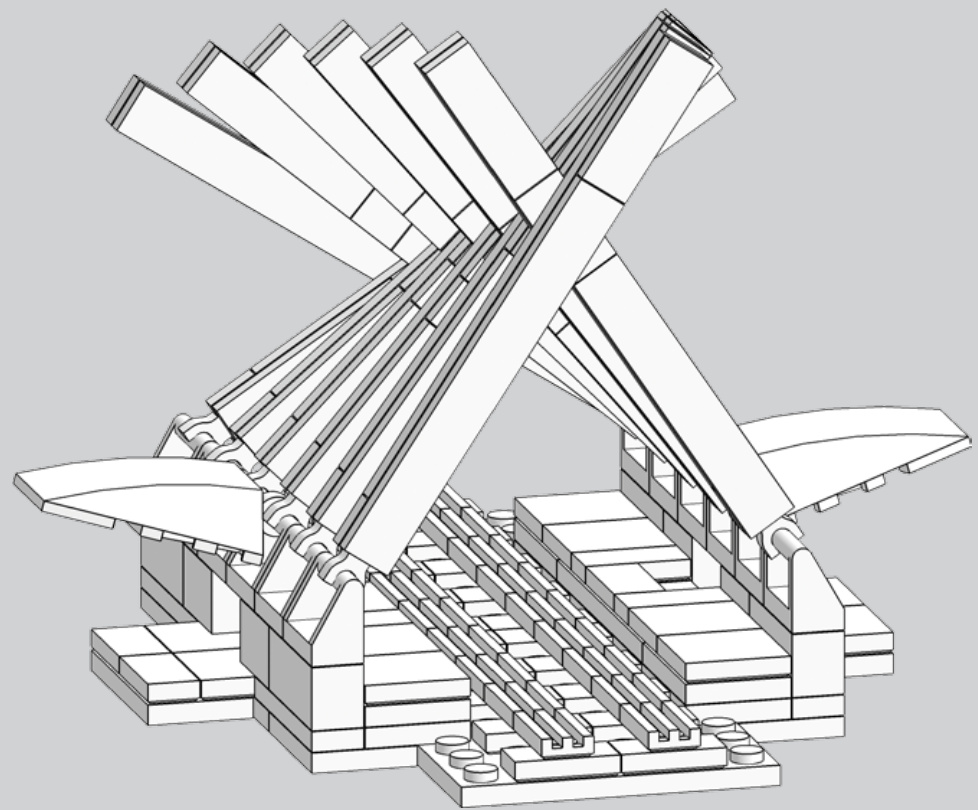
This is an example of parametric architecture where each section of the roof crosses at a lower point than the beam in front of it. This approximates a curved roof using straight beams.
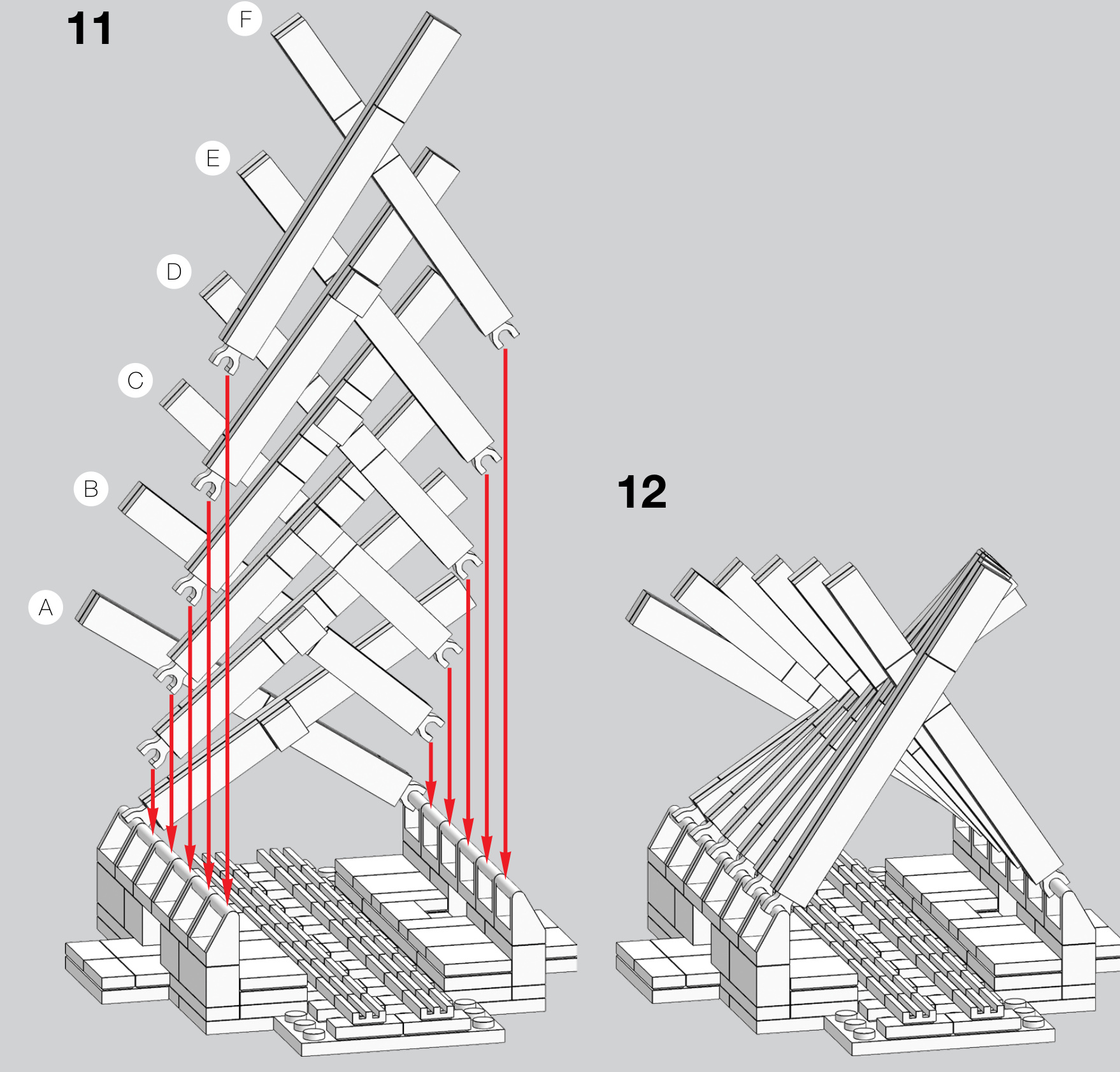
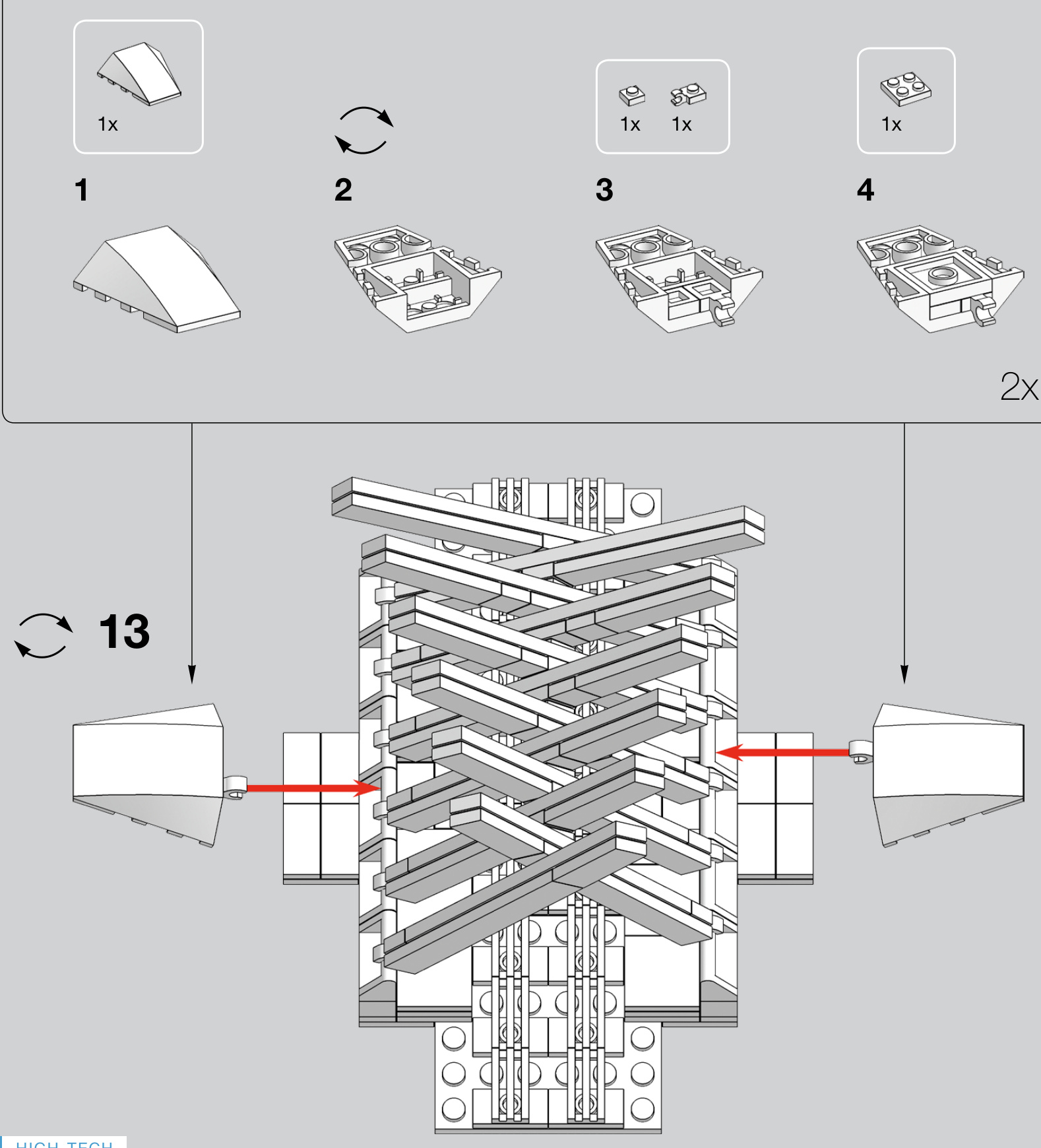
14
Now it’s your turn to create your own LEGO architecture!
Whether you want to create a model of your dream home or re-create your favorite building, here are some tips to get started.
Ideas
With so many amazing buildings around the world, how do you decide which one to re-create with LEGO? A good way to start is to pick an architectural style you like or your favorite architect. Look for books or websites that include many different buildings so you can find something that you’re excited to build. Documentary videos are another great resource because they allow you to see buildings from multiple perspectives.
You can always look around your city for inspiration, too. Jameson Gagnepain likes to build models of buildings near his home: “It’s great to show people real buildings that they recognize. That really gets the attention of people who don’t normally appreciate LEGO.”
When you have a specific building in mind, it’s time to do some research. Collecting photographs from several different angles will help you capture the most important details in your model. You may be able to find 3D models of a building in Google Street View, or detailed floor plans to help you understand the building better. You
might even be able to visit the building— many historic or notable buildings offer tours.
Design Your Own Building
Maybe you would rather build a model of your dream home or design the perfect skyscraper. Many architects build models to explore interesting new designs, and you can too! Models let architects improve a building before it’s constructed.
Even if you decide to construct a LEGO building of your own design, you’ll want to do some research. Once you’ve picked your favorite architectural style, you can study many different buildings to find interesting architectural details that you want to include in your design. Create a scrapbook of favorite buildings and architectural features, capture ideas in a sketchbook, or build a rough model using LEGO bricks. Don’t feel like you need to stick with just one style, either. Architects have been combining elements from different architectural styles for years, and you can too. This approach is called eclecticism, and it was especially popular in the late 1800s.

Builder Profile: Jameson Gagnepain
Jameson is a founding member and the vice president of KLUG, the LEGO users group in Kenosha, Wisconsin. The Modular Buildings series got him excited about building LEGO architecture models. He even had a LEGOthemed wedding, where the guests had turned the LEGO centerpieces into towers and spaceships by the end of the night.
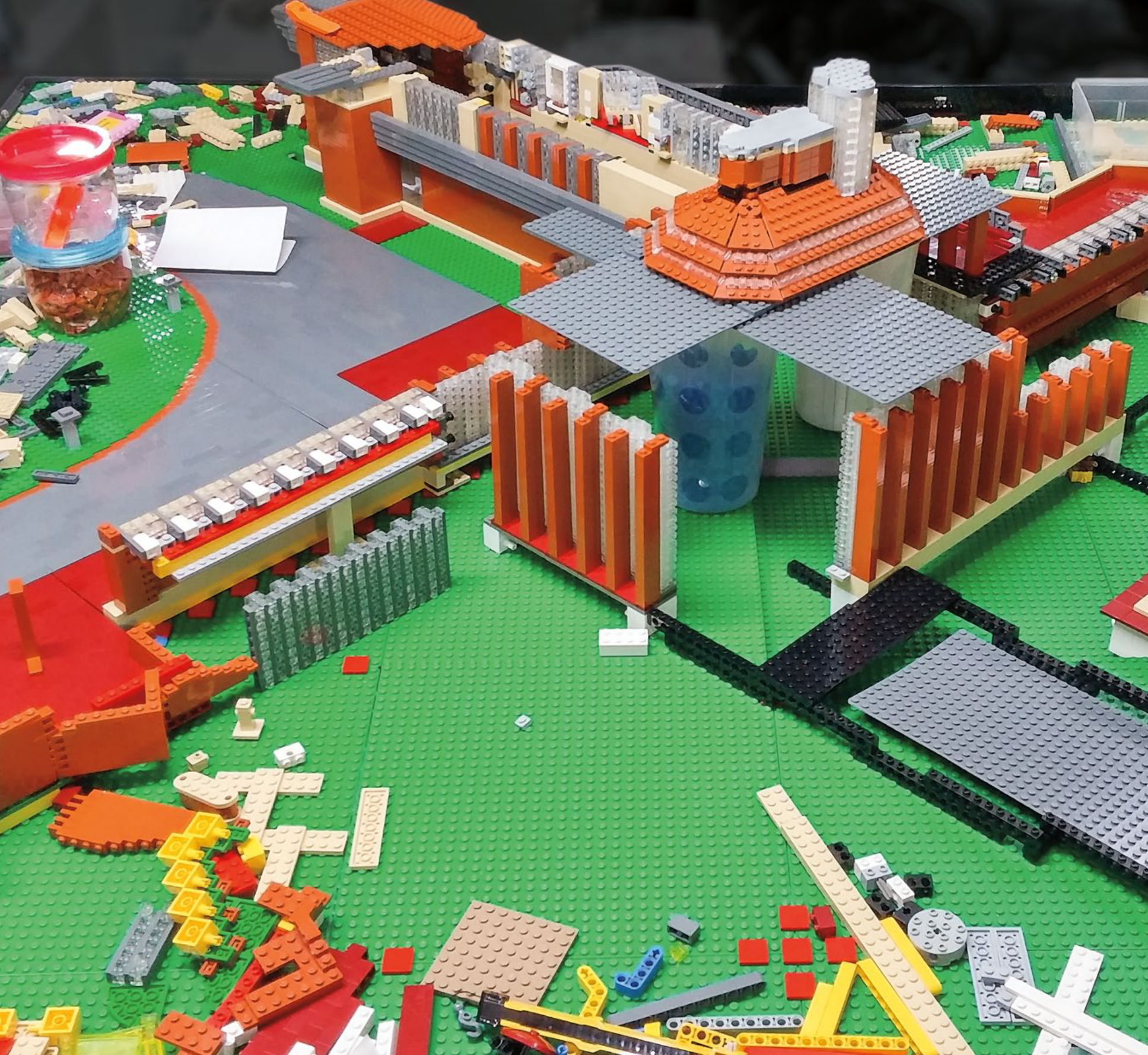
Jameson loves to build LEGO models of the buildings in his community. This includes a number of buildings by Frank Lloyd Wright, which Jameson has recreated as large models with intricate details and advanced building techniques. His latest project is a sprawling foot LEGO re-creation of Wright’s Wingspread.
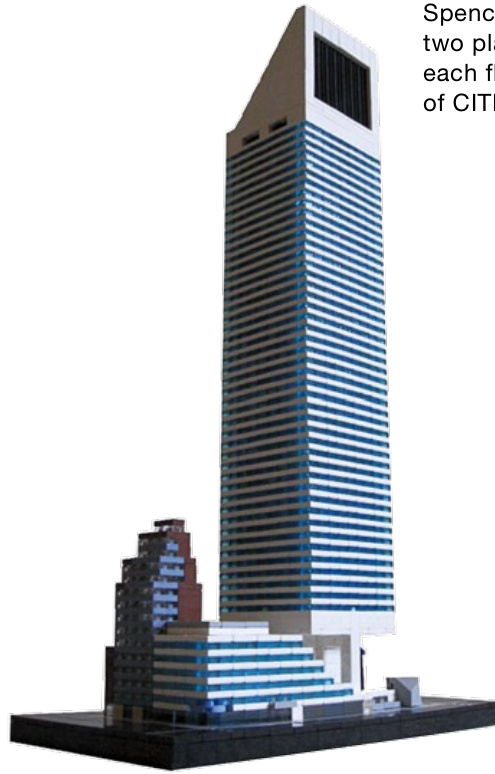
Spencer Rezkalla used two plates to represent each floor in this model of Citigroup Center.
Minifigure Scale
MICROScale
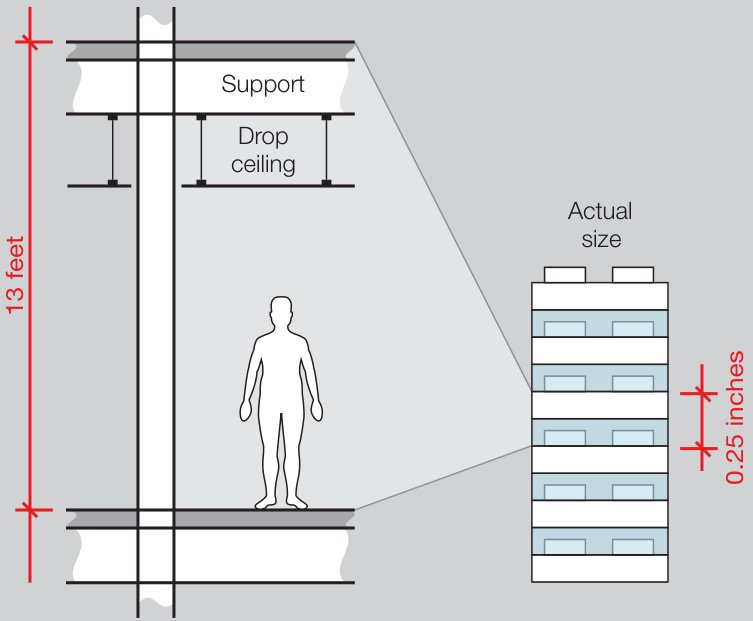
If you use two LEGO plates to represent an entire floor of a skyscraper, your model will have a scale of approximately 1:650.
Scale
One key design tool for an architect is the scale model. The scale of a model describes how much smaller it is compared to the real building. Choosing the right scale for your LEGO model is a crucial first step.
Minifigure Scale
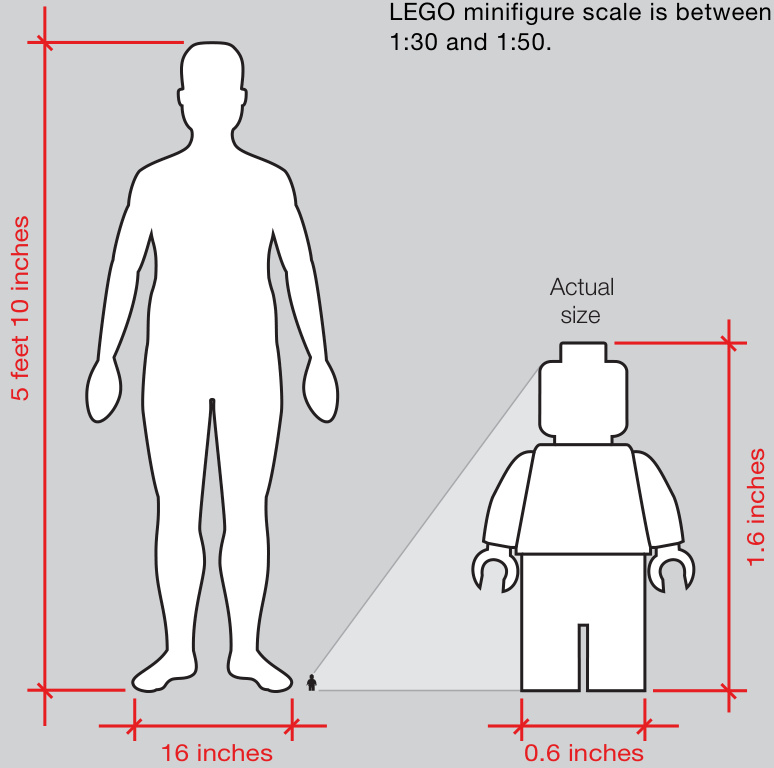
Designing your model to fit a LEGO minifigure is one of the most popular approaches. Because LEGO minifigures are unrealistically short and wide, mini figure scale is not very precise, ranging from 1:30 to 1:50. An easy rule of thumb is to remember that a LEGO door is six bricks tall, so each floor of your model should be about eight bricks tall (about one foot per stud).
Microscale
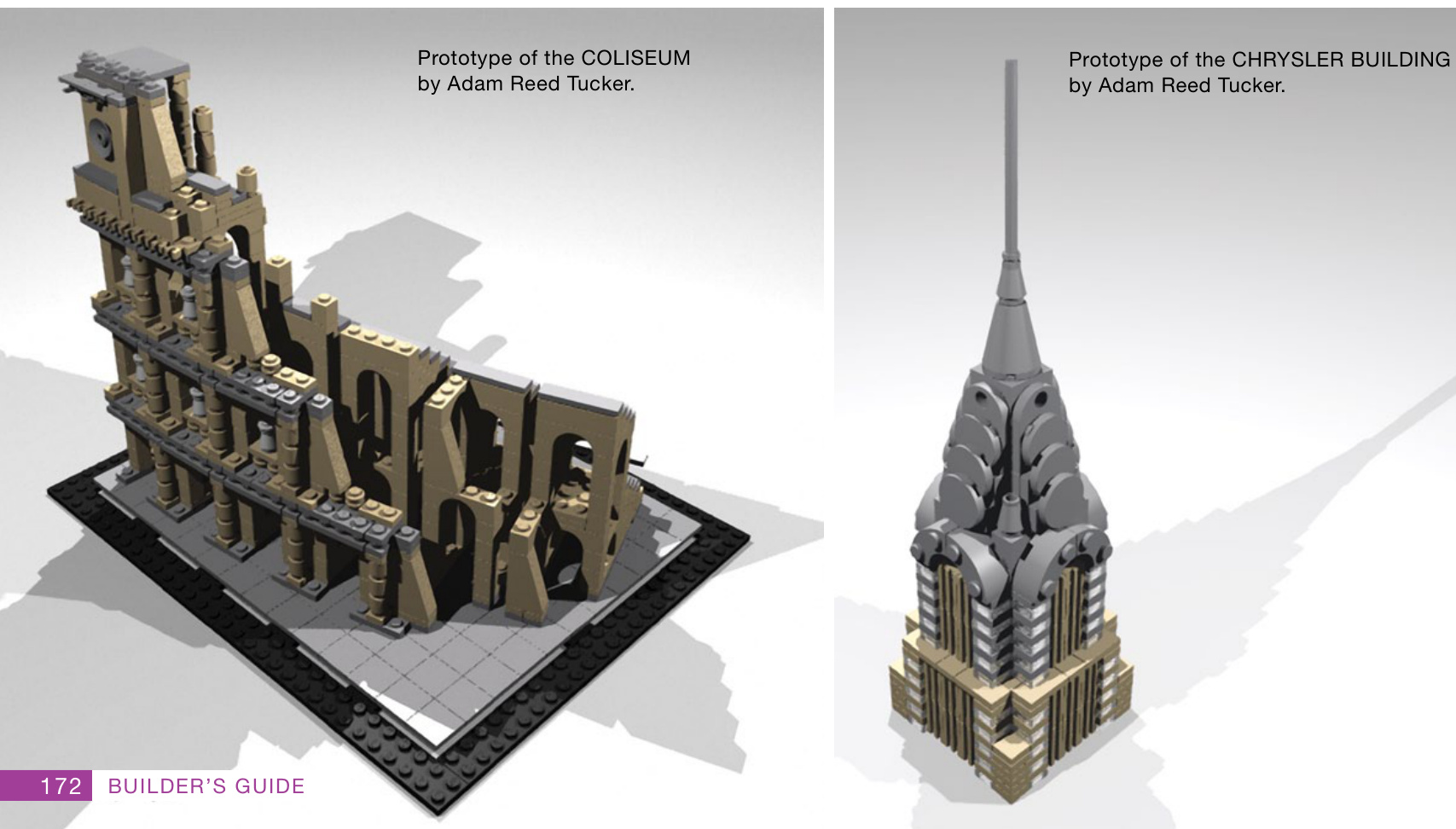
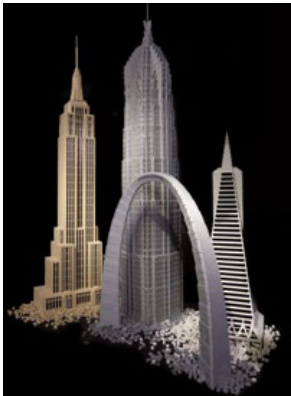
When a LEGO architecture model is much too small for a LEGO minifigure to visit, this is called microscale. One approach to picking a scale is to decide how big you want your finished model to be, and calculate your scale with that goal in mind. This is how Adam Reed Tucker chose a scale of 1:200 when building his first large LEGO skyscraper. Adam wanted the model to be at least eight feet tall so that viewers would have to look up to see it!
While some builders have a size in mind before they start building, others explore how to best capture the smaller details with LEGO and use that to determine the scale for the rest of the model. Spencer Rezkalla has built dozens of models based on the 1:650 scale, which “was the result of a fortunate accident when sizing my very first skyscraper model. At this scale, floor heights are reasonably modeled with one plate serving as a window and one as a spandrel [the panel between windows on different floors].” The 1:650 scale makes it possible to include every floor in a tall skyscraper by stacking alternating rows of clear and colored plates, as in Spencer’s model of the Citigroup Center.
Building at larger scales requires a lot of bricks and space, but it can allow you to capture more details and more accurate proportions. When building his model of Wingspread, Jameson Gagnepain used an original blueprint of the house as the basis for his model: “I laid a grid over it using a photo editing program and used that to determine all scale wall lengths.”

Builder Profile: J. Spencer Rezkalla
Spencer is a talented LEGO artist who has been building intricately detailed LEGO models for more than a decade. His fascination with tall buildings began when he was a young child growing up near New York City. He enjoys following the progress of new skyscrapers as they are being built, and sometimes completes a LEGO version before the actual building is finished.
By building all of his models at the same 1:650 scale, Spencer enables viewers to compare the sizes of famous buildings from around the world. This scale is large enough to capture the key details of each building without overwhelming the viewer. Each model is the result of extensive research into architectural theory, engineering, design, and the landmark’s history. Spencer’s work has been featured in books and magazines, displayed at museums, and re-created by fans around the world.
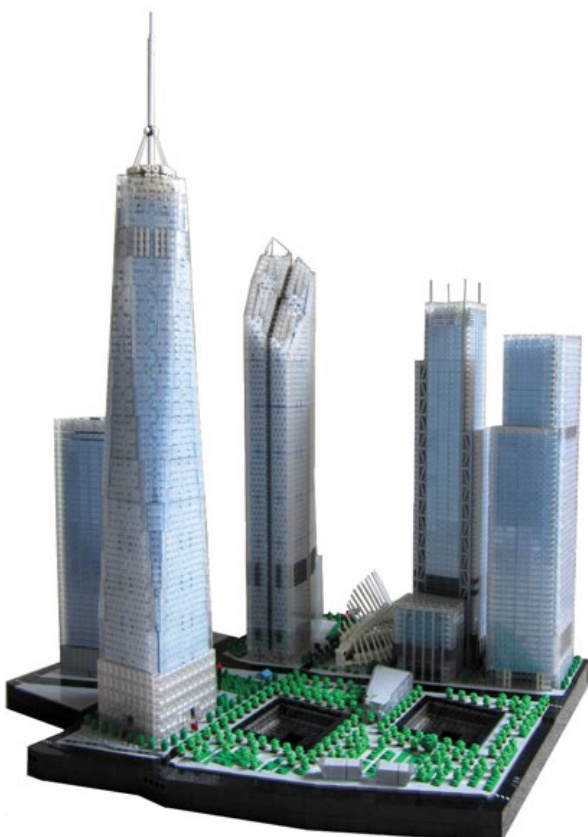
Spencer Rezkalla spends a lot of time on the space between his buildings, as in this model of the new World Trade Center.
Form and Detail
The LEGO artists featured in this book fall into two categories: those who focus on capturing the basic form of a building and those who prefer to create intricately detailed models. This stylistic difference is similar to how one painter prefers impressionism while another prefers realism.
Form
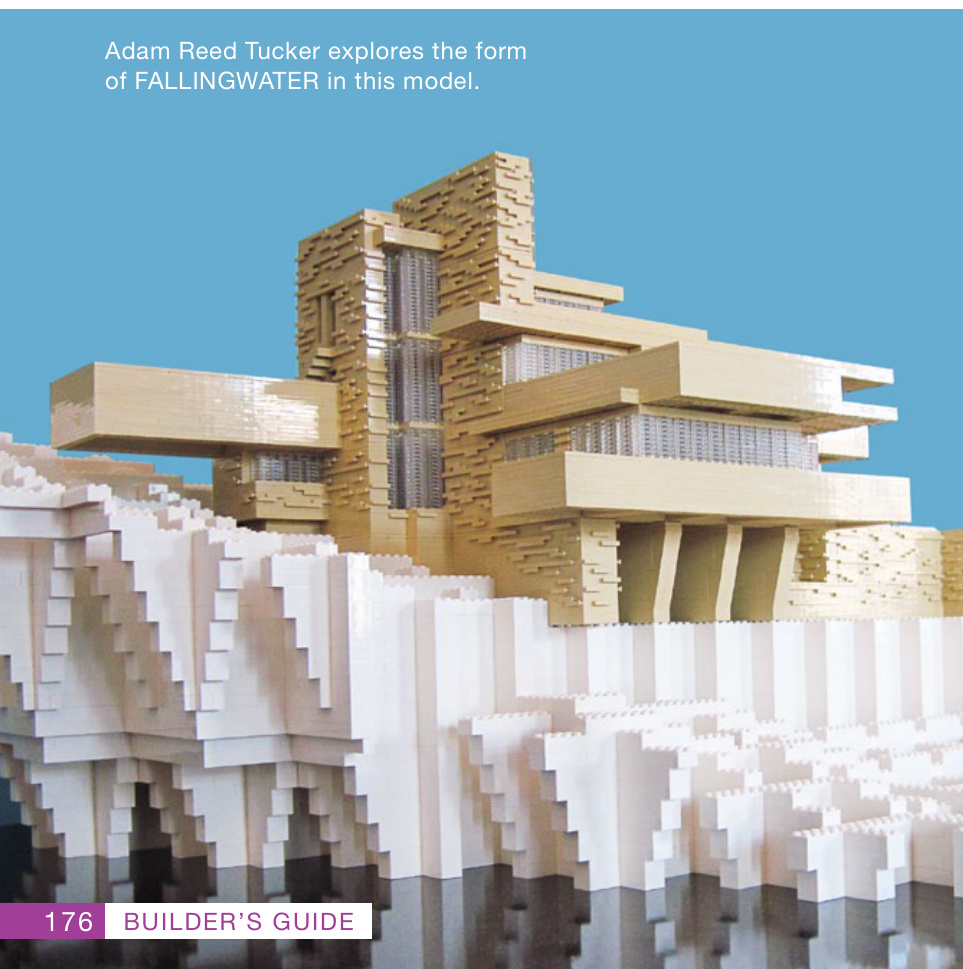
Adam Reed Tucker is most interested in capturing the “essence and pure sculptural form” in his LEGO models rather than perfect proportions and very fine details. Adam explains, “I view the LEGO brick as a creative medium, like paint to a painter or metal to a blacksmith.” From his perspective, too much detail can make a LEGO model look more like a toy—a design philosophy that is clearly reflected in the models he designed for the official LEGO Architecture series and his largescale models.
By focusing on the basic form, you can build a pretty large model using a small number of LEGO bricks. It can be liberating to stop worrying about the details and explore interesting shapes using basic bricks and simplified forms. Spencer Rezkalla relies on the “mind’s eye” approach when designing the basic shape for his models—he builds “what you expect to see, rather than what’s actually there, because landmarks are generally recognizable by the proportions of key architectural features.”
When building very small models, you’ll need to find creative ways to capture the essence of the building by eliminating unnecessary details.
Detail
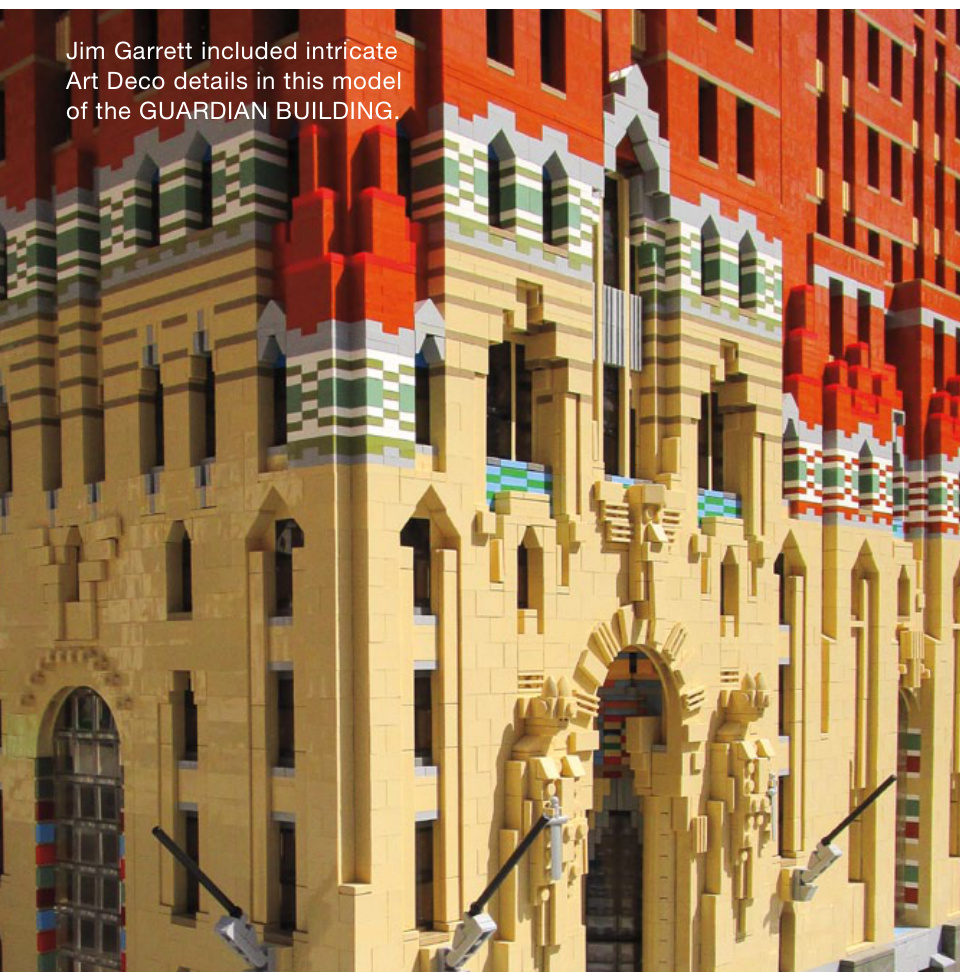
After capturing the basic form of a building, you can include some of its finer details. This is where specialty parts and advanced building techniques are helpful. Jameson Gagnepain explains the benefit of trial and error: “Getting the details right is all about refinement. I like to start with a rough picture by getting the lengths and colors right. I’ll often revisit sections over and over again to improve them.”
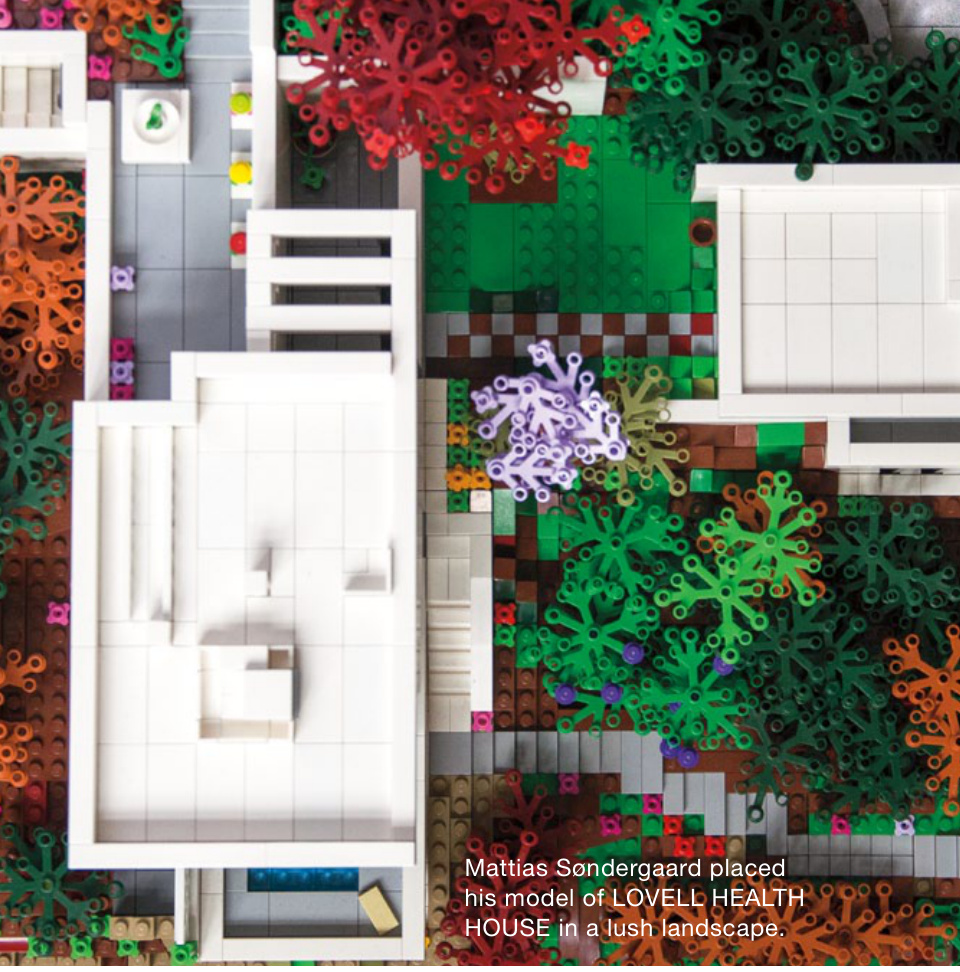
Context matters too! Spencer Rezkalla says, “Oftentimes, I spend more time designing plazas or an attached shopping center than I do with the main centerpiece tower.” By placing your model in a landscape, you give it a sense of scale and make it easier for viewers to enjoy.

Builder Profile: Adam Reed Tucker
As an architect and LEGO Certified Professional, Adam conceived and codeveloped the official LEGO Architecture series in 2008. He designed 15 iconic models in the series, including the White House, the Empire State Building, the Sydney Opera House, and Fallingwater. His proudest model in the series is the 2,276-piece model of Robie House. He also co-authored the book LEGO Architecture: The Visual Guide (DK, 2014).
Adam also builds LEGO models for public display, like the intricate model of Taliesin West featured on page 32. What gets Adam really excited are skyscrapers, which he prefers to build at a large scale to force viewers to look up, since “skyscrapers need to have a presence in order to command the respect they deserve.”
Trans-clear over medium blue bricks.
LEGO model by Spencer Rezkalla. Trans-light blue over Sand green bricks.
LEGO model by Spencer Rezkalla.
Color
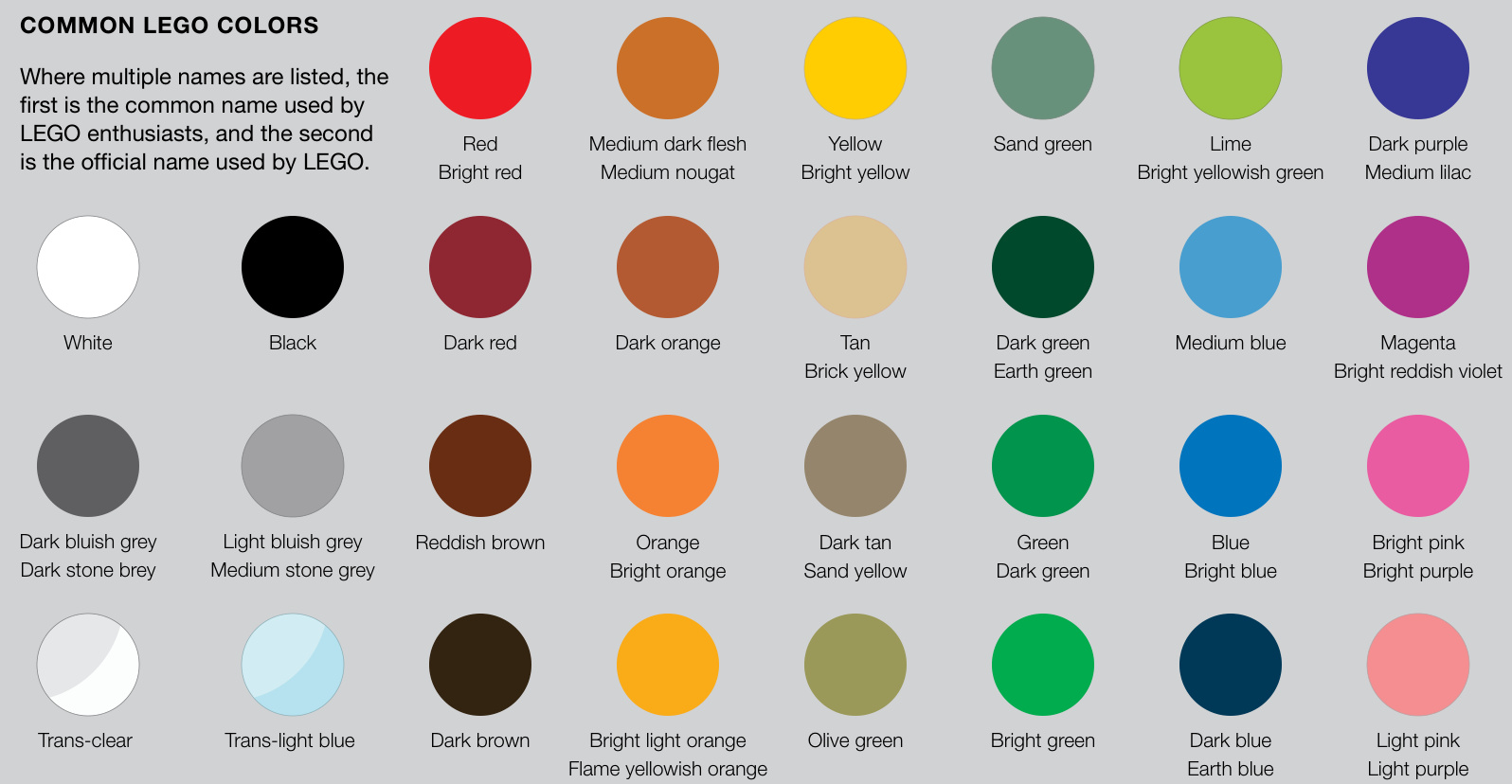
Although there are more colors in the LEGO universe than there were 20 years ago, there are still only about 30 colors to choose from. It’s important to understand that not every part is available in every color—for example, there are more than 800 different LEGO parts currently available in black, 600 in white, and 125 in dark red but only 23 parts in sand green. A lack of parts in the color you need can feel like a big limitation when you’re trying to create an accurate scale model.
Thankfully, you should be able to find the most common parts, like basic bricks, plates, tiles, and cheese slopes, in almost every color. This gives you lots of choices when you’re building walls or adding accents. For intricately detailed sections of your model, you will want to use the more common colors so you will have access to a broader selection of parts. Specialty parts and rare colors can be very expensive, as Jameson Gagnepain explains: “I very much wish that dark orange was more common. I’ve totally fallen in love with the color, and I wish the plates weren’t so rare.”
Tricks with Color
Rather than fighting the limited palette of bright colors, Jonathan Grzywacz embraces the saturated colors when designing his modular buildings, which he describes as a kind of “Disney Main Street.” In the same way that you might employ tricks of abstraction to re-create a complex form using LEGO bricks, you should feel free to embrace bright colors to give your model interest.
One of the cleverest tricks in working within this limited palette is using transparent parts on top of solid-colored bricks to achieve new colors. You can see examples on the facing page where Spencer Rezkalla used clear tiles on top of a medium blue brick to create a glass building with a faint blue glow, or trans-light blue with sand green under it to create the right color for his model of Taipei 101.

Builder Profile: Rocco Buttlierre
Rocco is a young LEGO artist with a passion for building intricate scale models of skyscrapers. His interest grew out of the LEGO Modular Buildings series and his “intrigue with the architecture of downtown Chicago.” This led him to the Illinois Institute of Technology in Chicago, where he is studying architecture.
Rocco began building skyscrapers after seeing the work of Spencer Rezkalla at Brickworld 2008. He has since built more than 30 skyscrapers at the same 1:650 scale. Rocco is well on his way to achieving his ultimate dream—building an accurate scale model of downtown Chicago out of an estimated 3 million LEGO bricks.
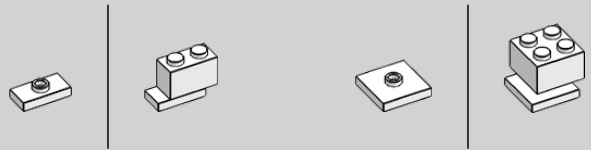
Jumpers allow you to offset a wall by half of a stud.

Some parts have interesting textures.
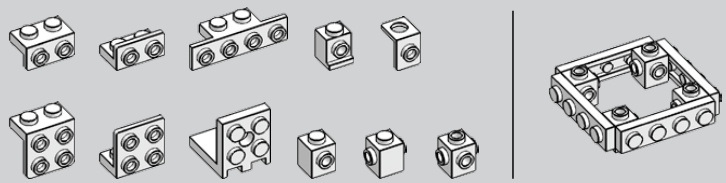
Some bricks allow you to attach parts facing outward.
This technique is called studs not on top, or SNOT.

Accessories can be used for accents, railings, or decorations.

Hinges, turntables, and clips allow you to work at any angle.
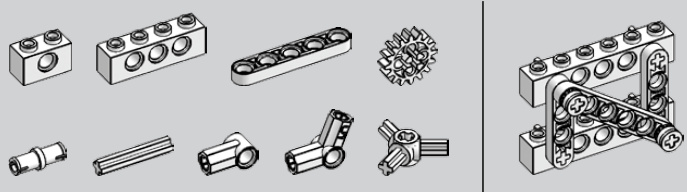
Technic parts allow you to build like an engineer.
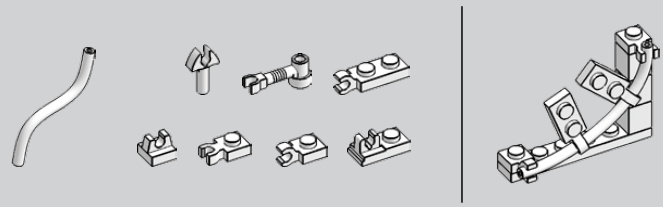
Flexible tubing and clips allow you to create almost any shape.
Bricks
There have never been more ways to get the bricks you need to build amazing LEGO architecture models. The traditional approach is to buy LEGO sets that you find interesting, and use the parts from those sets to build your own creations. This can be a lot of fun, but architecture models typically need large numbers of the same parts, and most LEGO sets include only a few of each part.
The sets in the LEGO Architecture series naturally lend themselves to building your own models, as they contain a lot of small parts in the same color. The LEGO Architecture Studio set is also a great place to begin, because it contains 1,200 white and clear bricks. This allows you to experiment with a versatile selection of parts without worrying about matching colors.
Even if you have a large collection of bricks, you will eventually want to get more. You can buy directly from LEGO online or in LEGO retail stores, but the best option is to visit online stores where you can browse through every LEGO
part that has ever been created, and see who has the parts you need available for purchase. You will find a list of great parts for building LEGO architecture models and advice on where to buy those parts at http://nostarch.com/legoarchitect/.
Organizing LEGO Bricks
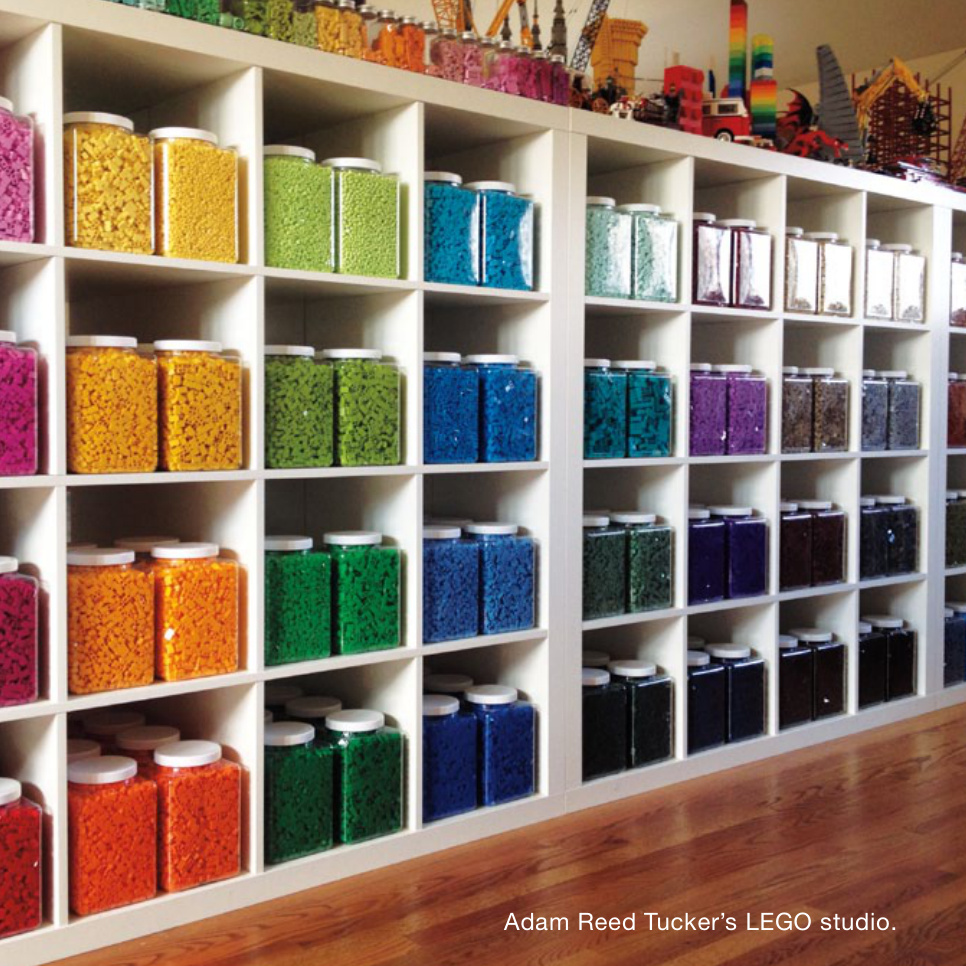
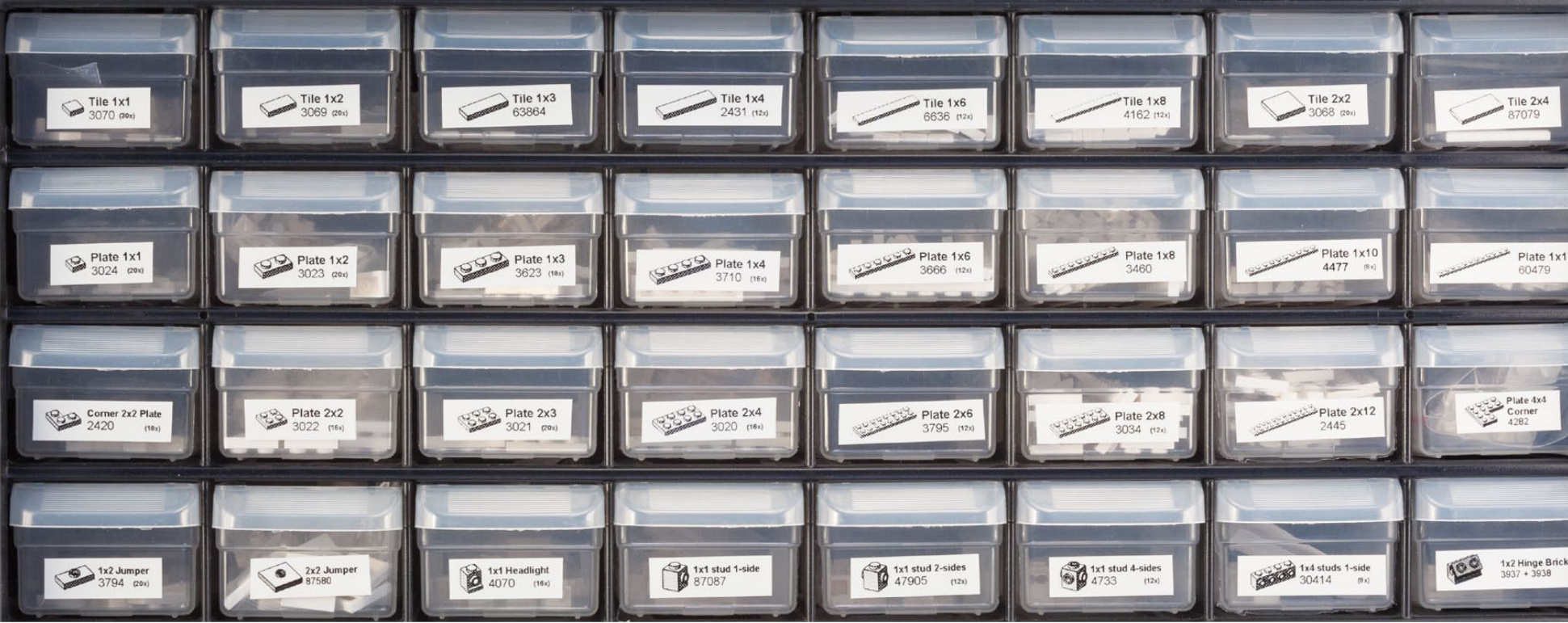
If you only have a small collection, you probably don’t need to think much about organization. You can just dump all of the bricks on the floor and start building. However, as your collection grows, it can become frustrating to dig through a huge pile of LEGO bricks just to find a specific piece.
While it might seem like a good idea to sort your parts by color, it is very hard to find a specific red brick in a sea of other red bricks. I prefer to sort by category: bricks, plates, slopes, tiles, plants, minifigures, and the inevitable “miscellaneous” group. As your collection grows, you might want to sort further with separate containers for the different parts in each category, like , , and so on.

Builder Profile: Jared Chan
Jared is a professional accountant living in Hong Kong, but it is easy to see that LEGO is his real passion. As with many other LEGO artists, Jared’s enthusiasm for LEGO was redoubled when the Café Corner set was released in 2007.
Jared is very involved in the Legend Bricks Hong Kong LEGO Creators Club, where he has helped re-create iconic buildings in their city for public display. When creating a new model, he likes to visit the building and review design schematics if he can find them. His creations range from the large, intricate model of the HSBC Building featured on page 157 to the intimate minifigurescale model of a typical 1970s public housing complex in Hong Kong, shown here.
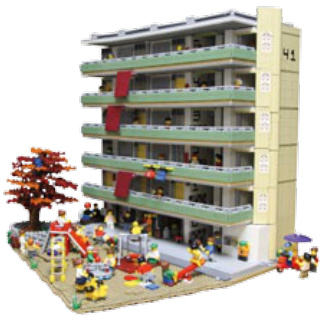
Photo Credits
Architecture photos Photographs courtesy Tom Alphin, except for those listed below.
Air traffic control tower. Photo Delmas Lehman / Shutterstock.com.
Arc de Triomphe. Photo Jeremy Reddington / Shutterstock.com.
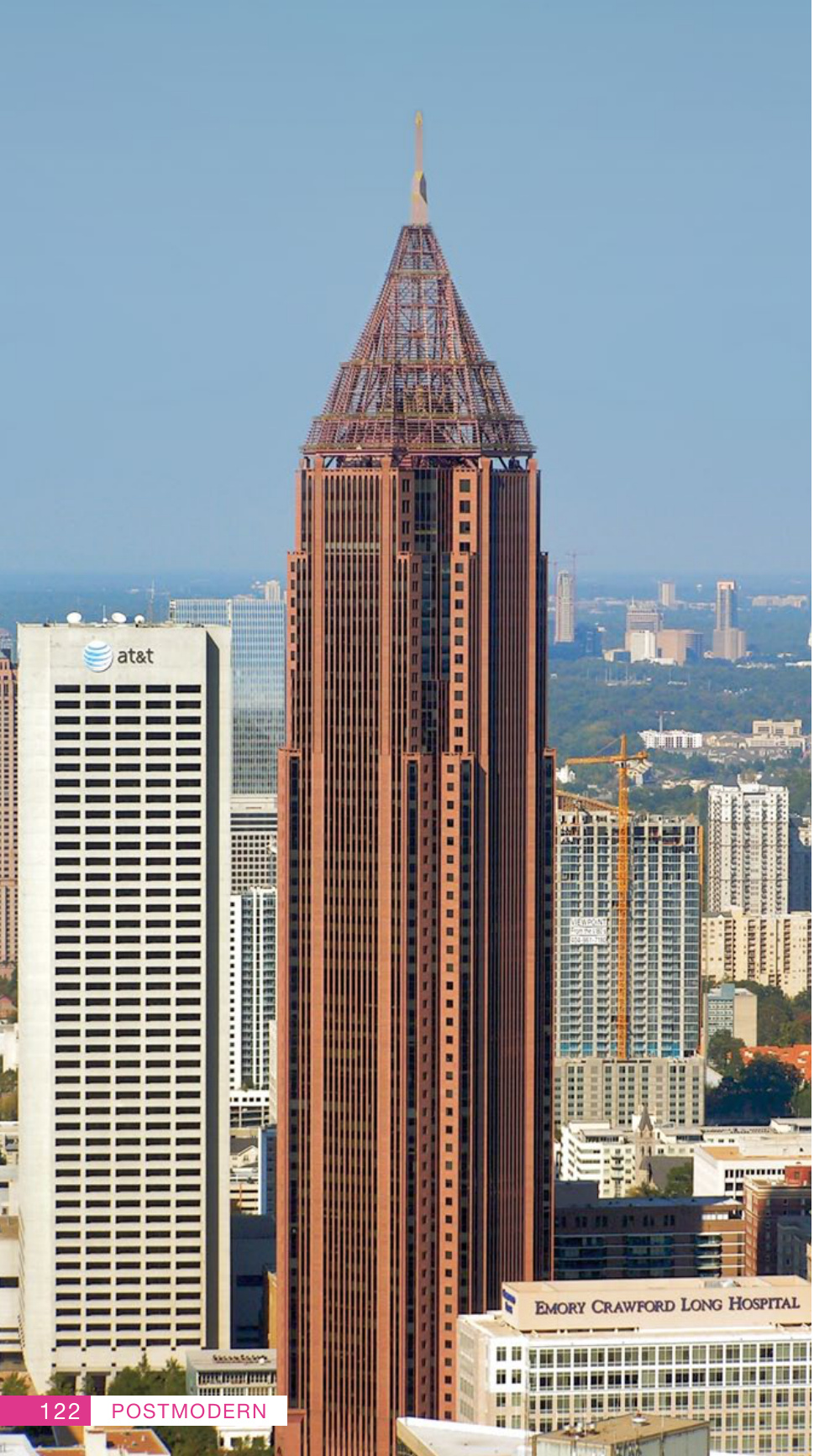
Bank of America Plaza. Photo Connor.carey, used under CC BY-SA 3.0.
Barcelona Pavilion. Photo Ashley Pomeroy at en.wikipedia, used under CC BY-SA 3.0.
Bauhaus Dessau. Photo Lelikron, used under CC BY-SA 3.0.
Brandenburg Gate. Photo elxeneize / Shutterstock.com.
Burj Al Arab. Photo Joi Ito, used under CC BY 2.0.
Centre Georges Pompidou. Photo Charles Leonard / Shutterstock.com.
Colony Hotel. Photo f11photo / Shutterstock.com.
Daily Express Building. Photo Jamie Barras.
Eames House. Photo Eames Office, LLC (eamesoffice.com).
Empire State Building. Photo cocozero / Shutterstock.com.
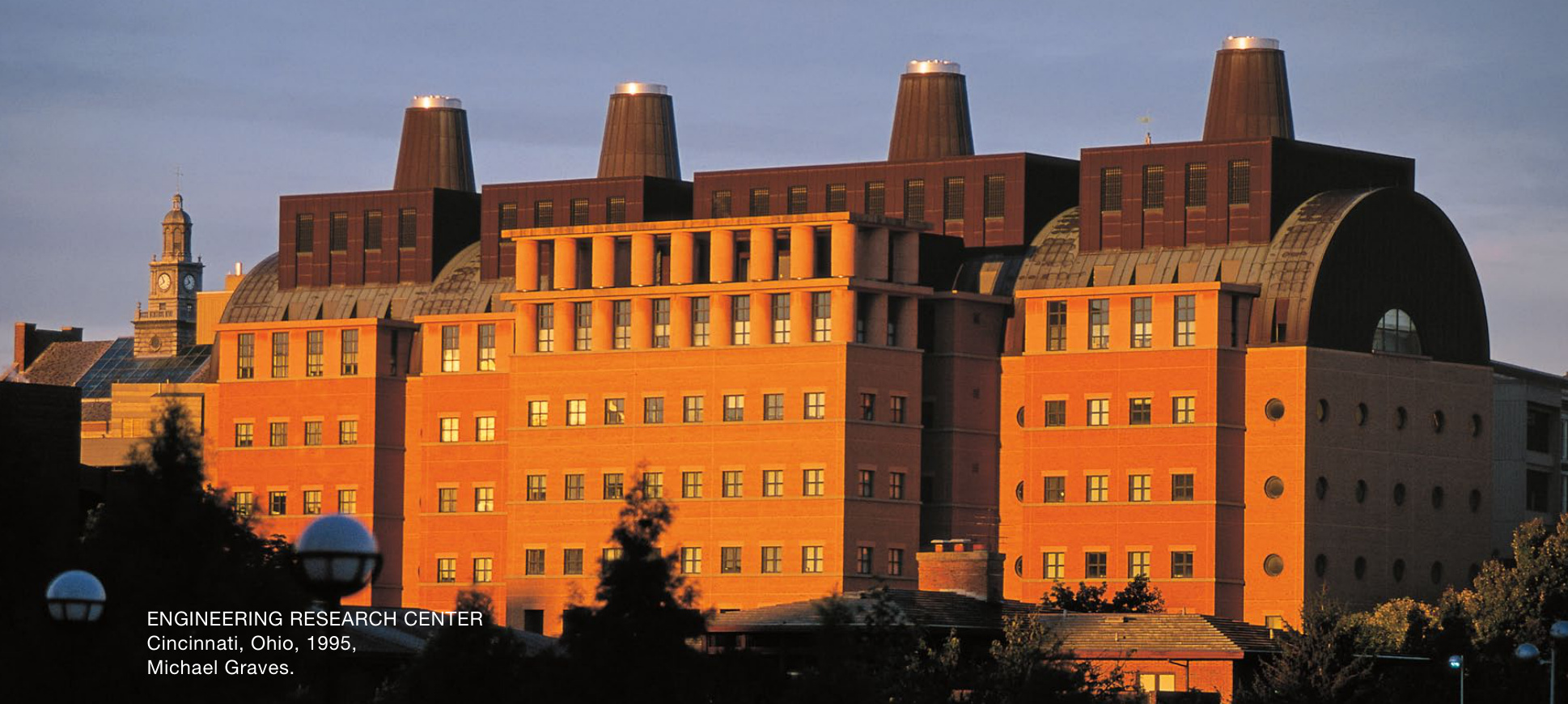
Engineering Research Center. Photo Robert A. Flischel.
Fallingwater. Photo by Carol M. Highsmith, Carol M. Highsmith’s America, Library of Congress, Prints & Photographs Division.
Farnsworth House. Photo by Carol M. Highsmith, Carol M. Highsmith’s America, Library of Congress, Prints & Photographs Division.
Gamble House. Photo by Carol M. Highsmith, Jon B. Lovelace Collection of California Photographs in Carol M. Highsmith’s America Project, Library of Congress, Prints & Photographs Division.
Geisel Library. Photo Fastily, used under CC BY-SA 3.0.
Government Service Center. Photo by Marc N. Belanger, public domain.
Guggenheim Museum Bilbao. Photo Jonatan Alonso Fernandez.
Habitat 67. Photo by Nora Vass. and stitched by Gergely Vass, used under CC BY-SA 3.0.
Harold C. Bradley House. Photo Bill Collins.
House in Katonah. Photo by Tom Bernard. Venturi, Scott Brown and Associates, Inc.
Imperial Hotel. Photo sangaku / Shutterstock.com.
Jerry’s Famous Deli. Photo Jorg Hackemann / Shutterstock.com.
Lake Shore Drive. Photo Chicago History Museum, HB-13809-L4, Hedrich-Blessing.
Lever House. Photo David Shankbone, used under CC BY-SA 3.0.
Michael Lee-Chin Crystal, Royal Ontario Museum. Photo Elliott Lewis.
Miller House. Photo by IK’s World Trip, used under CC BY 2.0.
Monticello. Photo by Martin Falbisoner, used under CC BY-SA 3.0.
Neue Staatsgalerie. Photo Claudio Divizia / Shutterstock.com.
Niagara Mohawk Building. Photo Jean-Paul Richard, used under CC BY-SA 3.0.
Normal Theater. Photo Ken Smith.
Palace of Assembly. Photo J. Palys / Shutterstock.com.
Palácio do Planalto. Photo ANDRE DIB / Shutterstock.com.
Phæno Science Center. Photo Richard Bartz, used under CC BY-SA 3.0.
Piazza d’Italia. Photo Loews New Orleans Hotel. Quadracci Pavilion, Milwaukee Art Museum. Photo John Picken, used under CC BY 2.0.
Ransila I. Photo Rémy Steinegger.
Reggio Emilia AV Mediopadana. Photo Stefano Carnevali / Shutterstock.com.
Robarts Library. Photo by Caz Zyvatkauskas. University of Toronto.
Robie House. Photo Teemu08, used under CC BY-SA 3.0.
The Rotunda, University of Virginia. Photo J. Adam Sowers.
Royal Saltworks. Photo Alban Mirabaud.
Salk Institute. Photo by Carol M. Highsmith, Carol M. Highsmith Archive, Library of Congress, Prints & Photographs Division.
San Antonio Public Library. Photo by Lourdes Legorreta. Legorreta Legorreta.
Sony Tower. Photo David Shankbone, used under CC BY-SA 3.0.
Sydney Opera House. Photo David Iliff, used under CC-BY-SA 3.0.
Taliesin III. Photo Bill Hamilton.
Taliesin West. Photo Aaron Reker.
Union Terminal. Photo Dacoslett, used under CC BY-SA 3.0.
Unité d’Habitation of Berlin. Photo Claudio Divizia / Shutterstock.com.
United States Capitol Building. Photo Martin Falbisoner, used under CC BY-SA 3.0.
Vanna Venturi House. Photo by Matt Wargo. Venturi, Scott Brown and Associates, Inc.
Villa Emo. Photo Blaz Kure / Shutterstock.com.
Villa La Rotonda. Photo Piergiorgio Martini.
Wainwright Building. Library of Congress, Prints & Photographs Division, HABS MO,96-SALU,49—4.
Walt Disney Concert Hall. Photo by Carol M. Highsmith. Carol M. Highsmith Archive, Library of Congress, Prints & Photographs Division.
White House. Photo Orhan Cam / Shutterstock.com.
William H. Emery Jr. House. Photo G LeTourneau, used under CC BY-SA 3.0.
Willis Tower. Photo Daniel Schwen, used under CC BY-SA 4.0.
LEGO Photos
All LEGO photographs are copyright of the individual builders, except for those listed below.
The Acropolis. Photo courtesy of LEGO Certified Professional Ryan McNaught, thebrickman.com.
Colony Hotel. Photo courtesy of brickmania.com.
Taliesin West. Photo Andrew Pielage.
Transamerica Pyramid. Photo Andrew Bossi.
Unité d’Habitation. Photo Dean Lavenson.
Villa Hillcrest. Photo Dean Lavenson.
Further information about Creative Commons licenses may be found at the websites below. CC BY 2.0: http://creativecommons.org/licenses/by/2.0/deed.en CC BY-SA 3.0: http://creativecommons.org/licenses/by-sa/3.0/deed.en CC BY-SA 4.0: http://creativecommons.org/licenses/by-sa/4.0/deed.en
Bibliography
The text in this book is informed by a wealth of excellent books, documentary films, and online resources about architecture. This is just a short selection of the resources that had the greatest impact during my research.
Visit http://nostarch.com/legoarchitect/ for a detailed bibliography with recommended reading, selected quotes, and more information about LEGO and architecture.
Books
DK Publishing. Great Buildings. London: DK, 2012.
Filler, Martin. Makers of Modern Architecture: From Frank Lloyd Wright to Frank Gehry. New York: New York Review Books, 2007.
. Makers of Modern Architecture, Volume II: From Le Corbusier to Rem Koolhaas. New York: New York Review Books, 2013.
Glancey, Jonathan. 20th-century Architecture: The
Structures That Shaped the Century. New York: Overlook Press, 1998.
Gossel, Peter and Gabriele Leuthauser. Architecture in the 20th Century. Cologne: Taschen, 2012.
Hess, Alan and Alan Weintraub. Frank Lloyd Wright Prairie Houses. With contributions by Kathryn Smith. New York: Rizzoli, 2006.
Jencks, Charles. The New Paradigm in Architecture:
The Language of Postmodernism. New Haven, CT: Yale University Press, 2002.
Legler, Dixie and Christian Korab. Prairie Style: Houses and Gardens by Frank Lloyd Wright and the Prarie School. New York: Stewart, Tabori and Chang, 1999.
Nichols, Karen, Lisa Burke, and Patrick Burke, eds.
Michael Graves: Buildings and Projects, 1990-1994. With a foreword by Janet Abrams. New York: Rizzoli, 1995. Palladio, Andrea. [1570]. The Four Books of Architecture. Translated by Isaac Ware. 1738. Reprinted with an
introduction by Adolf K. Placzek. Mineola, NY: Dover
Publications, 1965.
Pape, Thomas, Manfred Wundram, and Paolo Marton. Palladio: The Complete Buildings. 25th ed. Cologne:
Taschen, 2008.
Poppeliers, John C., and S. Allen Chambers, Jr. What Style Is It: A Guide to American Architecture. Rev. ed. Hoboken: John Wiley & Sons, 2003.
Pryce, Will. World Architecture: The Masterworks. New York: Thames & Hudson, 2008.
Roeder, Annette. 13 Buildings Children Should Know. Munich: Prestel, 2009.
Summerson, John. The Architecture of the Eighteenth Century (World of Art). New York: Thames & Hudson, 1986. Toman, Rolf, ed. Neoclassicism and Romanticism:
Architecture, Sculpture, Painting, Drawings: 1750-1848. Potsdam: h. f. ullmann, 2008.
Venturi, Robert. Complexity and Contradiction in
Architecture. New York: The Museum of Modern Art, 1966.
Films
Architectures. Volumes 1-8. Directed by Stan Neumann, Richard Copans, et al. ARTE. 2007-2015.
Bunkers, Brutalism and Bloodymindedness: Concrete Poetry with Jonathan Meades. Parts 1 & 2. 118 minutes. Directed by Francis Hanly. BBC FOUR. 2014.
Frank Lloyd Wright. 146 minutes. Directed by Ken Burns and Lynn Novick. PBS. 1998.
Oscar Niemeyer – A Vida É Um Sopro. 90 minutes.
Directed by Fabiano Maciel. 2010. Rococo: Travel, Pleasure, Madness. Parts 1-3.
180 minutes. Directed by Waldemar Januszczak.
BBC FOUR. 2014.
Safdie, Moshe. “Moshe Safdie on his iconic Habitat 67.” Dezeen video, 2:40. December 19, 2014. http://www .dezeen.com/2014/12/19/moshe-safdie-movie-interview -habitat-67/
“Sketches of Frank Gehry,” American Masters, season 20, episode 7. 83 minutes. Directed by Sydney Pollack. PBS. Aired September 27, 2006.
Unfinished Spaces. 86 minutes. Directed by Benjamin Murray and Alysa Nahmias. 2011.
WEbsites
Metropolitan Museum of Art. “The Grand Tour.” http:// www.metmuseum.org/toah/hd/grtr/hd_grtr.htm.
Peeron. “Peeron Color List.” http://www.peeron.com/inv/ colors.
New Elementary. “LEGO® colour chart reference.” http:// www.newelementary.com/2015/03/lego-colour-chart -reference.html.
Wikipedia. “Architectural Style.” Last modified April 14, 2015. http://en.wikipedia.org/wiki/Architectural_style.
Index
Numbers
311 South Wacker Drive model, 127
A
accessories, LEGO, 180
Acropolis model, the, 1
Adler & Sullivan, 70
air traffic control tower (Tampa International Airport), 111
Allemann, Jason, University of Waterloo Mathematics & Computer building model, 105
Allum, Matthew, Nakagin Capsule Tower model, 129
Andrew Melville Hall, 101
Aqua model, 157
Arc de Triomphe, 4
arched pediments, 123
arches, Roman, vi
Art Deco architecture, 44–67 inspiration for, vi LEGO models, 50–53 materials used, 47
Art Nouveau movement, 47
Arts and Crafts movement, 27
AT&T Building. See Sony Tower
awnings, 91
B
Bank of America Plaza, 122
Bank of China Tower, 154
model, 156
Barcelona Pavilion, 71, 73
Baroque style, vi, 5–6
Bauhaus, 70
Bauhaus Dessau, 71
Berghe, Jan Vanden, Menin Gate
model, 8–9
Beth Sholom Synagogue model, 77
Bley & Lyman, 46
Blomfield, Reginald, 8–9
Borromini, Francesco, 6
Botta, Mario, 131, 36
Boucher, Nathalie, Habitat 67 model, 105
Brandenburg Gate, 6
bricks (building material), 5, 27, 29
bricks (LEGO) for Art Deco architecture, 48 for Brutalist architecture, 102 colors, 178, 179 concrete textures using, 101 for High-Tech architecture, 154 inverted slope, 102 for Modernist architecture, 73 for Neoclassical architecture, 6–7 organizing, 181 overview of pieces, 180 for Postmodern architecture, 124 for Prairie architecture, 28–29 SNOT, 180 Technic parts, 154
Brown, Scott, 125
Brutalist architecture, 98–119 LEGO models, 104–105 origin of term, 101
Buffalo City Hall model, 53
building materials for Art Deco architecture, 47 for High-Tech architecture, 153 for Modernist architecture, 71 for Neoclassical architecture, 5 for Postmodern architecture, 123 for Prairie architecture, 27
Burj Al Arab, 153, 154 model, 156, 174
Buttliere, Rocco, 179 311 South Wacker Drive model, 127 Aqua model, 157
C
C.Y. Lee & Partners, 127
Calatrava, Santiago, 154, 155, 169
cantilevers, 113
Case Study House project, 72, 73
Cathédrale Notre-Dame de Paris, vi model, 1
Centre Georges Pompidou, 154
Chalgrin, Jean, 4
Chan, Jared, 181 HSBC Building model, 157
Chili’s Restaurant model, 126
China Merchants Tower model, 128
Chippendale pediment, 123, 124
Chrysler Building, 44–45, 48 spire model prototype, 172
Citigroup Center model, 174, 175
City Restaurant model, 126
Cocoa Hotel model, 53
Coliseum model, 172
Colony Hotel, 49 model, 51
colors, LEGO, 178–179 for Art Deco architecture, 49 for Brutalist architecture, 103 for High-Tech architecture, 155 for Modernist architecture, 75 for Neoclassical architecture, 7 for Postmodern architecture, 125 for Prairie architecture, 29
columns history of usage, vi in Modernist architecture, 71 in Neoclassical architecture, 2, 5, 6, 13 in Postmodern architecture, 123, 125
computer-aided design, 150, 153, 154–155
concrete in Brutalist architecture, 99, 101, 107, 113 in High-Tech architecture, 153 history of usage, vi in Modernist architecture, 71 textures using LEGO bricks, 101
cornices, 91
Cubism, 47
curtain walls, 70, 87, 91
D
Daily Express Building, 49
Deconstructivist architecture, 102, 153, 154
decorations, 28, 47, 71, 125, 180
Denver Public Library model, 126
Dietel, George J., 53
Dinkeloo, John, 122
domes LEGO instructions for, 14–16 in Neoclassical architecture, 2, 13 Pantheon example, vi
E
Eames, Charles and Ray, 72
Eames House, 72, 74
eaves, 35, 27
eclecticism, 173
Egyptian influence, vi, 47
elements, LEGO. See bricks (LEGO)
Elmslie, George Grant, 26, 28
Empire State Building, 46, 48
Endo, Arata, 28
Engineering Research Center,
139, 148
Eyerly, Chris, Robie House model, 30
F
facades, 45, 48, 131, 139, 149
Fallingwater, 29, 73, 74
model, 176
Farnsworth House, 68–69, 73
Fellheimer & Wagner, 47
Finch, Alice, Cathédrale Notre-Dame
de Paris model, 1
floor plans, 173
form, 176, 177
“form follows function”, 70
Foster, Norman, 154, 157
Fowke, Captain Francis, 11
Franchini, Gianfranco, 154
H
G
Habitat 67, 101, 102–103 model, 105
Hadid, Zaha, 103
Harold C. Bradley House, 26, 28
hemispere bricks, 6
Héricart de Thury, Louis-Étienne, 4
High-Tech architecture, 150–169 LEGO models of, 156–157 materials used, 153
hinges, LEGO, 28, 29, 180
history, of architecture, vi
Hoban, James, 4
Hohauser, Henry, 49, 51
Hong Kong public housing complex model, 181
Hope, Deborah, Royal Albert Hall of Arts and Sciences model, 11
House in Katonah, 124, 125
HSBC Building, 154, 181 model, 157
Huis Ter Dijk model, 79
Gagnepain, Jameson, 173, 175, 177 Wingspread model, 30, 170–171
Galaxy Diner and Empire Theater model, 50–51
Gamble House, 26, 27 model, 31
Gang, Jeanne, 157
Garrett, Jim, Guardian Building model, 52, 176
Gehry, Frank, 152, 153
Geisel Library, 118 model, 105
Germany, influence on Modernism, 70
Geurts, Niek, Huis Ter Dijk model, 79
glass, 70, 71, 75, 153
Google Street View, 173
Gothic architecture, vi
Government Service Center, 102
Graves, Michael, 126, 148
Great Depression, 48
Greek influence, vi, 2, 5
Greene & Greene, 26, 31
Griffin, Walter Burley, 27, 28
Gropius, Walter, 70, 71
Grzywacz, Jonathan colors, 179 Galaxy Diner and Empire Theater model, 50–51
Guardian Building model, 52, 176
Guggenheim Museum Bilbao, 152
I.M. Pei, 154, 156
I Quattro Libri dell’Architettura, 5
Imperial Hotel, 28, 29
International Style, 71, 73, 75, 81
Jantzi, Thad, Buffalo City Hall
model, 53
Japanese architecture, 27, 28
Jazz Age, 45
Jefferson, Thomas, 3, 7, 12, 13
Jerry’s Famous Deli, 48
John Hancock Center model, 78
Johnson, Philip, 122, 129
Jones, Sullivan W., 53
K
Kahn, Louis, 101
Kaleta, Dave, Modern Home model, 77
Kenney, Sean, New York Stock Exchange model, 8
King Tutankhamun’s tomb, 47
Kohn Pedersen Fox Associates, 127
Kranhaus Süd model, 157
Kurokawa, Kisho, 129
Kwan, Simon, 128
L
Lake Shore Drive, 70
landscaping, 75, 176, 177
Langhans, Carl Gotthard, 6
Le Corbusier, 71, 98, 100, 104
leaded glass, 27, 28
Ledoux, Claude-Nicolas, 4, 6
LEGO Architecture series, v, 177, 181
LEGO Architecture Studio, v, 181
Legorreta, Ricardo, 124
Lever House, 74, 81
L’Exposition Internationale des Arts Décoratifs et Industriels Modernes, 47
Libeskind, Daniel, 151, 153
Linster, Alfons, 157
Lovell Health House, 71 model, 79, 176
Lyles, Brian and Jason Chili’s Restaurant model, 126 City Restaurant model, 126
Lyman, Duane, 46
minifigure scale, 49, 174, 175
Modern Home model, 77
Modernist architecture, 68–97 High-Tech architecture and, 154 LEGO models, 76–79 materials used, 71
Modular Bank model, 53
Monticello, 12
Moore, Charles, 121
Moratz, Arthur F., 46
Museum of Modern Art (New York), 70–71
N
M
Nakagin Capsule Tower model, 129
National Congress of Brazil model, 78
Neobrutalist style, 102
Neoclassical architecture, 2–23 inspiration for, vi LEGO models, 8–12 materials used, 5
Neue Staatsgalerie, 124
Neutra, Richard, 71, 72, 79
New York Stock Exchange model, 8
Niagara Mohawk Building, 46
Niemeyer, Oscar, 74, 75, 78
Normal Theater, 46
Madryga, Dan Unité d’Habitation model, 104–105 Villa Hillcrest model, 76–77
Mahony, Marion, 28
Mallinson, Alex, St. Paul’s Cathedral model, 10–11
marquees, 48, 55
Mathers & Haldenby,102
McNaught, Ryan, The Acropolis model, 1
Menin Gate model, 8–9
Mesoamerican architecture, vi, 47
metal, 71
Michael Lee-Chin Crystal (Royal Ontario Museum), 150–151, 153
microscale, 174, 175
Miller House, 72
O
Ocean Restaurant model, 51
Ohrndorf, Jens China Merchants Tower model, 128 Kranhaus Süd model, 157
organization of LEGO bricks, 181
P
pagodas, 124
Palace of Assembly, 98–99, 101
Palácio do Planalto, 75
Palladian buildings, 5, 13, 172
Palladio, Andrea, 4, 5, 11
Pantheon, vi, 2
parametric design, 159
Parel-Sewell, Ken Unité d’Habitation model, 104–105 Villa Hillcrest model, 76–77
Parthenon, vi
parts, LEGO. See bricks (LEGO)
pediments in Neoclassical architecture, 2, 13 in Postmodern architecture, 123–124
Pereira, William, 105, 118, 129
Phæno Science Center, 102, 103
Piano, Renzo, 154
Piazza d’Italia, 120–121, 124
pilotis, 71, 73, 75
plastic, 153
Post, George B., 8
Postmodern architecture, 120–149 LEGO models, 126–129 pediments, 123
Prairie architecture, 24–43 LEGO models, 30–33 materials used, 27
Q
Quadracci Pavilion, 169
R
Raines, Phil, Royal Albert Hall of Arts and Sciences model, 11
Ransila I, 131, 136
Reggio Emilia AV Mediopadana, 155
Rezkalla, Spencer, 174–179 Bank of China Tower model, 156 Burj Al Arab model, 156, 174 Citigroup Center model, 174 John Hancock Center model, 78 Sony Tower model, 128 Taipei 101 model, 127 World Trade Center model, 176
Rigney, Imagine, Denver Public Library model, 126
Robarts Library, 102
Robie House, 27 model, 30
Roche, Kevin, 122
Rococo style, vi, 5
Rogers, Richard, 154
Roman influence, vi, 2, 5
Roman Pantheon, 2
roofs Neoclassical architecture, 6 Prairie architecture, 29
Rotunda, the (University of Virginia), 3, 7
Rowland, Wirt C., 52
Royal Albert Hall of Arts and Sciences model, 11
Royal Ontario Museum, Michael Lee-Chin Crystal, 150–151, 153
Royal Saltworks, 4, 6
Rudolph, Paul, 102
rustications, 13
S
Safdie, Moshe, 102–103, 105
Salk Institute, 101
San Antonio Public Library, 124
scale, 174–175
Scamozzi, Vincenzo, 5, 11
Scholbrock, G. W. Gamble House model, 31 Unity Temple model, 31
Schwalfenberg, Tim, Beth Sholom Synagogue model, 77
Scott, Major-General Henry Y.D., 11
Sears Tower. See Willis Tower
Shreve, Lamb & Harmon, 46
Siskind, Daniel, Colony Hotel model, 51
Skidmore, Owings & Merrill, 72, 78, 81
skyscraper, 45, 48, 70, 73, 74, 174, 177
SNOT (studs not on top), 180
Søndergaard, Mattias, Lovell Health House model, 79, 176
Sony Tower, 122, 124 model, 128
St. Paul’s Cathedral model, 10–11
steel, 70, 153
stepped piers, 55
Stirling, James, 101
stone, 5
Stonehenge, vi
Streamline Moderne, 48, 49
studs not on top (SNOT), 180
Sullivan, Louis, 26, 27, 28, 70, 91
Svelte, Dita, Modular Bank model, 53
Sydney Opera House, 152, 153
symmetry, 2, 6, 47
Sz´o´ke, Ferenc, Villa la Rotonda model, 11
T
Taipei 101, 124, 179 model, 127
Taliesin, 24, 27
Taliesin West, 177 model, 32–33
Tate, Andrew Cocoa Hotel model, 53 Ocean Restaurant model, 51
Technic, 154, 180
Teherani, Hadi, 157
terra-cotta, 5
Thornton, William, 7
titanium, 153
Transamerica Pyramid, 125 model, 129
Tucker, Adam Reed, 175, 177, 178 Chrysler Building spire model, 172 Coliseum model, 172 Fallingwater model, 176 Taliesin West model, 32–33 Transamerica Pyramid model, 129
Turner, Robert, Villa Amanzi model, 7
Usonian system, 29
Utzon, Jørn, 152
V
Van Alen, William, 45, 48
van der Rohe, Mies, 68–69, 70,
71, 73
Vanna Venturi House, 123
Venturi, Robert, 121, 123, 125
Villa Amanzi model, 78
Villa Emo, 4
Villa Hillcrest model, 76–77
Villa la Rotonda, 5
model, 11
Villa Savoye, 71, 101
Vitruvius Britannicus, 5
volume over mass, 71
W
U
Union Terminal, 47
Unité d’Habitation, 101 of Berlin, 100 model, 104–105
United States Capitol Building, 7
Unity Temple model, 31
University of Waterloo, Mathematics & Computer building model, 105
Wade, John J., 53
Wainwright Building, 70
Walt Disney Concert Hall, 153
Wellington, Paul, National Congress of Brazil model, 78
White House, 4, 7
William H. Emery Jr. House, 27, 28
Williams, Sir Owen, 49
Willis Tower, 72, 74
windows clear panel for, 73 leaded glass, 27, 28 Palladian, 172 scale of, 175
Wingspread, 175 model, 30, 170–171, 173
World Trade Center model, 176
Wren, Sir Christopher, 10–11
Wright, Frank Lloyd architecture examples, 24–25, 27, 28, 29, 74 models of architecture by, 30, 31, 32–33, 77, 173 Modernist architecture and, 71, 73 Prairie architecture and, 25–29
Wright, Tom, 153, 154, 156
Become a LEGO Architect
Travel through the history of architecture in The LEGO Architect. You’ll learn about styles like Art Deco, Modernism, and High-Tech, and find inspiration in galleries of LEGO models. Then take your turn building 12 models in a variety of styles. Snap together some bricks and learn architecture the fun way!
This book is not authorized or endorsed by the LEGO Group.
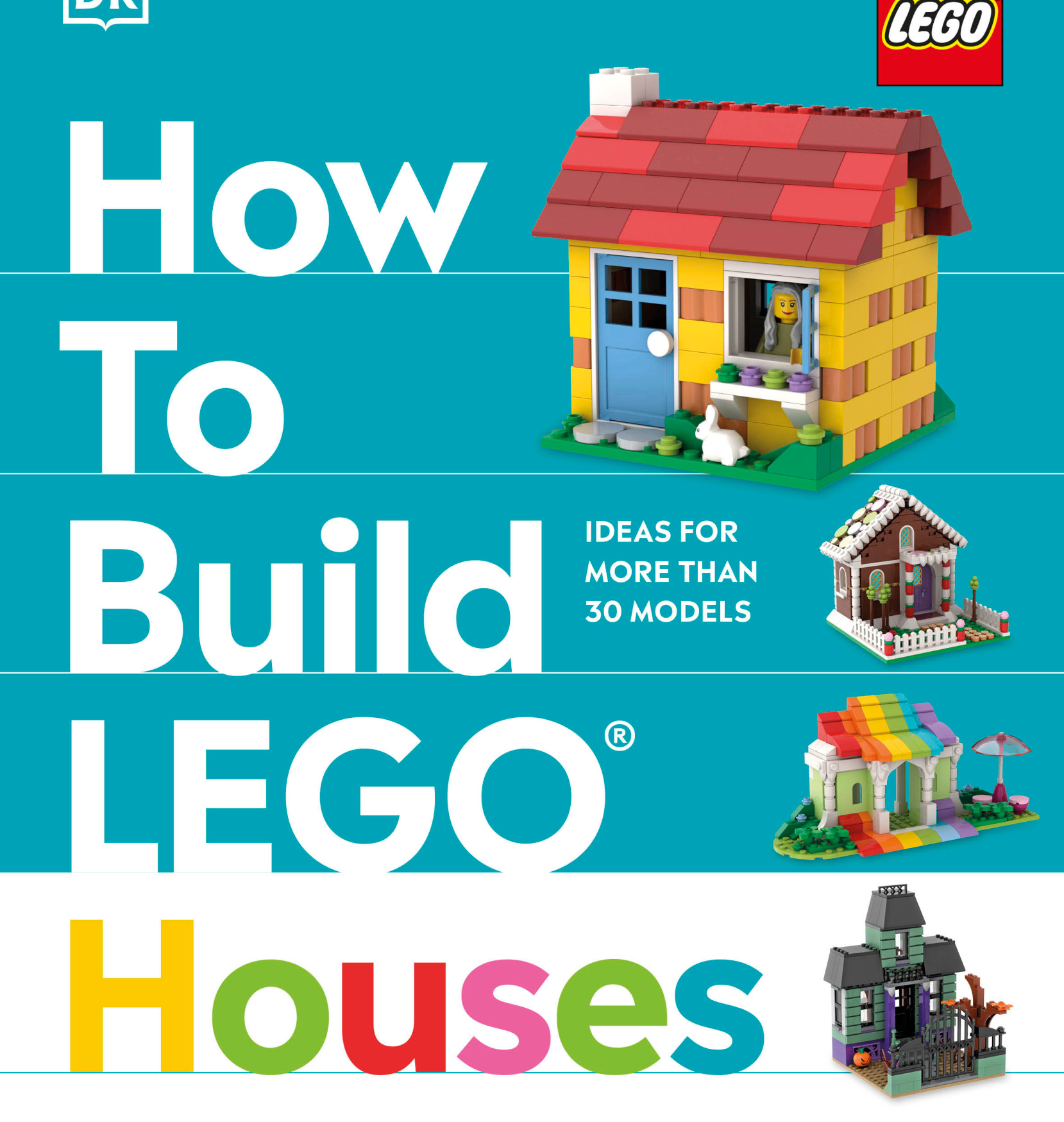
Go on a journey to become a better builder
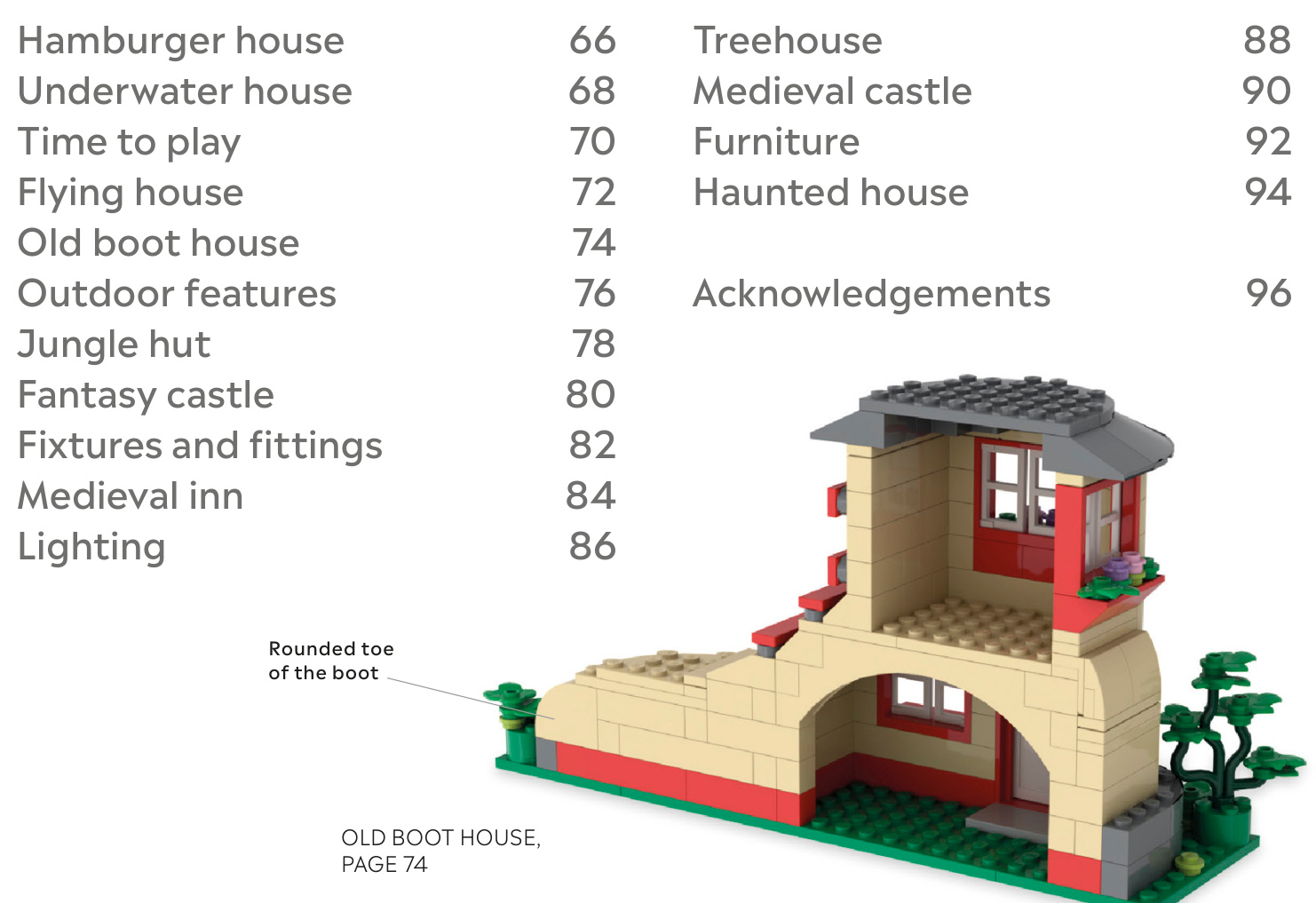
CONTENTS
How to begin 4
Simple house 6
Log cabin 8
Colours and textures 10
Beach house 12
Country cottage 14
Doors 16
Bungalow 18
Lighthouse 20
Windows 22
Fairy house 24
Festive house 26
Roofs 28
Viking longhouse 30
Ski chalet 32
Balconies and terraces 34
Modern house 36
Suburban street 38
Towers 40
Rainbow house 42
Townhouse 44
Extensions and extras 46
Gingerbread house 48
Modular apartments 50
Microscale models 52
Hillside village 54
Playhouse 56
Garden plants 58
Snail house 60
Thatched cottage 62
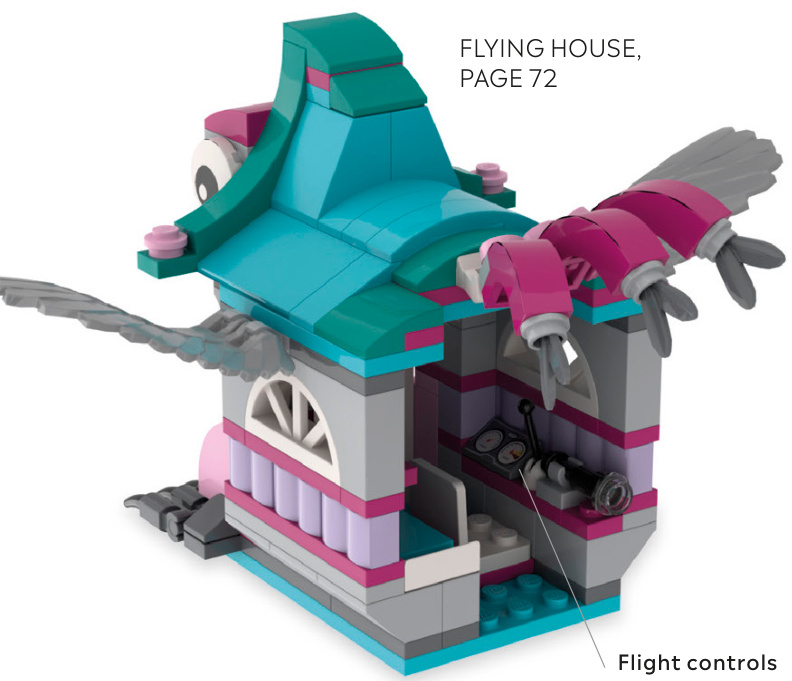
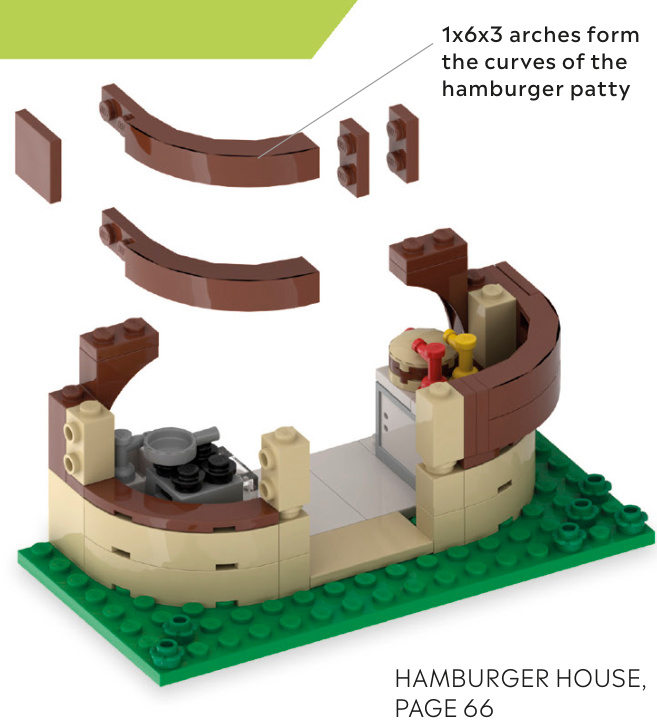
Unusual features 64
I hope you enjoy my designs!
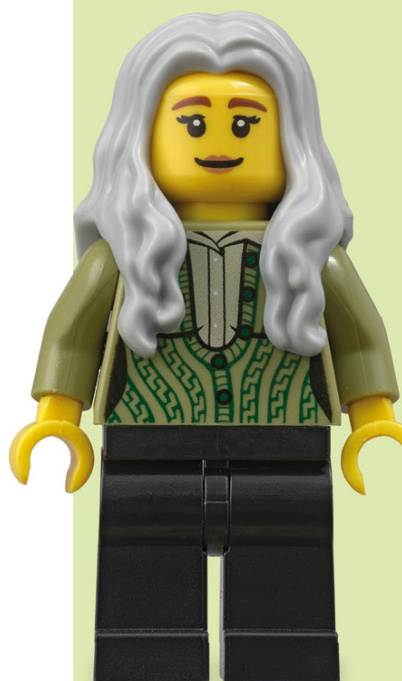
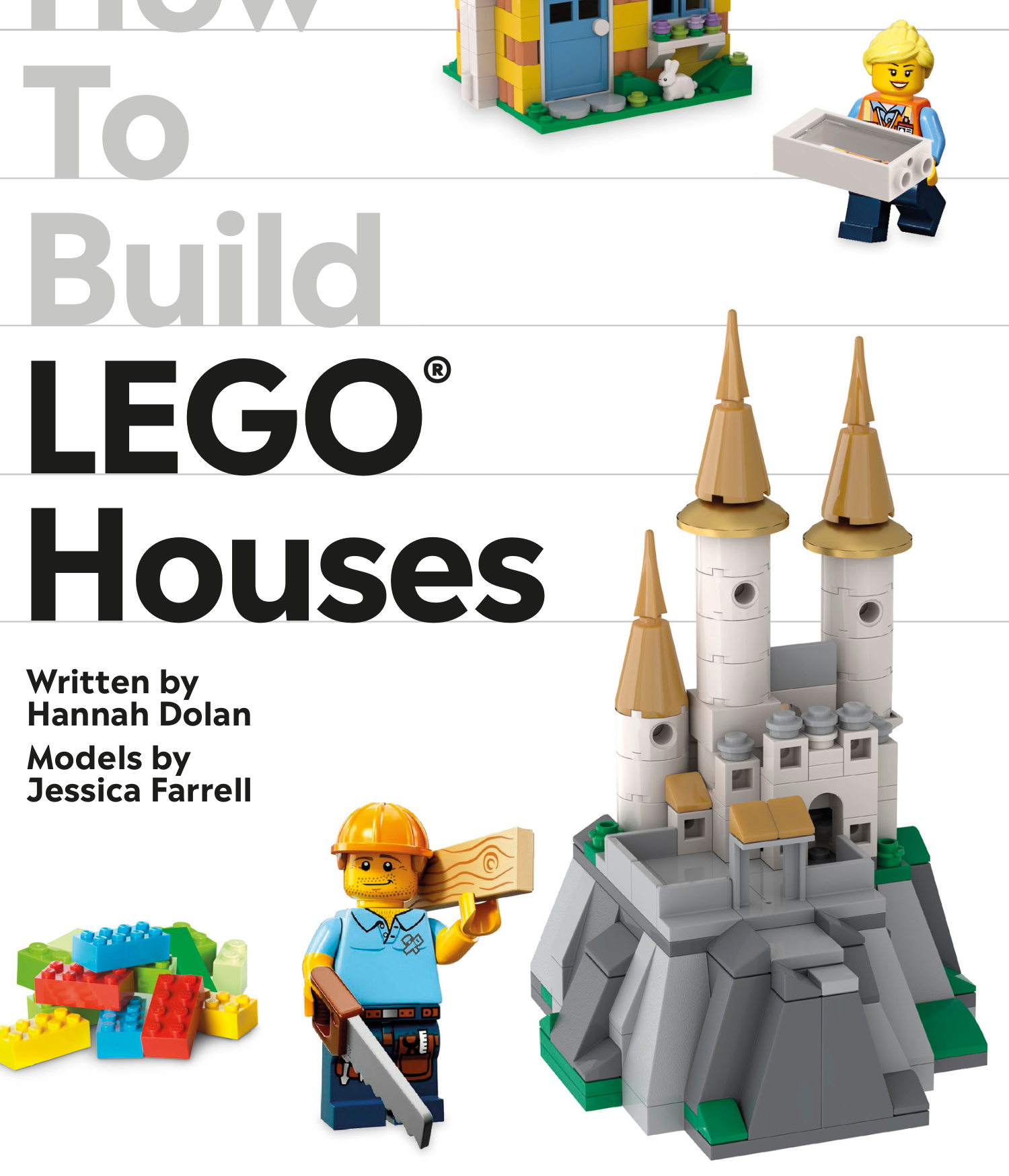
Jessica Farrell designed and created all of the houses in this book. She is a professional brick artist from lrelandwhose models are displayedatevents around theworld.
When did you first start building? At the age of four, when my mother gave me my first LEGO? set.I am very grateful because she startedalifelongloveandfuturecareer.
MEETTHEBUILDER
What’s your favourite LEGO?piece?
The jumper plate. It enables you to add lots of detail tobuildsby“offsetting”pieces byhalfastud.Ioncebuilt amodel that usedalmost7,OoO jumperplates!
Which house in this book would you most like to live in? The fairy house, shaped like a mushroom (page 24). It’s small but it’s magical, sol imagine it has hundreds of roomsinside!
HOWTOBEGIN
T his book is all about building houses, from their foundations to the tips of their roofs. Some are high up in the trees, while others are perched on the seashore.There are colourful gingerbread and rainbow houses, and even a flying home. The houses start off easy and become harder as you move through the book, making it one imaginative building journey. Are you ready to begin?

TECHNICALTIPS
These notes for builders will help you to understand some of the LEGO words and terms that are used a lot in this book.
LEGO?DICTIONARY
2x3brick

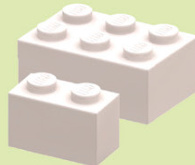
Studs are the round, raised bumps ontop of bricks and plates.They fit into “tubes” on thebottom ofpieces.
1x2brick
Bricks are found in most LEGO models,especially houses! They are namedaccordingto how many studs they have on top.
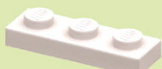
1x3plate
Plates are similar to bricks becausethey have studson top and tubes on the bottom, butthey are much thinner.
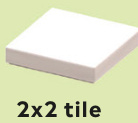
Tiles are thin, like plates, but they have no studs on top.

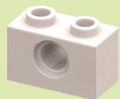
1x2brickwith LEGOTechnic hole
Holes insidebricks and other piecescan holdconnectors like pins, bars, and axles.
WAYSTOBUILD
1x4 plate attached underneath
Upwards
The“easy”housesinthisbook mostlyshowpiecesstacked on top of each other like this.
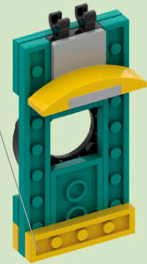
Downwards
You canadd pieces underneath parts of yourhousestomake them more secure.
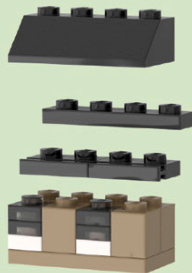
1x2 brick with two side studs
Hinge plates attach to hingebricksto form the roof shape
Sideways
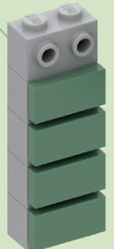
For more advanced models,you can usepieceswith studson their sides to build sideways.
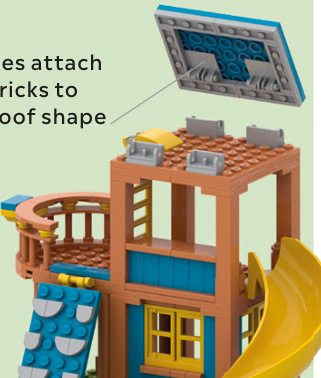
All angles
Build moving parts or interesting shapesinto your houses using hinged pieces or clips andbars.
HOWBIGISYOURHOUSE?
Modularbuilds
Minifigure scale
If you want minifigures to live inside your house, thinkabouthowwide or tall your minifigure residentsareand how theywould move aroundwithin it.
Microscale
This is anything smaller than minifigure scale, oftenusingfewerpieces. You can imagine your tiny homeowners inside!
You couldbuild multiple homes, like a block of flats or a row of houses, using modular building techniques.
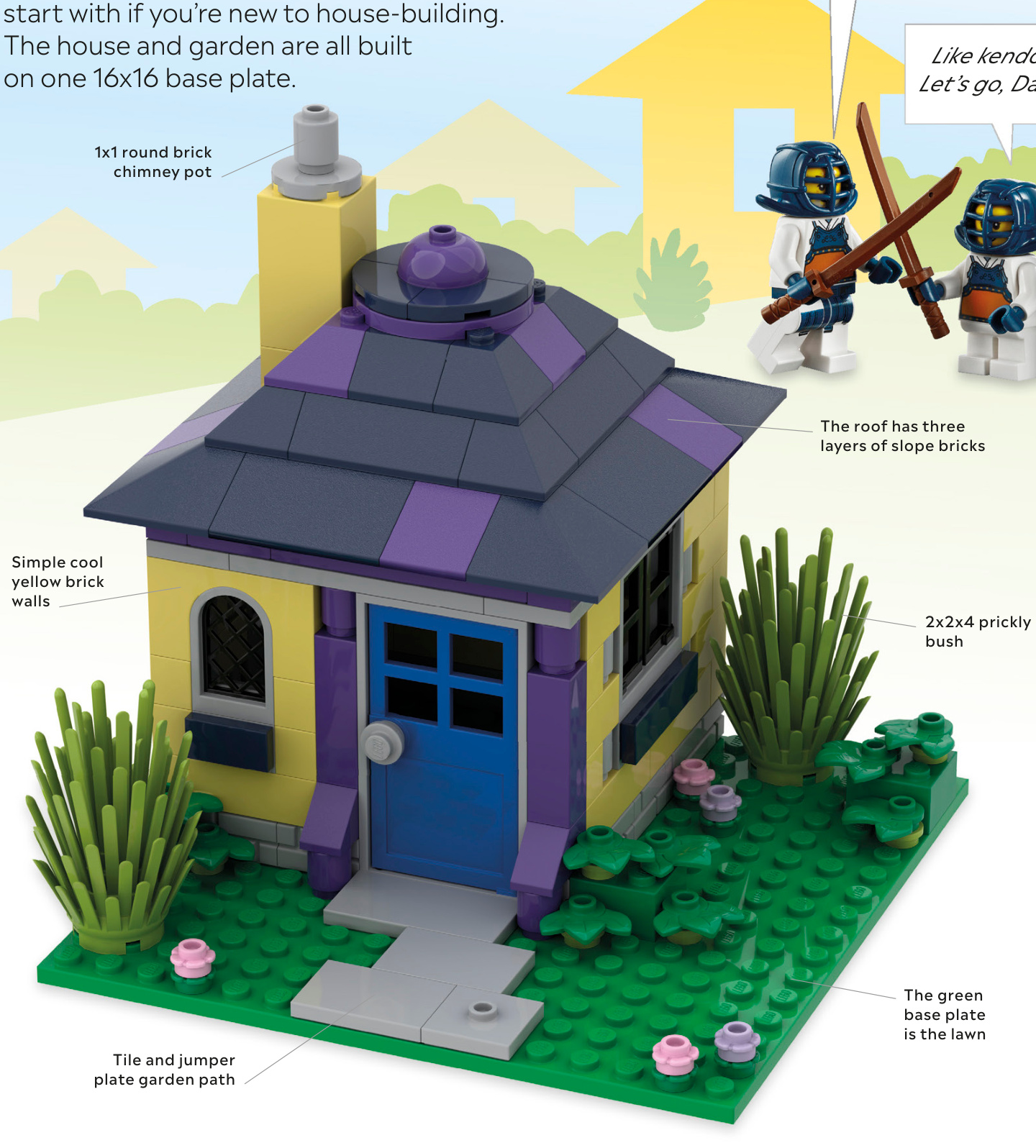
SIMPLEHOUSE
his little dwelling is for minifigures and builders who enjoy the simple things in life. Its perfectly square proportions make this a good one to
If you live simply,
you have more
time for fun
hobbies.
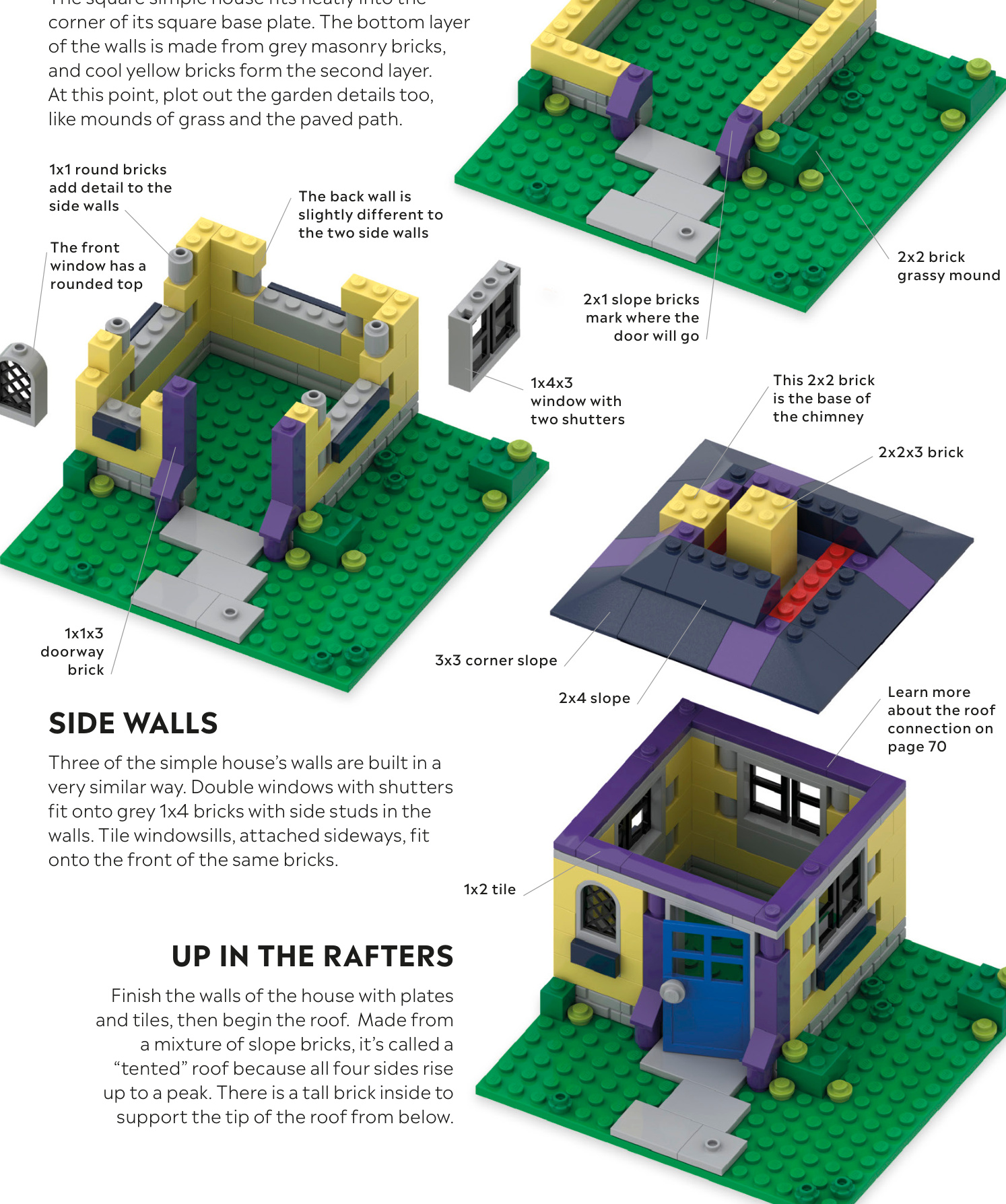
SQUAREONSQUARE
Thebackofa1x2 masonry brick looks different to the front
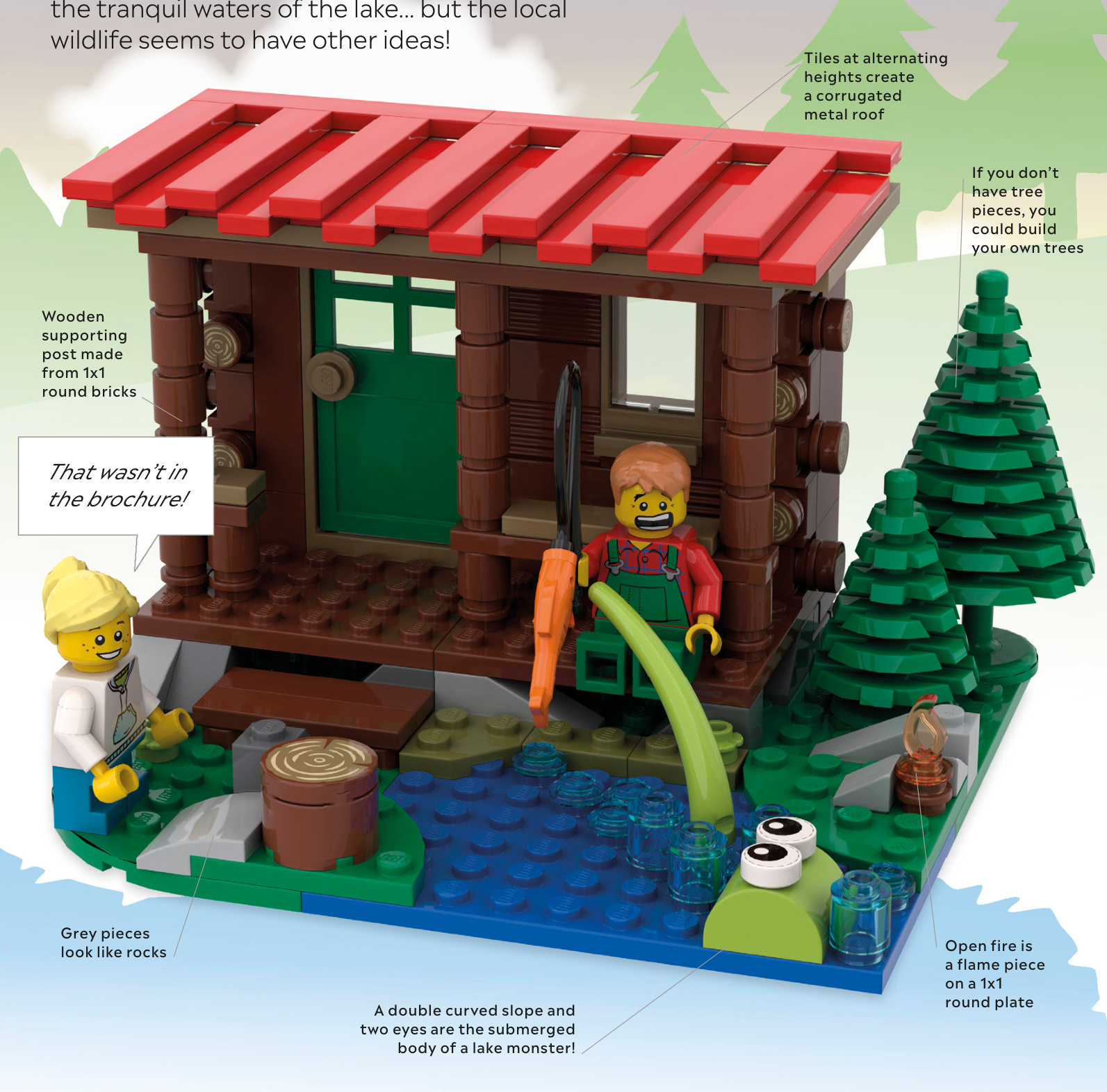
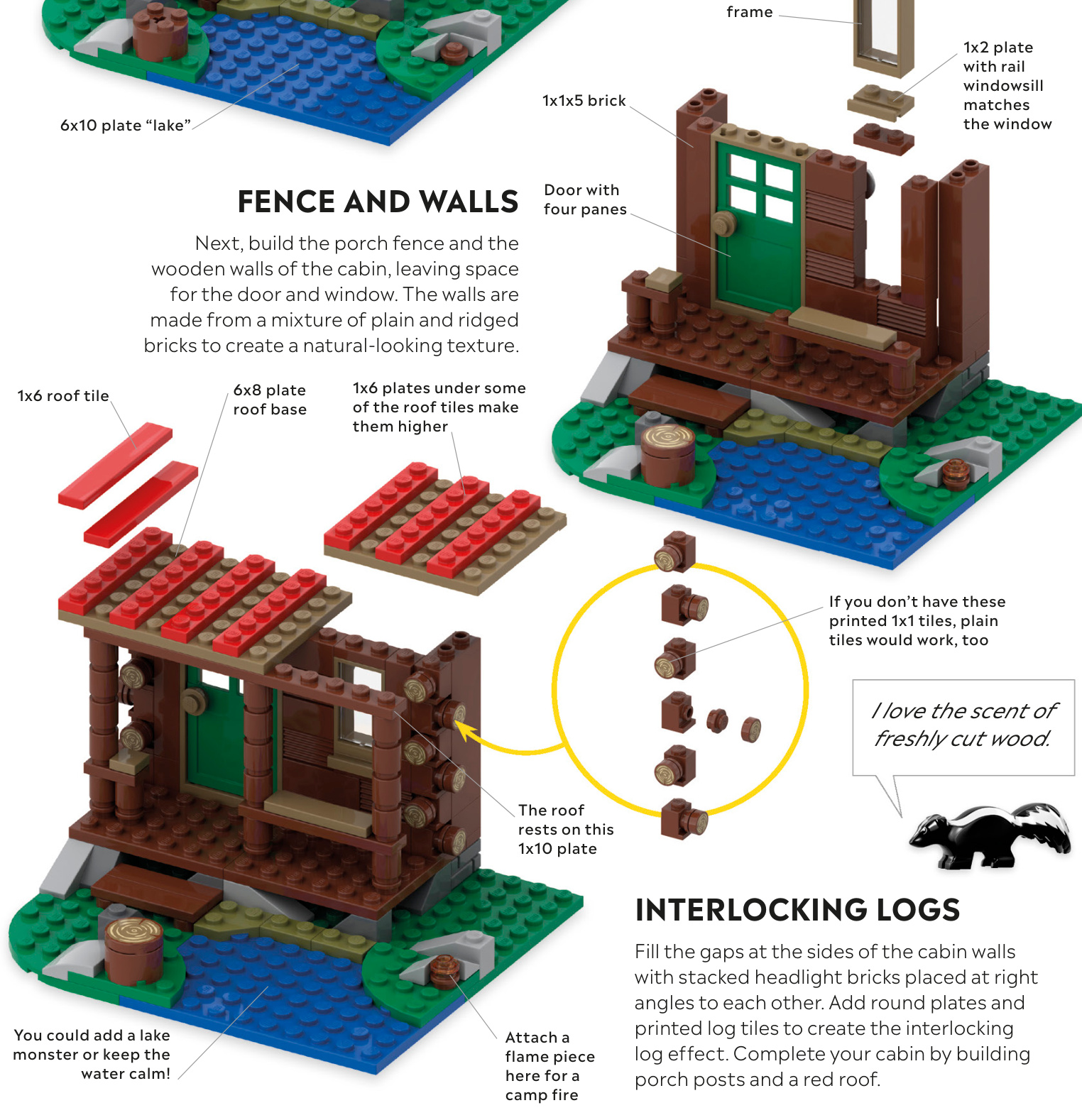
LOG CABIN
eep in the LEGO? woods lies this traditional log cabin. It has walls made from horizontal
logs that interlock at the corners.Minifigures
come here to get away from it all and relax by
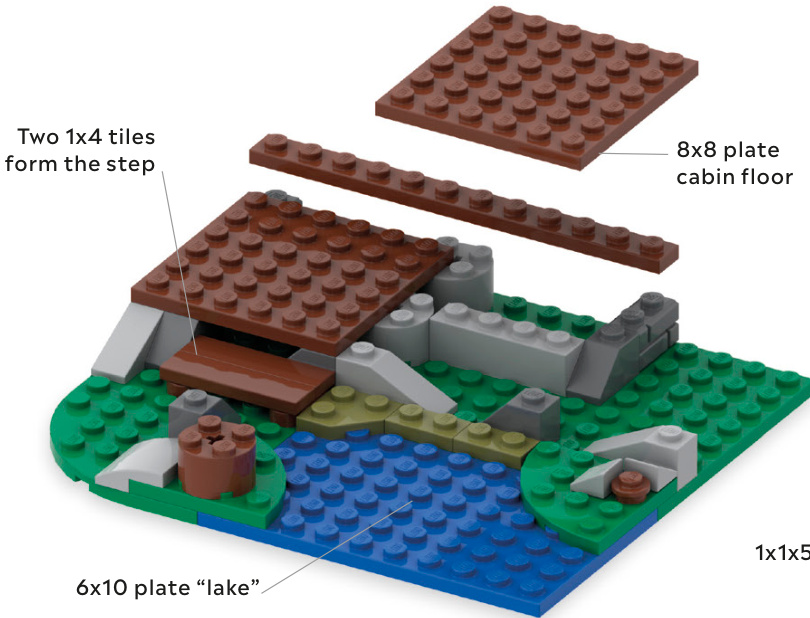
ONTHELAKE
Green and blue plates form the pretty lakeside location of the log cabin. The bottom of the cabin is made from grey bricks that look like rocks on the lake shore.
COLOURSAND TEXTURES
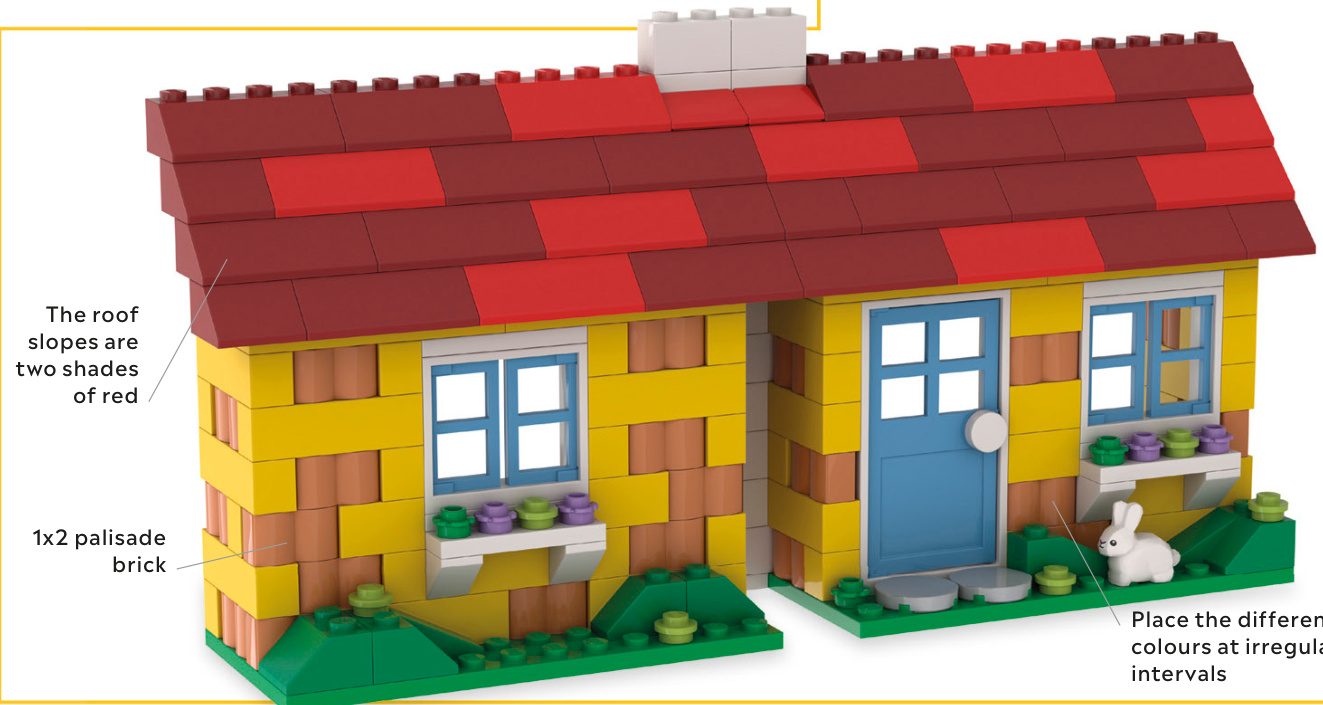
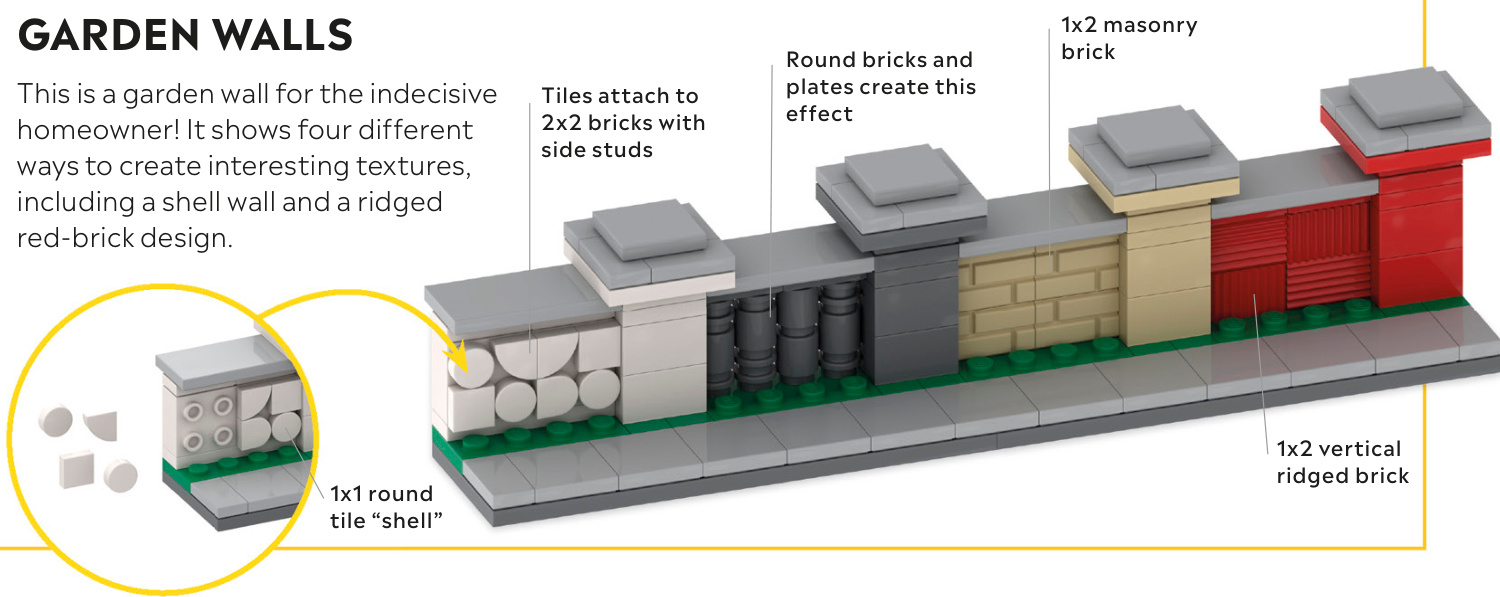
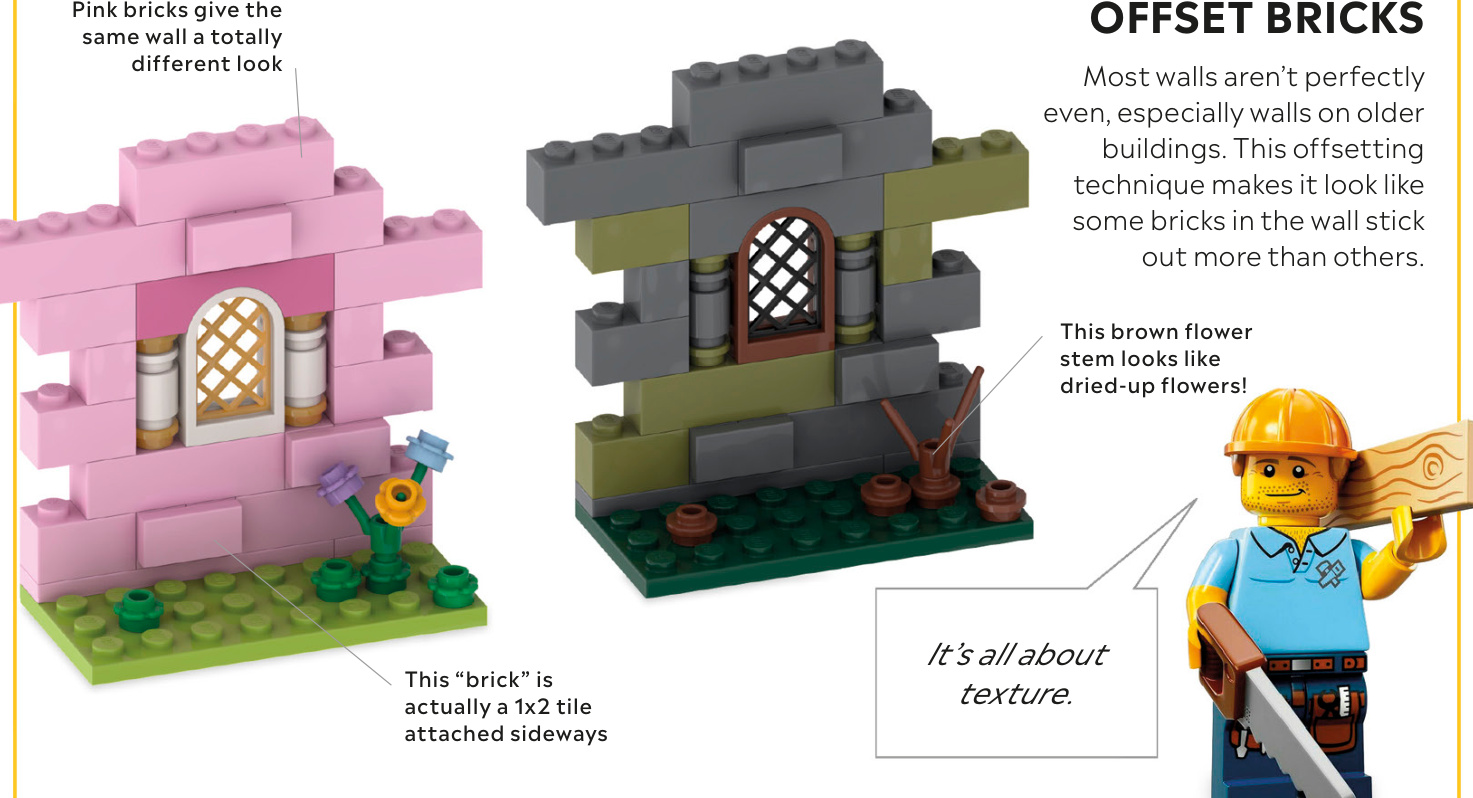
Dlain LEGO walls look great and serve their purpose perfectly, but building in more texture and colour can take your house-building to the next level. Try out some of these wall techniques to give your homes a more natural or unusual look.
SIMPLE CHANGES
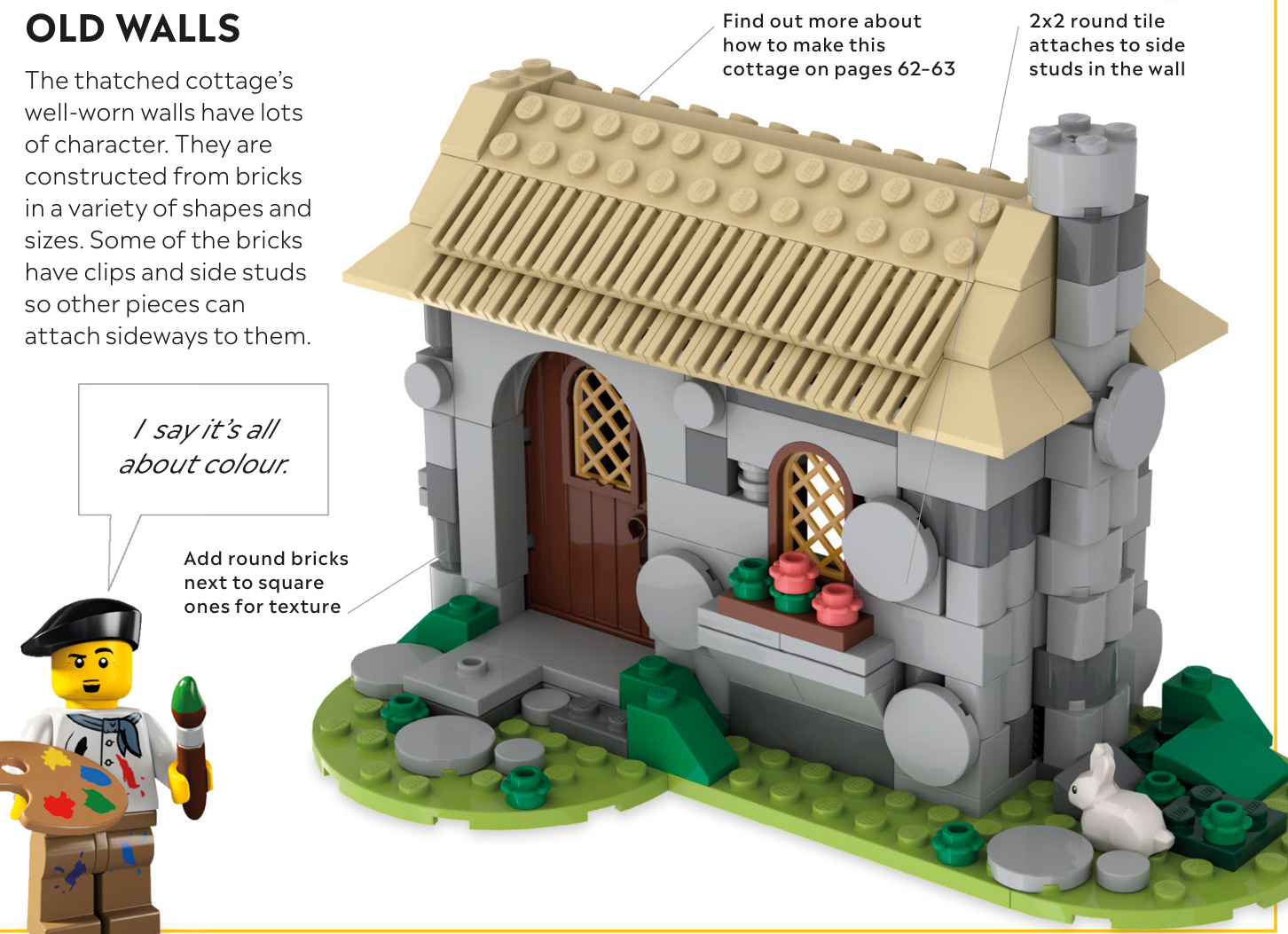
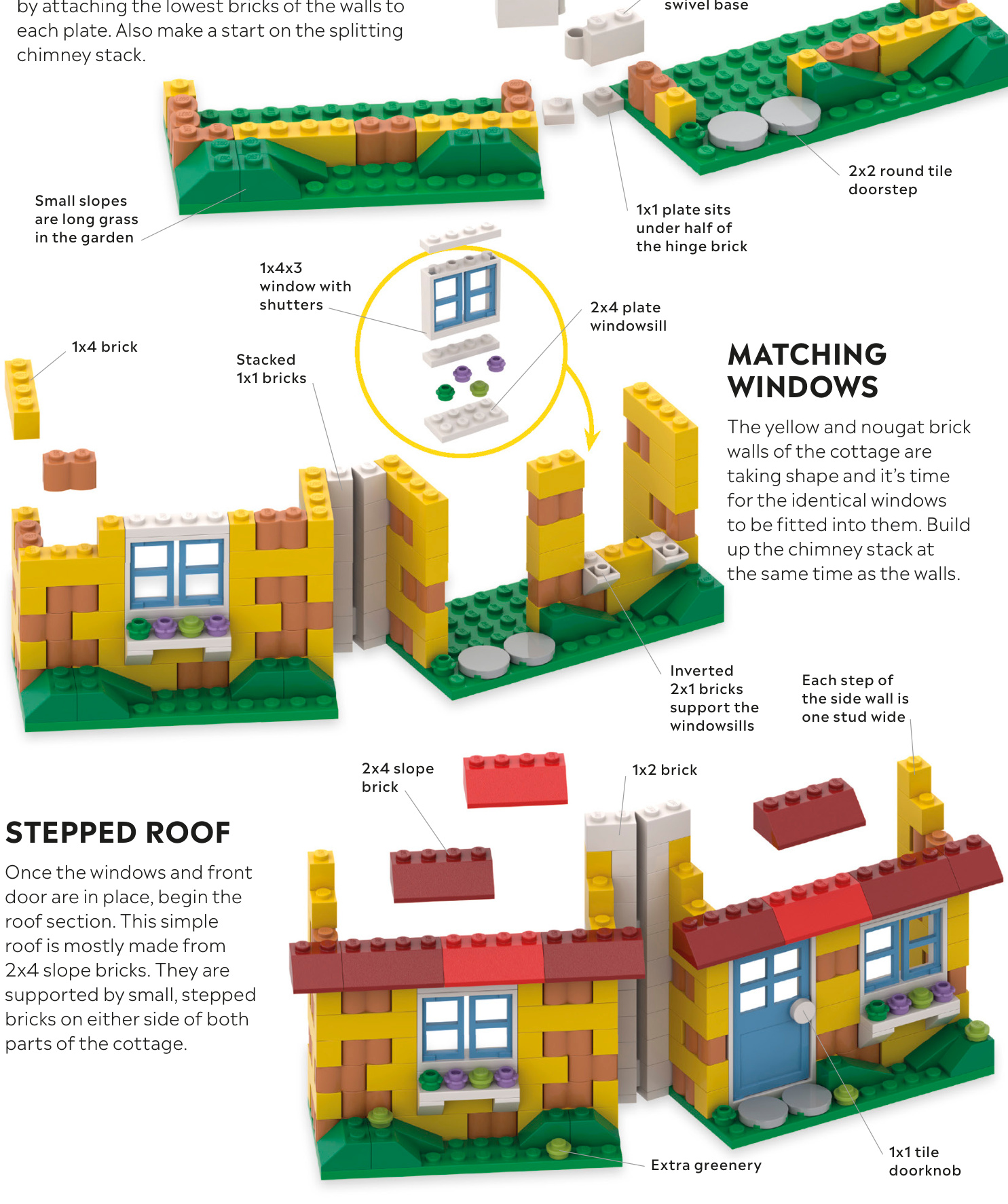
Adding just one other colour to a plain wall can make a big difference to the look of it. This country
cottage has lots of ““palisade”
bricks in a colour (nougat) that works well with yellow.The curved edges of thepalisade bricks create texture,too.
BEACHHOUSE
STILTED START
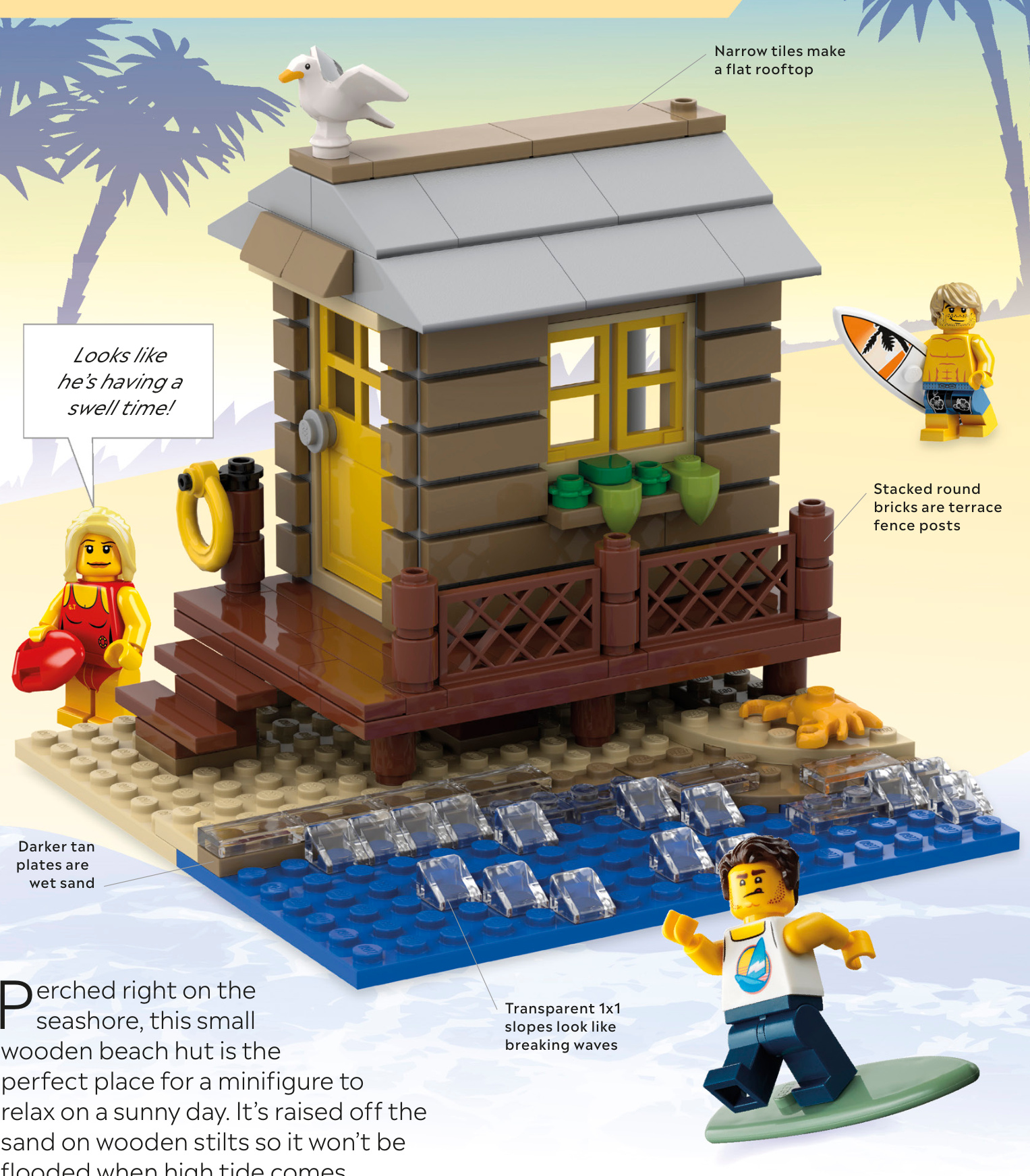
Begin the beach hut with sandy and sea-coloured plates, then plot out the shape of your hut by adding the stilts and stair pieces.A brick will provide extra stability for the beach hut’s floor.
Rounded plates
create an
uneven
shoreline
Blue8x16 plate is the sea
This1x1x6pillar supports the roof
Leave exposed studsfor the fence
1x2brick with two side studs
WOODENWALLS
Build up the floor of the hut using brown
plates topped with tiles,which look like smooth planks of wood. The walls come next-they’re made from horizontal tiles attached to brickswith side studs.
with bar、
SHORELINESHELTER
Finally, add a window, door, and roof to give your minifigures shelter from the sea breeze.The roof has sides made from slope bricks. To finish off, add a second layer of slope bricks and top them off with tiles.
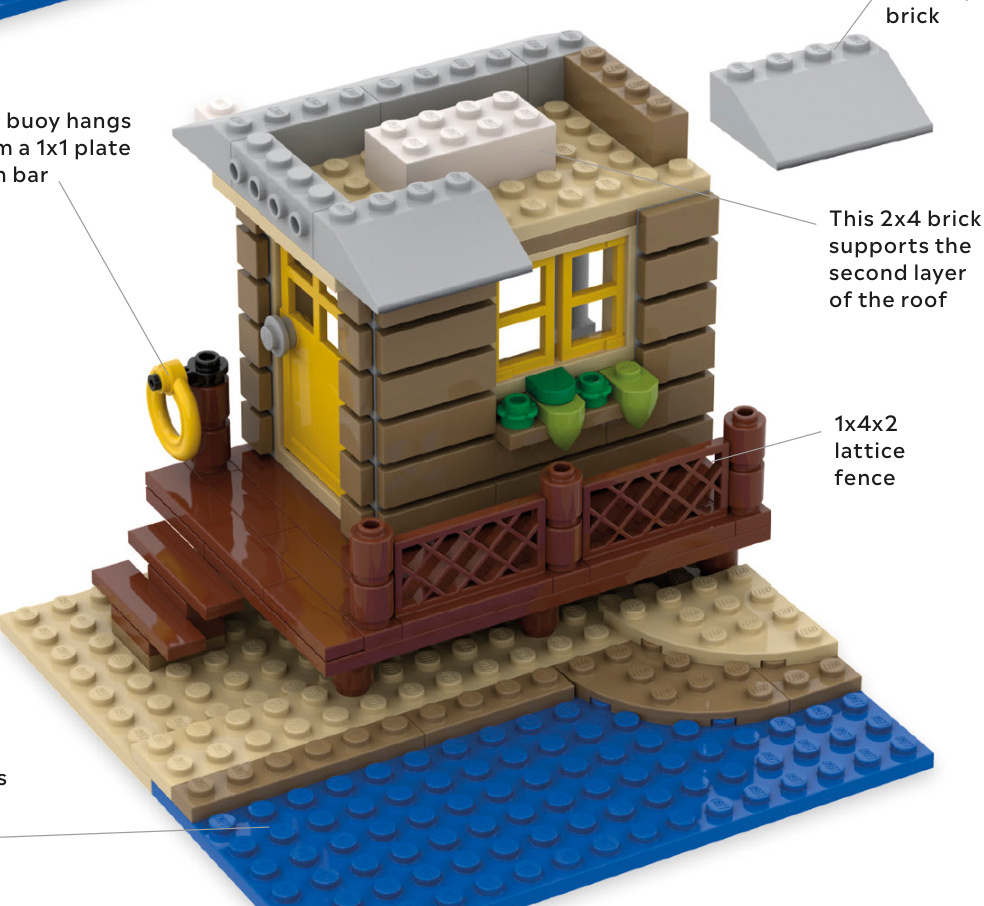


Add transparent “wave”pieces and sea creatures here to bring the scene to life!
COUNTRY
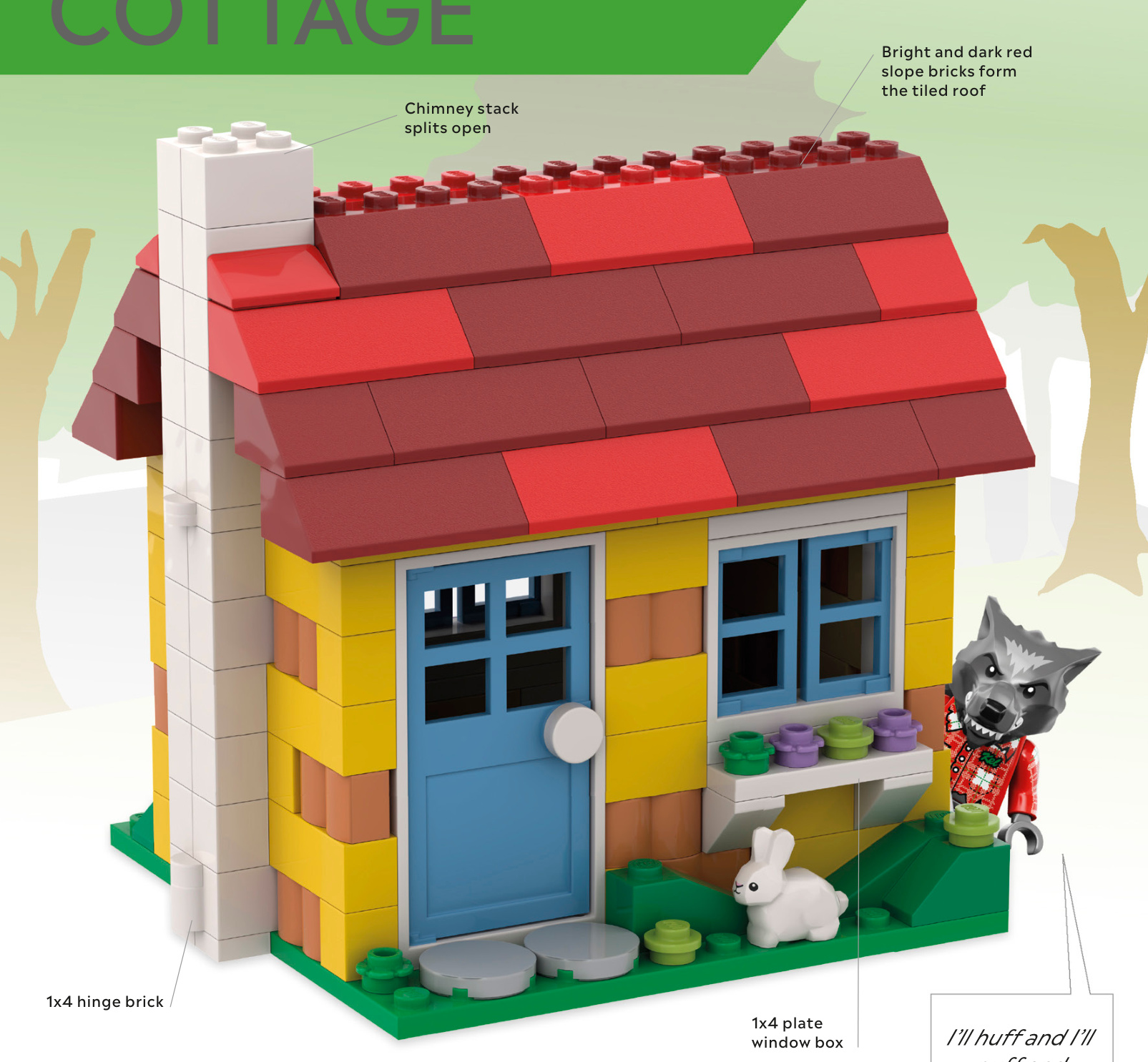
his simple country home is easy to build and even easier to play inside, thanks to hinge pieces in the chimney stack. They allow the front and back walls of the house to open up. The back part of the house has a matching blue window and another window box filled with flowers.
puff and I’ll split your house open!
TWO SIDES
The country cottage is built on two identical plates. Plan out the shape of the home
DOORS
White-framed window matches the door,
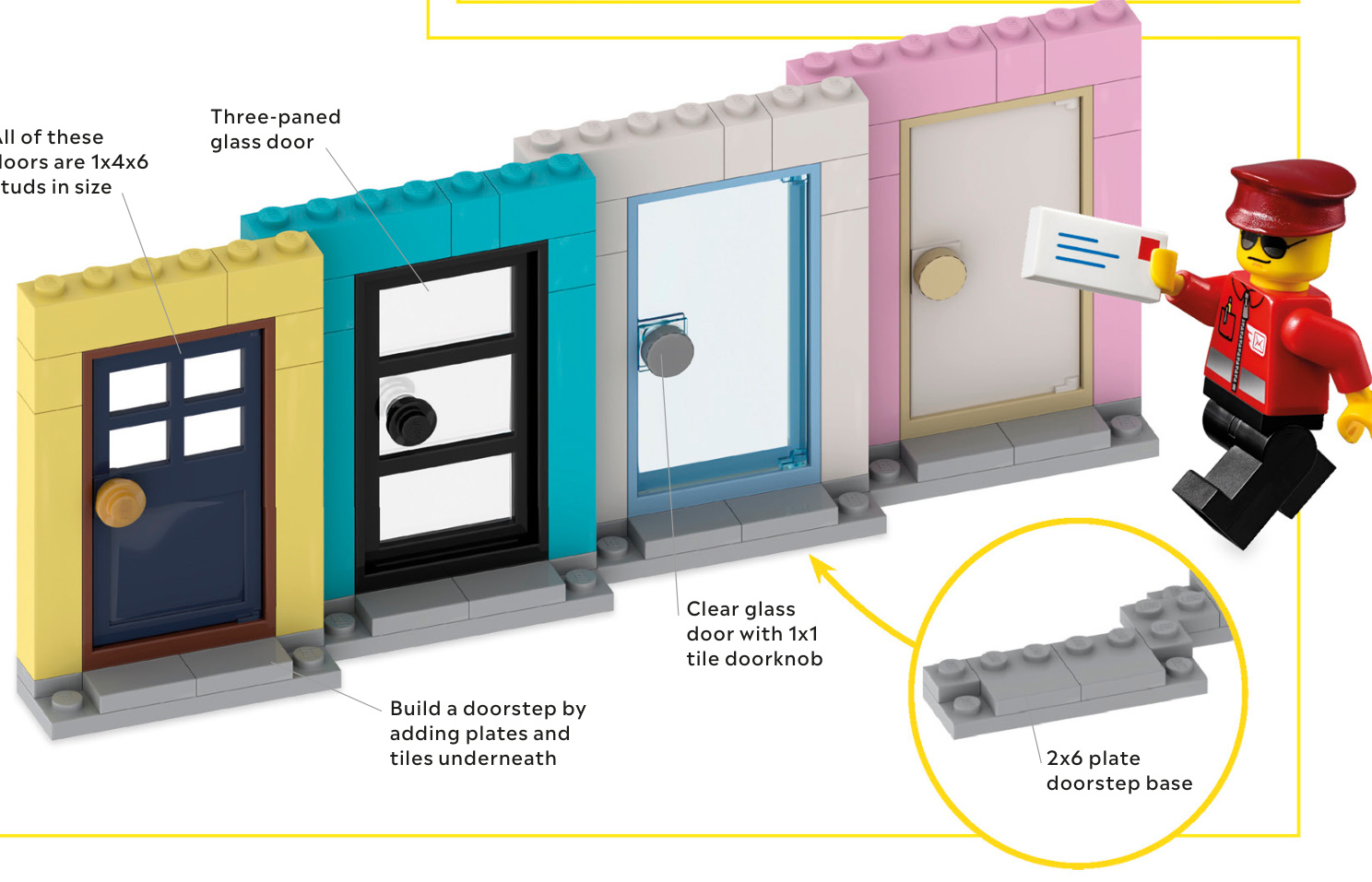
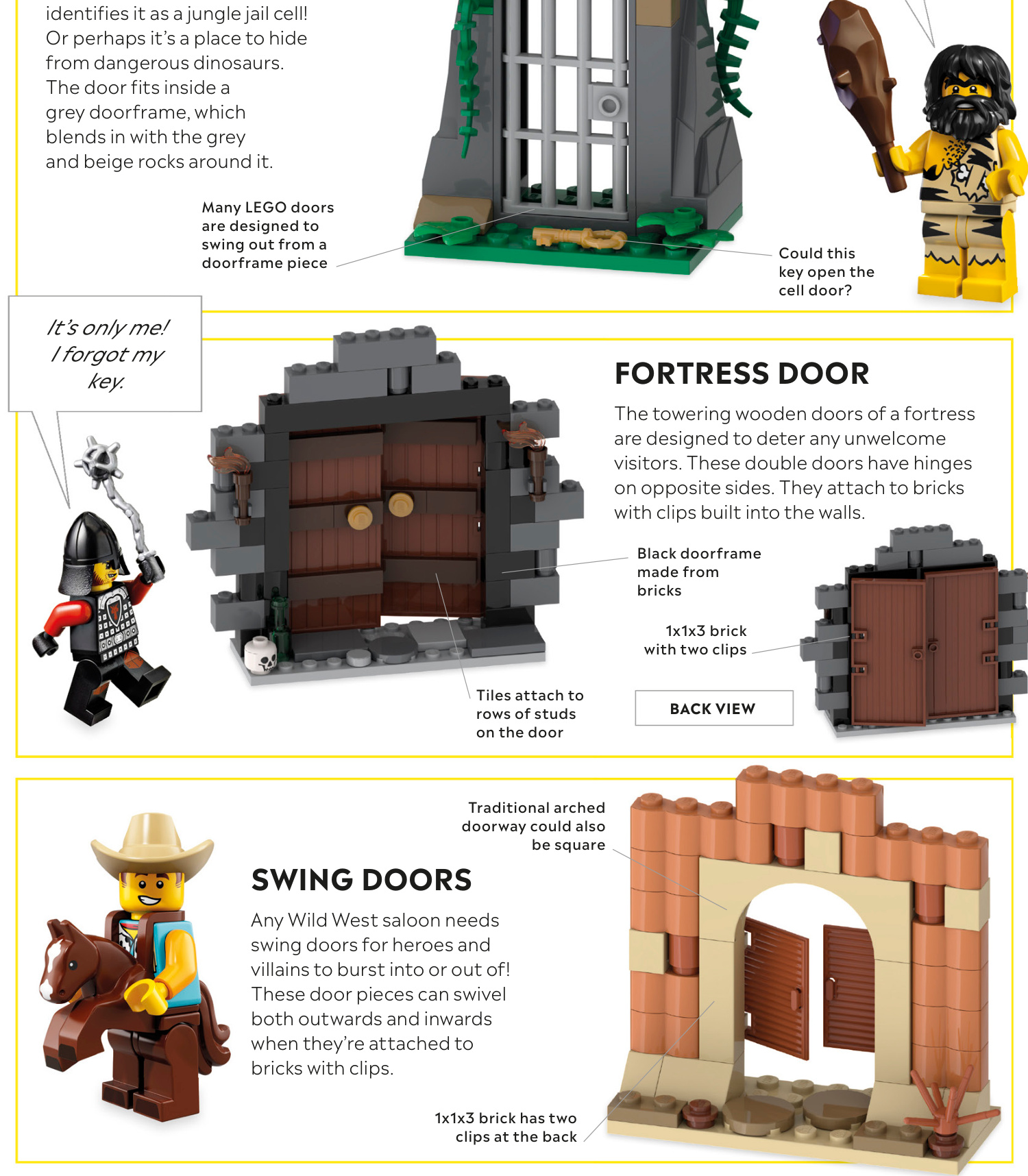
^ door is a very important part of any ILEGO home - and not just because it’s the way in! It can also add a lot of personality. Will you choose single or double doors, a modern glass or wooden door, or something altogether different?
It’s just a-door-able!
STREET DOORWAYS
A row of doorways may be all you need to make a street scene.Adding different 1x1 round tiles and plates to make doorknobs can give doors a distinctivelook.

SIMPLEDOOR
There arelots of ready-made LEGO door pieces to choose from.A plain white door fits in well with this simply designed red-brick cottage.
BUNGALOW
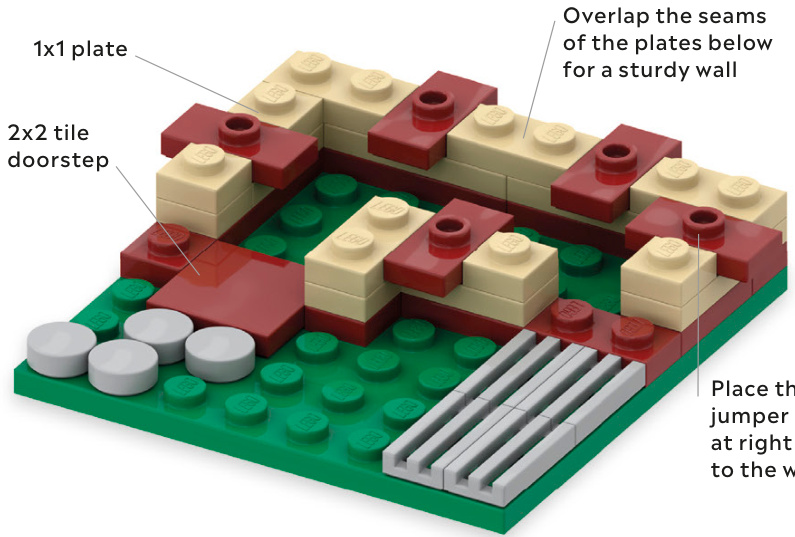
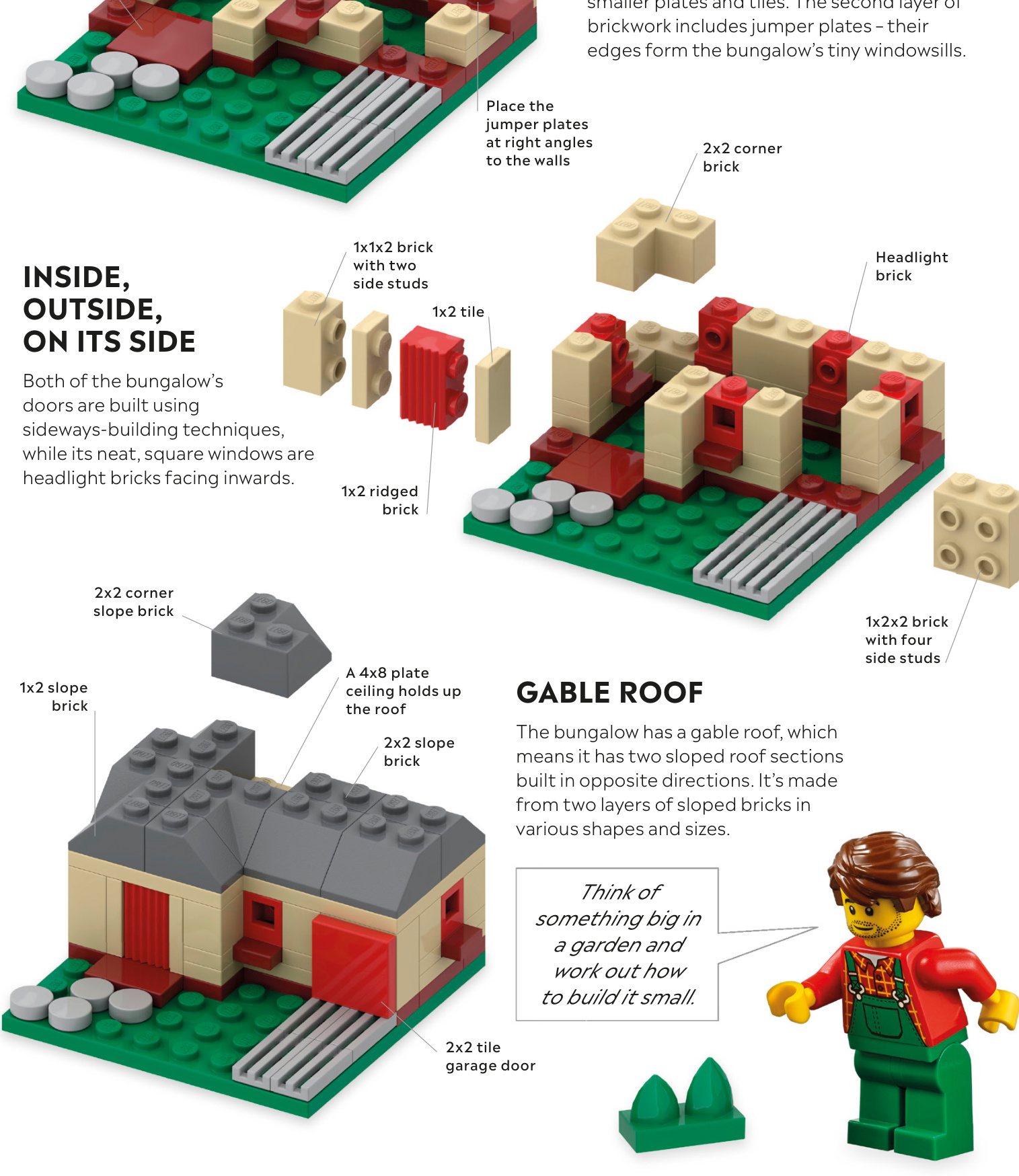
BUNGALOWBRICKWORK
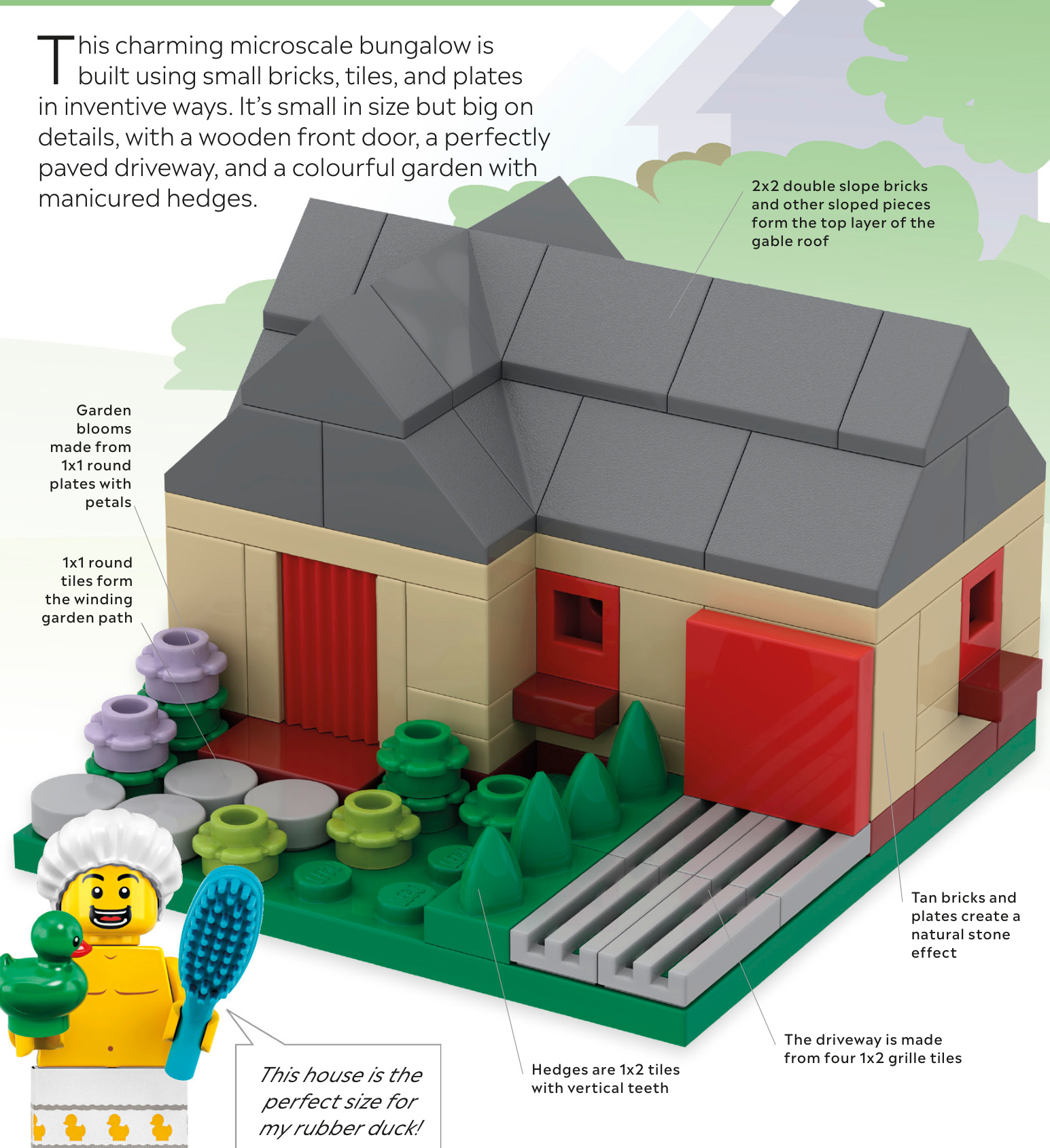
The whole bungalow is built on one base plate,with foundations made from smaller plates and tiles.The second layer of
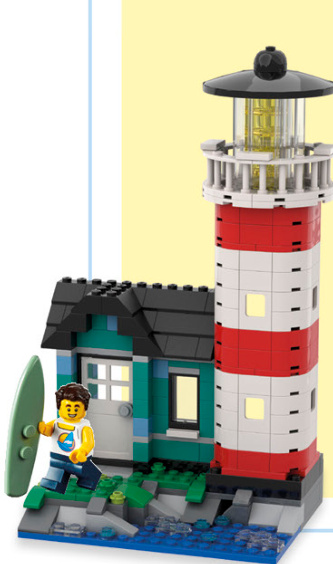
LIGHTHOUSE
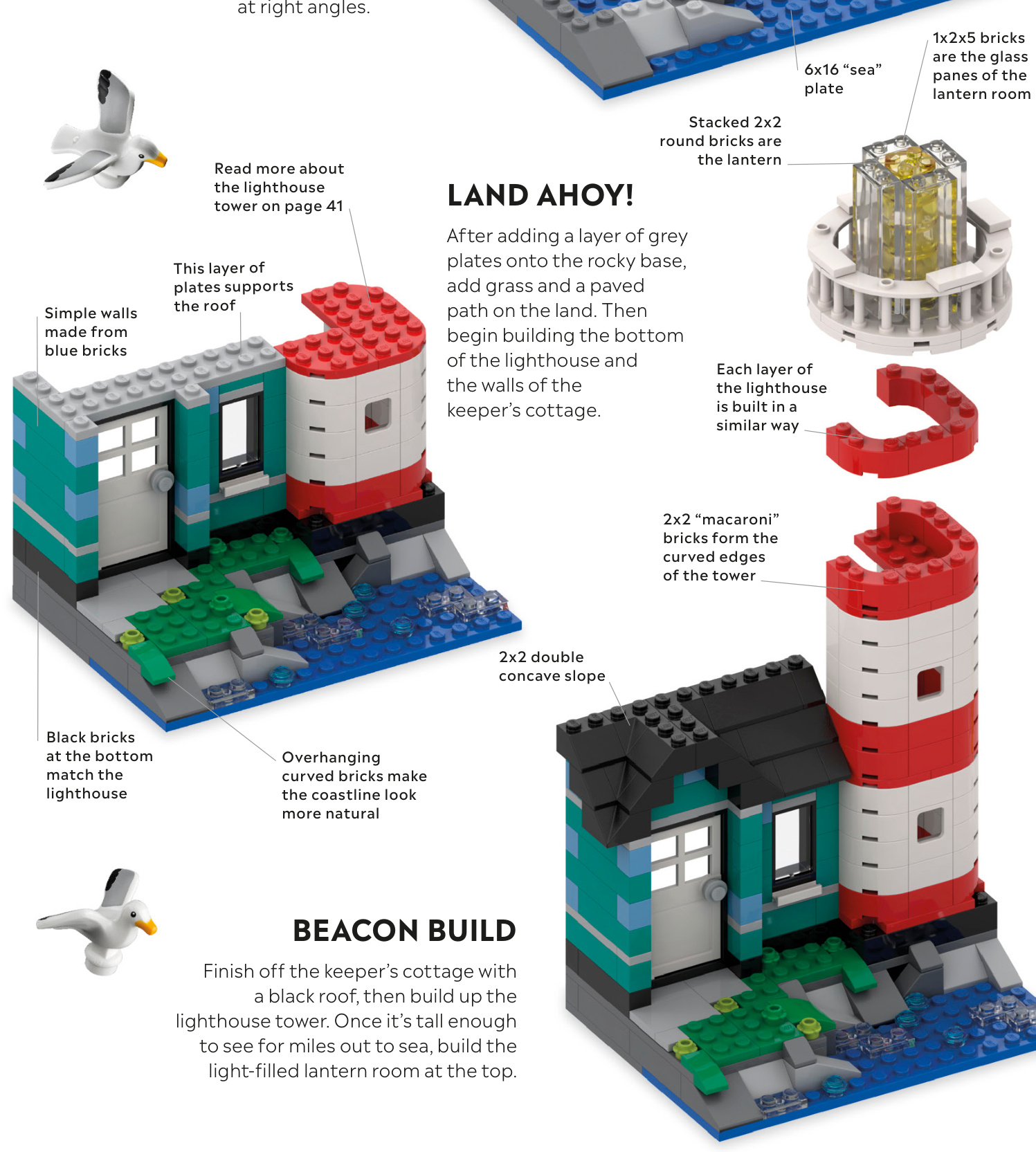
S clear of hazardous rocks. The lighthouse’s red-and-white striped tower has a lantern room for its powerful lamp at the top and an adjoining lighthouse keeper’s cottage at the bottom.
Lantern room balcony
Hey, I’ve just washedthat roof! Pesky gulls.
Redandwhite stripesare
easy for ships to spot
Small transparent pieceslook like swirling water
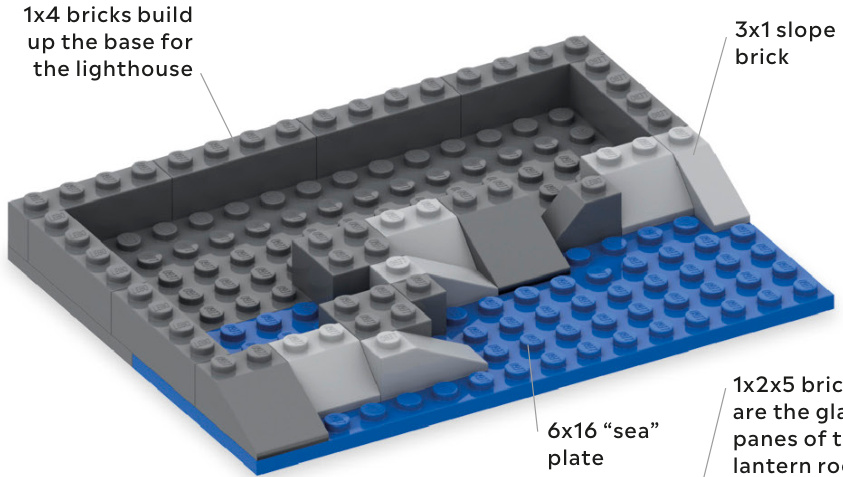
ROCKY BASE
The lighthouse is built on a base that’s half-land,half-sea thanks to large dark grey and blue plates
The sharp, uneven-looking rocks on
the coastline are made from slope pieces in different sizes,placed
WINDOWS
LEGO? house wouldn’t be a home without Awindows. They let the light in and let
minifigures look out on their surroundings.
There’s a whole world of LEGO window pieces
and a multitude of ways to build them into walls.
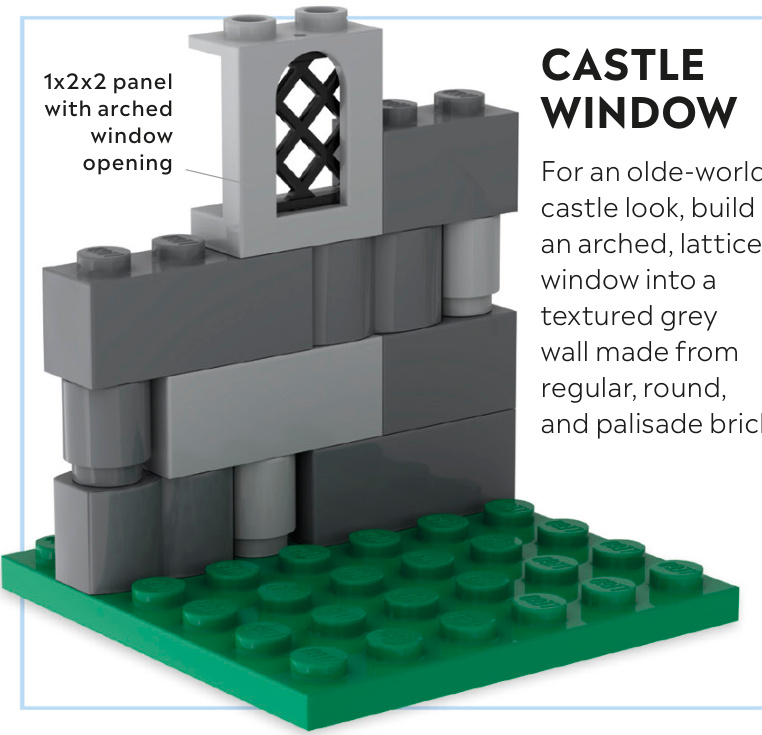
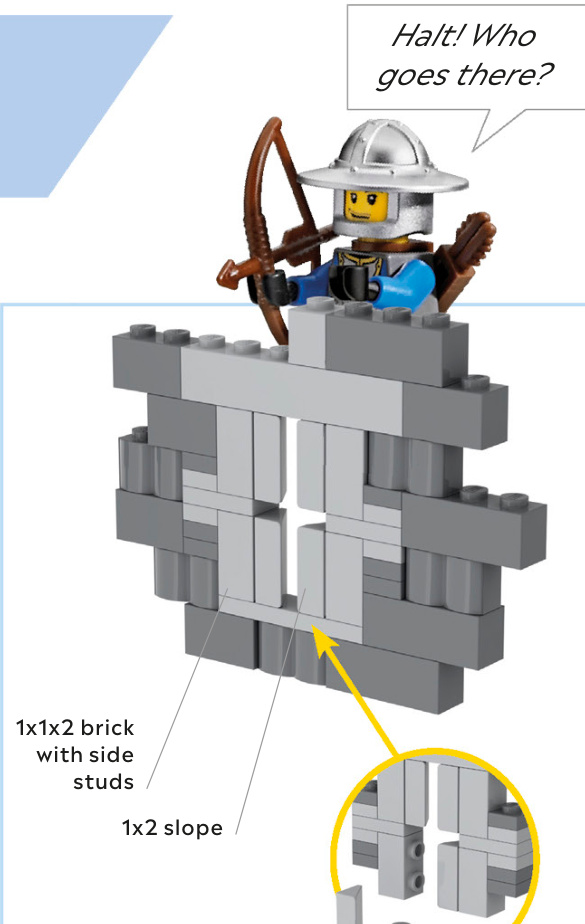
ARROWSLIT
Look out!Archers shoot arrows from these long,narrowwindows,which are found on many castles. The cross-shaped gap is made using four slope bricks attached to bricks with side studs.
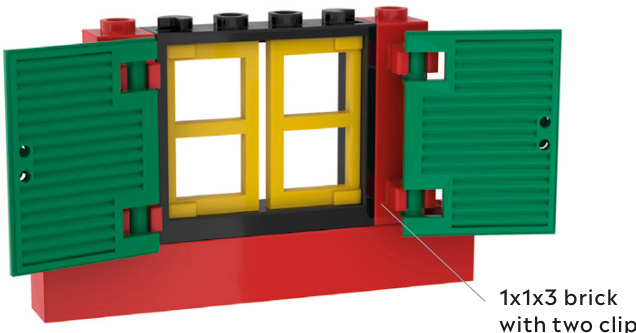
SHUTTEREDWINDOW
Some windows have shutters to protect them from bad weather,to control the sunlight, and because they look nice! To add them to your designs, build in bricks with side clips on either side of a window.
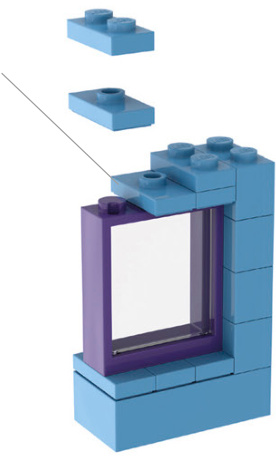
Jumper plates are two studswide with one studin the middle
RECESSED WINDOW
Sometimes windows sit slightly inside the walls that surround them.This recessed window style is built into a two-stud-wide wall but attached with jumper plates at the top and bottom.
WIDEWINDOW
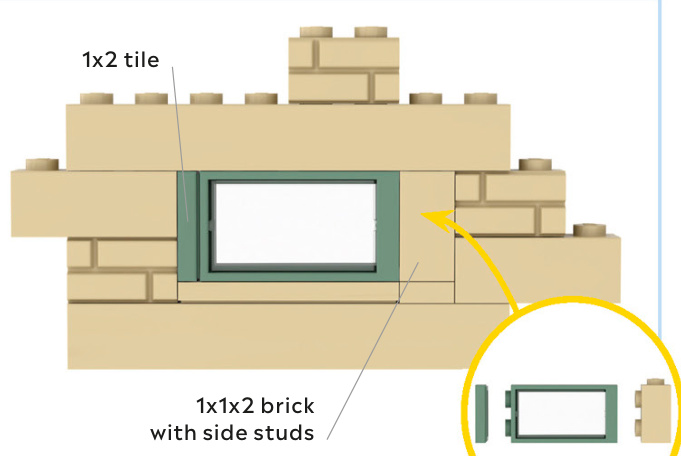
This wide window is built into the wall on its side thanks to a brick with side studs.Adding a tile in the same colour on theleft side of the window frame makes it look more symmetrical.
SHOPWINDOWS
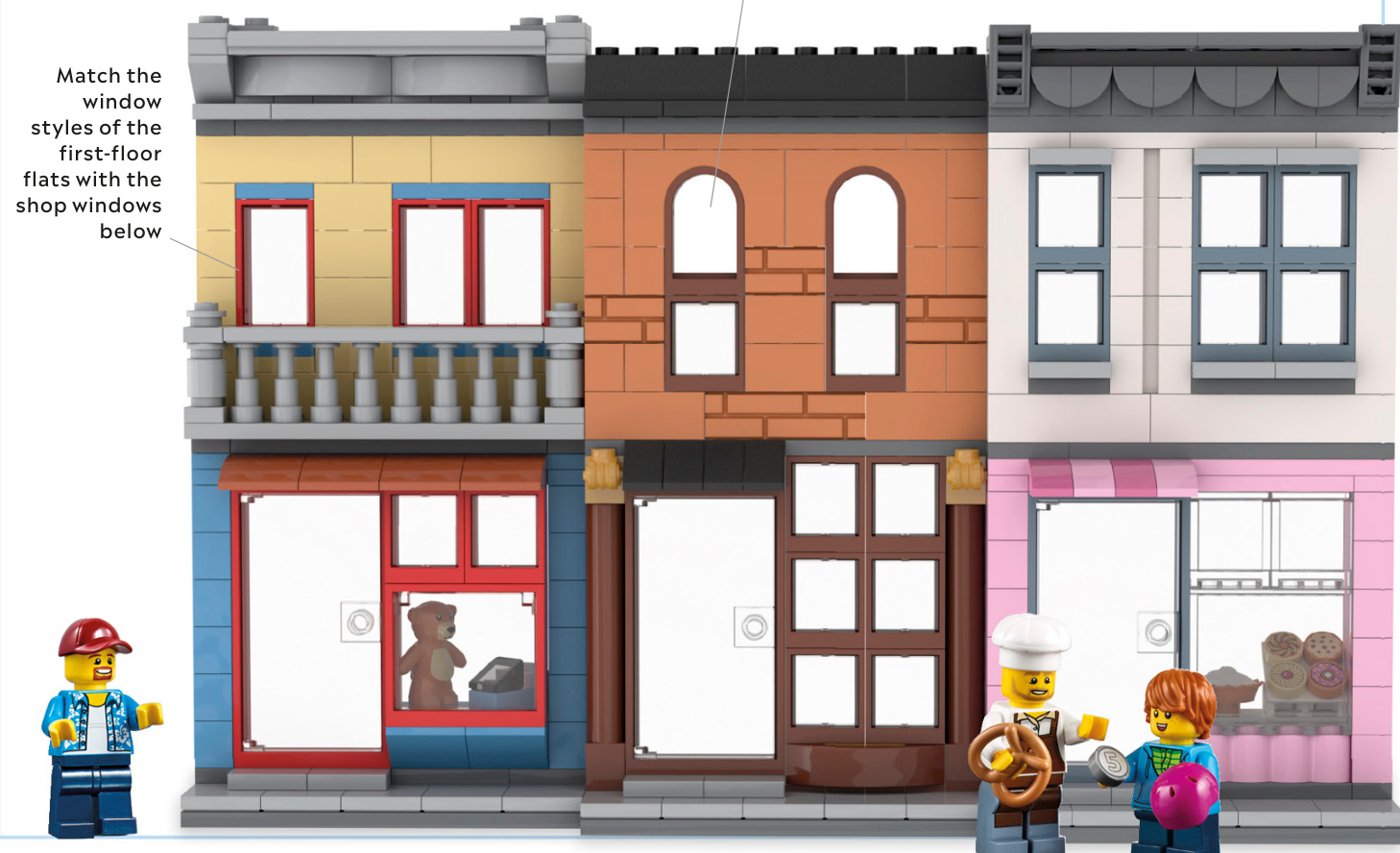
A good shop window needs to tempt passing customers inside by displaying the shop’s best wares. The large windows on this row of shops are all built by combining multiple window pieces.
1x4 hinge brick
BAYWINDOW
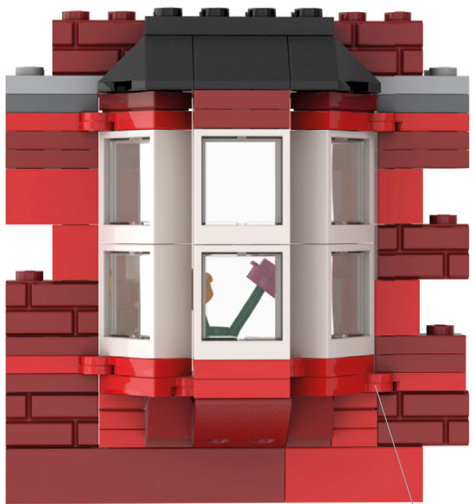
Bay windows project out from a wall to create a light-filled living space.The three separate window panels on this build are joined together and to the wall with hinge bricks to give the window its protruding shape.
Elongate arched windows by adding square onesbelow
FAIRYHOUSE
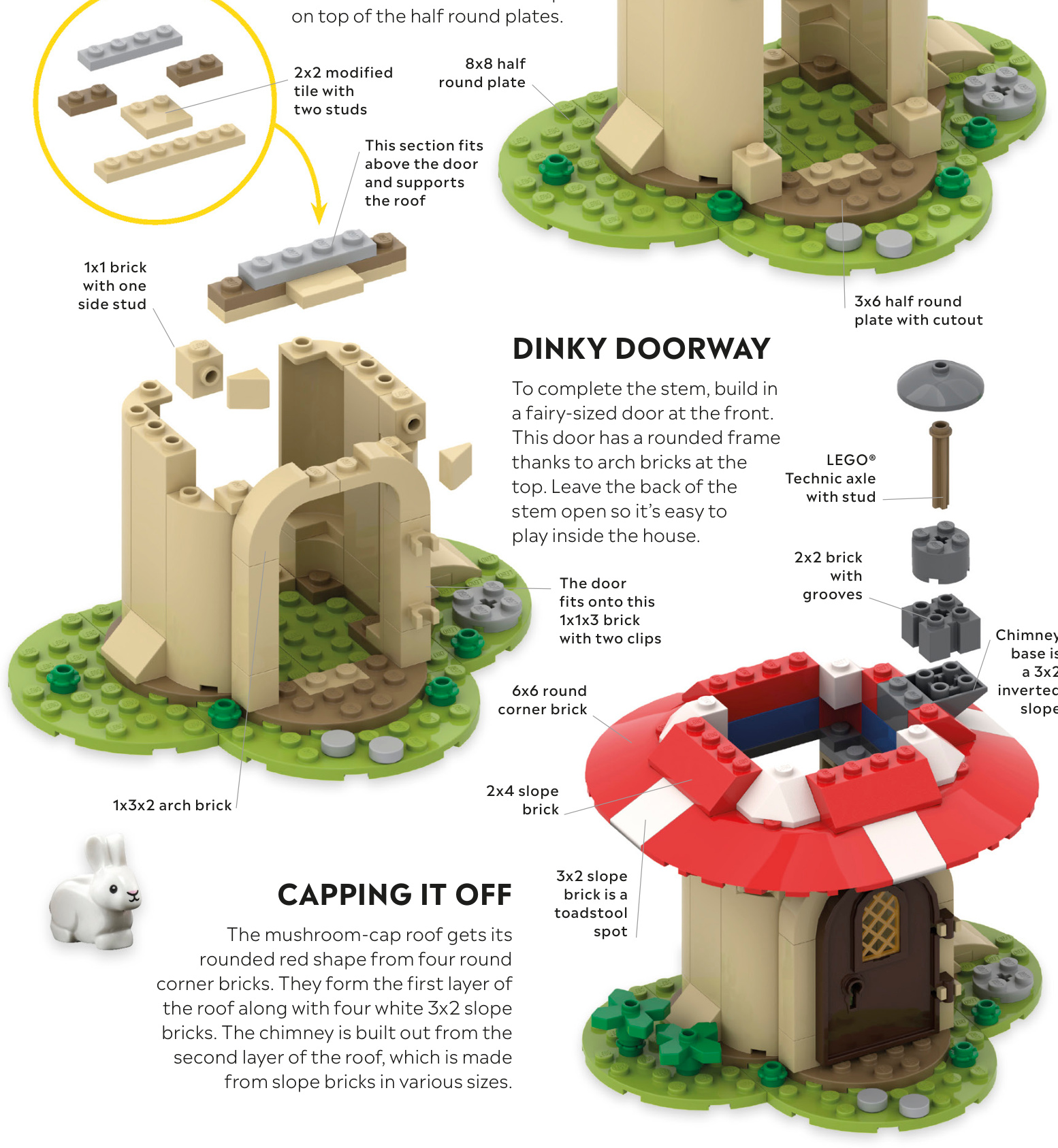
inett like this one! The mushroom’s recognizable red cap with white spots is its tiny roof,
with a fairy-built chimney poking out.
There’s a large door built into
the mushroom’s stem for
welcomingtinyvisitors.
“Cheese”slopes andcurvedslopes formthetoplayer oftheroof
3x3 radar dish is the chimney lid
Round-topdoor withlatticed window
So this next house is one of our most unique properties.
It’s nice but there’s not mush-room.
Greenbase plates are the forestfloor
1x1plates with petals are tiny plants or moss
STEMWALLS
The mushroom house grows out of a base layer of regular and rounded plates.
Half round plates lock them together and form the foundations of the house. The stem walls are then built up
The curved parts of the stem walls are quarter cylinders
FESTIVE HOUSE
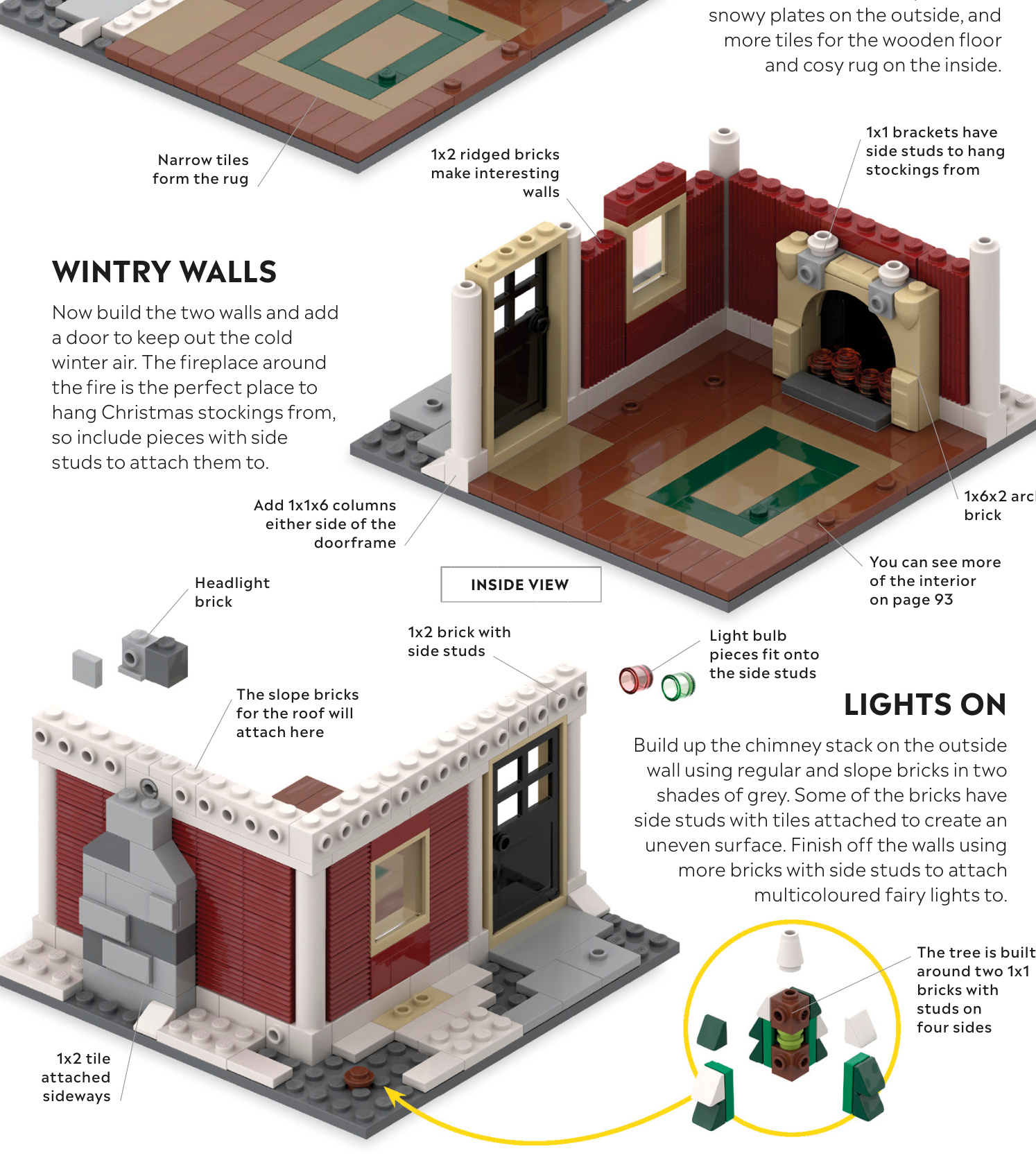
his cosy home is a welcome sight in the cold and dark days and nights of winter. Illuminated with colourful lights, a freshly built snowman, and frosted foliage, it’s beautifully decorated inside and out for the festive season.
Chimney stack promisesa warming fire inside
Whitepiecesinthe roof look like snow
Colourful fairy lights are light bulbpieces
田
Garden Christmas tree
1x1 round tiles create snowcovered plants
Have you seen the broom?
INSIDEANDOUT
The base of the festive house is one big plate. If you don’t have one,you could use smaller plates as most of the base plate isn’t visible. lt’s covered by tiles and
ROOFS
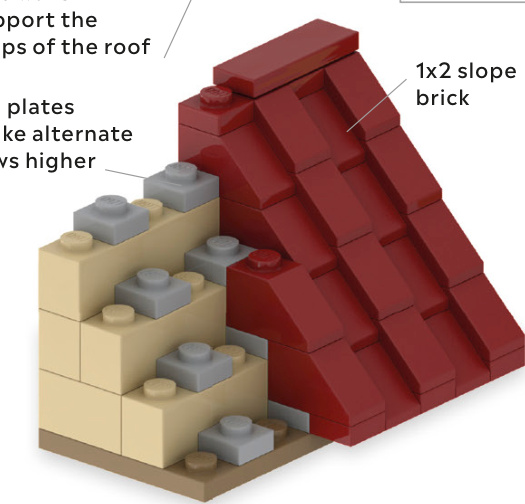
strong and sturdy roof is a must on any Iminifigure home because it provides warmth and protection from the elements. Roofs might all do the same job, but that doesn’t mean they have to look the same. Here are five very different roof techniques to inspire your LEGO house-building.
2x2x3 corner slope
Modified 4x4tile with studs on the edge
Brick-built side walls
BACK VIEW
MEDITERRANEANSTYLE
Homes in the warm climate of the Mediterranean often have roofs made from tiles of terracotta,which is a type of clay.This Mediterranean-inspired roof is constructed from steppedlayers of dark red slope bricks.
MANSARDROOF
This haunted house has a mansard roof, which means each of its three black roof sections has a flat top and sloping sides.Their exposed edges are made from slope bricks in different sizes with tiles, modified tiles, and plates on top.
I do like aflattopped roof style.
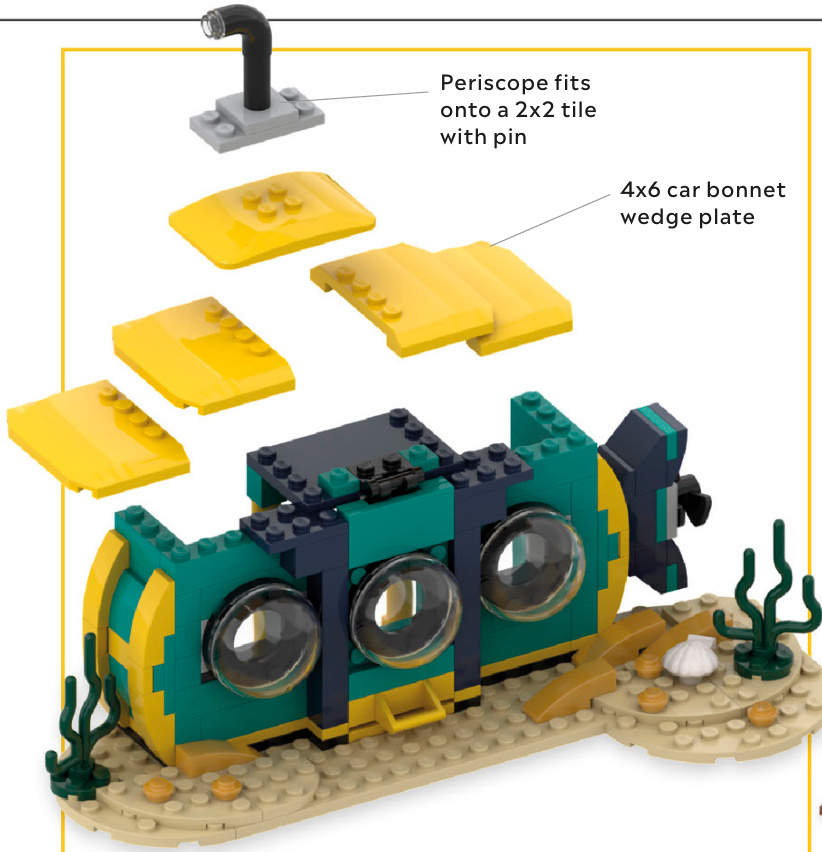
UNUSUALROOF
The underwater house’s roof is made almost entirely from car bonnet pieces! It’s fun to think outside the box and use pieces in unusual ways, especially on imaginative builds like this one. You can see more of this house on pages 68-69.
SLOPING ROOF
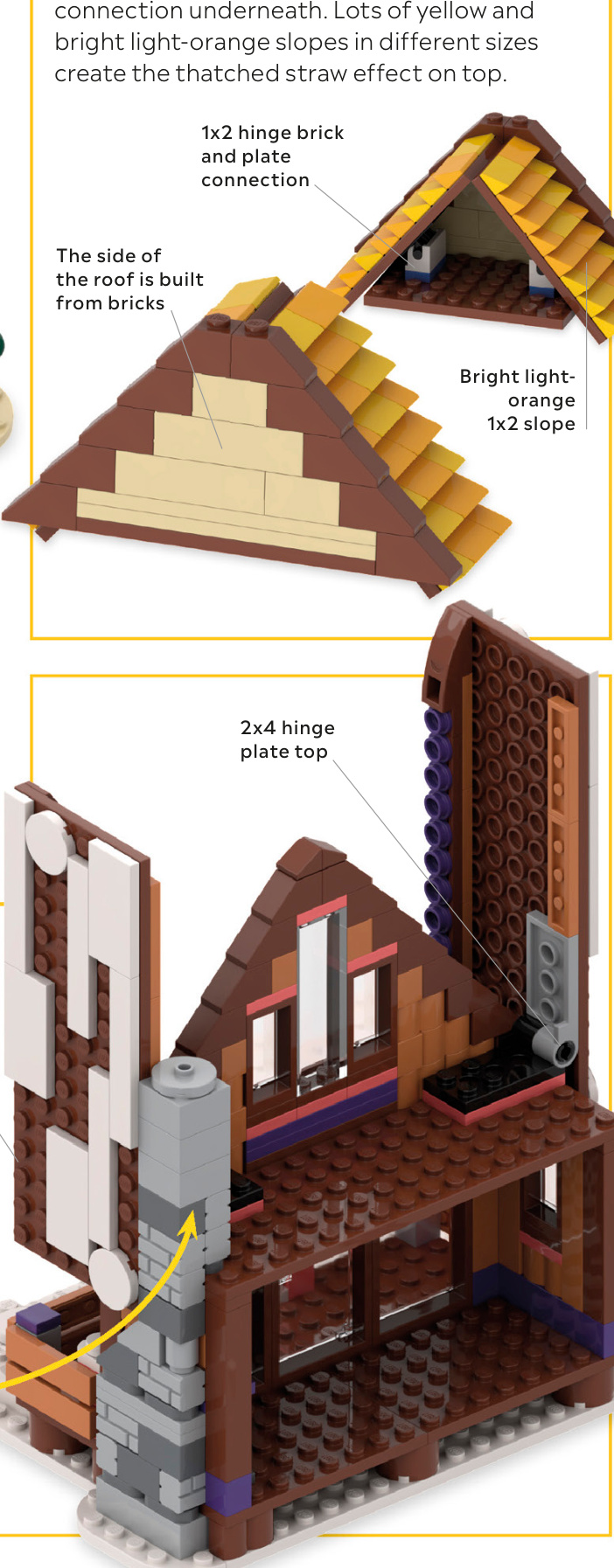
Like the rustic roof above,the winter chalet’s large, steeply sloping roof plates are angled from underneath using hinge connections.The plates rest on the triangular-shaped front wall of the first floor of the chalet.
2x4 hinge plate bottom
6x16plate
RUSTICROOF
This yellow straw roof is made from plates,which are held at an angle by a hinge
VIKINGLONGHOUSE
Miiftdses together in one big living space alongside their farm animals. This longhouse has a narrow wooden frame and a turf roof that keeps it warm in freezing temperatures.
Layersofolive and lime green platesform
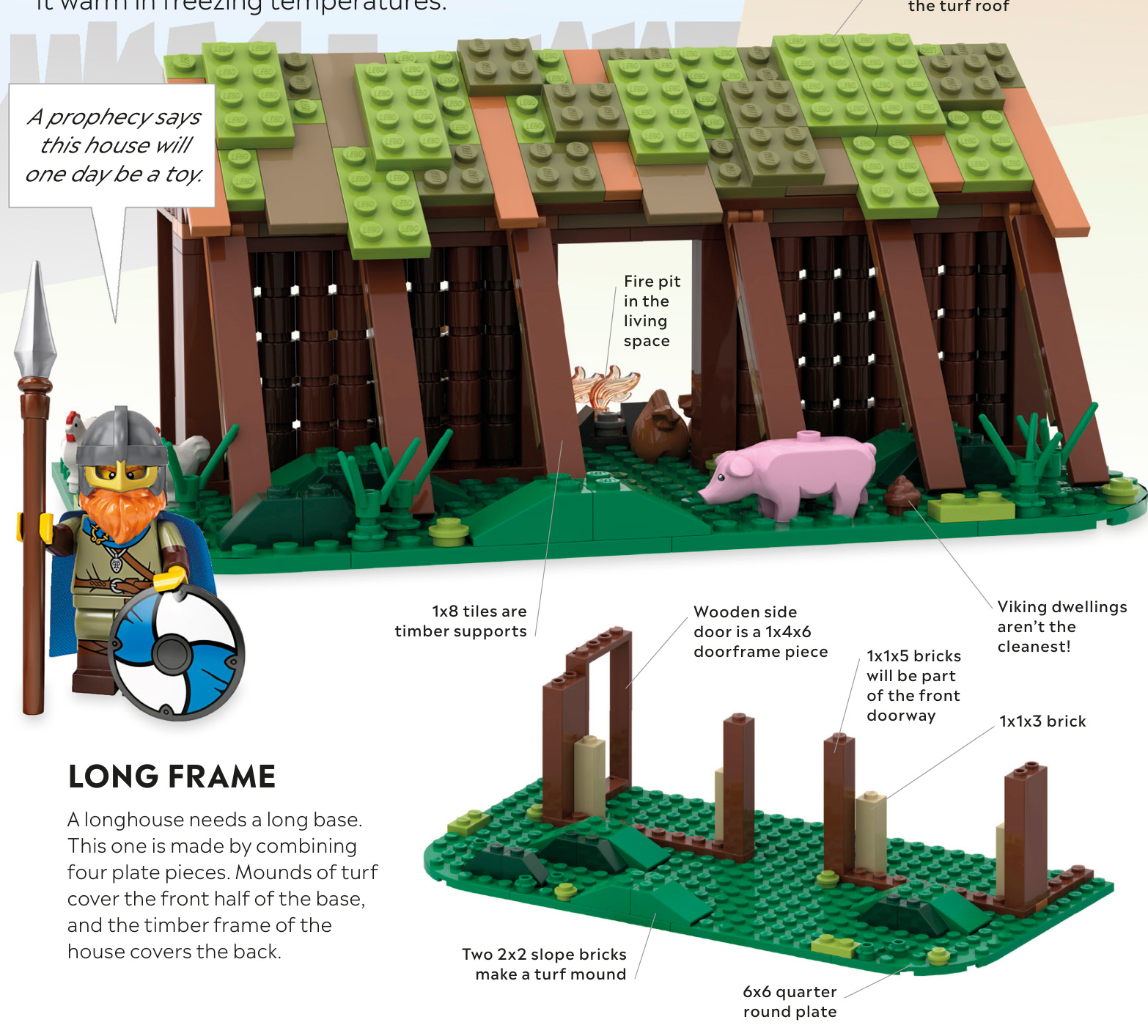
The roof rests on cheese slopes
The logs attachto narrowplates
LOTS OF LOGS
The log walls and inner roof supports of the longhouse are
now in place. Each log in the walls
is made from five 1x1 round bricks with open studs threaded onto a bar with stopper.
TURFROOF
The long turf roof is made from two separate plates. They each attach to two hinge brick bases at the top of the frame.The supporting beams at the front of the frame are also added at this stage.
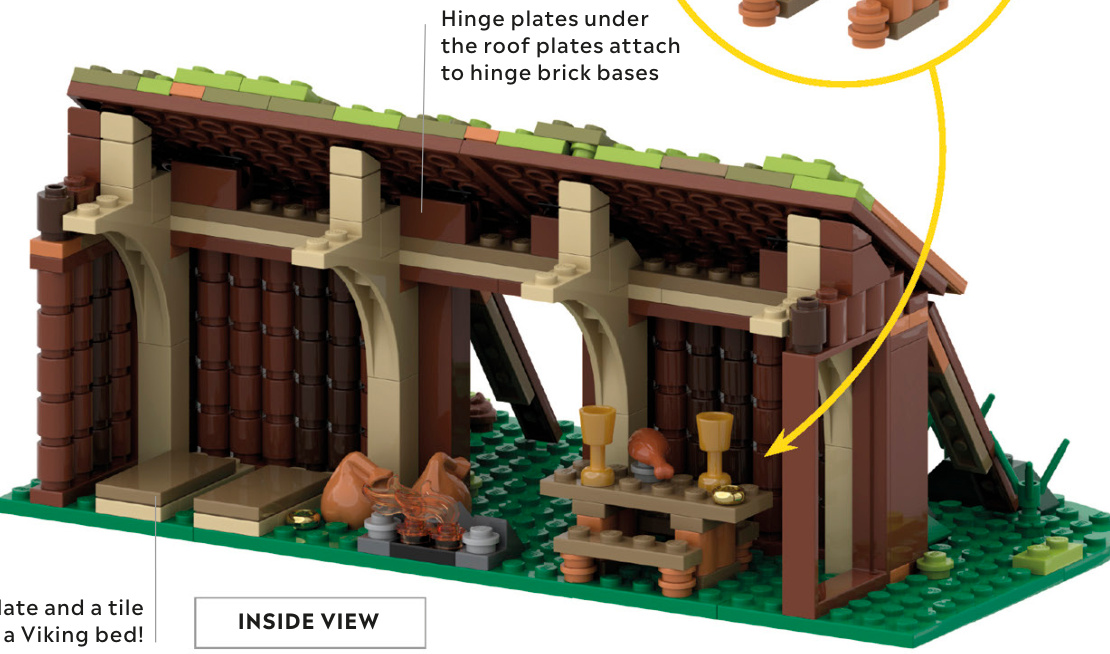
2x6 table top
FAMILYLIFE
Inside the completed longhouse,build some items that a Viking family might need,such as beds,a banquet table, and an open fire.
SKI CHALET
Wheee!
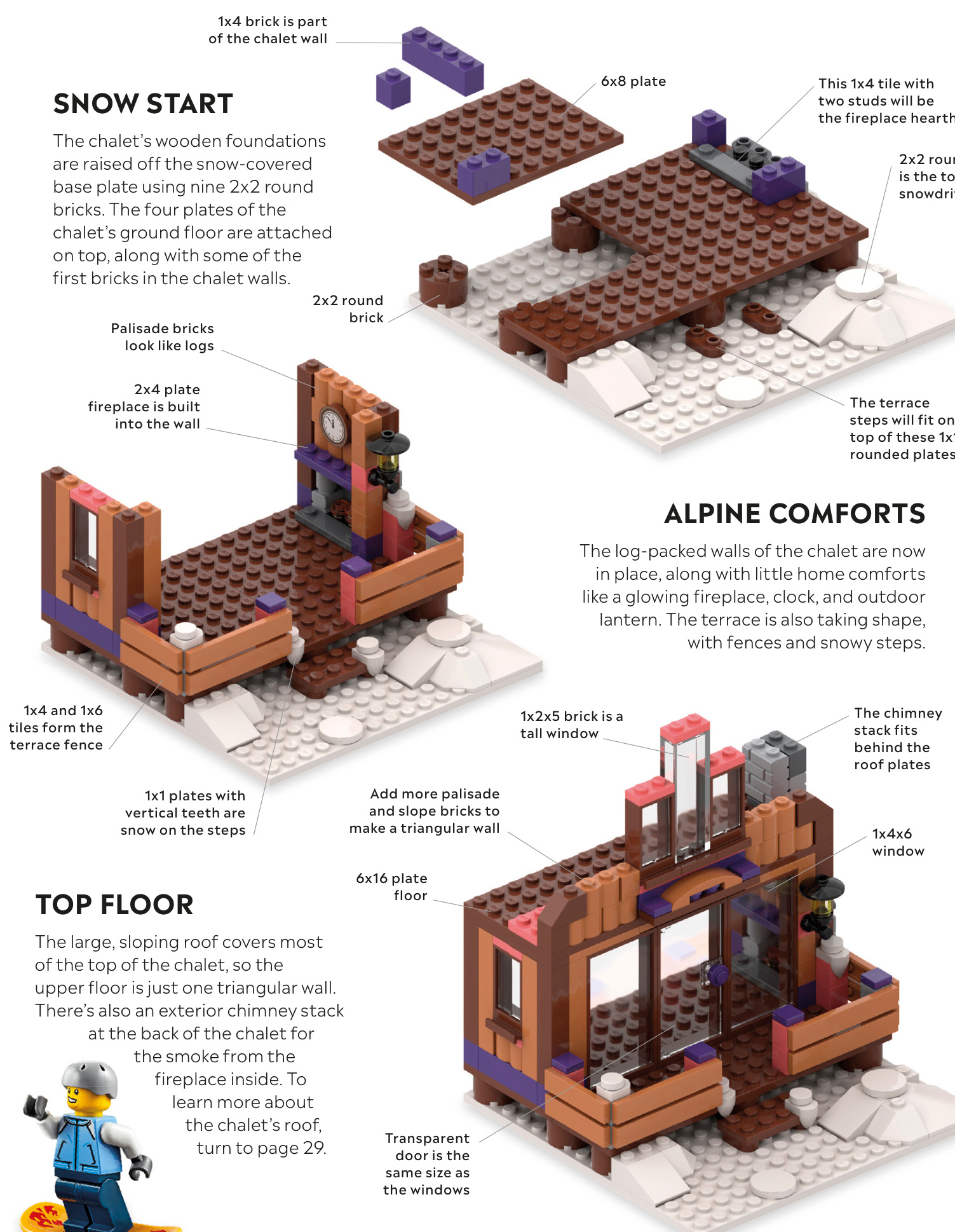
With along,sloping rofand overhanging eaves, this wooden ski chalet is built in the traditional style of mountain retreats in the Alpine regions of Europe. It’s a place where adventurous minifigures can enjoy warmth, comfort, and steaming hot chocolate after an exhilarating day out on the slopes.
White tiles are piles of snow
Floor-to-ceiling windows for taking in the views
I came here for the piste and quiet.
Build on white base plates for instant snow
BALCONIESAND TERRACES
dding a balcony or terrace to your ILEGO?house creates an extra
outdoor space for your minifigures
to enjoy. There are many ways to
build them and many more things
you could add to them, like seats,
doors, or potted plants and flowers.
Romeo,
Romeo… why are
you a frog,
Romeo?
1x3x2 inverted arch
MEDIEVALBALCONY
The balcony on the medieval inn ties in with the timber architecture of the main building It’s supported by four posts made from 1x1 round bricks.See how to build the medievalinn on pages 84-85.
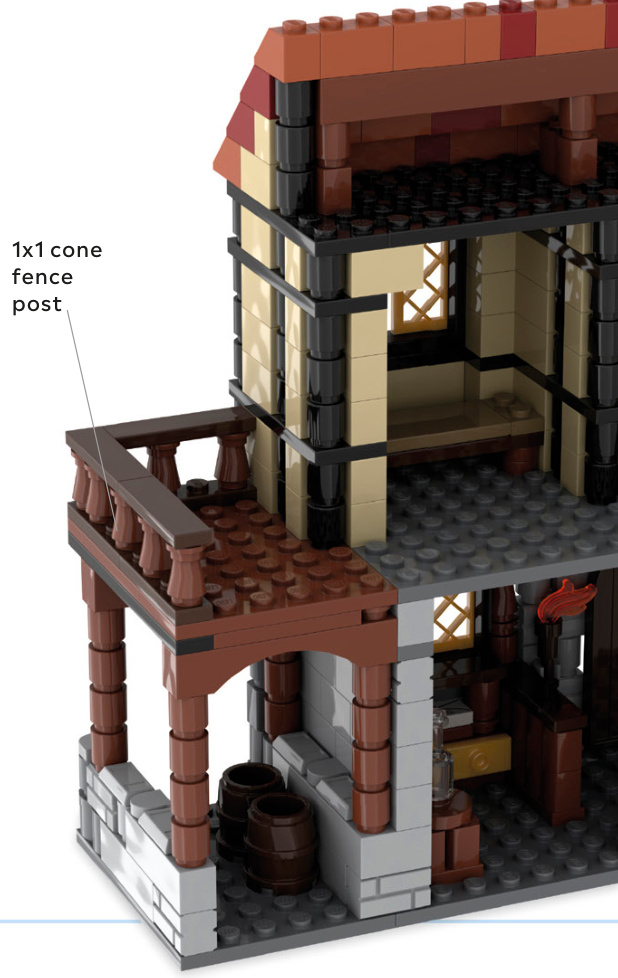
Telescope railings
CLASSICBALCONY
Without a balcony like this, one of William Shakespeare’s most famous scenes might never have happened! It is built on a plate that juts out from an upper floor, with supporting arches below.
TREEHOUSEBALCONY
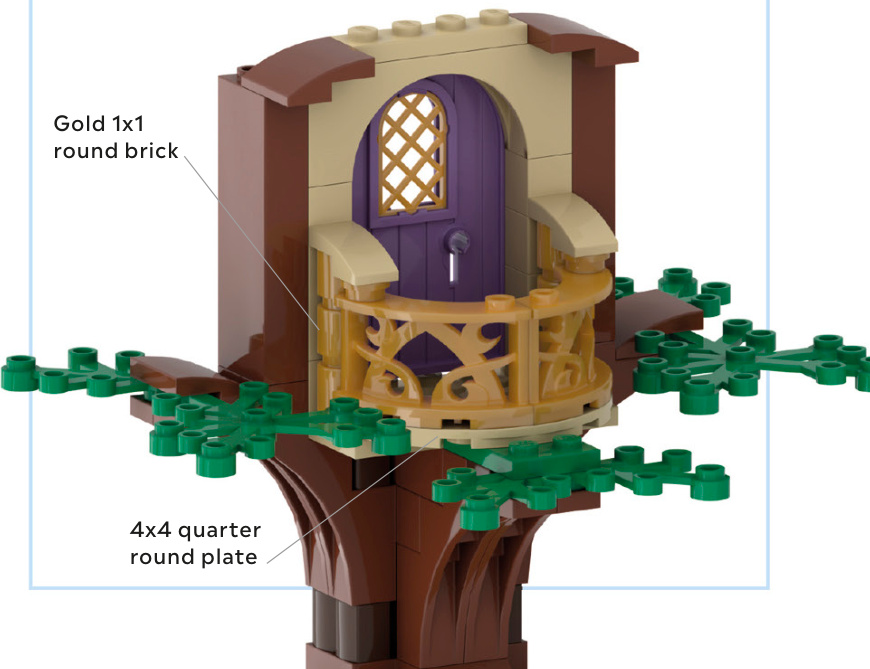
Could a forest fairy or elf live behind the door of this little round balcony,built into a tree? Its pretty pearl gold railings are made from two ornamental fence pieces.
MODERNTERRACE
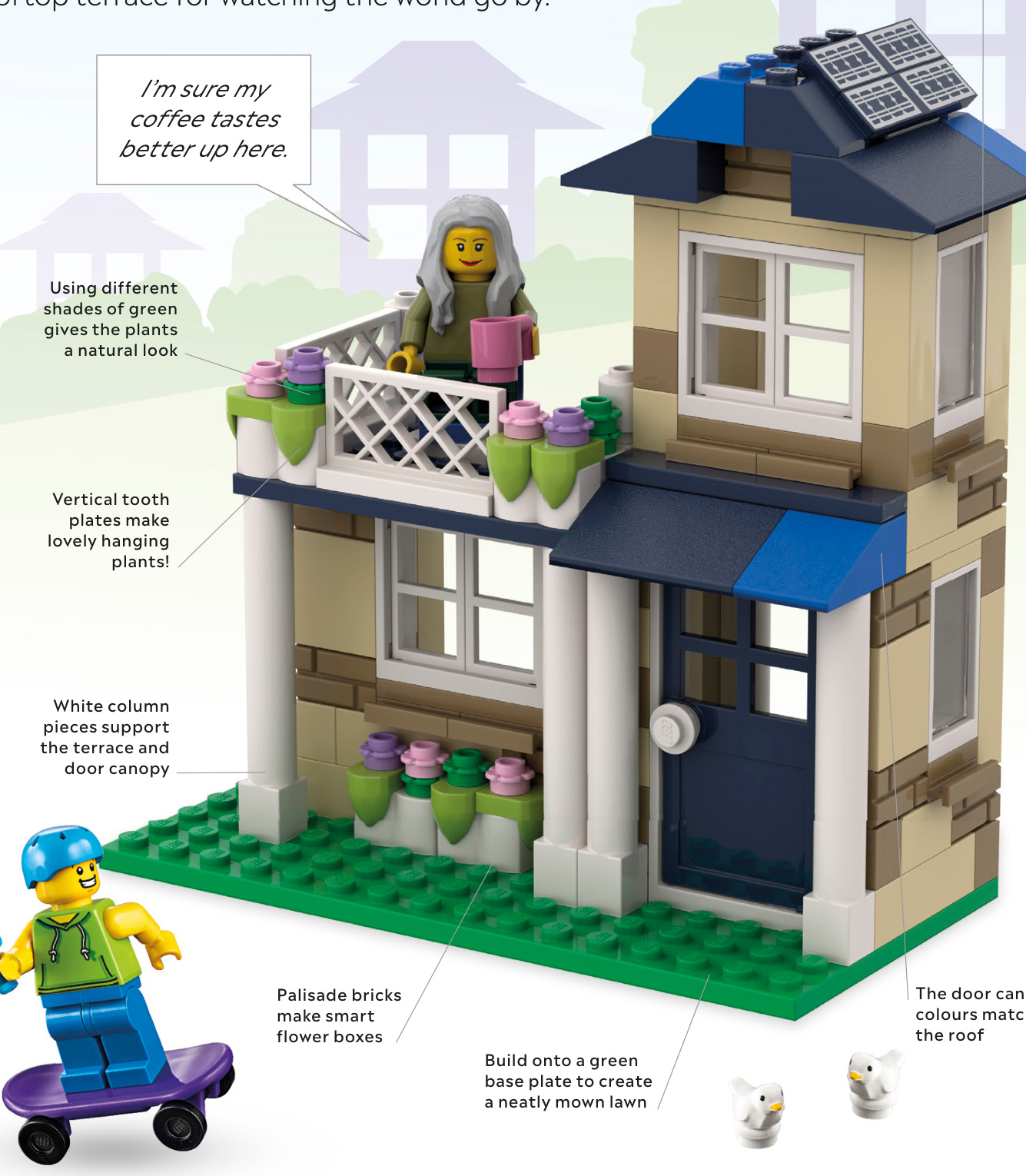
The large first-floor terrace on the modern house (see more of it on pages 36-37) is built on top of one plate,which covers more than half of the ground floor. It’s supported by pillar pieces at the front.
Its nice to relax on my terrace aftera hard day’s work.
ROOF TERRACE
6x8plate terracefloor
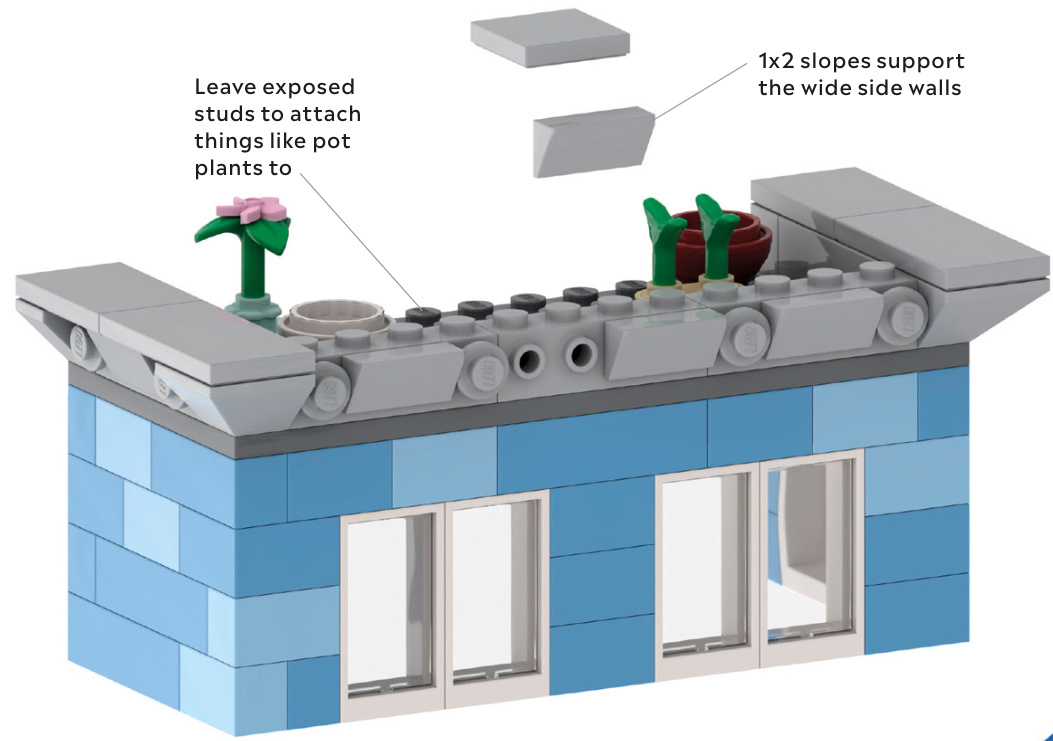
If you build a house with a flat roof, you could turn it into a roof terrace. This one has a roof garden.Remember to build small walls around the terrace so your minifigures won’t fall off!
If you don’t have any fence pieces, you could build walls using small bricks

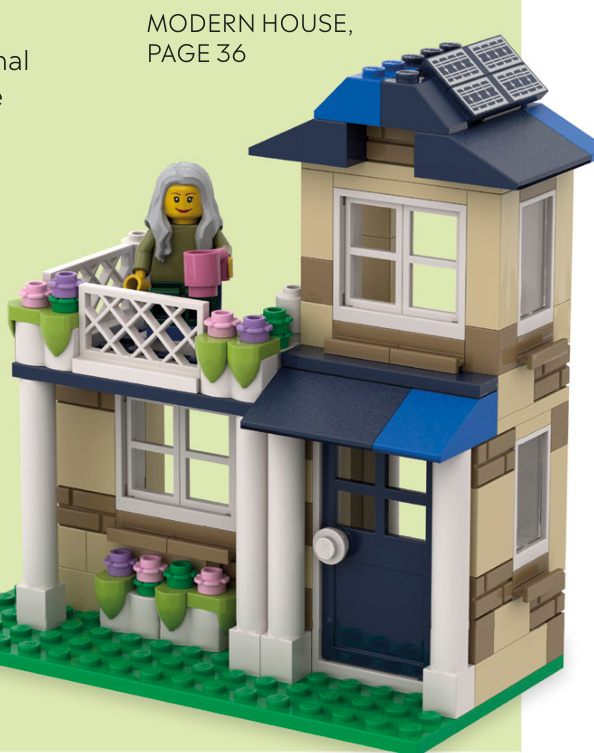
MODERNHOUSE
I t’s no wonder this homeowner looks I perfectly content in her two-storey modern home. It has solar panels that provide power and heat, sweet-scented flower boxes, and a rooftop terrace for watching the world go by.
TEXTUREDWALLS
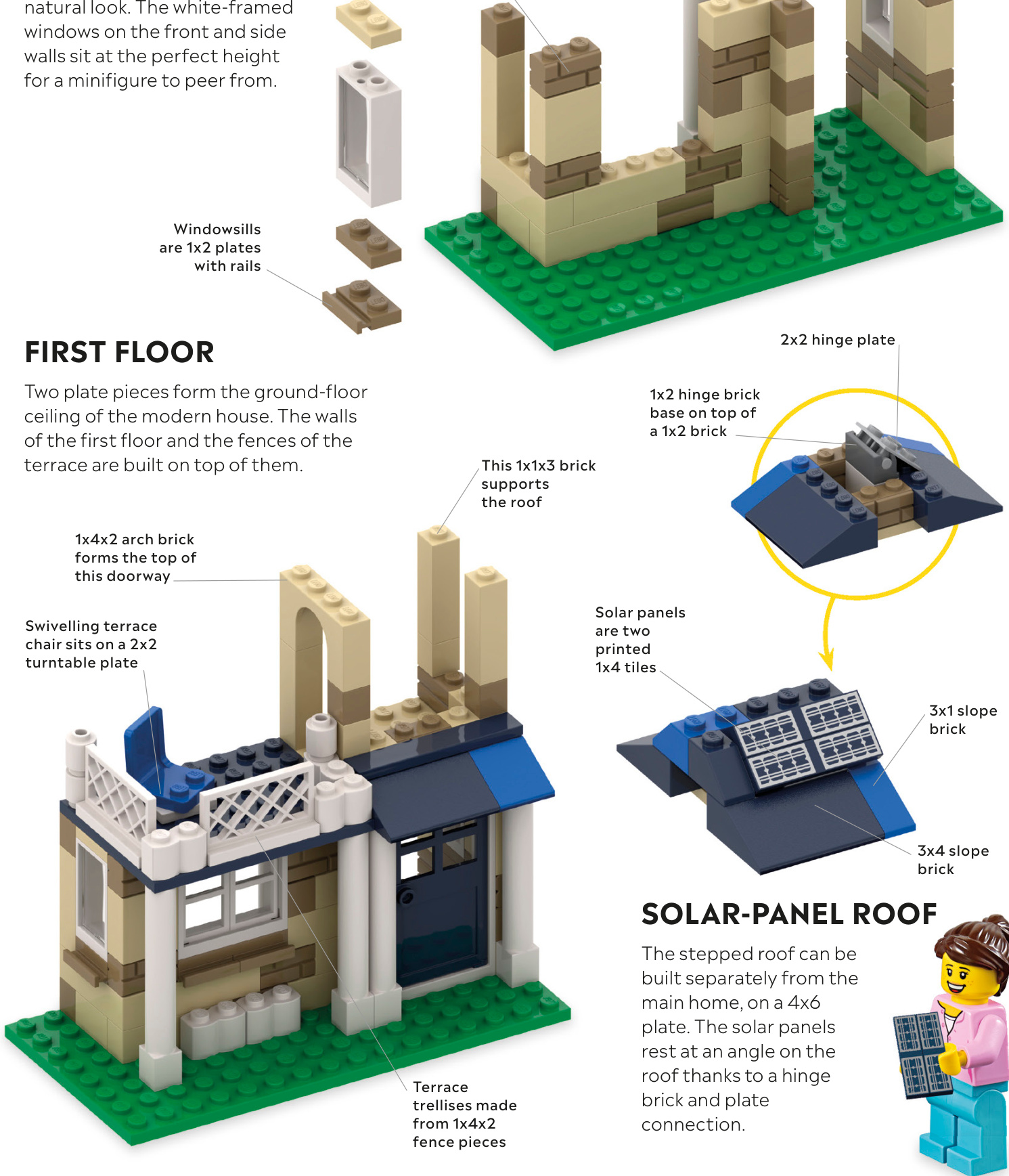
The modern house’s walls are made from bricks in different colours and textures to give it a
These 1x2 bricks have grooves to look like house bricks
These columns support the ground-floor ceiling
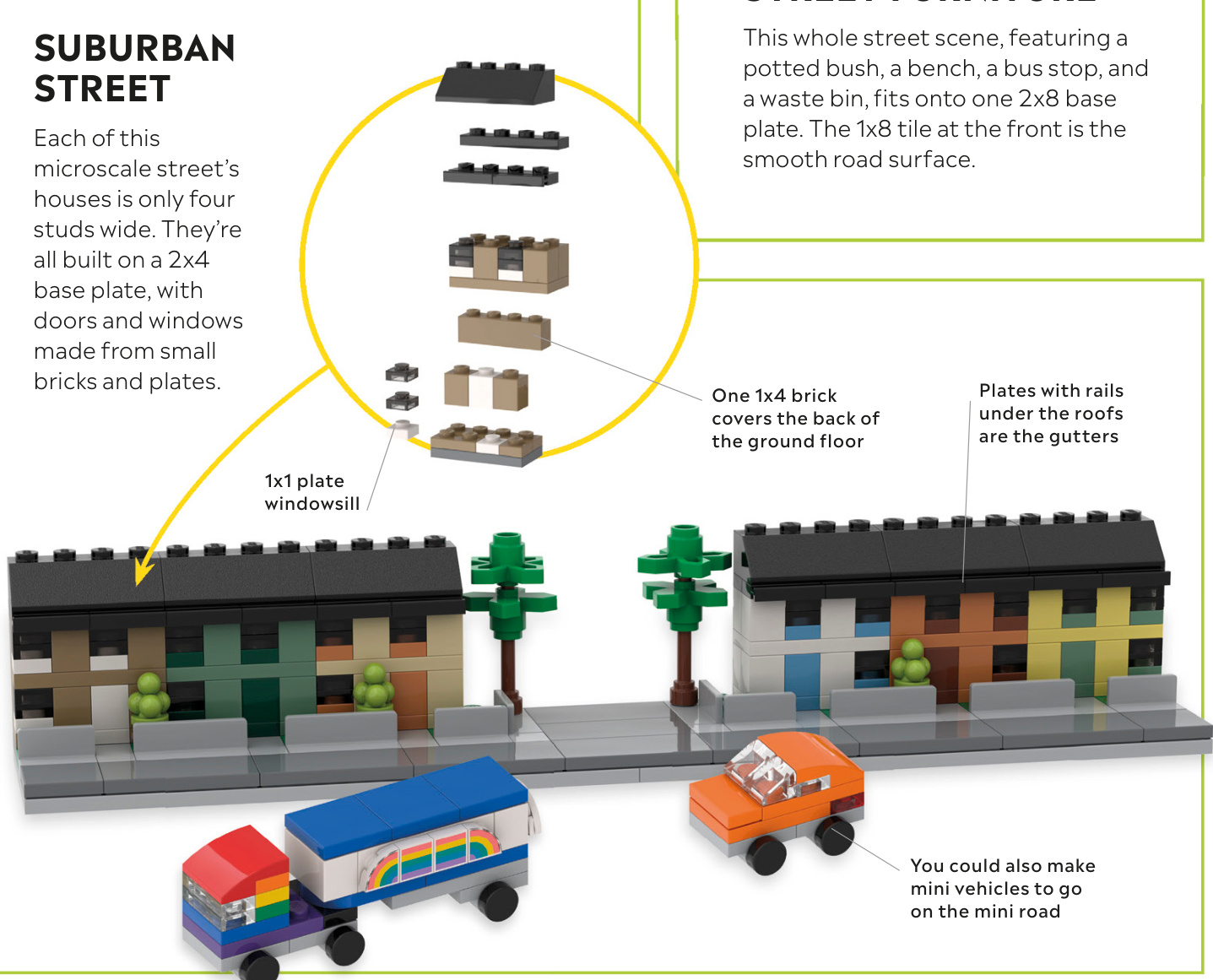
SUBURBAN STREET
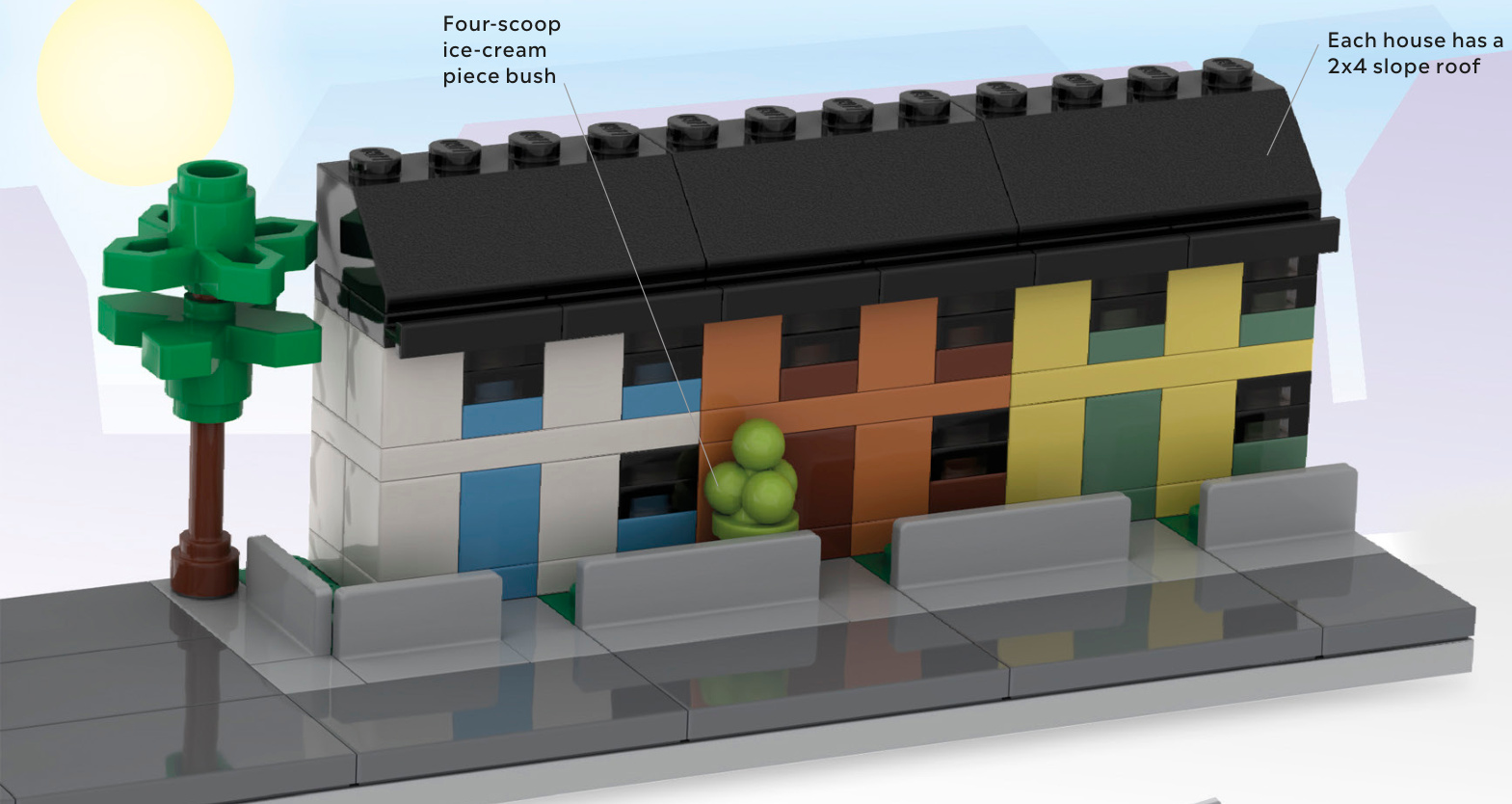
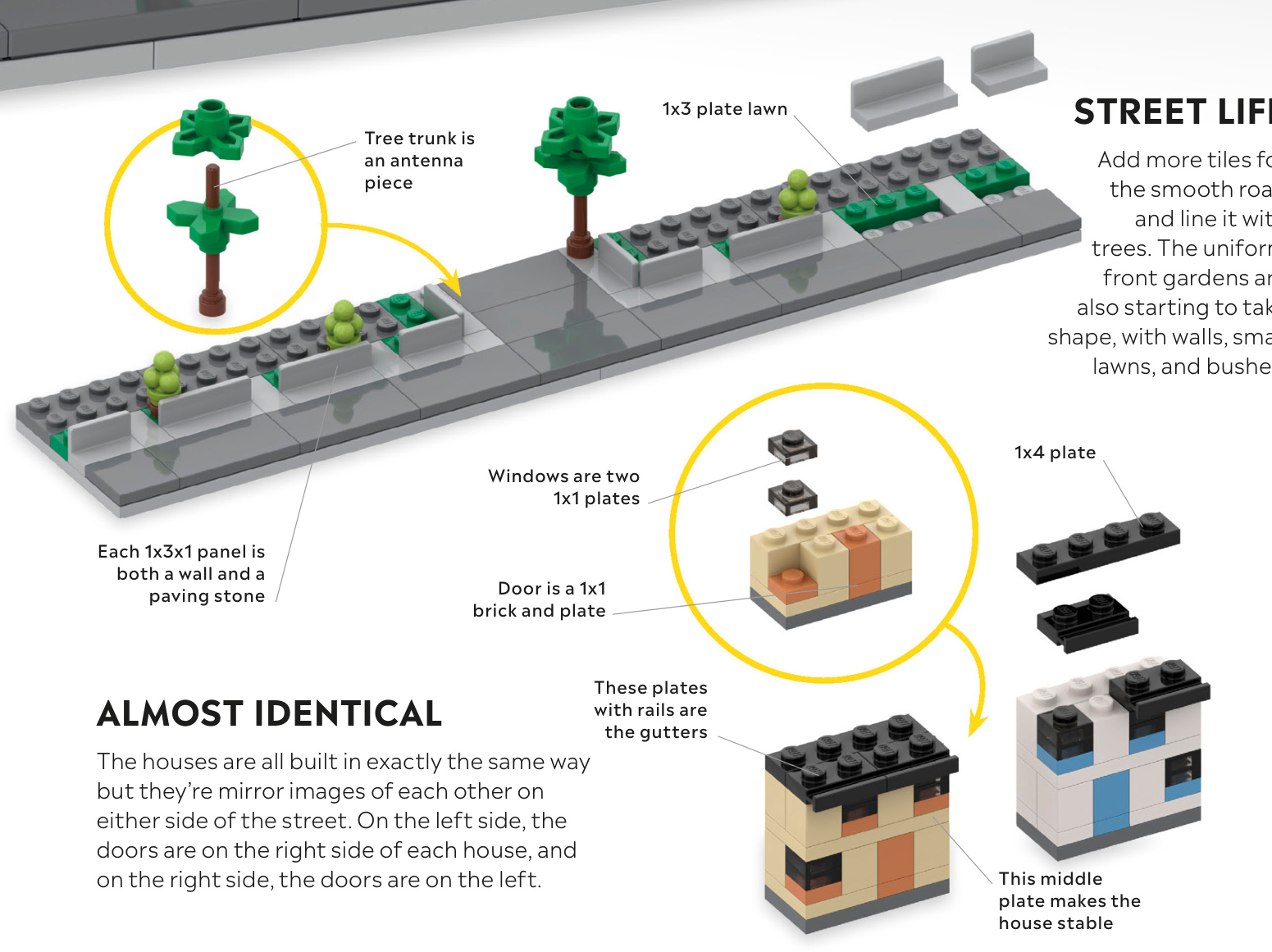
Treetops are 2x2flower piecesattached upside down
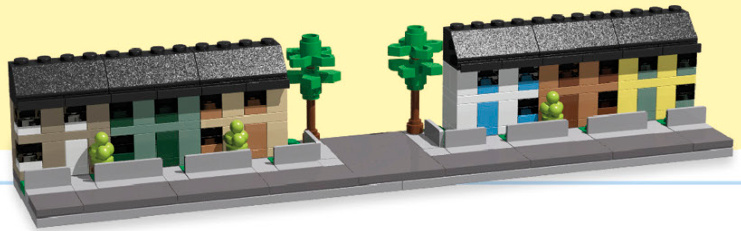
his neat microscale street has a row of six matching houses in complementary colours. At this size,ice-cream-scoop pieces become bushes and panel pieces are garden walls. Each of the four-stud-wide houses is built separately so they can be arranged in different ways. What would your street look like in microscale?
\The road is madefrom dark grey tiles
STREETLEVEL
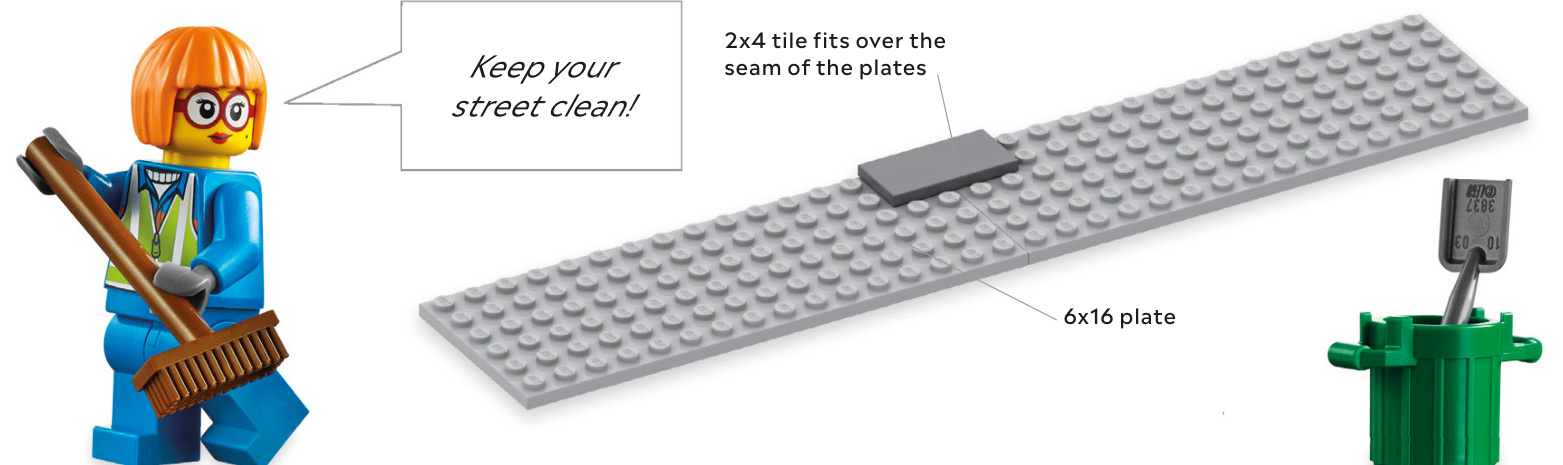
The base of the street is made from two long,narrow plates.They’re locked together in the middle with tile pieces that will become a crossroad on the final model.
TOWERS
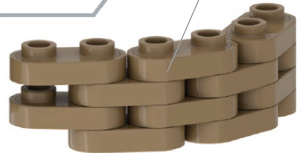
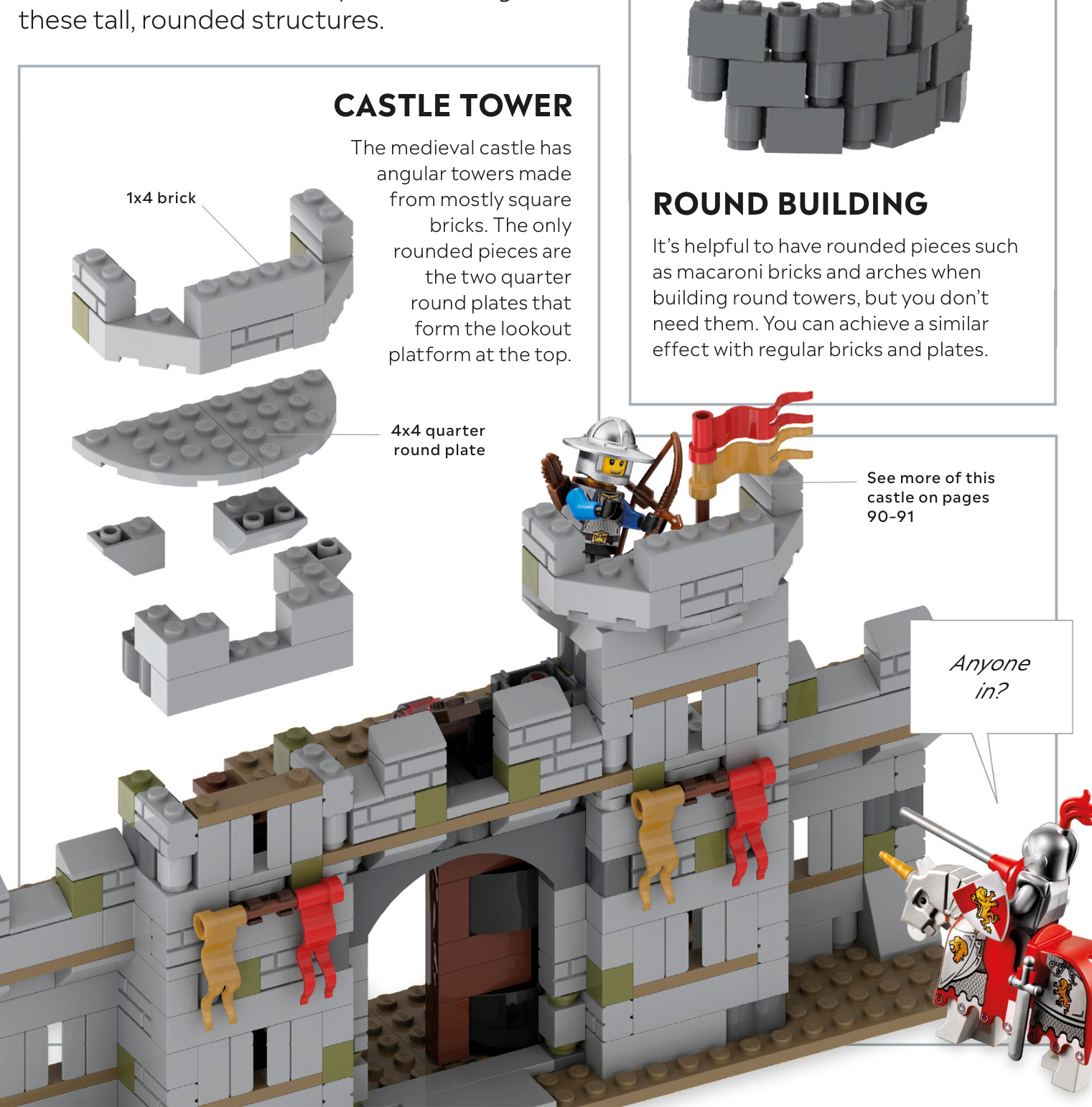
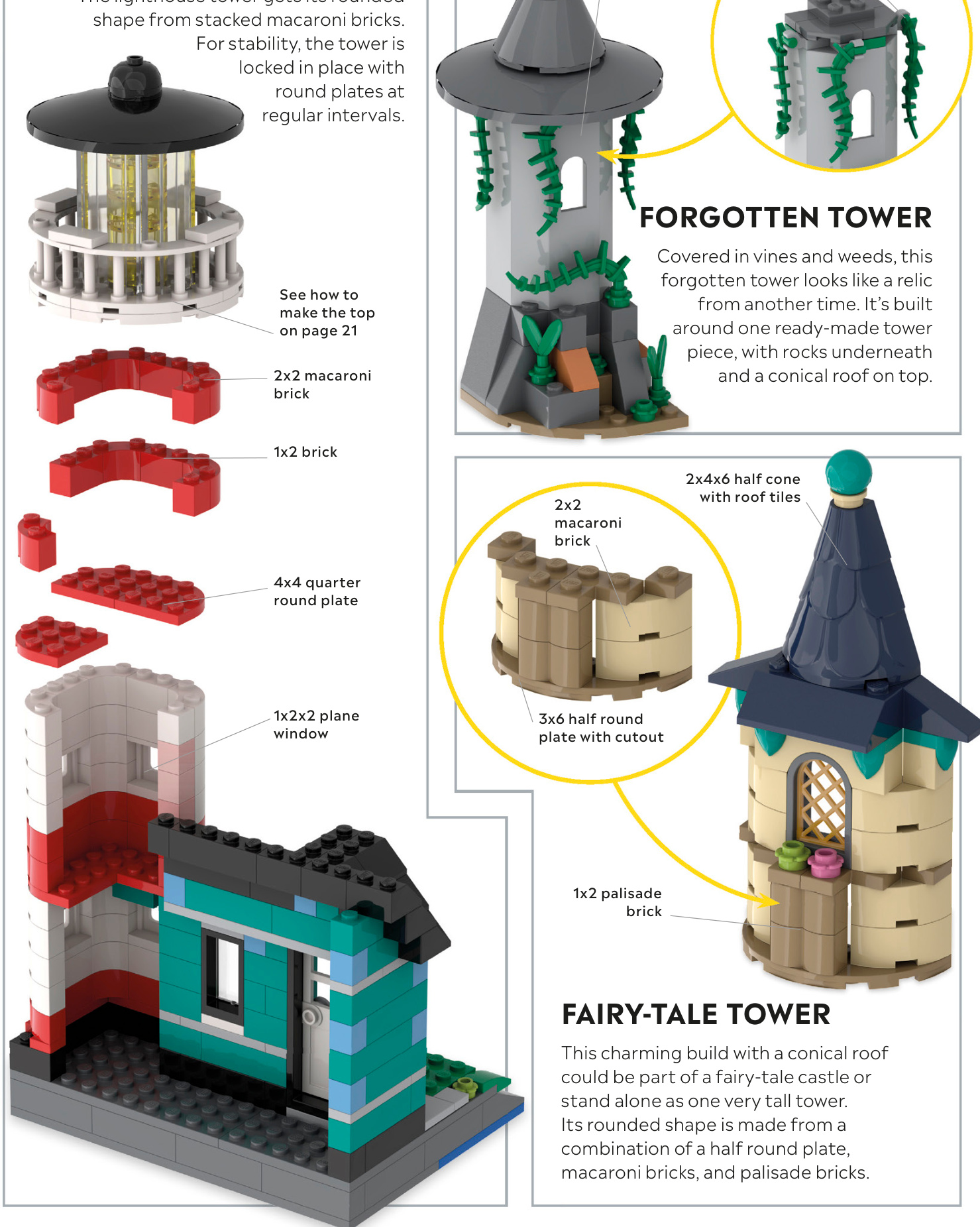
owers can be functional lookout points or grand-looking features that say“Look at me!”They can be connected to a main building, like a castle or a church, or stand alone, like a lighthouse or fairy-tale tower. Here are some ideas and tips for building
1x2 rounded plate
LIGHTHOUSE
3x4x6 turret wall piece
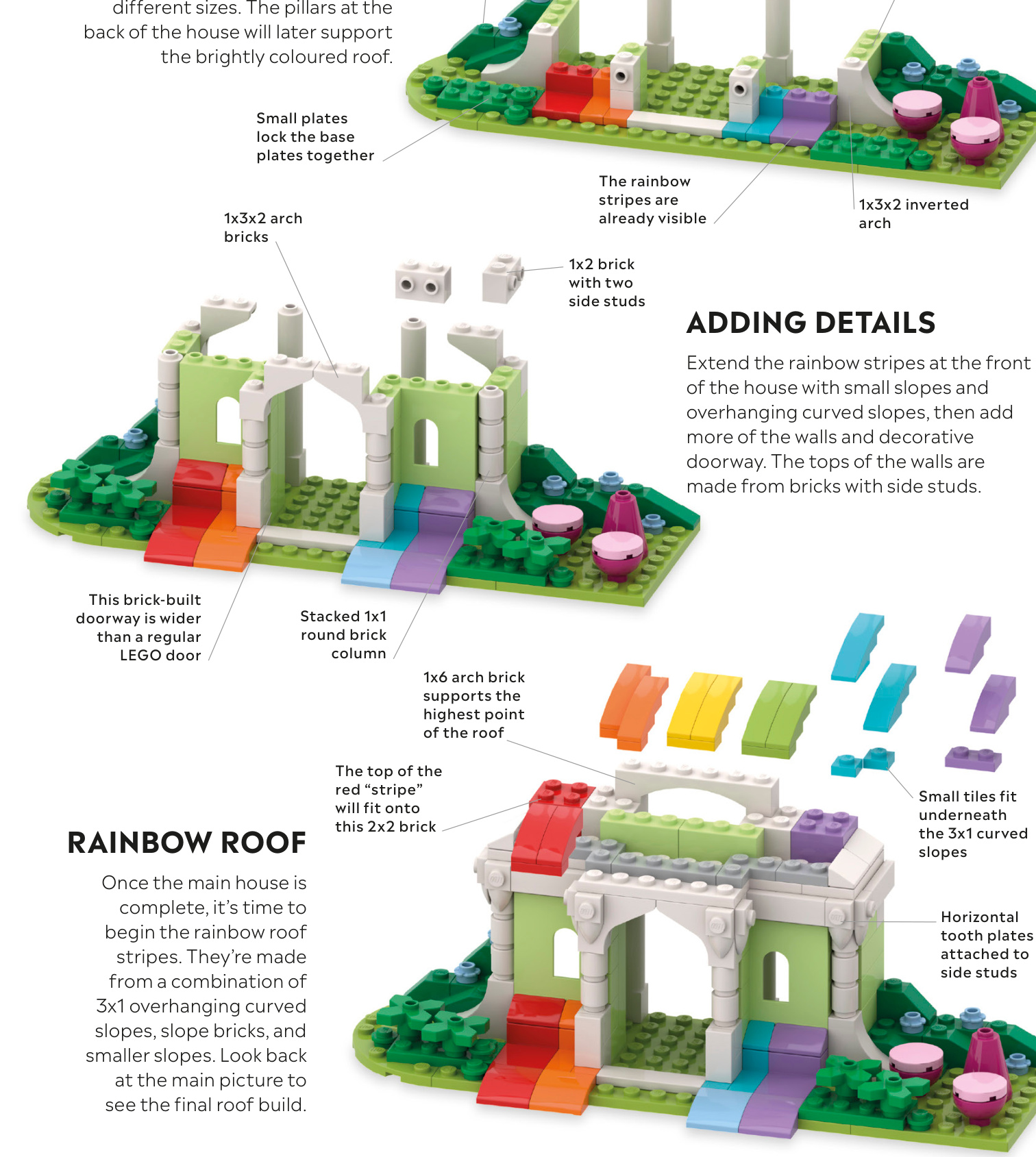
RAINBOW HOUSE
? /hen the sun is shining and it’s raining somewhere, a rainbow appears for a little while. It looks like one such circular arc of colour has left its mark on this house, turning its roof and front lawn red and yellow and purple and green..
Small slopes form the tapered tip of theroof
2x2 slopes form the secondlayer of theroof
Parasol shields minifigures from the
bright colours
2x2curvedslopes continuethe rainbow’s arc
I feel instantly at home here.
This part of the Find out front wall is one more about wall panel this seating area on page 77
COLOURFULSTART
The wide walls and garden areas of the rainbow house are built on top of three green base plates in
TOWNHOUSE
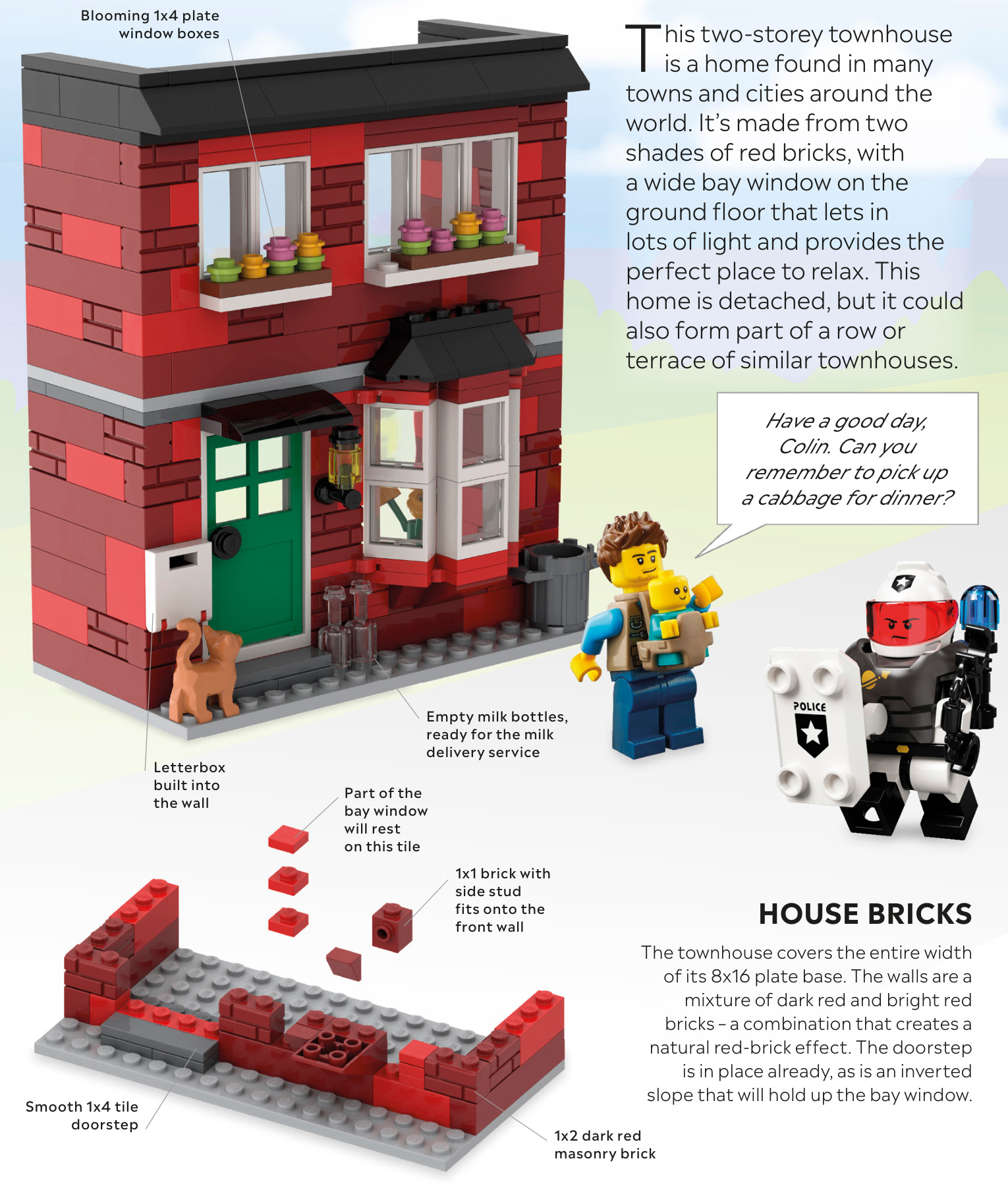
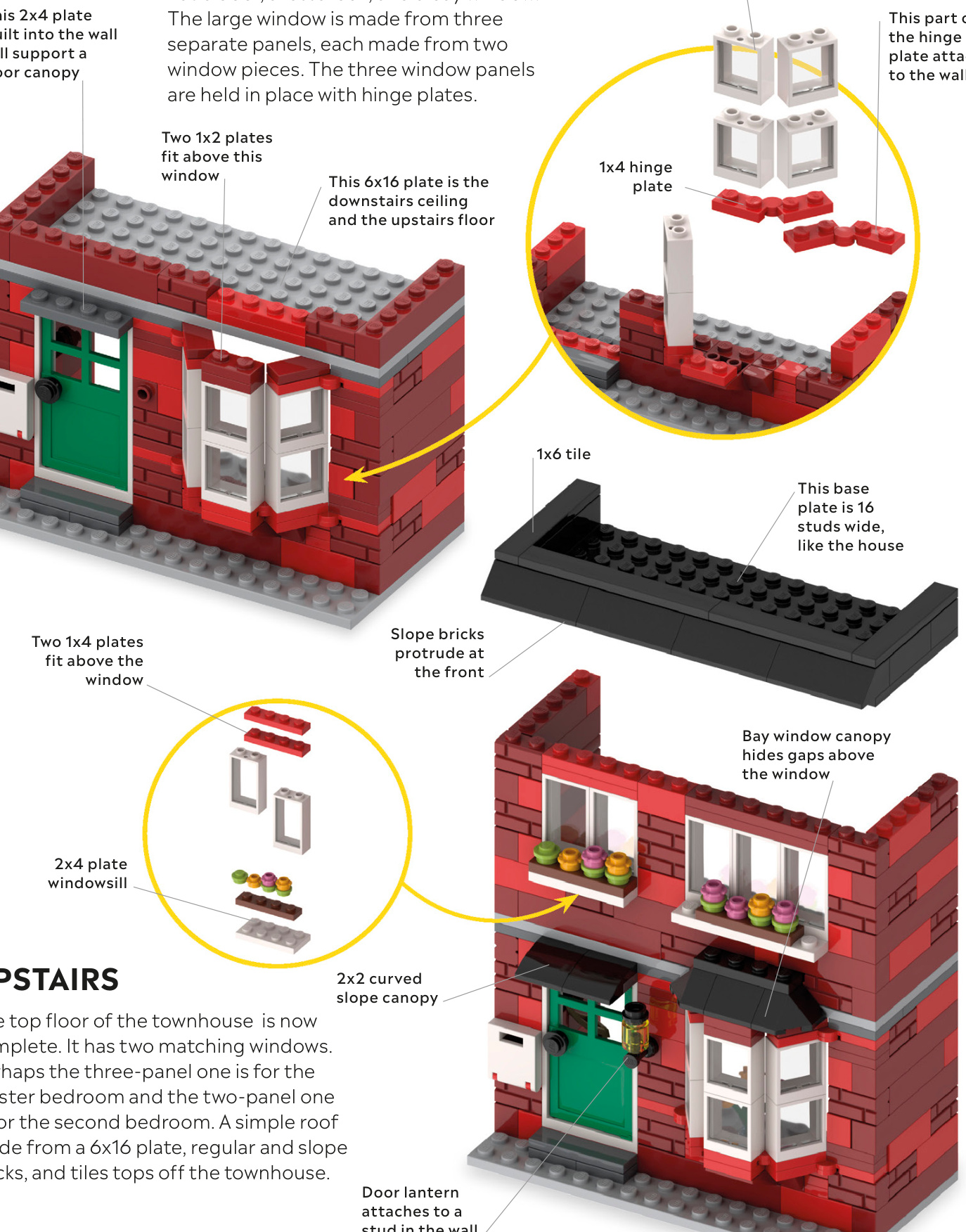
DOWNSTAIRS
The ground floor of the townhouse now has a door, aletterbox, and a bay window.
EXTENSIONS AND EXTRAS
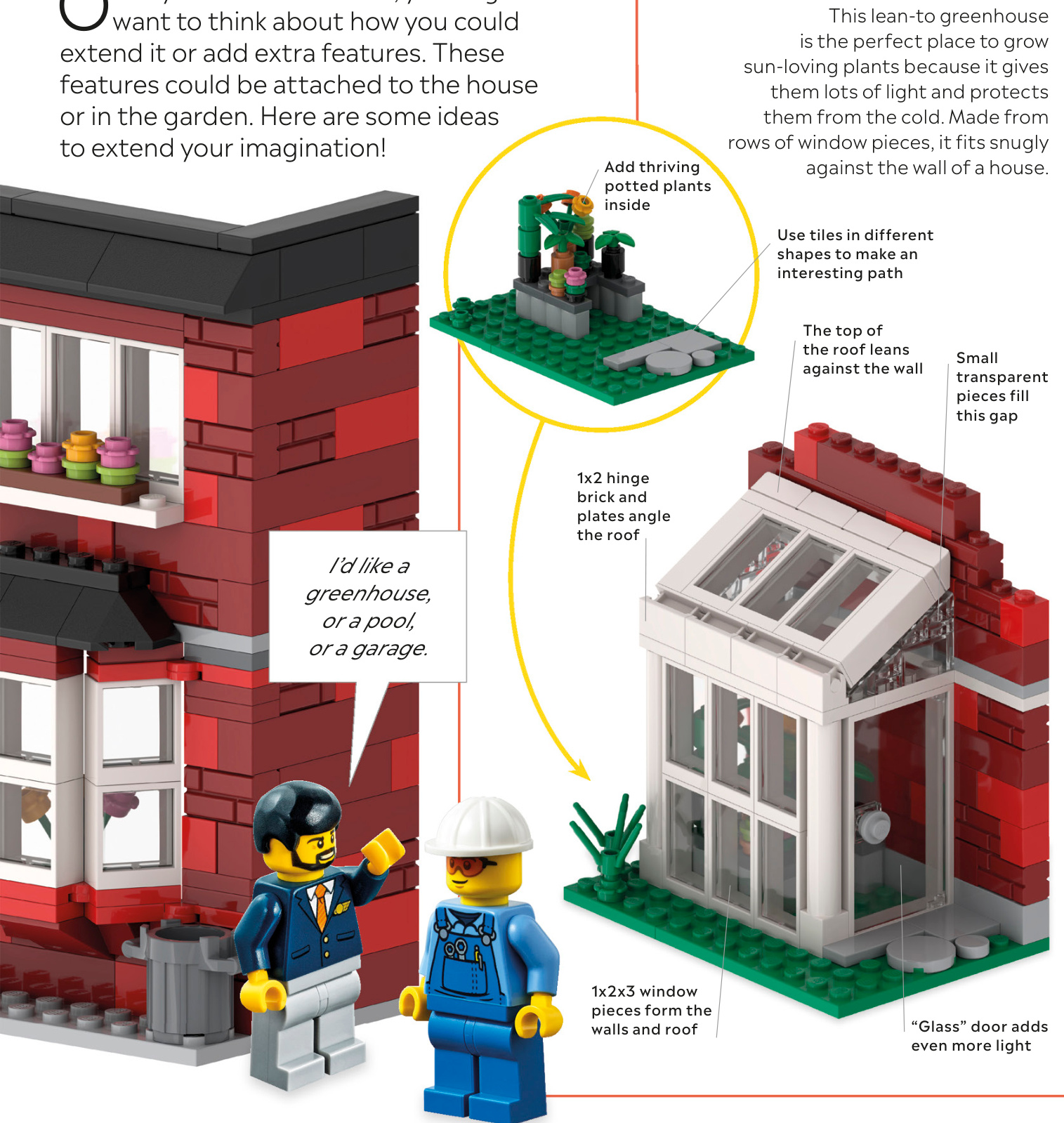
GREENHOUSE
PATIO
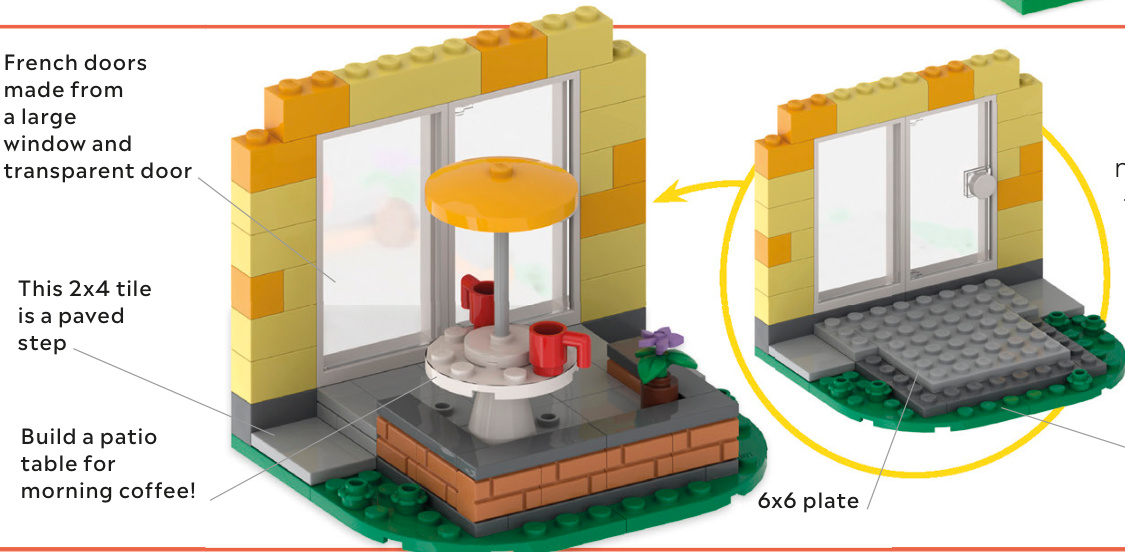
Perhaps your
minifigures would like
to relax on a patio on a sunny day!Add square tiles onto a baselayer ofplates to create a paved area in the garden.
Two 6x6 curved round plates form the lawn
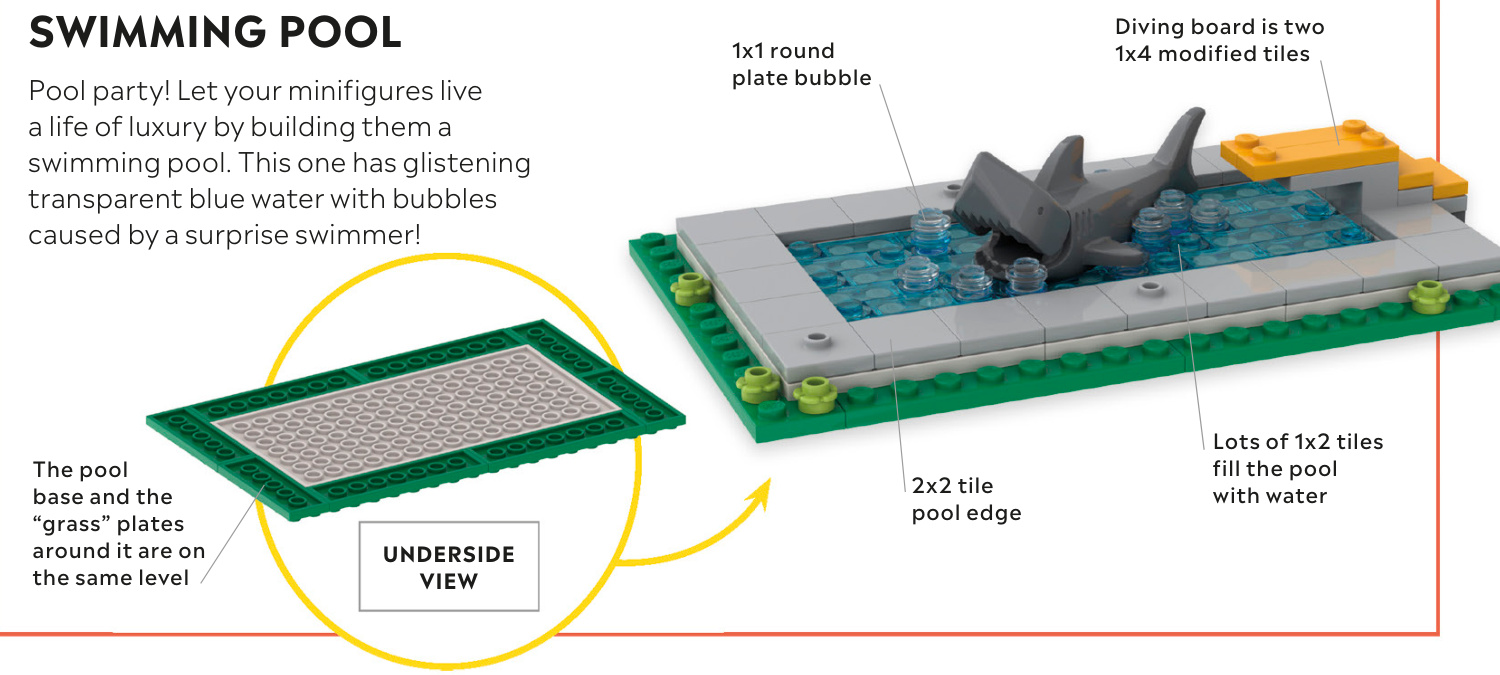
GINGERBREAD HOUSE
Vertical tooth plates make icingicicles
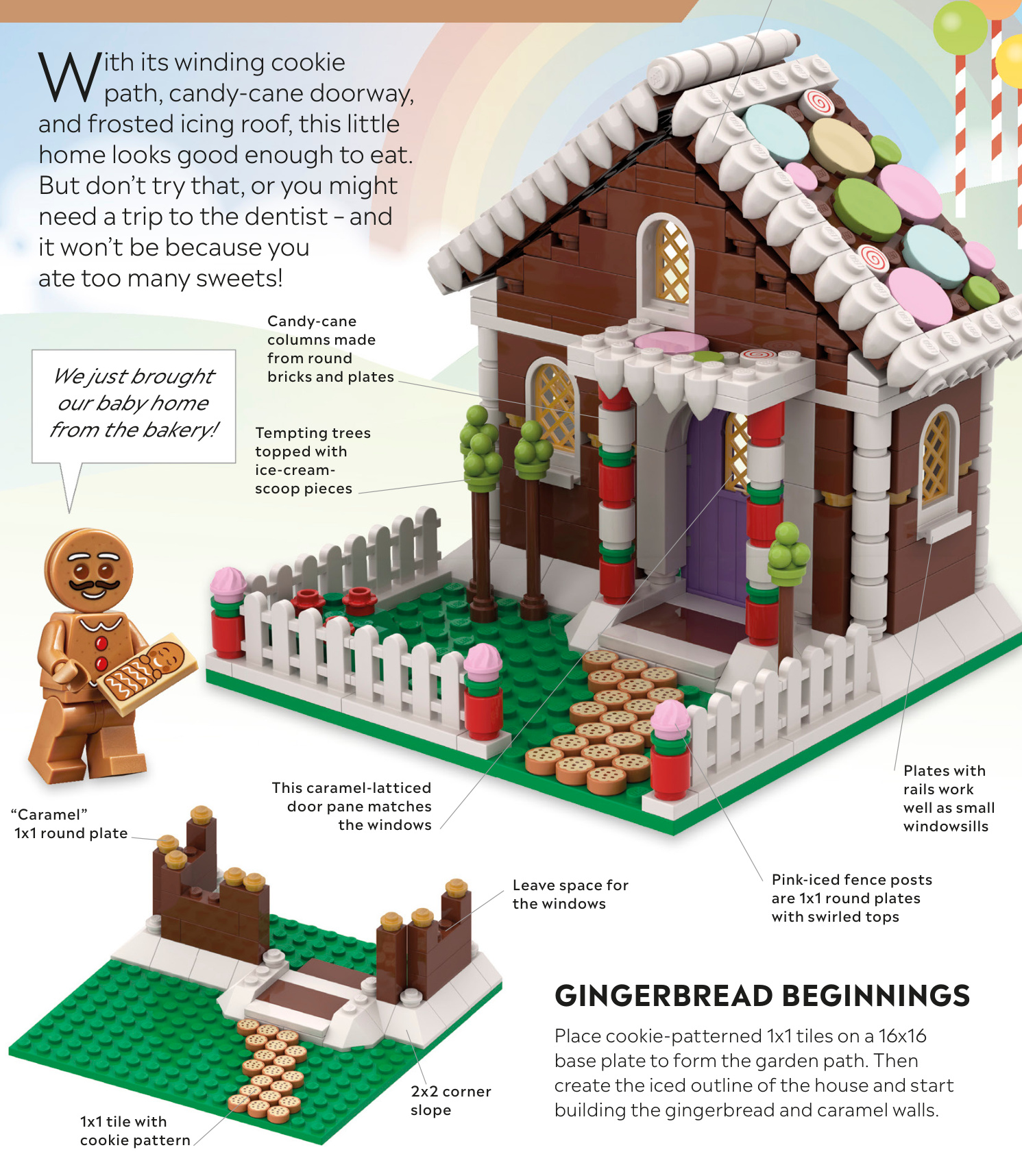
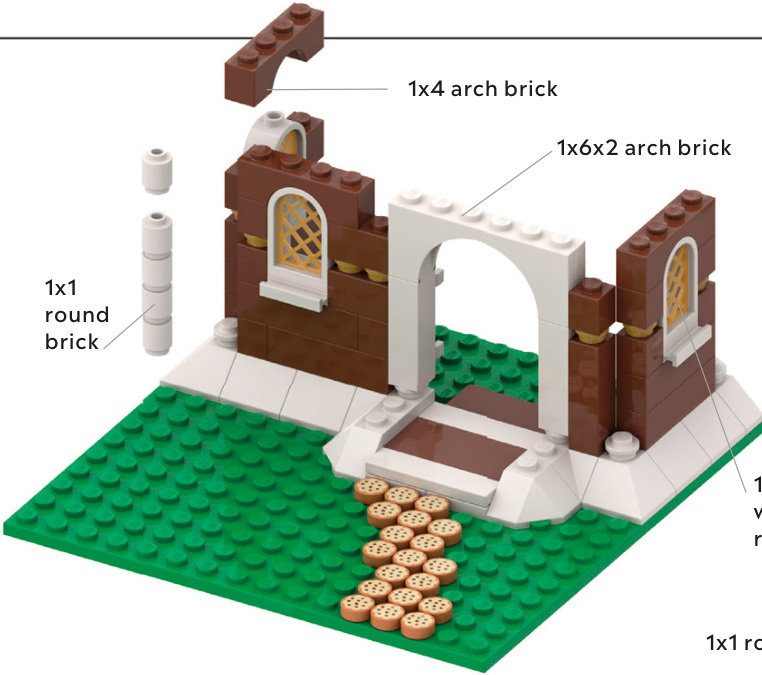
SWEETDETAILS
The walls of a real gingerbread house would be joined at the corners with icing.Create that look by adding white corner columns made from stacked 1x1 round bricks.Then add the doorframe arches and windows.
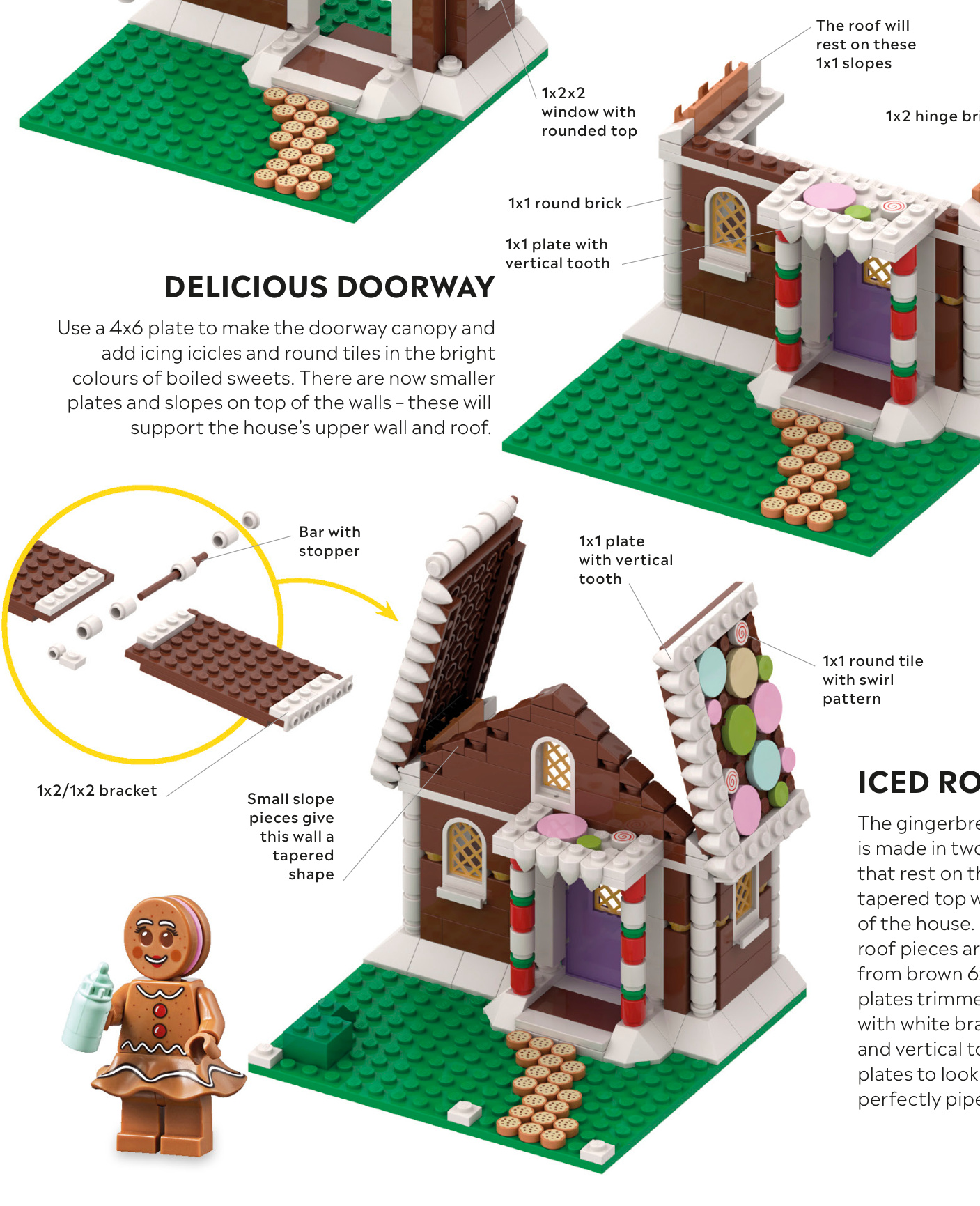
MODULAR APARTMENTS
I thinkI’llbuild my apartment right on top.
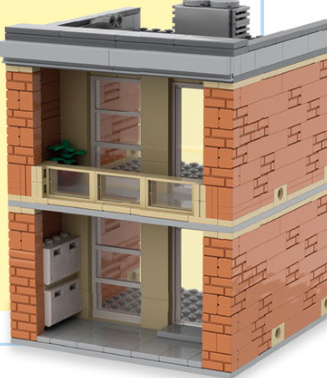
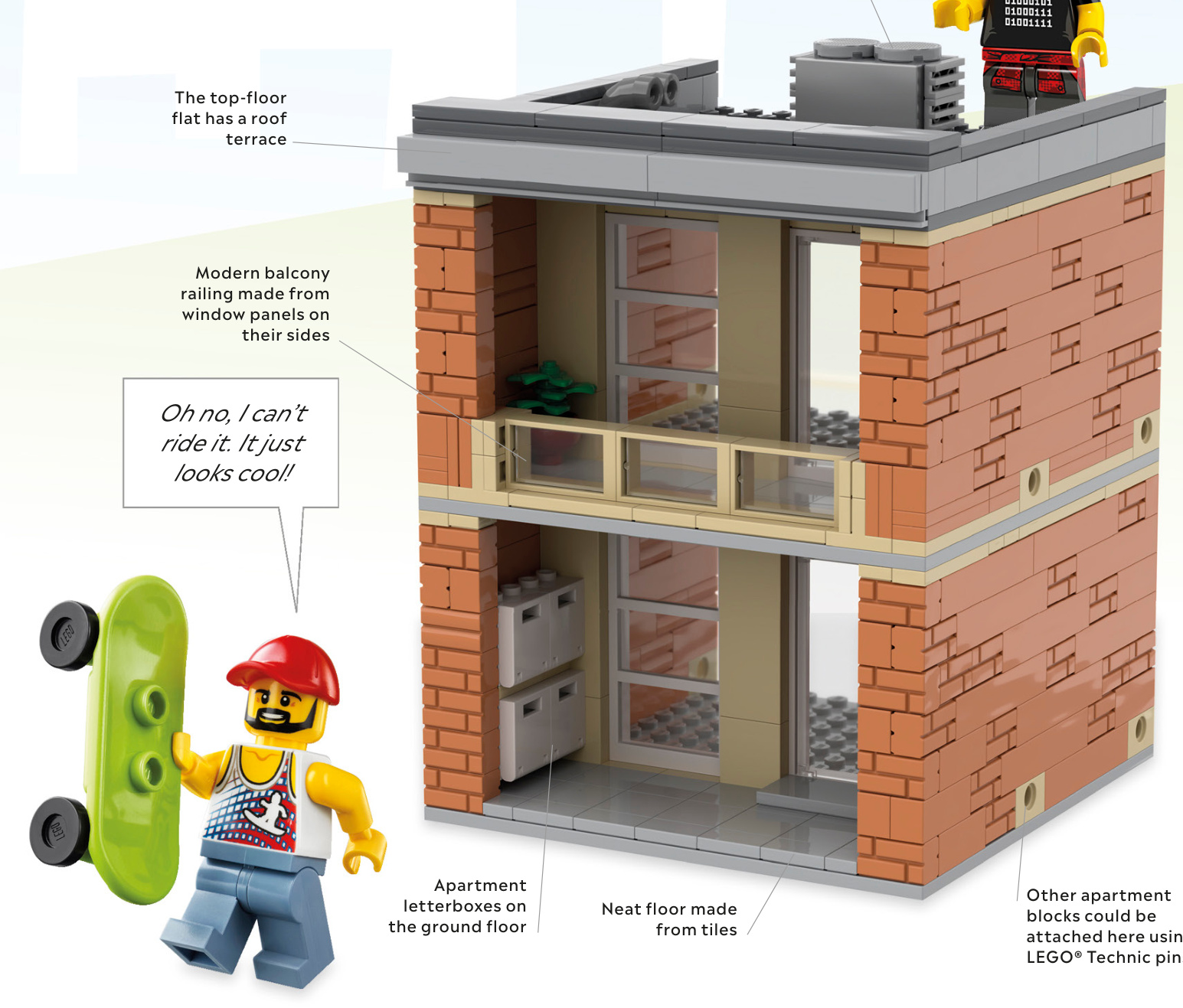
I n bustling towns and cities, many people live Iin apartment blocks like this one. The two separate, open-plan flats in this block are stacked on top of each other, but they can also be joined at the side - this makes them modular builds.You could build even more flats to make a tower block!
Details like this air-conditioning unit bring the building to life、
BOTTOMUP
Each modular apartment is built on a square plate, with walls made from a mixture of plain and textured masonry bricks. The ground-floor apartment has a tiled front entrance with letterboxes built into the wall.
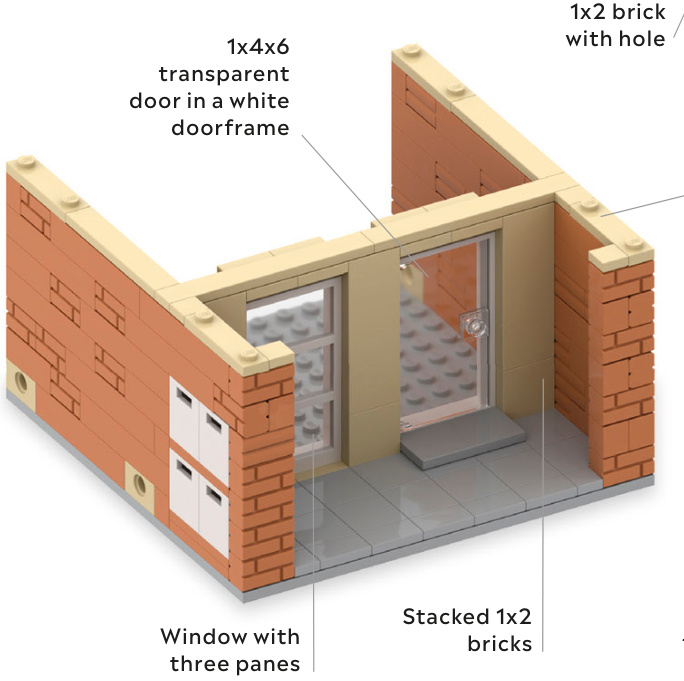
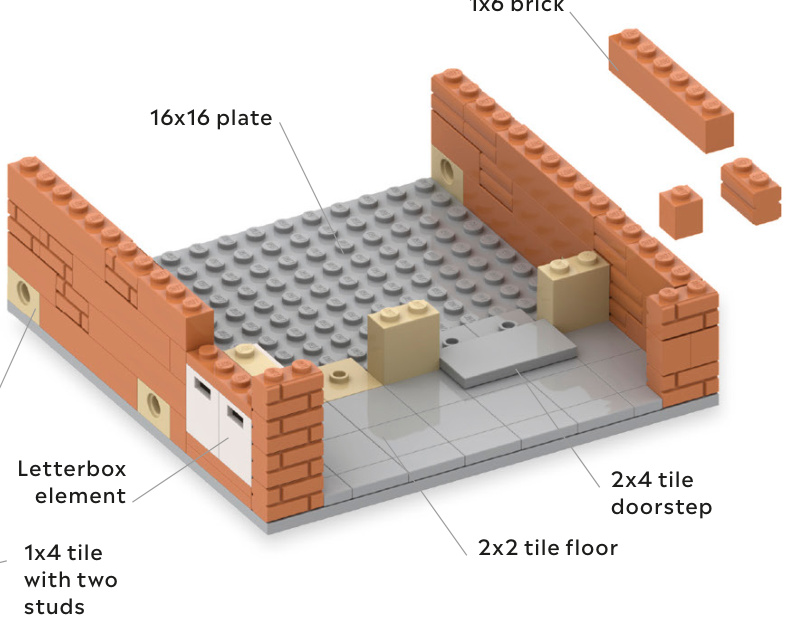
GROUNDFLOOR
Add a modern door andwindow and finish off the walls. The tops of the walls are lined with mostly smooth tiles, so any floors that are added above the apartment can easily be lifted off.
ROOF
This square roof could be added to any number of modular apartments. Like the apartments,it’s built on a base plate.Add low walls around its sides to make it a roof terrace,and add practical details like pipes and air-conditioning units.
UPPERFLOOR
The second floor of the modular apartment block is built in the same way as the ground-floor apartment, except it has a balcony with railings, and a pot plant in place of letterboxes.
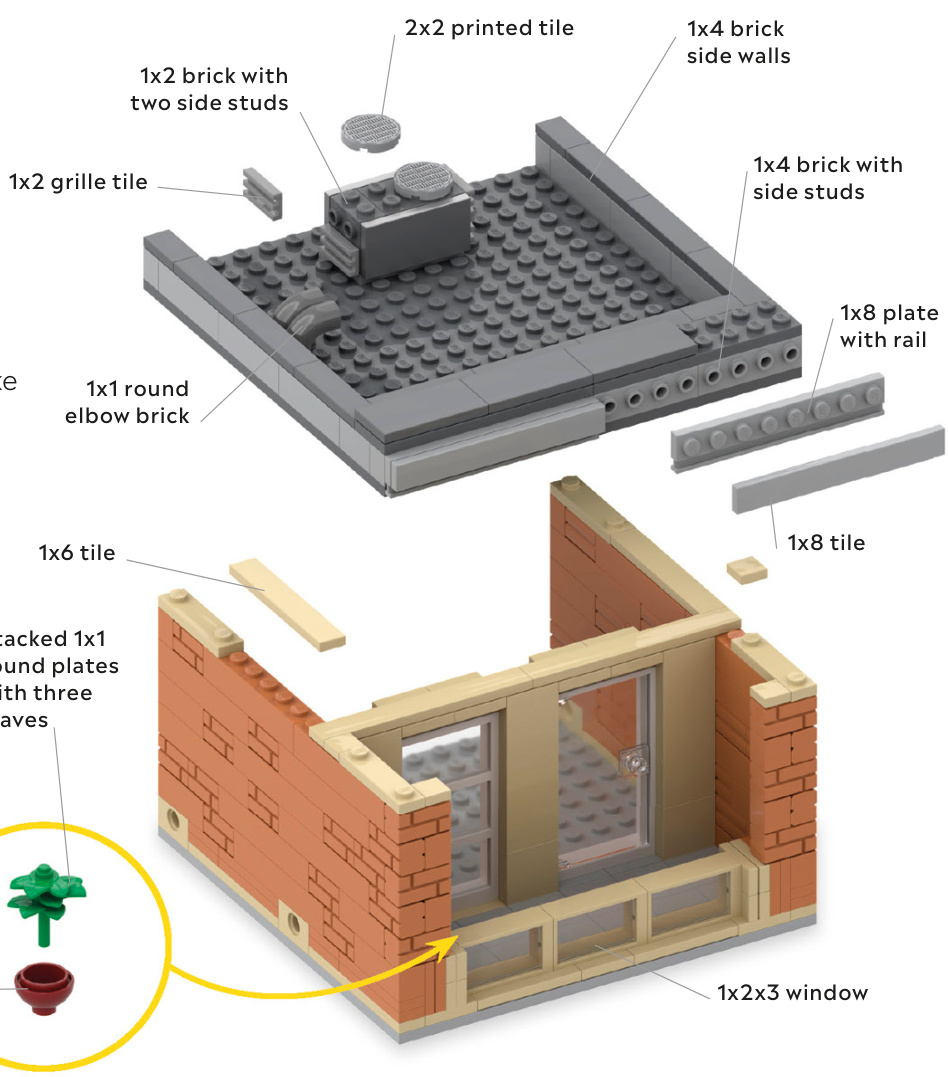
2x2inverted dome pot
MICROSCALE MODELS
/our houses, gardens, and streets don’t have to be built for minifigures. At microscale, which is any size smaller than minifigure scale, the tiniest pieces can become whole objects. Think of something big and work out how to build it small, then build anything else in your model at the same scale so everything looks in proportion.
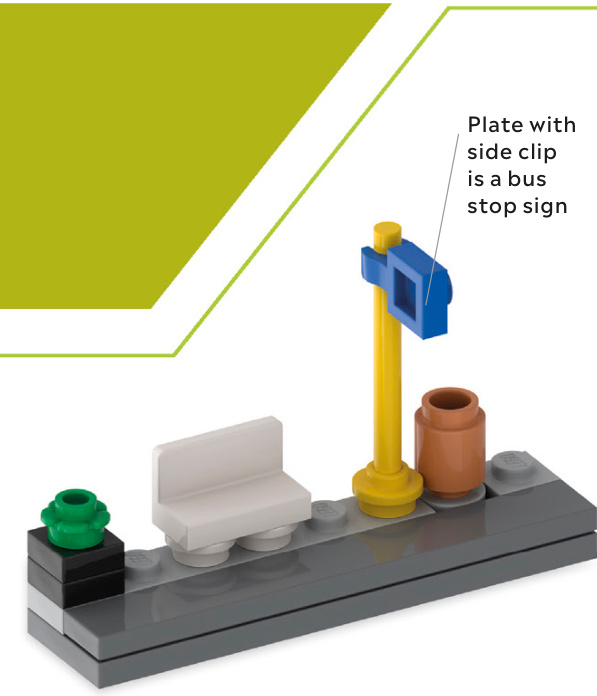
STREETFURNITURE
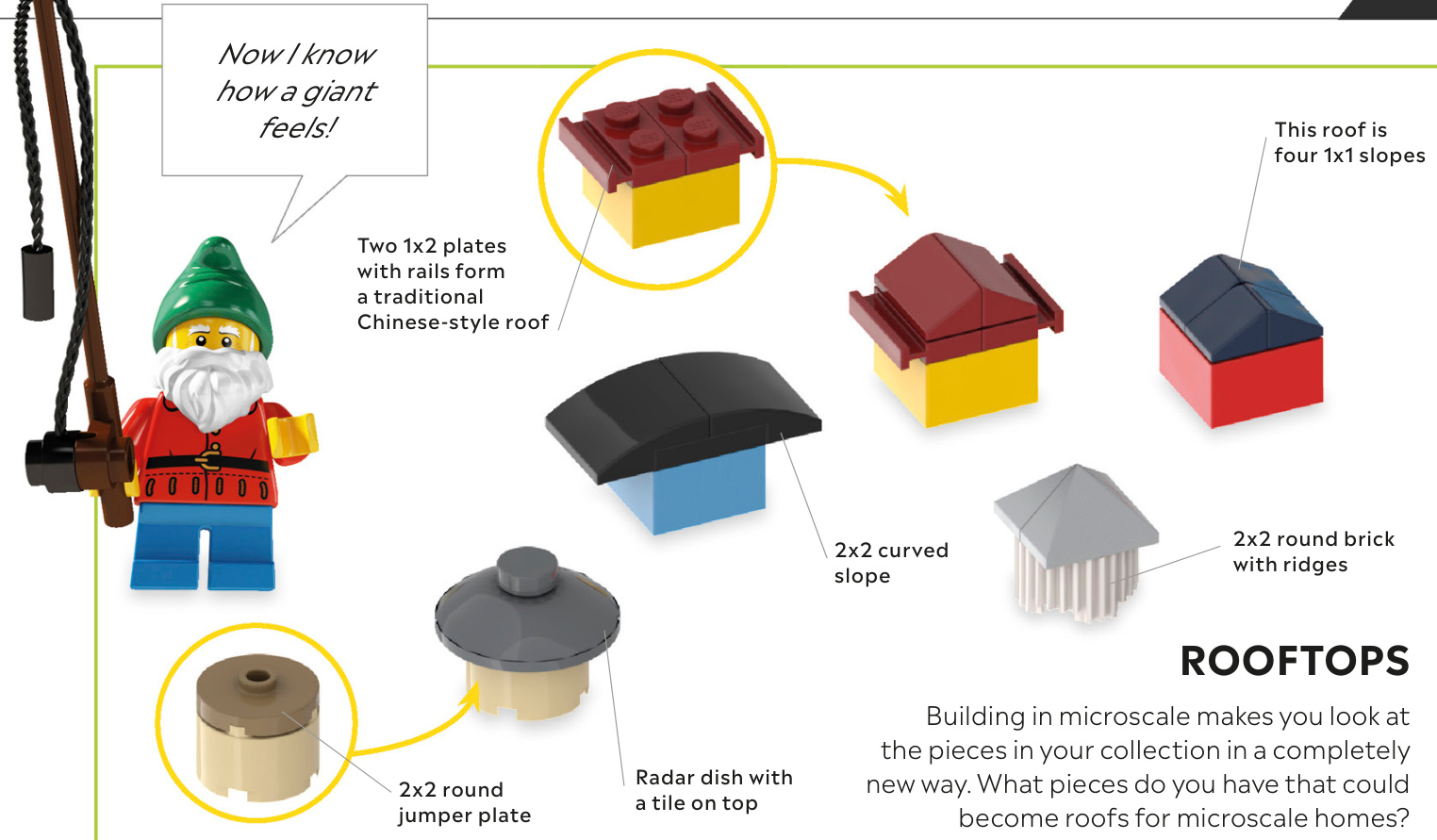
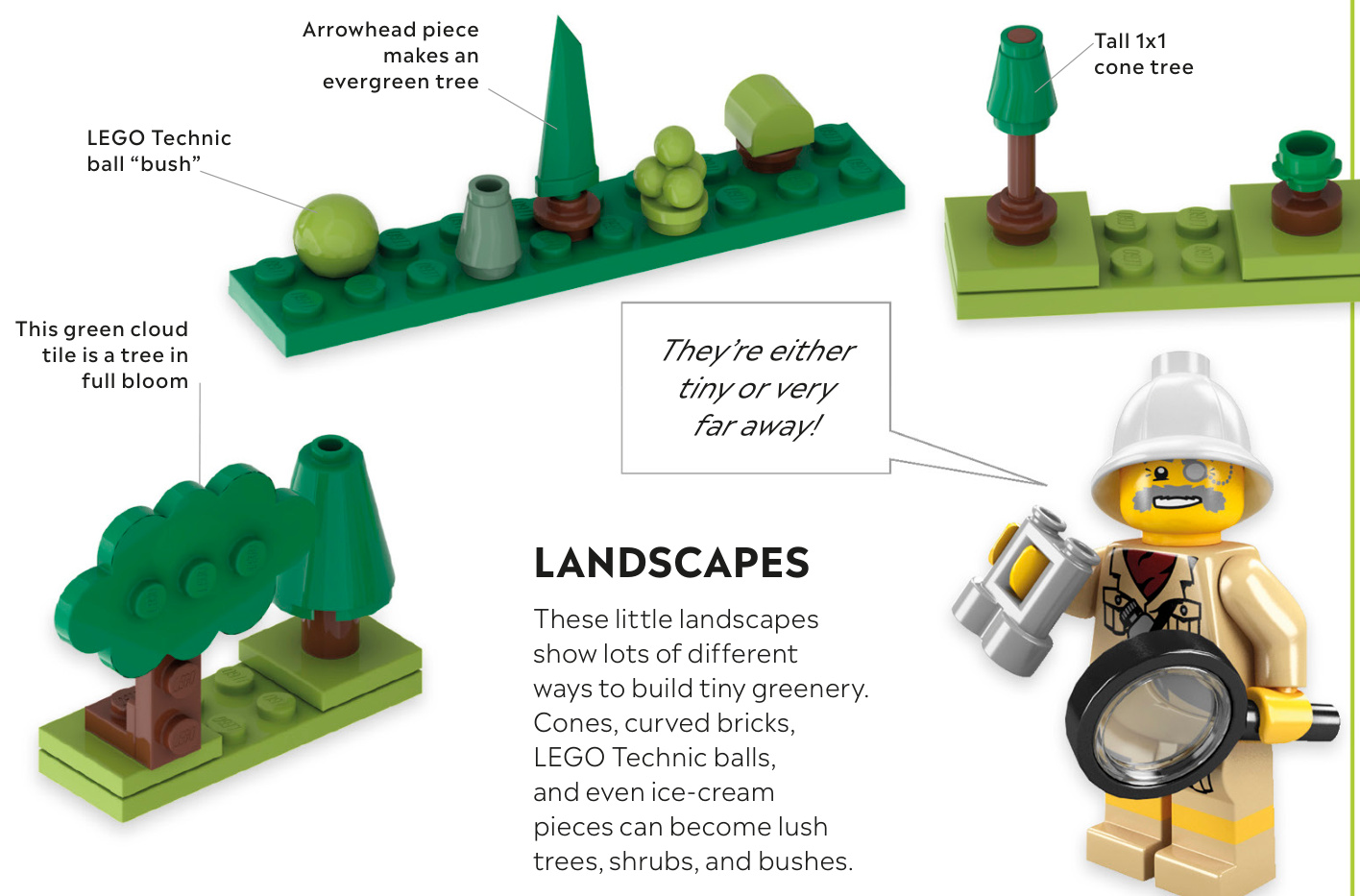
HILLSIDE VILLAGE
/hen building in microscale, you can literally have a whole world in your
hands. This entire hilltop village - with
leafy greenery, buildings of all shapes and
sizes, and a gently winding road running
through it -fits onto one base plate.
Thisshouldbe easy enough to invade.
Church made from 1x1bricks and slopes
Trees made from 1x1cones and bar pieces

1x1 double curved slope roof
1x4palisade bricks add interesting texture
Bricks on the edge will be seen,so they’re grey
GOINGUPHILL
To begin the gently sloping hill, add bricks at the back, where the highest part of the hill will be, and plates at the front.As most of the pieces on the bottom layer won’t be seen, they can be any colour you like.
This 1x8 plate won’t be seen later
8x16 baseplate
STEEP CLIMB
Now there are more bricks and plates on the hillside,in natural
looking greys, browns, and greens.
The dark grey winding road is also starting to take shape.Two curved slopes form the steepest
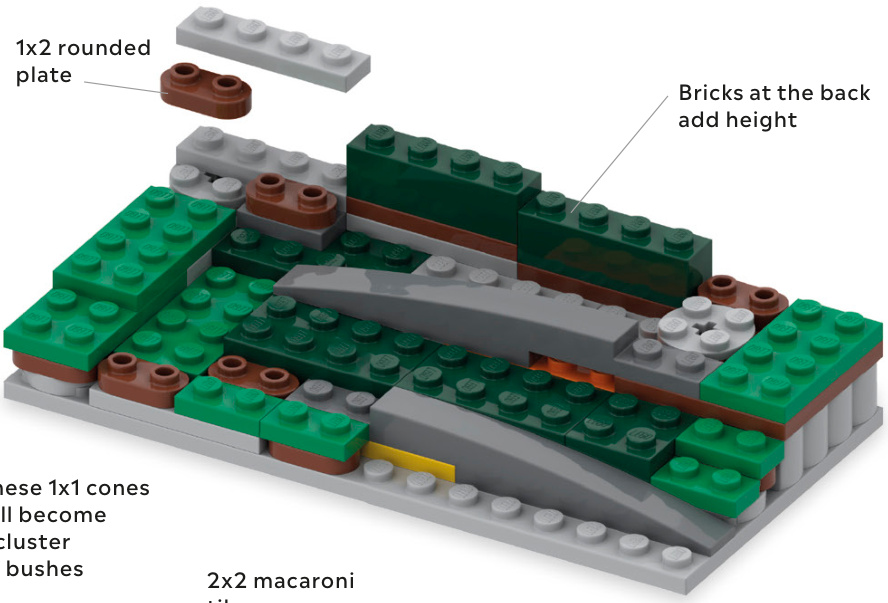
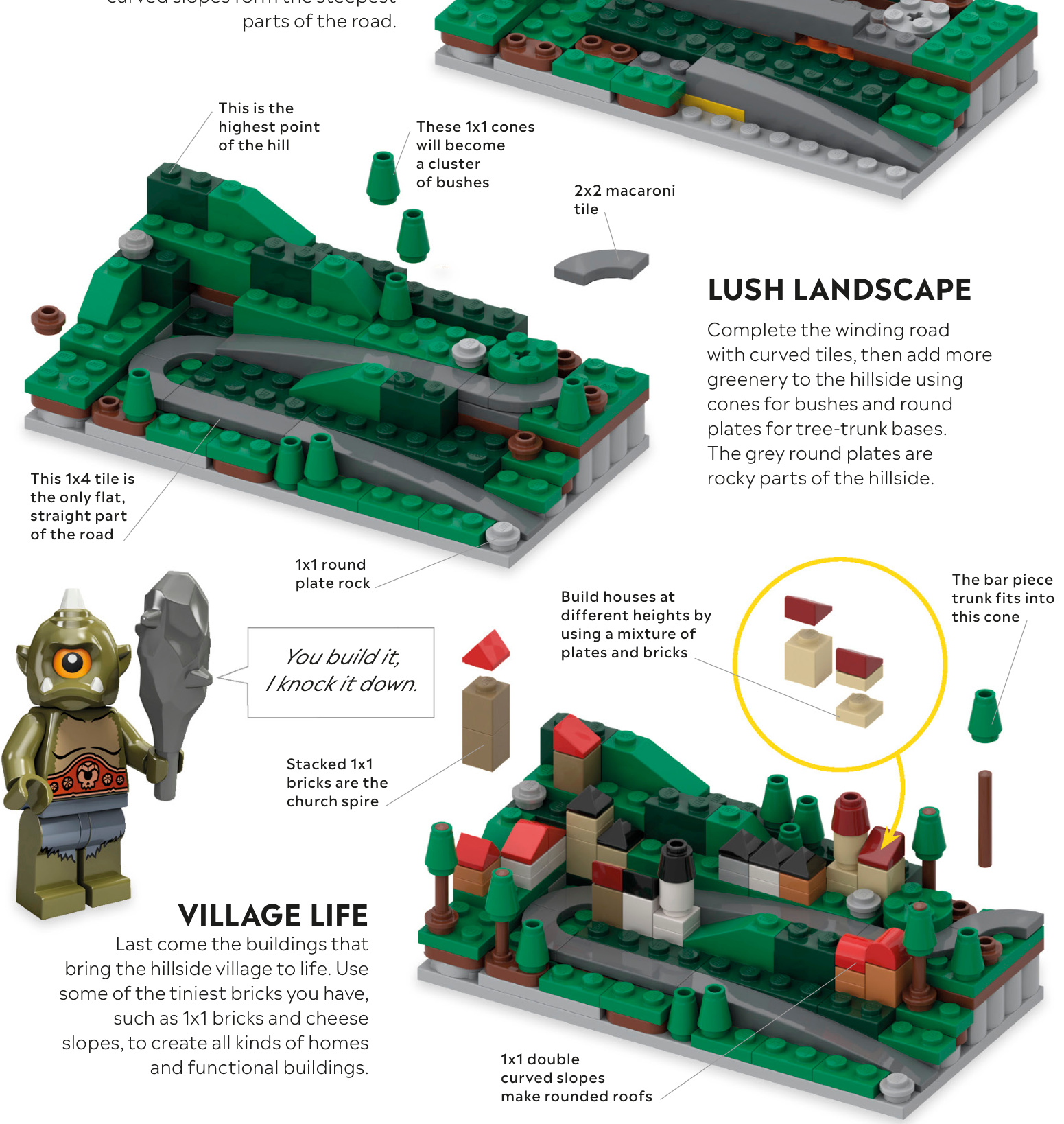
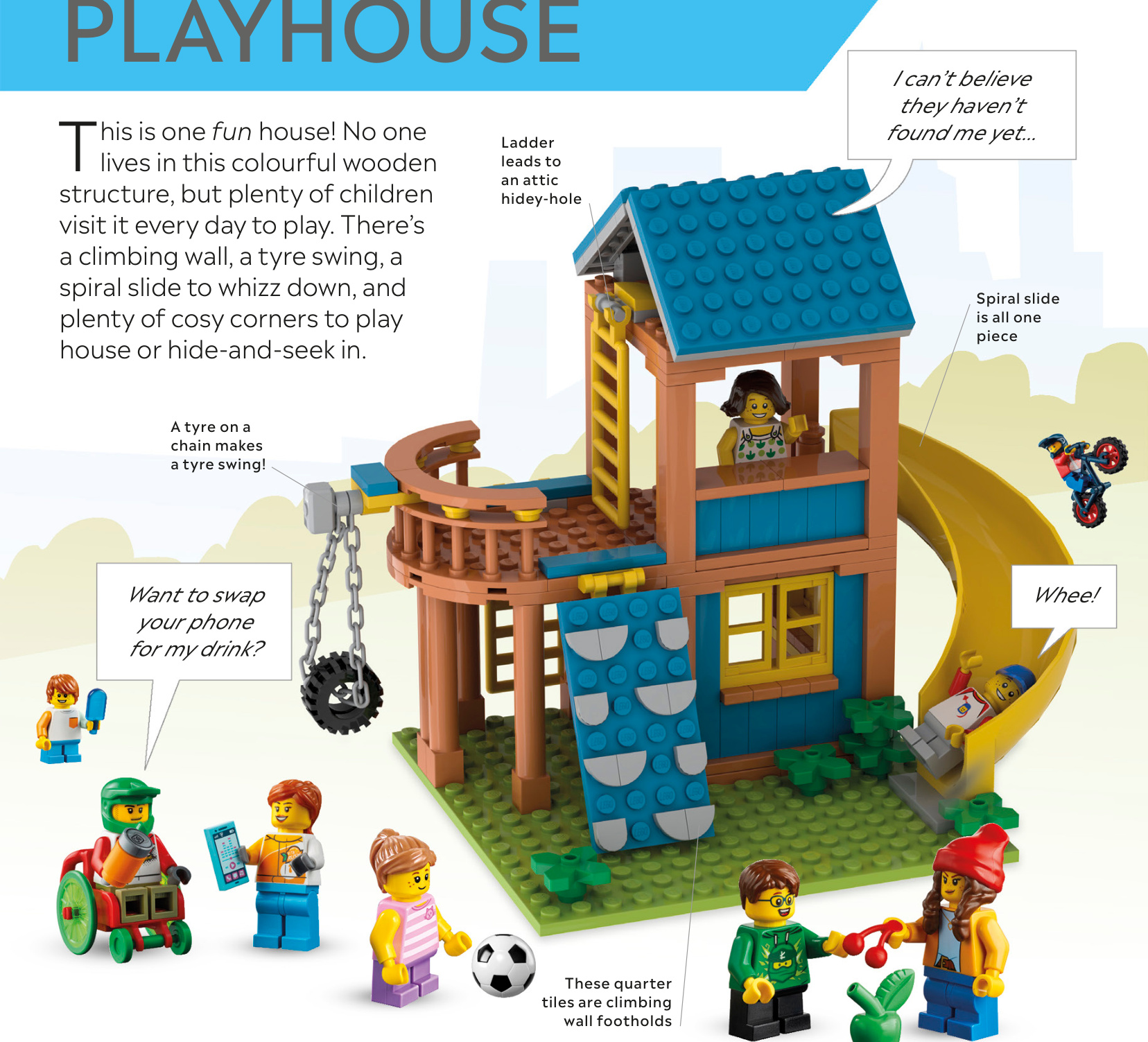
LET’SPLAY
The playhouse has a wooden base of nougat brown plates topped with tiles around the edges.The blue panels on the wall are tiles attached sideways to studs in the wall.The house fits neatly in the corner of a 16x16 plate.
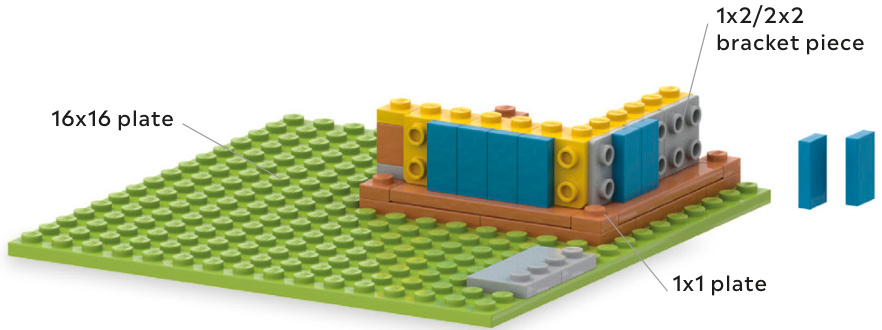
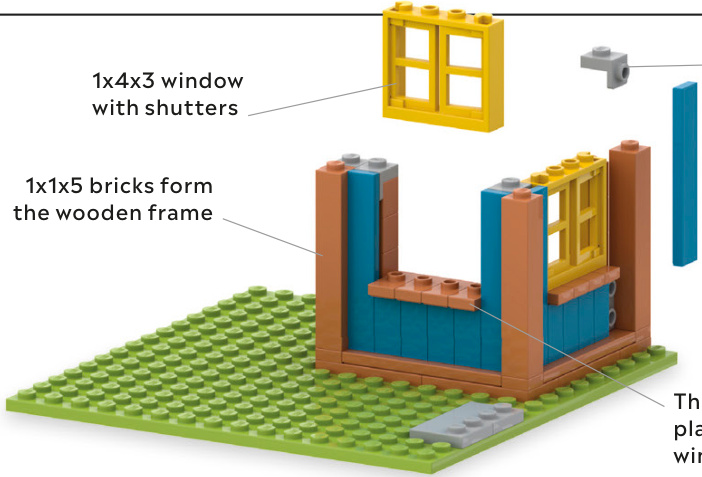
1x1/1x1bracket holds up the longer 1x6 tile
PEEKABOO
Build up the wall by adding more blue panels anda wooden frame.Then add wide windows with shutters for children to peek out from.
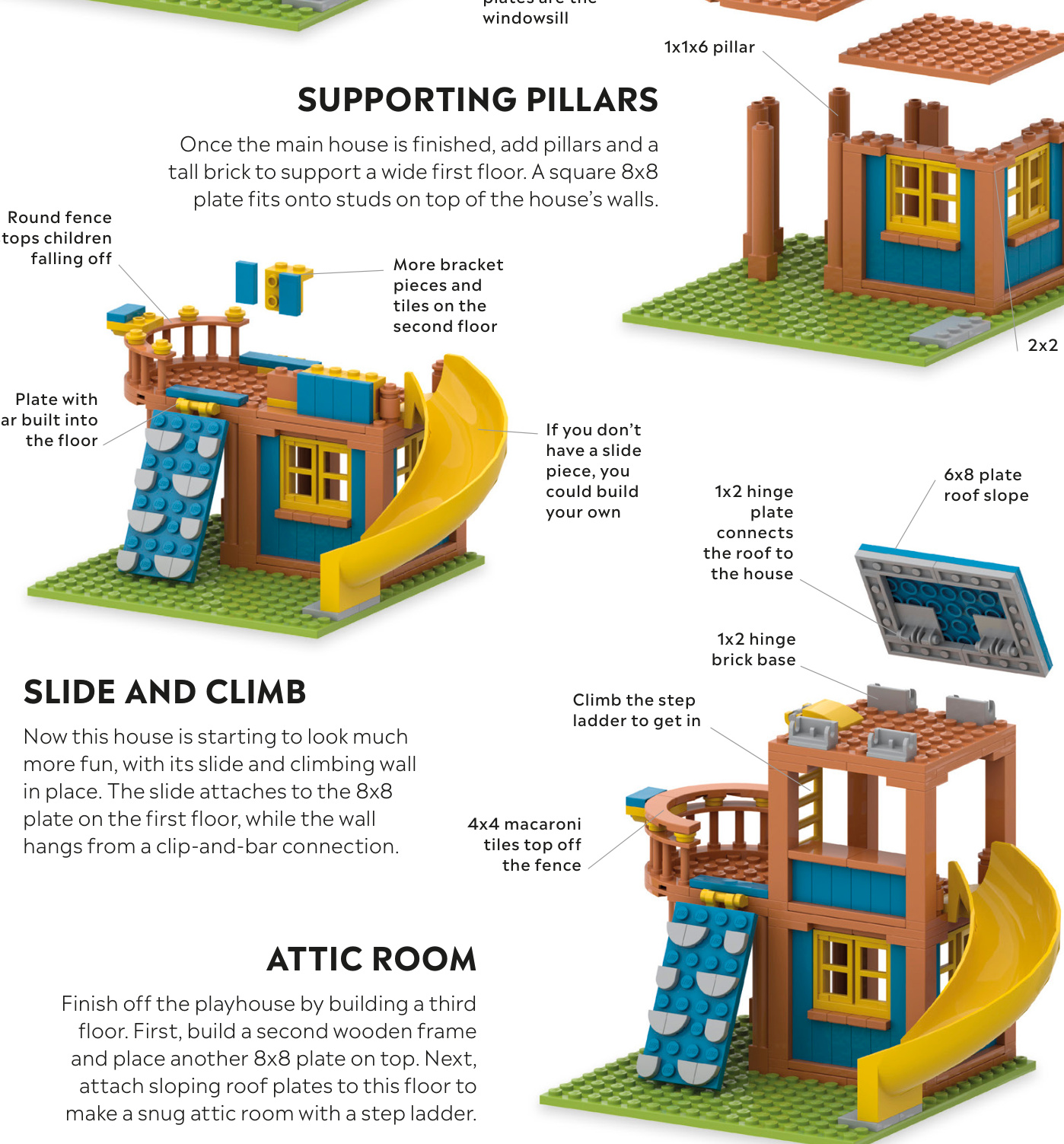
GARDENPLANTS
Natesng pLie’s really bring it to life. Gardens can be neat or overgrown, and full of colourful flowers, rows of vegetables, or wild weeds! The choice of colours you use can even reflect the season. Animals enjoy gardens as much as minifigures do, so you could add some of those, too.
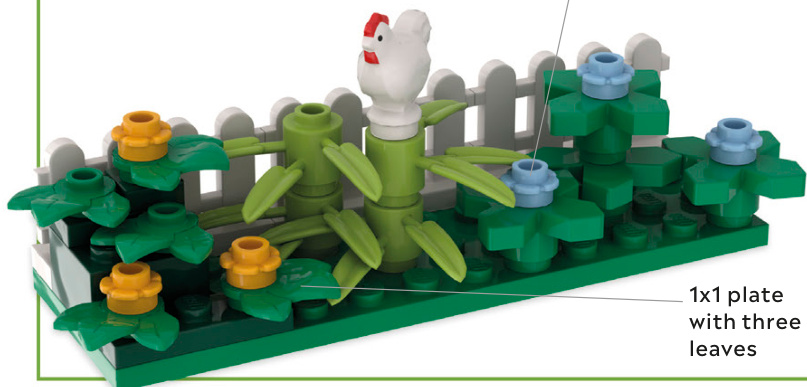
SHRUBBERY
Short plants with lots of stems are called shrubs.When lots of shrubs are planted together like this, they are shrubbery.You can make your own by stacking up lots of similar leaf pieces in small sections.
Add flowers (or chickens!) for extra detail
AUTUMN TREE
Make an autumnal
tree by adding leaves or other pieces in
autumnal colours.
Leaving the
tree’s branches
bare changes
the season
to winter.


Carrot-top pieces with white 1x1 platesareleeks
VEGETABLEPATCH
Help your minifigures to “grow their own” by building them a vegetable garden. This flourishing plot features neat rows of carrots,leeks,and other vegetables surrounded by soil.
Heart-shaped jewel piece
HEART-DROPTREE
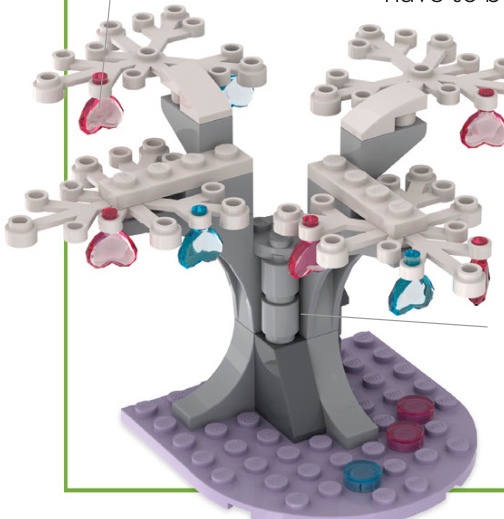
Trees,plants,and flowers don’t have to be based on those you can see in real life.
Imaginary ones can be much more fun!This
tree has colourful, heart-shaped
blossoms hanging
from its branches.
Imaginary tree trunks can be any colour
YUMMY GARDEN
Create a garden that matches the unique design of your house.This deliciouslooking gingerbread house garden features ice-cream trees and a winding cookie path.The red shrubs and picket fence also tie in with the colour scheme.
The tops of the trees are four-scoop ice-cream pieces
Cookie-patterned 1x1tiles
SNAILHOUSE
Oculartentacles arebarpieces with stop rings
here are no limits to the kinds of houses you can build in LEGO? bricks- as this imaginative home proves! A shell is a snail’s house, so why can’t it be a minifigure’s, too? Its bright pink shell haslatticed windows and a letterbox for any snail mail.
Radar dishes givethetop of the shell its rounded shape
Sometimes, I have a hard time coming out of my shell
Leverpieces are the snail’s lowertentacles
Fourround cornerbricks form thefront of the shell
Snails love to eatplants!
Letterbox piecebuilt into the shell
The head will be built up from here,
2x4 slope brick
BESTFOOTFORWARD
The foundations of the snail house look just like the bottom part of a snail’s body, which is called a foot.Slope bricks in different sizes form the low,flat, slithering shape. The plate that fits on top of the foot section will become the floor of the house.
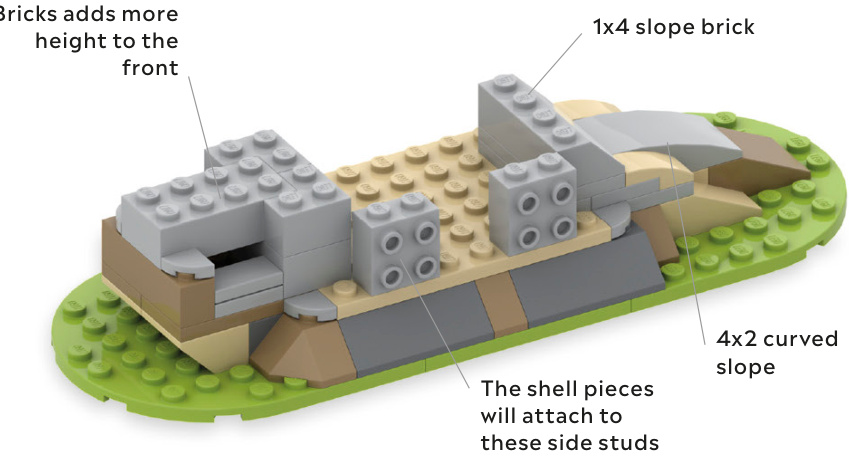
HOUSEWALLS
Complete the foot of the snail by adding curved slopes to finish the back and more bricks at the front.At this stage,you can also start constructing the grey inner walls of the shell house.
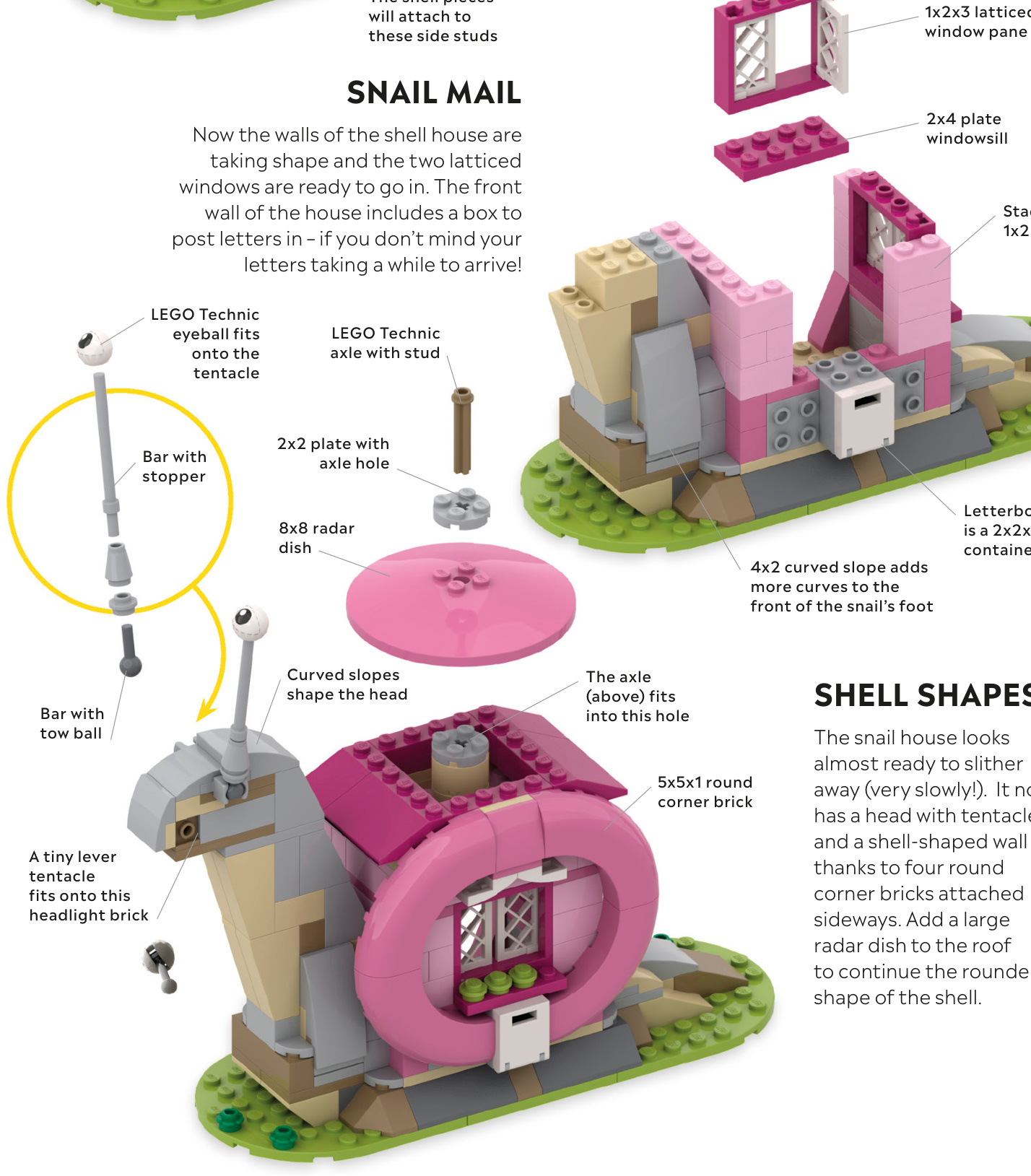
THATCHED COTTAGE
his cosy countryside cottage looks like it could have been home to minifigures for hundreds of years. It has a thatched roof, which means it is made from
layers of straw or othe dried plants, and uneven grey walls that have stood the test of time.
Uneven garden path made from round tiles in different sizes
These green round
plateswithpetals couldbesmall plants or moss
I hope grandma will be home.
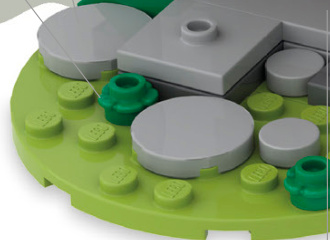
2x4 tile doorstep
HUMBLEBEGINNINGS
The walls of the thatched cottage are made from a variety of grey bricks. Using pieces in different shades, shapes, and sizes gives the walls a weathered look.An open fire on the cottage floor heats the home.

1x2 grille plateslook like stalks of straw
Roundtiles attach to sidestuds in the walls
This rabbit likes the wild country garden
Colourful1x1 round-plate flowers in thewindowbox
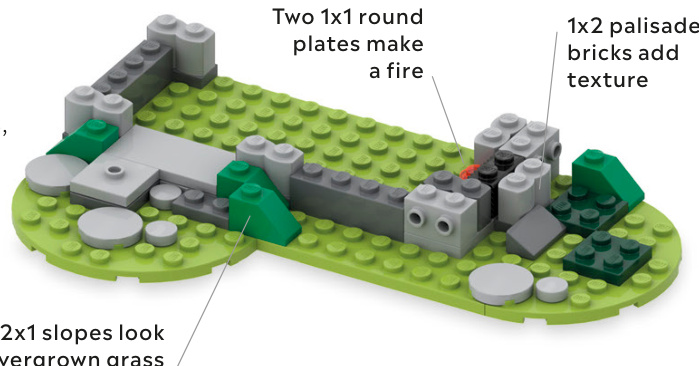
like overgrown grass
HOMELYDETAILS
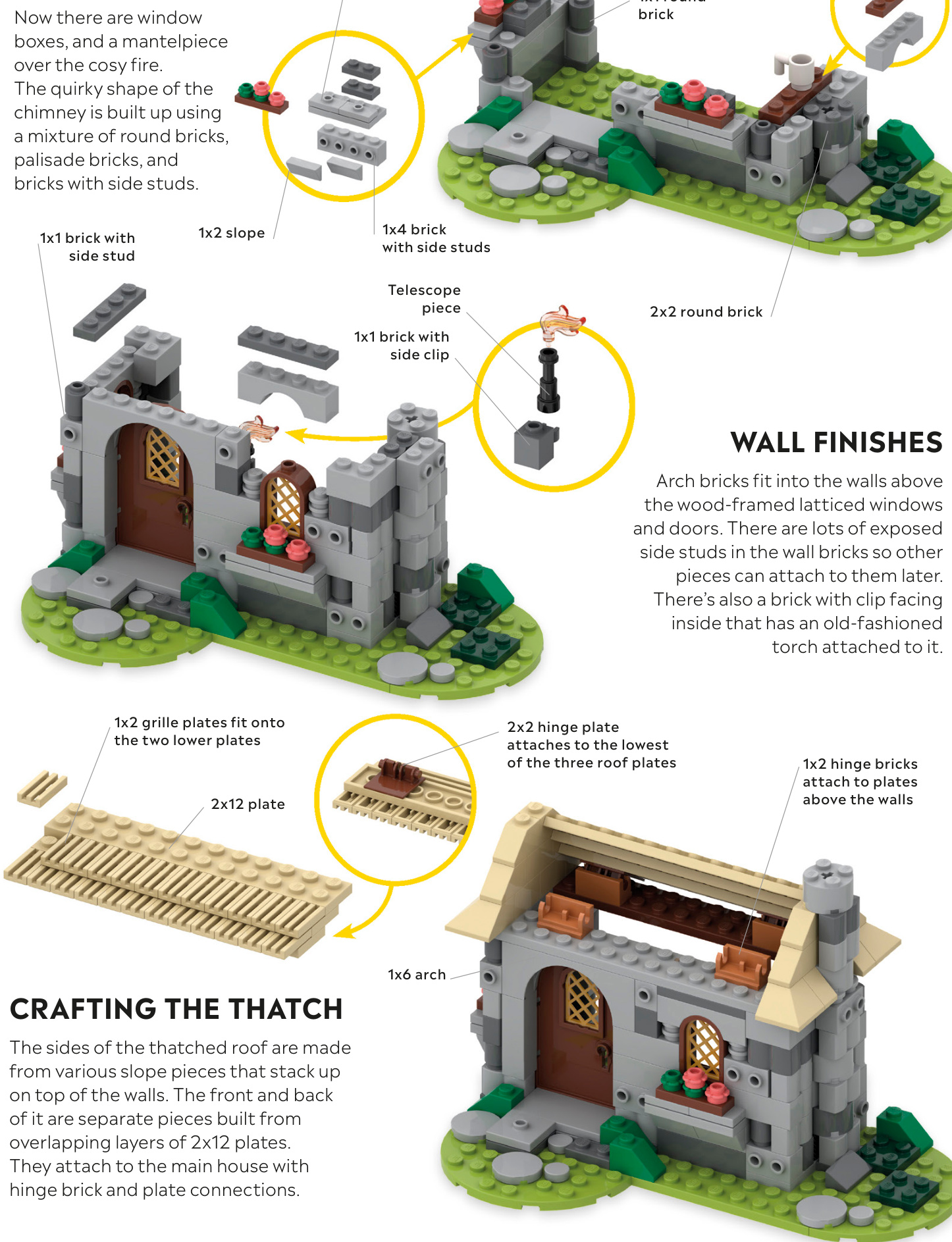
UNUSUAL FEATURES
et your imagination run wild and build some _unusual, funny, or functional features for your LEGO houses. Think about where your house is located, who lives in it, and what they might need to live and laugh there
The periscope can rotate on this pin
UNDERTHESEA
You can see more of this house on pages72-73
The underwater house has lots
of submarine features, such as a
propeller and rudder for moving through water. It also has a rotating periscope for peering above the surface.Seehow to
build this house on pages 68-69.
Macaroni tube
Small propeller attaches to a tile with pin
Large wings attachto clips in the houses’s walls
The house attaches to 2x2 jumper plates
Bird, house, plane… what’s not to love?

3x5 cloud tile
UPINTHE CLOUDS
Can you imagine living in a house with wings? Where would you fly to? The flying house’s wings flap up and down on clip-and-bar connections. It has a cloud perch to come home to roost on.
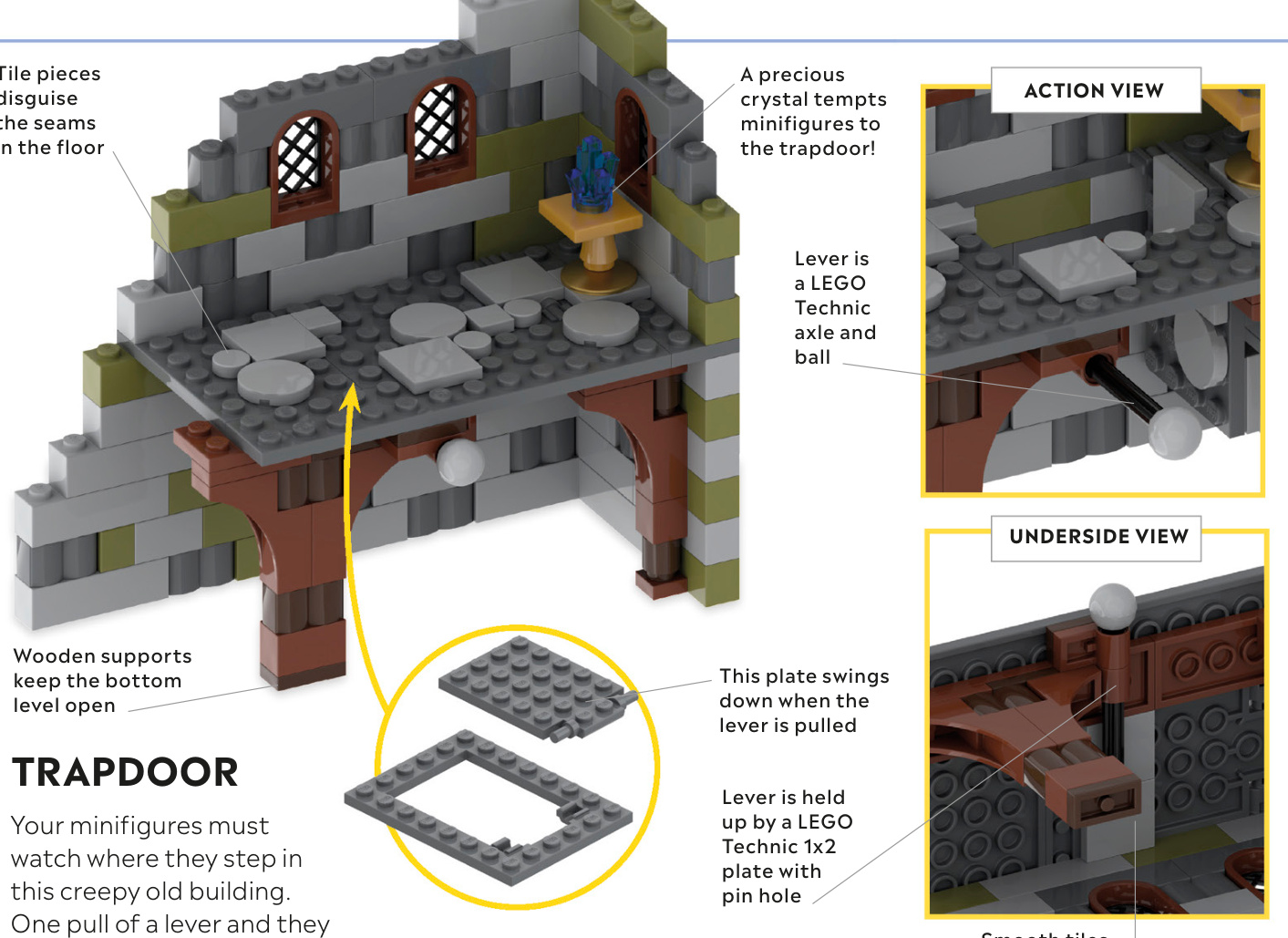
could be tumbling through a trapdoor into who knows where!
Smooth tiles here help the lever glide out
CASTLECATAPULT
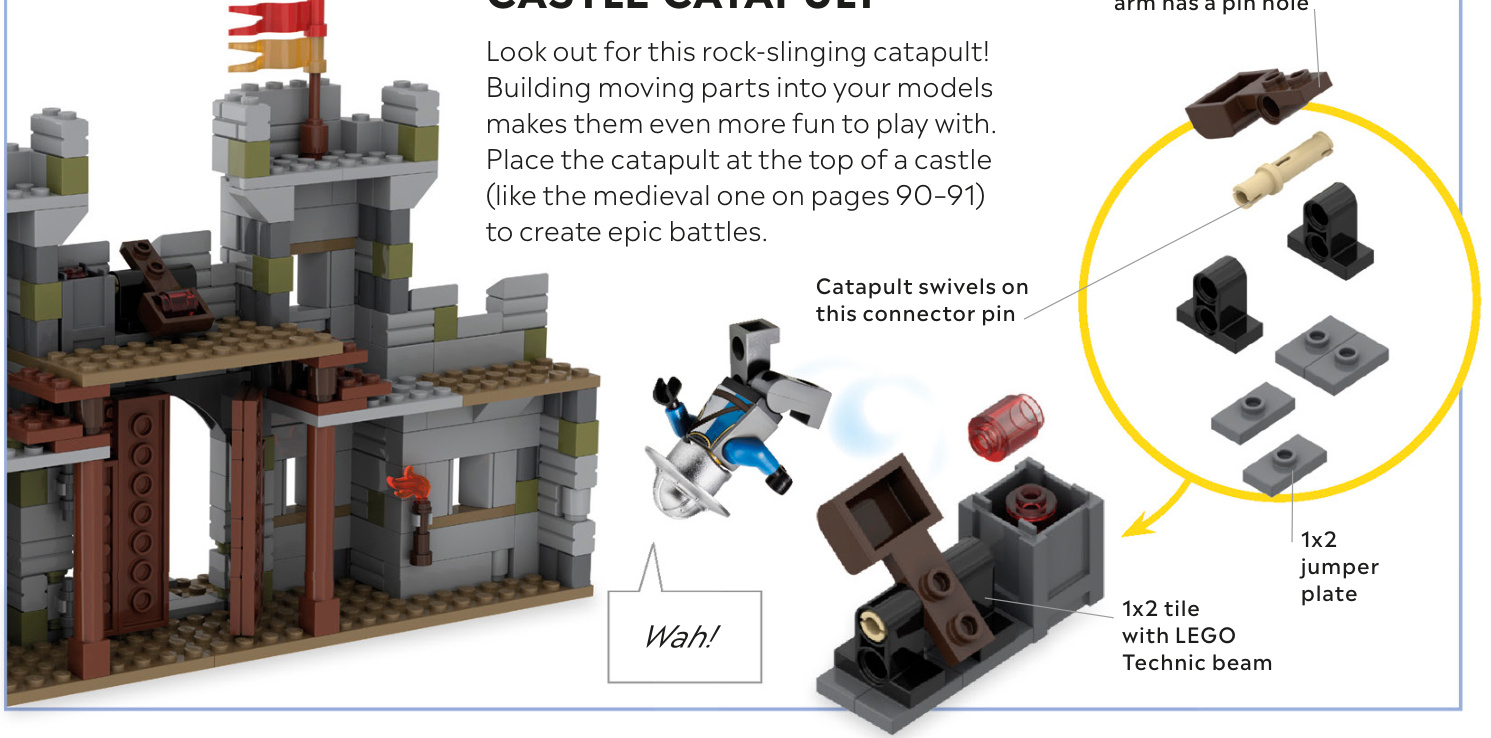
HAMBURGER HOUSE
This antenna piecelookslike a burger skewer
The minifigure owner of this house relishes the thought of coming home every day..because it’s shaped like his favourite fast food! Beneath the bun roof are layers of lettuce, cheese,
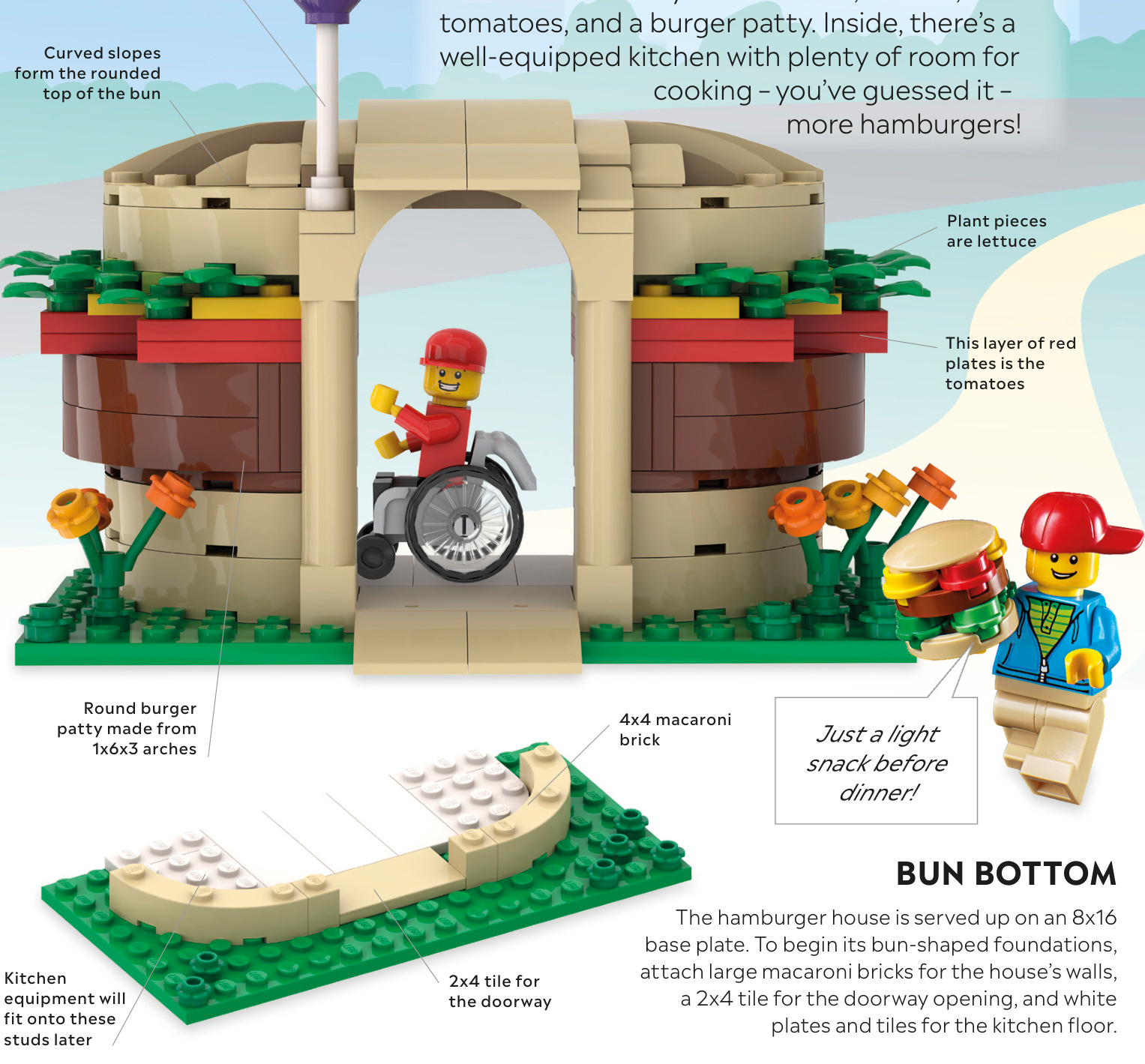
I think /‘ve eaten too much.
See more of this kitchen equipment on page 82

BUILDABURGER
Tap pieces are ketchup and mustard
Add more macaroni and other bricks to build up the beige bun,then begin the burger build,starting with macaroni tiles.At the back, buildin some arch bricks that will later support the bun lid roof. It’s a good idea to think about ways to make your model stable at the early stages of building,so it’s easy to play with later.
This doorframe with pillars is all onepiece
Round 1x1plate withthreeleaves
4x4 macaroni tile
NO gHERKINS?
Once the burger patty is in place, it’s time to add the relish. Layer up
red-plate tomatoes and yellow-plate cheese, then add plant pieces as lettuce leaves.You could add any relishes you like to your hamburger house. What will you choose?
curved slopes make the door ramp
Two plates are shorter than a brick
UNDERTHEBUNLID
Taller bricksin the middleof the bun、
Beneath the curved slopes of the bun lid are plates and bricks in various shapes and sizes.They bring together two corner plates andbuild up the height of the bun so it’s taller in the middle.
UNDERWATER HOUSE
This aguatic home is located in the dark depths of the ocean, on the seabed. All kinds of marine life whizz past its three bubble windows, wondering what on earth it is. Half-submarine, half-home, the underwater house has a rudder and propeller so it can relocate in a flash if any predators approach.
The home’s residentscan peeroutof thisperiscope
These pieces are moreoftenused ascarbonnets
Small propeller spinsonatile with pin
1x1x6 pillars support the roof butleave the back of the house open
Watertightbubble window attaches toa round plate with hole
1x2tile doorstep
SANDY START
Layeredroundtiles create aripple effect
The curvy, uneven base of the underwater house looks like ripples of sand on the seabed. It’s made from one rectangular plate surrounded by round plates in different sizes.Plates form the lowest parts of the house’s walls, with a layer of bricks on top.
SUBMARINESIDES
The walls of the underwater house are deceiving -they look round but they’re actually square! Each square wall contains a brick with four side studs so that separate, rounded walls can be attached sideways.
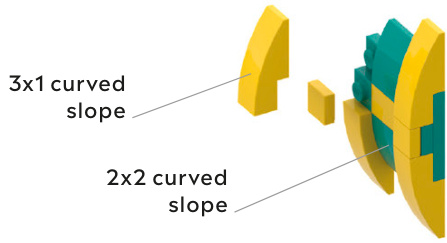
The roof will rest on this 1x1 brick
4x4 round plate with hole
Tilewith two studs is the windowsill
4x4 cylinder
BUBBLEWINDOWS
A house underwater needs big
bubble windows! These ones are
made from cylinders attached to
round plates with holes.They fit onto bricks with side studs on either side of the window openings in the wall.
Stacked1x2 bricks create an extra-thick doorframe
Add tilesto make the door lookheavierand more watertight
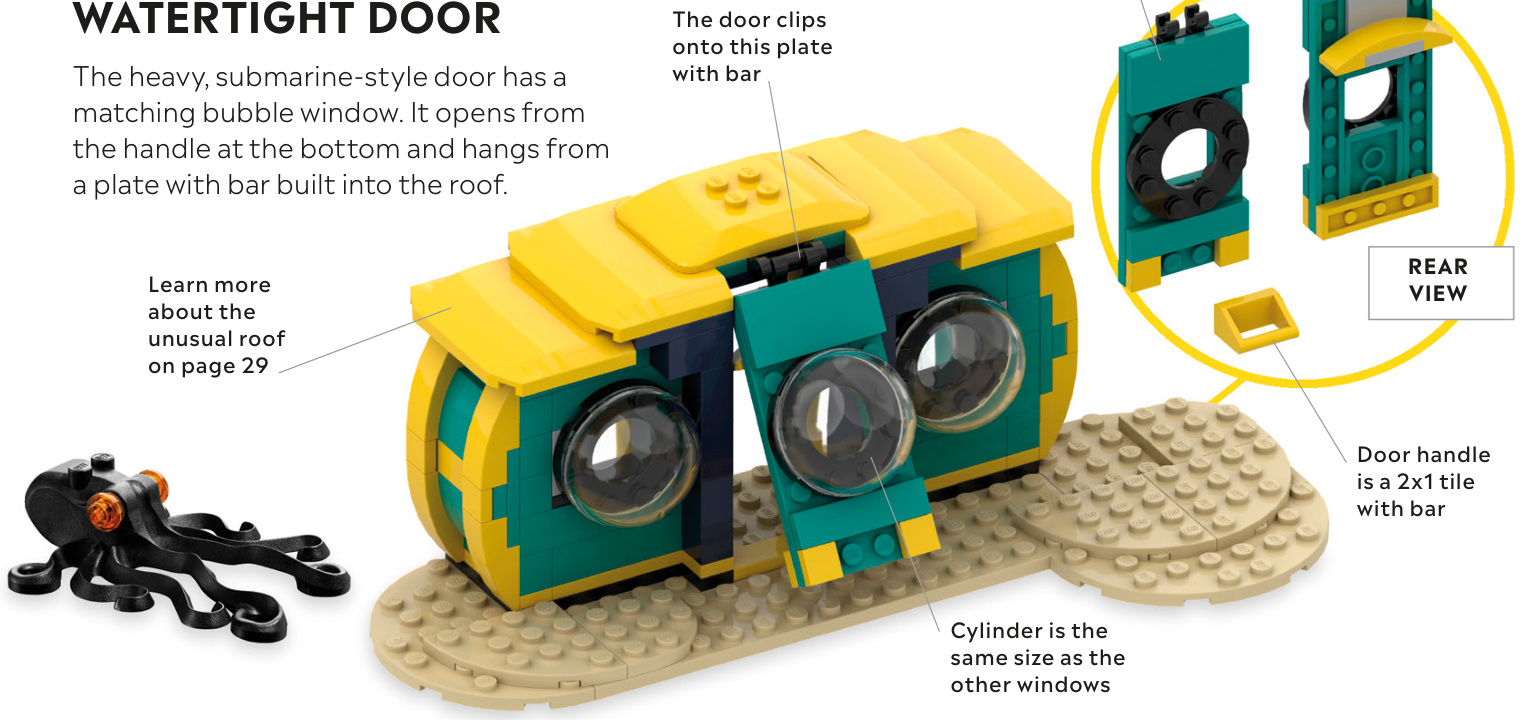
TIME TO PLAY
/hile you’re thinking about ways to make your LEGO house look good
on the outside,you might also want to
consider how you can access it to play
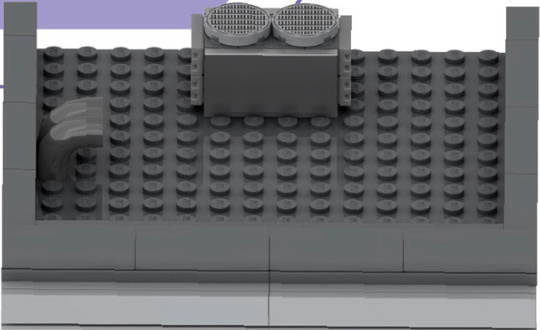
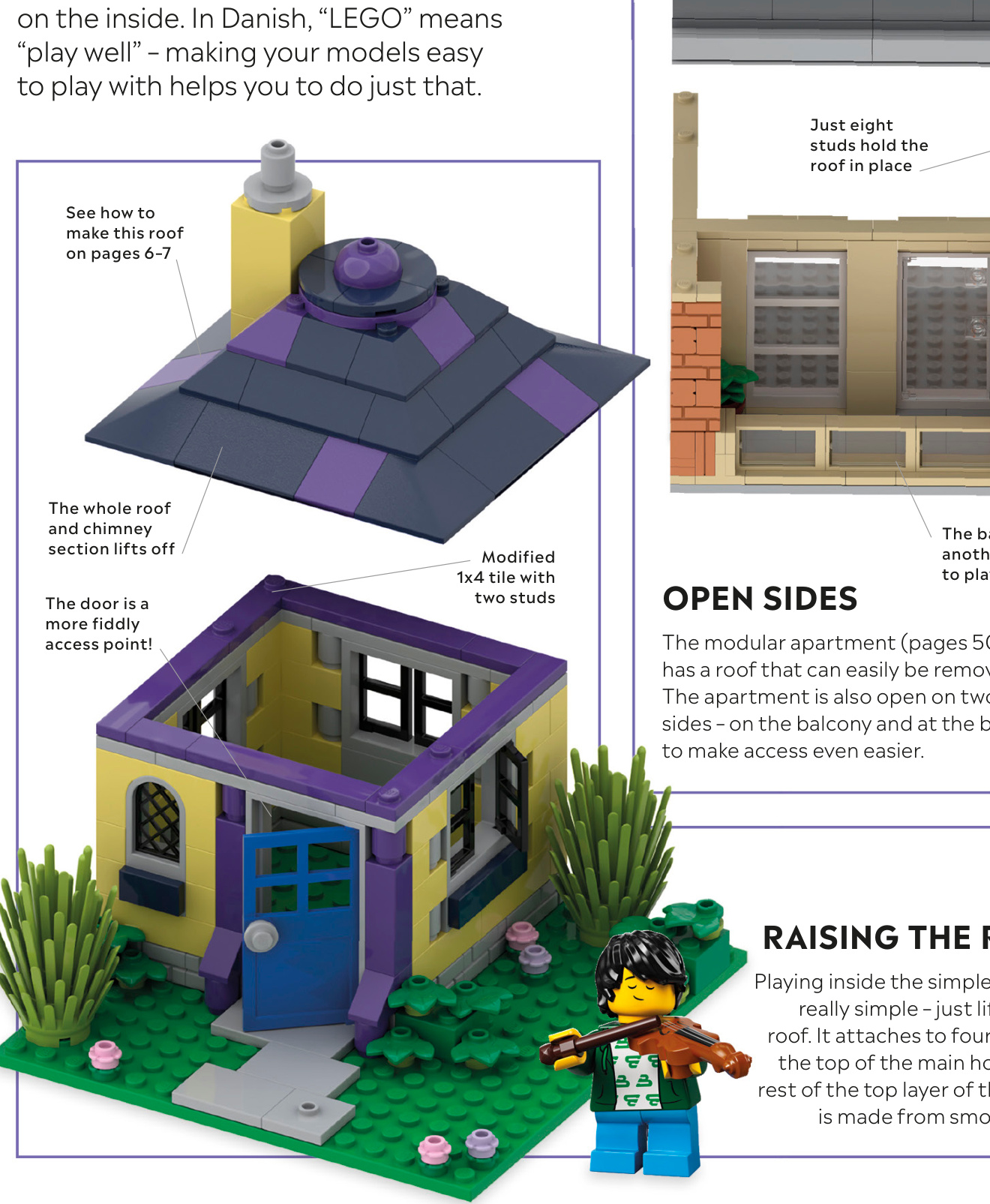
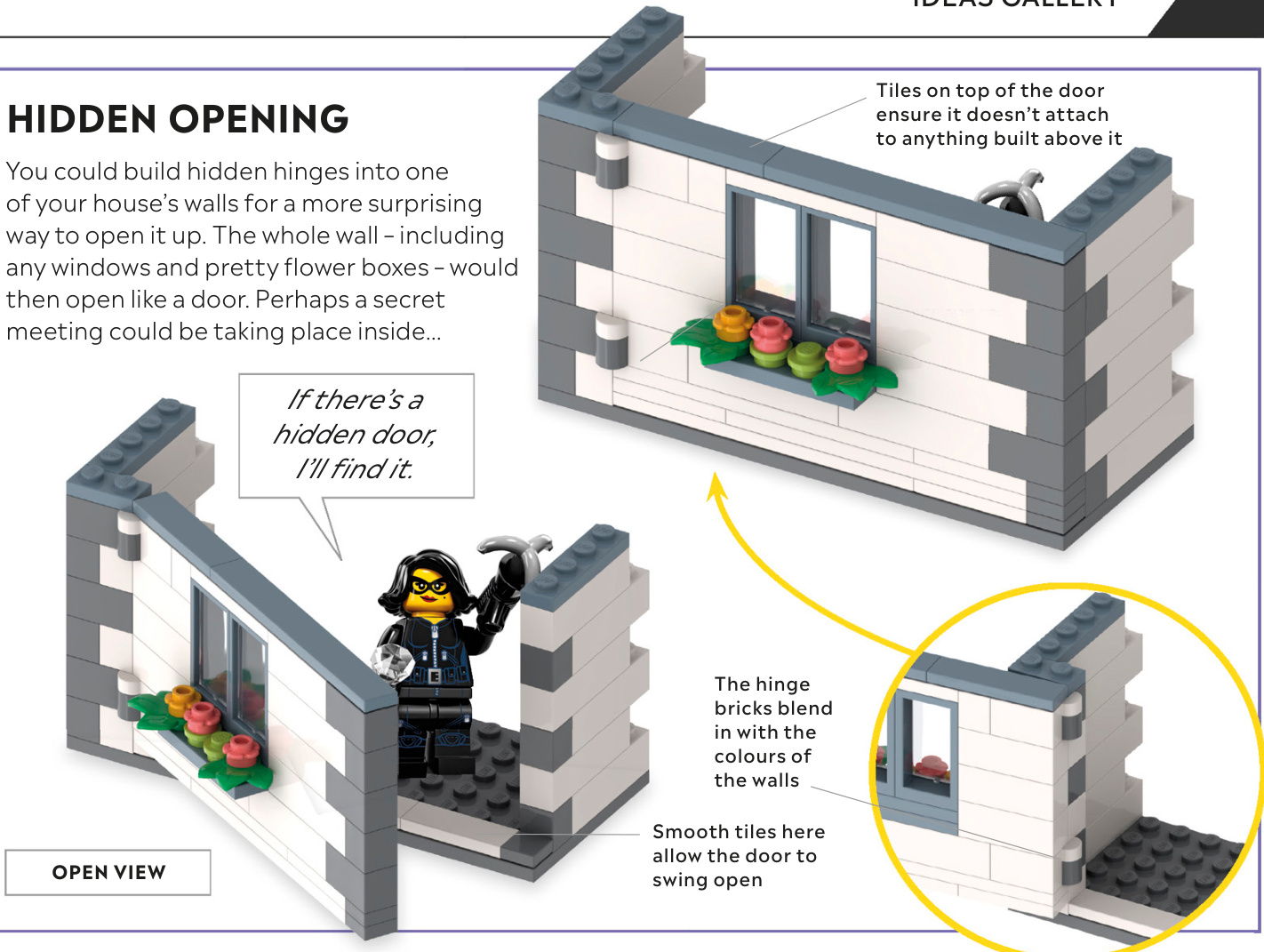
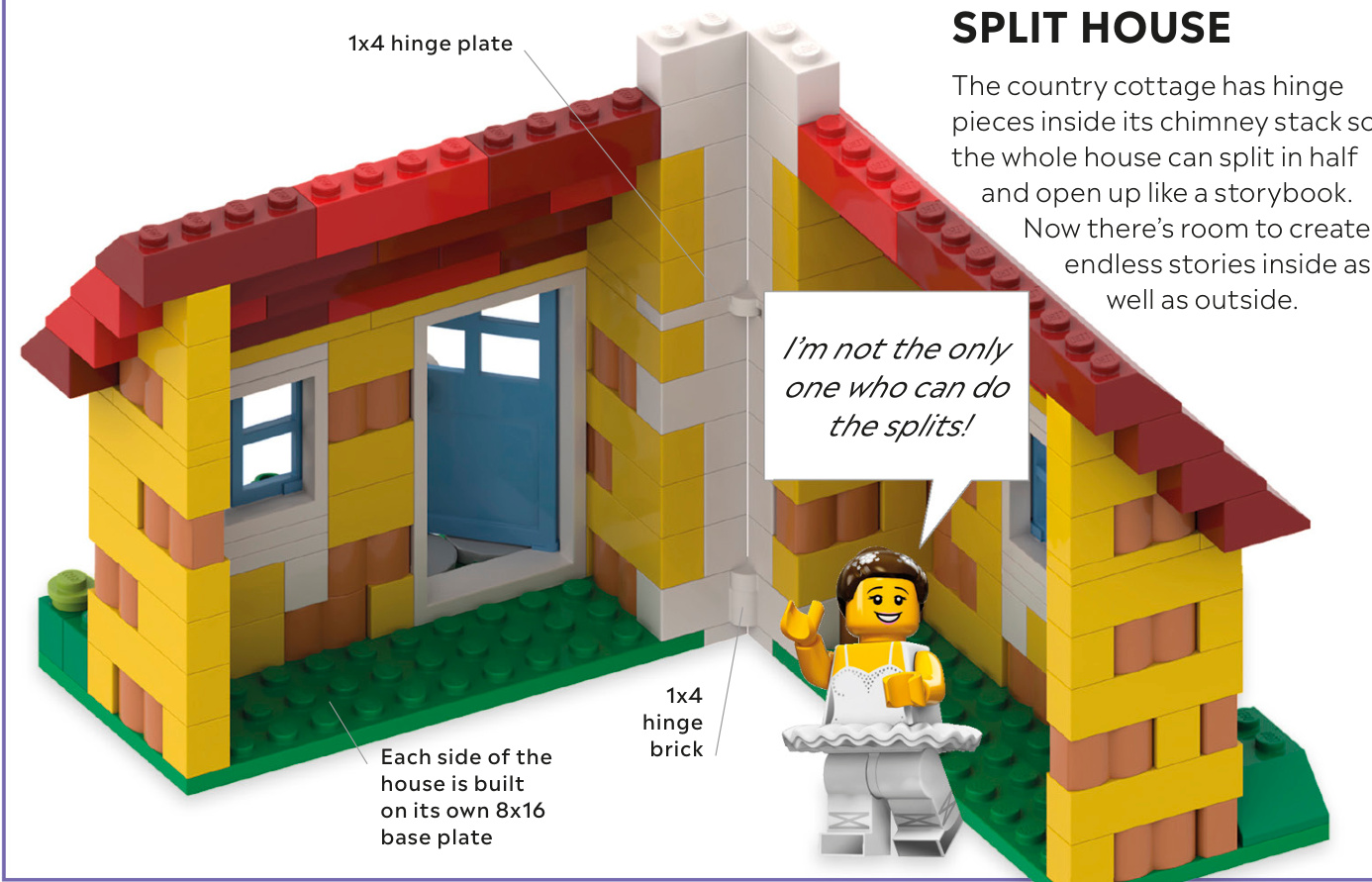
FLYINGHOUSE
S /ho wants to live in a street when you can live high up in the clouds? This bird-shaped house with brightly coloured plumage is not only a delightful imaginary home - it’s also a form of transportation. It can take off from its cloud perch and soar through the skies.
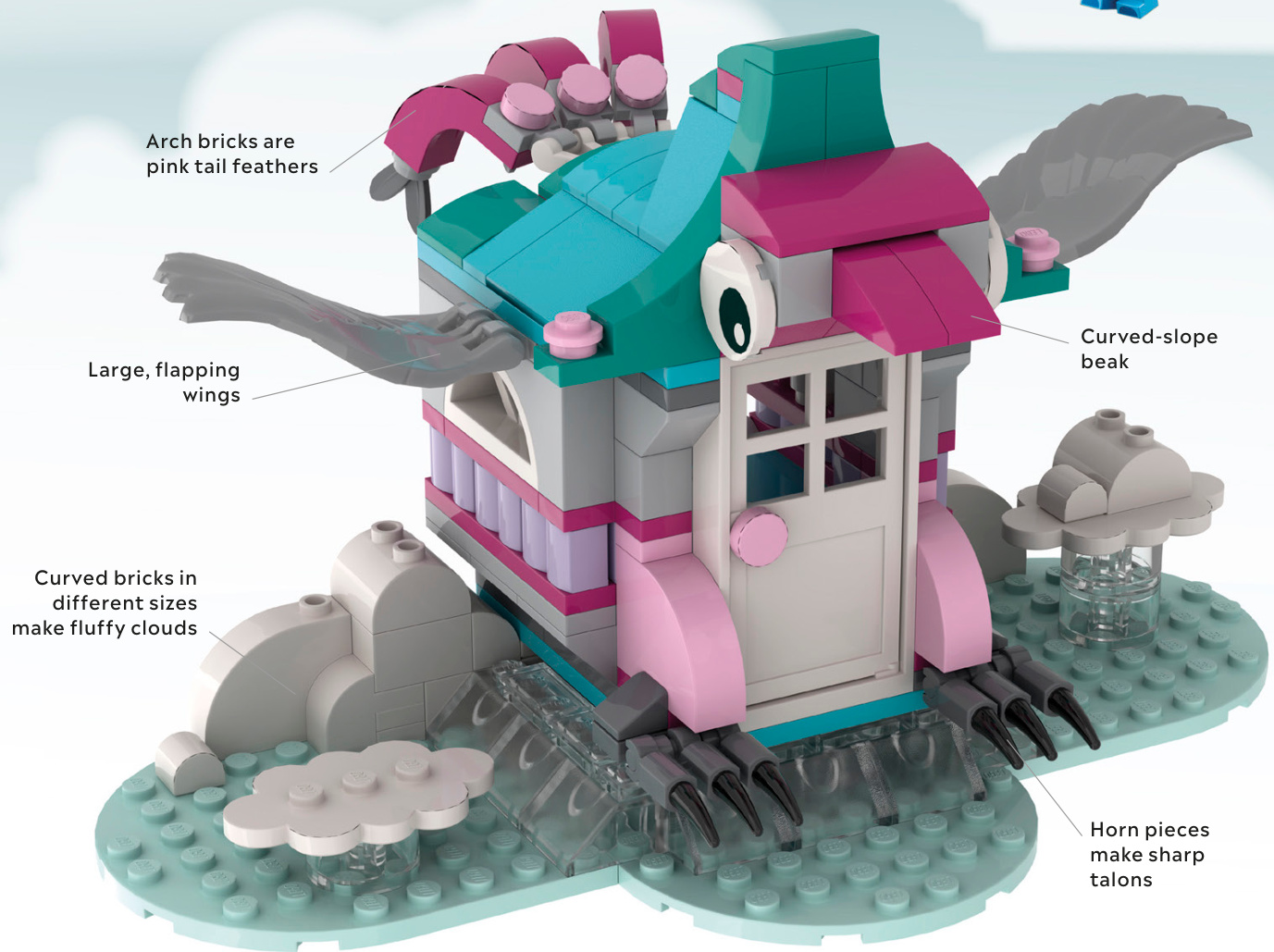
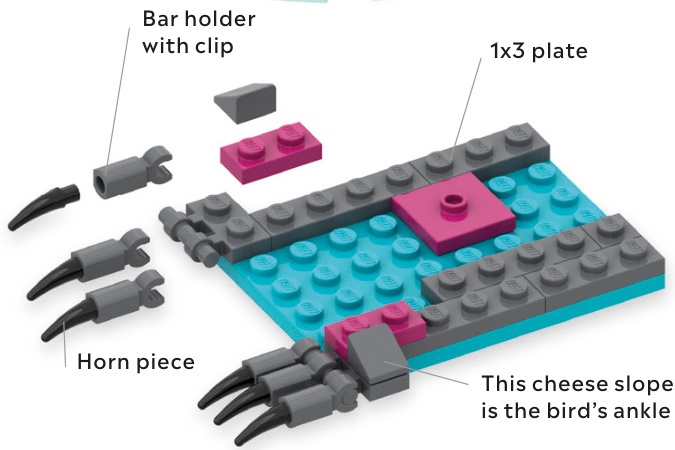
FEETFIRST
Begin this bird-like build with a plate, adding narrow plates for the bases of the side walls.Next,make the bird’s feet and claws.Start with a plate with bar handle and clip three bar holders to it. Add horn pieces to create the talons.
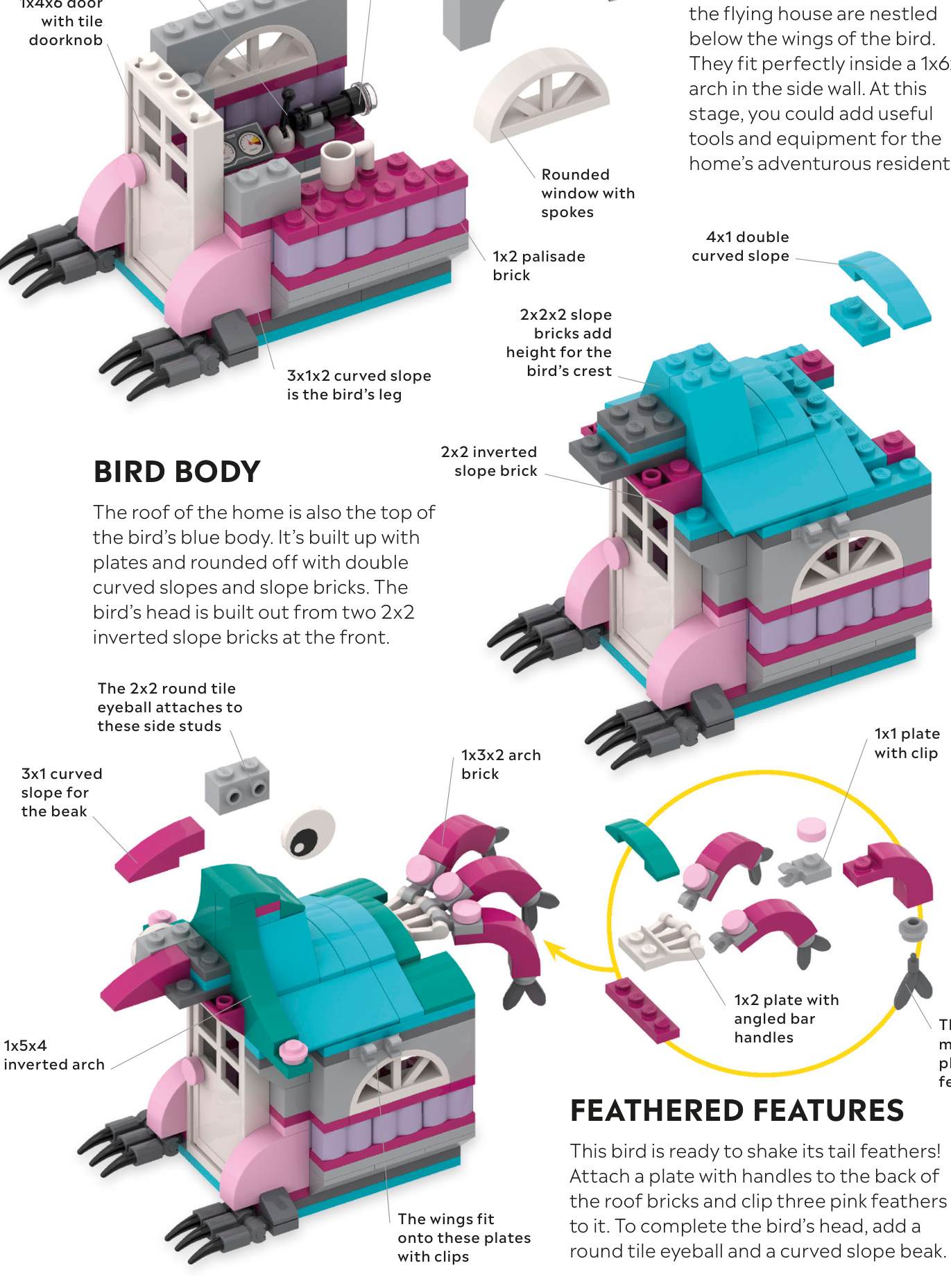
This is a minifigure’s plume feather
OLDBOOT HOUSE
One half round plateformsthe top oftheroof
All my children have left, so I’m downsizing to a size 4.
Mdufroairldbytthis rhyme“There Was an Old Woman Who Lived in a Shoe”. There’s a door in the boot’s heel, flower-filled windows in its collar, and “lace” steps that lead up to the flat roof. Can you think of any rhyme-inspired houses you’d like to build?
1x4 tile bootlaces
The grey bricks are the boot’s heavysole
The boot’s toe is a 6x6x2 round corner brick
FOOTPRINT
The grey sole of the old boot is,fittingly, the foundations of the house.The heel gets its rounded shape from macaroni bricks,while the shape of the toeis made by offsetting bricks. Leave space in the sole for the doorway.
Stacked4x4 macaroni bricks
These bricks are thewalls of the house
Round corner brick fits above the sole
6x1 curved slope adds shape to the sole
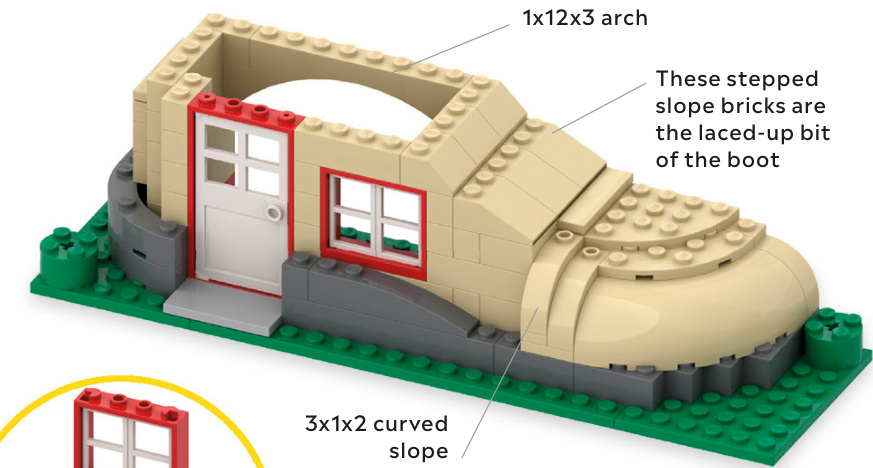
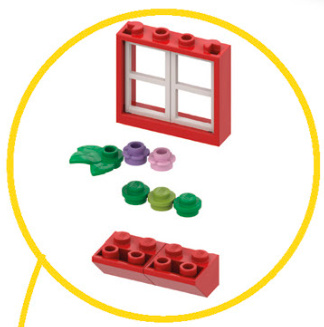
COLLARFLOOR
Stacked
macaroni
bricks make
this curved wall
The upstairs room of the boot house is inside the collar. lts red windowsills jut out of the walls thanks to inverted slope bricks.
BOOTROOM
The bottom of the boot is the lower room of the house.Add a window and door and a large arch at the back to keep it open for play. Also build up the toe with round plates and slope pieces.
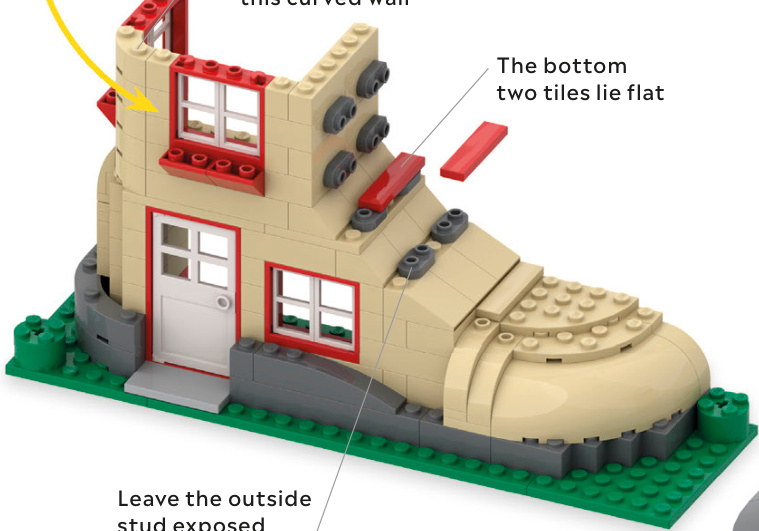
2x2inverted slope
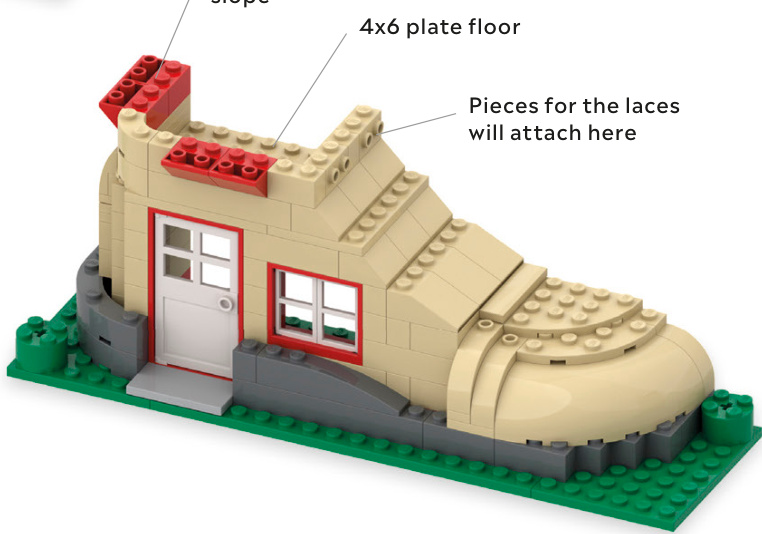
LACEITUP
Once the top floor is complete with windows and flower boxes,the old boot house is ready for some laces!Two rounded plates underneath each tile lacelook like the holes the laces thread through.
6x6 round corner brick with sloping sides
ROUNDROOF
This boot is built to be lived in, not worn,so it needs a roof at the top of the collar. The round roof has a first layer made from two sloped round corner bricks and two slope bricks.
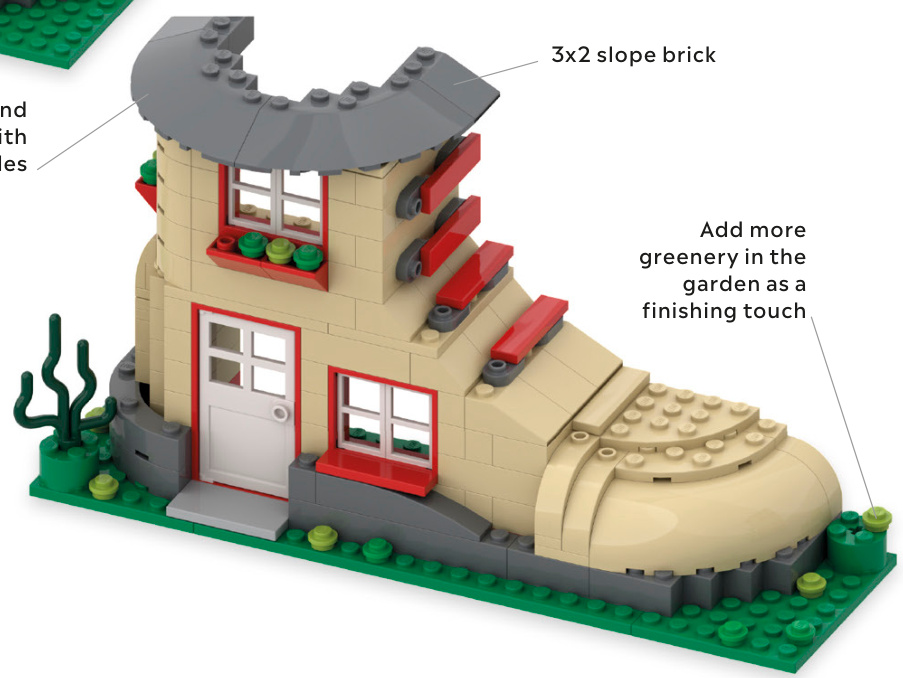
OUTDOOR
DOG KENNEL
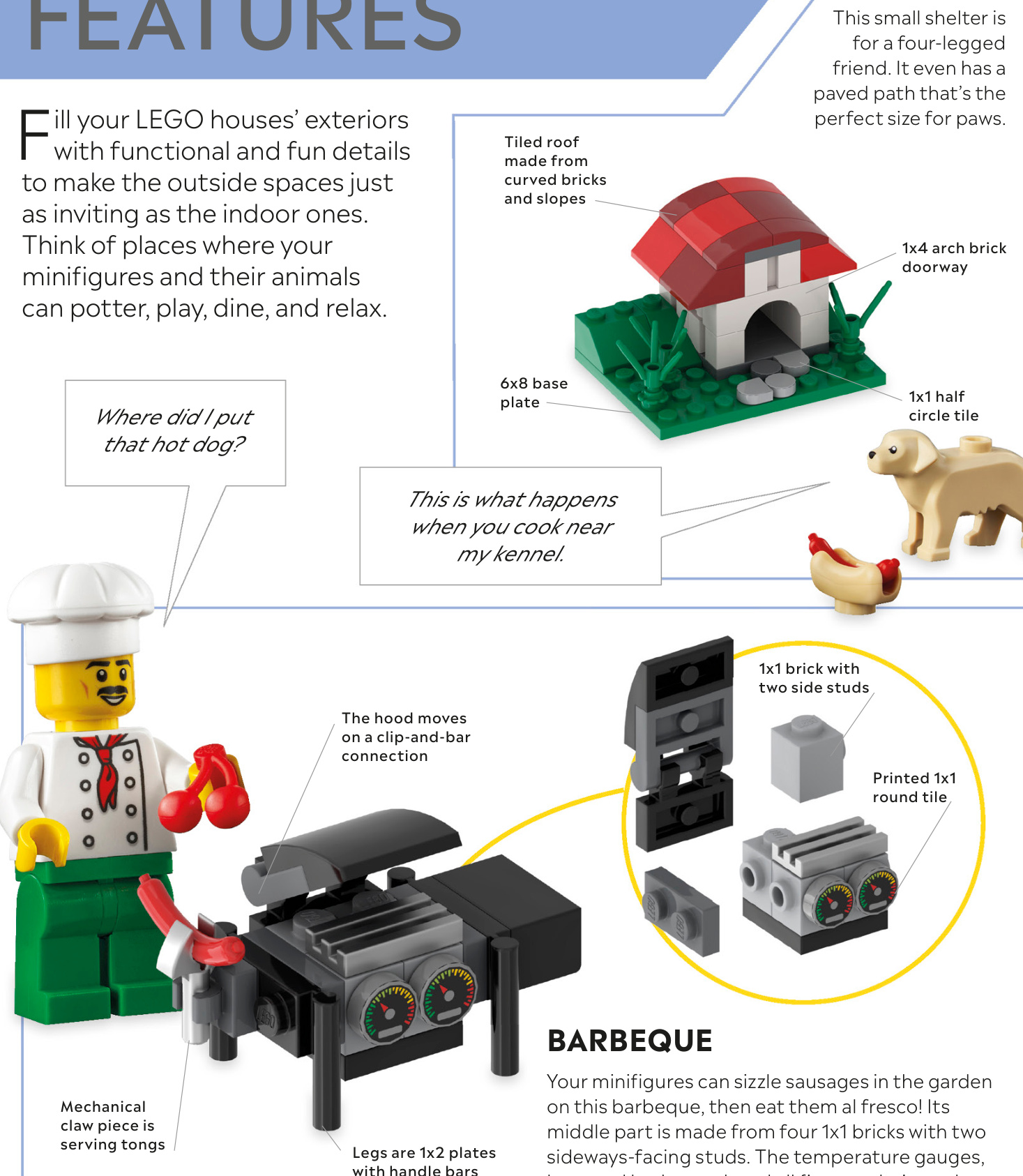
1x6tile
LAWNMOWER
Legs are two1x2 rounded plates
There are always lots of jobs to do in a garden, such as cutting the grass. This lawnmower rolls around on two sets of skateboard wheels attached to plates with clips.
BENCH
Give your minifigures somewhere to sit and enjoy their garden. This little wooden bench is made from four 1x6 tiles. Pairs of plates hold the tiles together at the back.
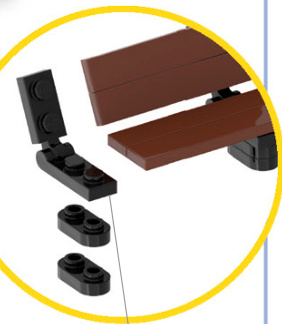
|1x1plate with side clip
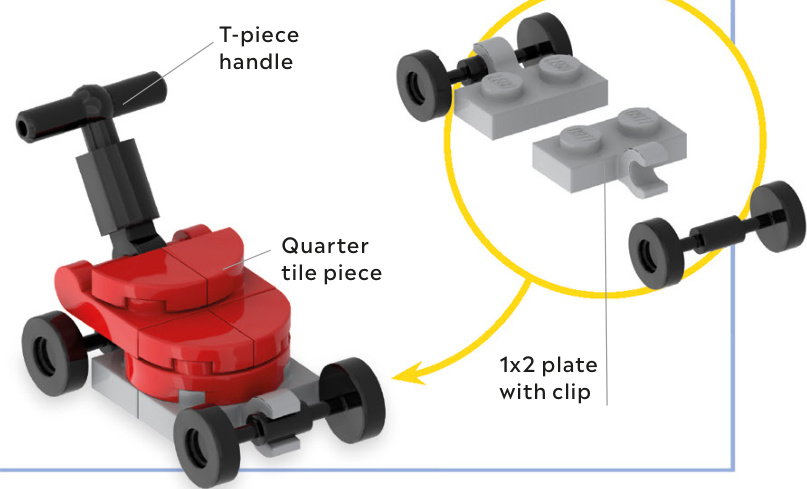
FOUNTAIN
A fountain can be the calming centrepiece o a garden.Water made from transparent blue pieces flows down the three layers of this pretty fountain.
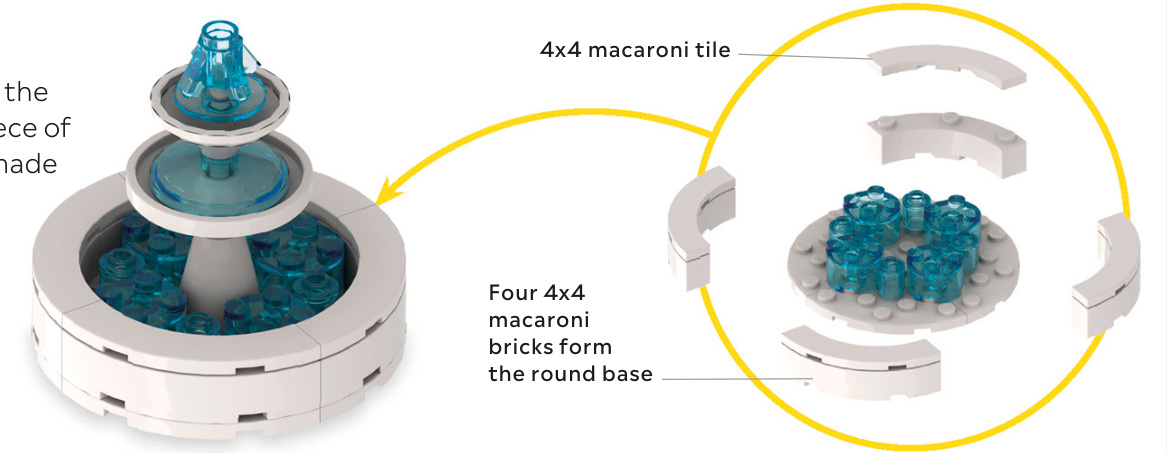
SEATINGAREA
Build a shady spot for your minifigures to sit in on a bright day. If you don’t have a parasol piece,you could use a radar dish instead.
Two 1x2 slopes form the roof
1x2brick with hole
BIRDHOUSE
Parasol stand is a bar and a cone
Birds need houses, too! An open hole in a brick makes the perfect entrance for feathered friends.
. Tiny seats are round tiles and inverted domes
2x2 radar dish base
JUNGLE HUT
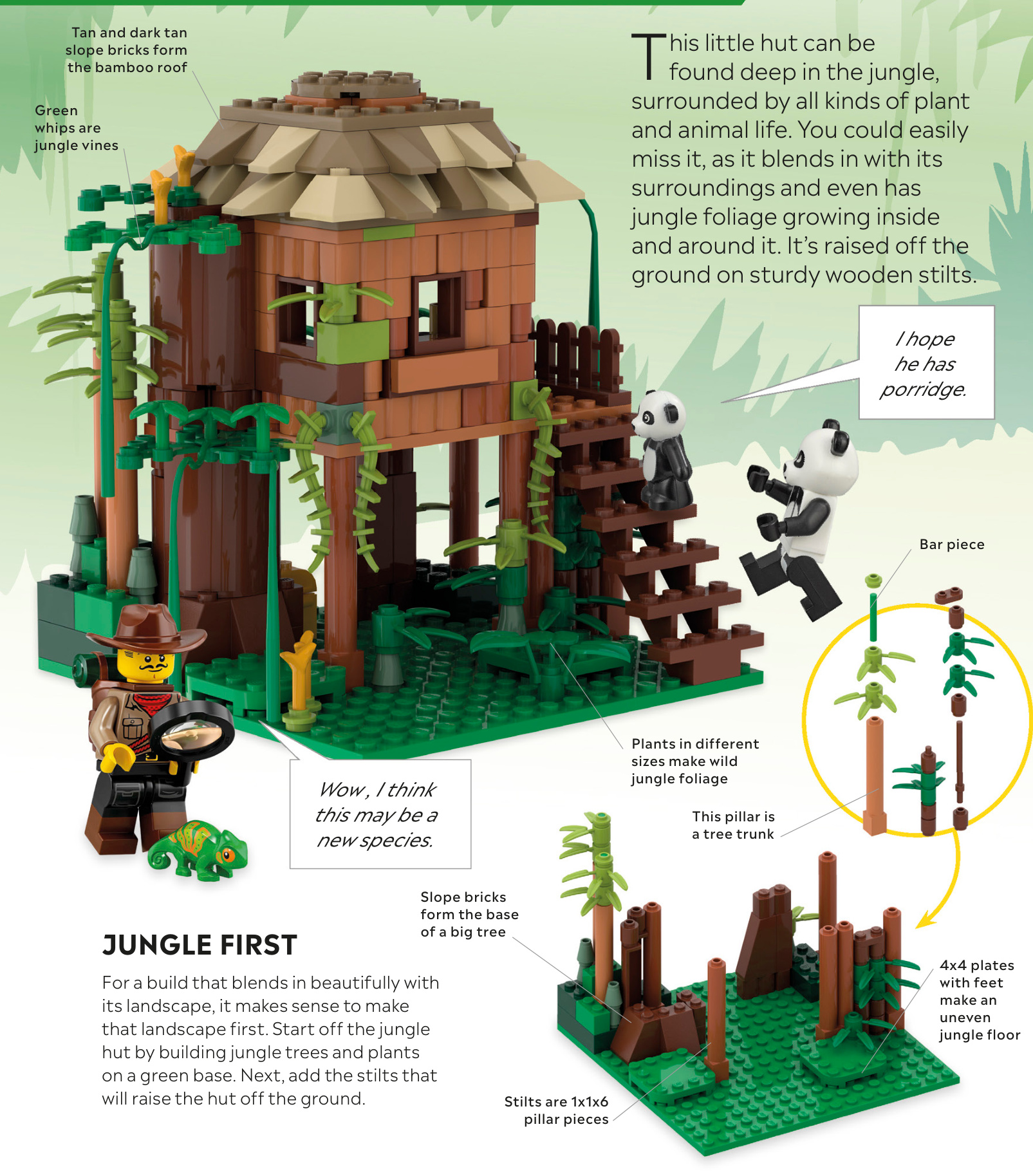
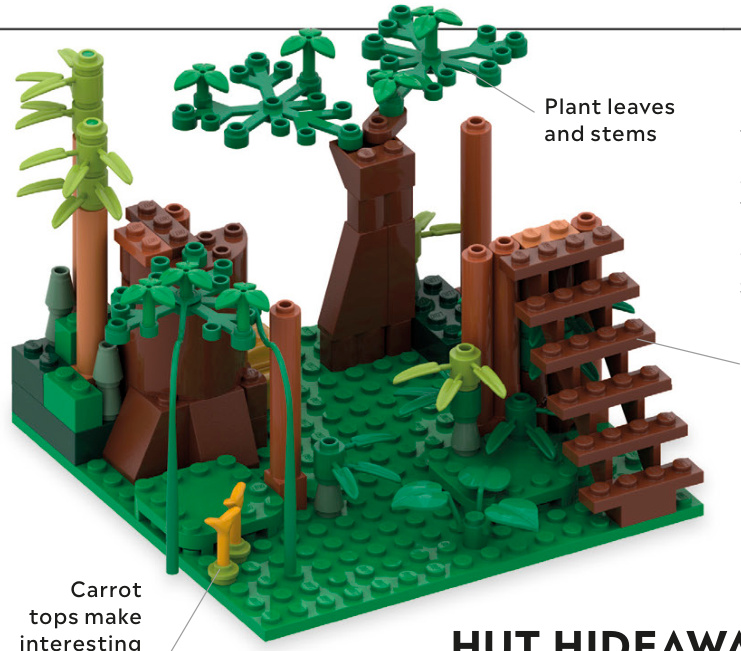
jungle plants
Ceiling plate is the same dimensions as the hut、
The plate floor of the hut is now in
place and the walls are taking shape.
They’re made from a combination of curvy palisade bricks and round bricks to create a log effect.
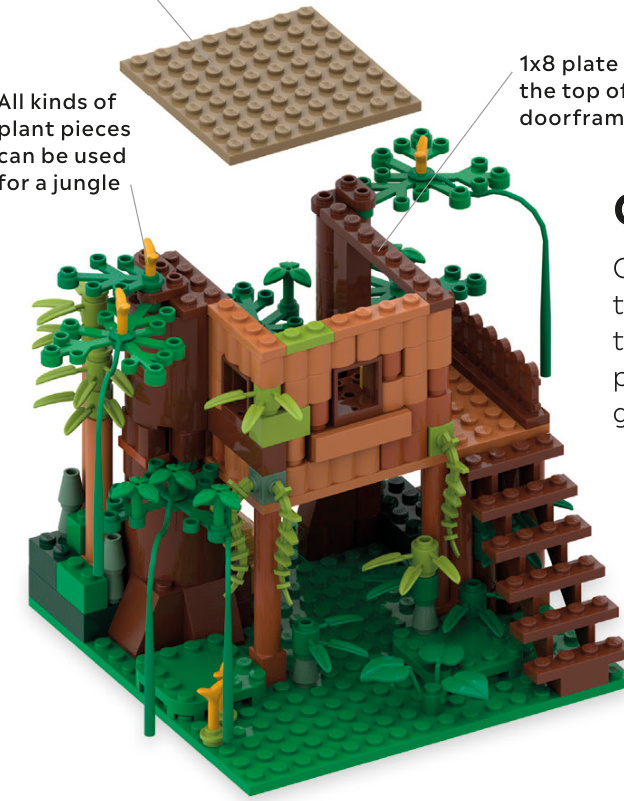
STEP IT UP
This jungle is growing rapidly! Now there are even more trees,plants,and vines. There may not be a hut yet, but the steps are there already. They fit onto a sturdy section of stilts and jungle plants.
HUTHIDEAWAY
Stairs are all one piece
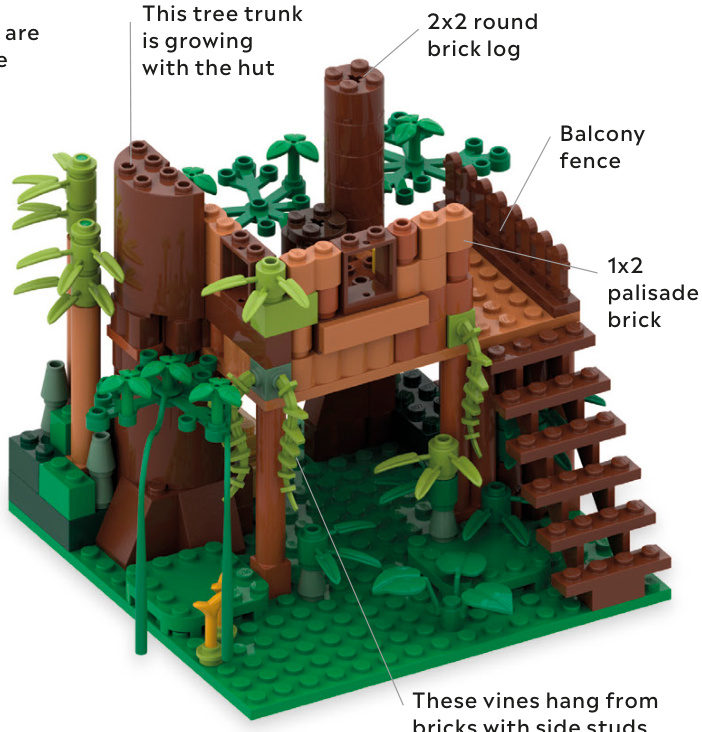
CEILING
2x2 wedge slope
Once the walls are finished and topped with plates,it’s time to attach the hut’s square plate ceiling.While the walls were growing,the jungle foliage was too!
3x1slope
An extra layer of
plates attaches here to finish off the roof
BAMBOOROOF
Bamboo is a jungle plant with a very hard stem that is often used to make roofs in hot countries. The two layers of small slope pieces in the jungle hut’s roof overlap each other so they look like thatched bamboo.
FANTASY CASTLE
astles don’t need to be big to be spectacular! The pristine white
towers and golden spires of this
microscale fantasy castle are as
awe-inspiring as any regular-sized royal
residence. It is perched high on a rocky
mountaintop so its minuscule residents
can look out for minifigure-scale invaders.
Spear tip pieces formthetopsof thespires
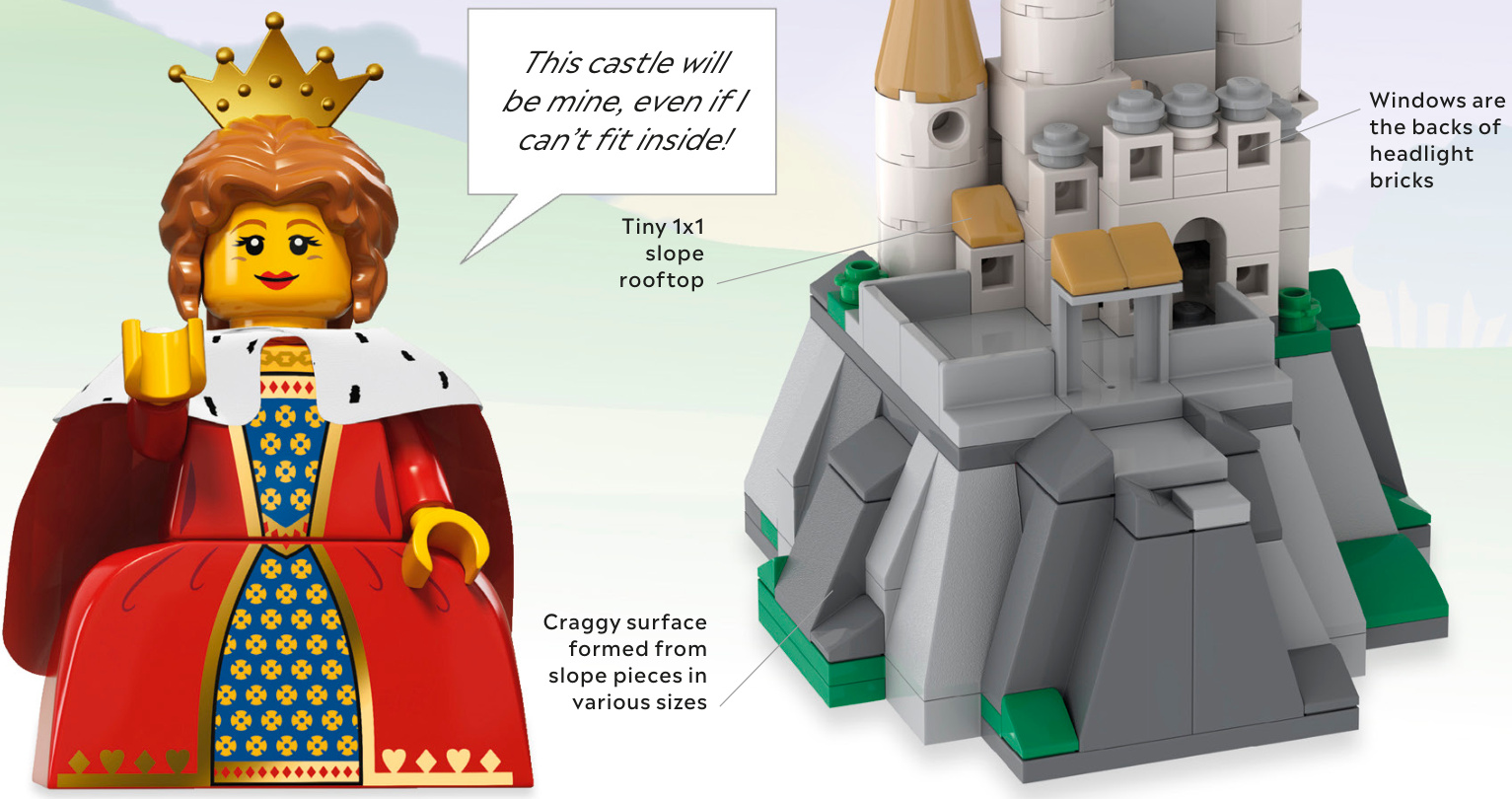
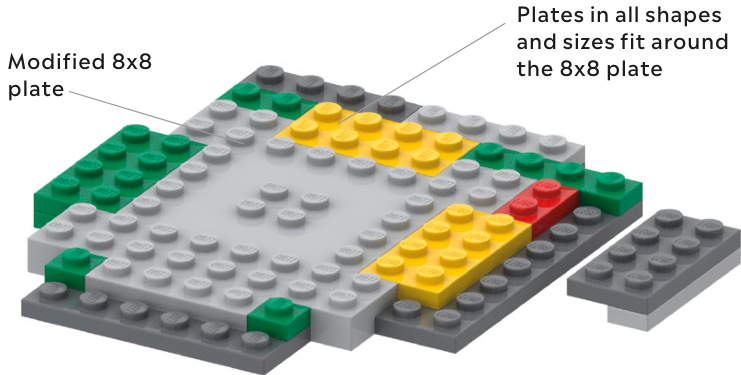
ROCKY START
Before building the fantasy castle,make the mountaintop it stands proudly upon. The rocky terrain has a characteristically uneven base,which is built around an plate with cutout parts.
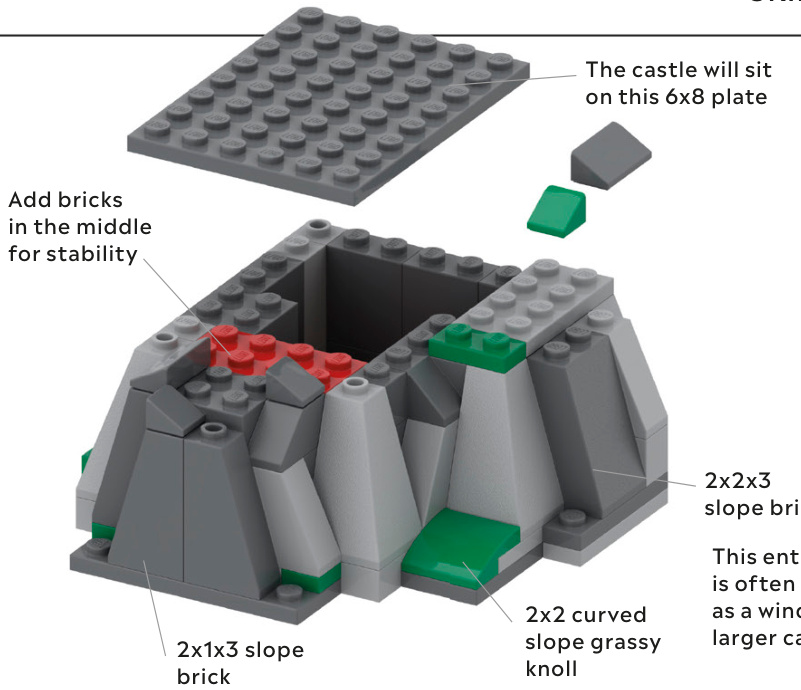
CASTLE WALLS
Carve the jagged surface of the mountain out of slope bricks in two shades of grey.Add small green pieces among the grey bricks to make small sections of grass and moss on the rocks.
This entrance is often used as a window on larger castles
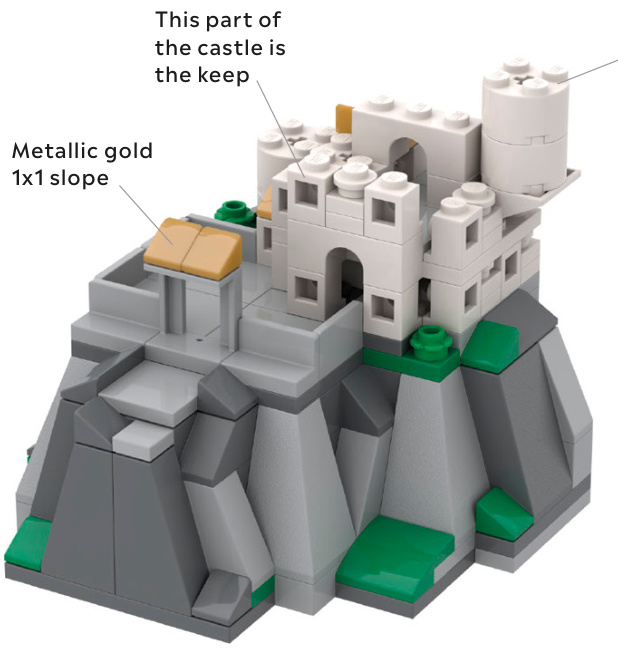
MAJESTICMOUNTAIN
The castle is now emerging from the rocks. It has solid square walls with a large entrance. Inside the walls,there’s a smooth courtyard and the firstlayer of the castle buildings.
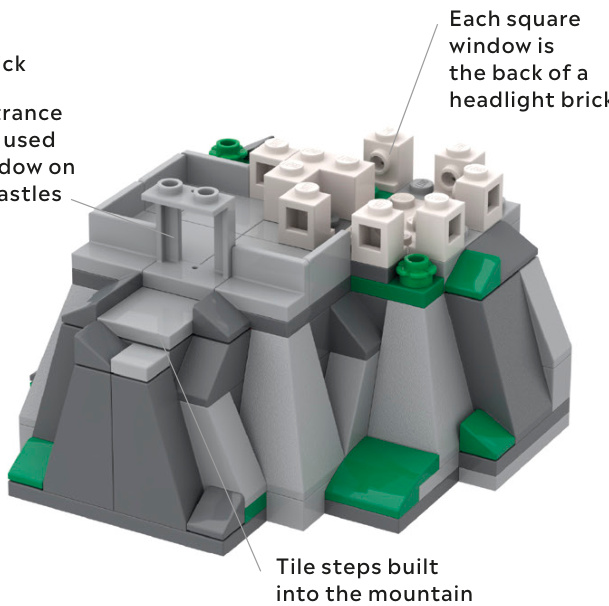
The start of a 2x2 round brick tower
GRANDDETAILS
The larger towers have radar dish roofs
The castle keep and other buildings are taking shape.Metallic gold cheese slopes abovethe entrance and on some of the castle rooftops make this castle look even more grand.